
Target out-of-state owners with vacancy, tax delinquency, or high equity first. Open with the property, not your pitch: name the address, mention it’s out of state, and ask one honest question about their experience owning it. Scrub every list against Do Not Call registries before dialing, and stack that step into your prep, not an afterthought.
TL;DR:
- Filtering for owners with vacancy, tax delinquency, or high equity significantly increases the likelihood of motivated leads, but too many filters reduce overall volume.
- Most conversions occur after the fourth to eighth contact, making multi-channel outreach and persistence essential for success.
- Out-of-state owners are often not distressed; effective opening scripts name the property, ask about their experience, and seek permission before pitching.
- Practicing calls using AI roleplay and scoring can dramatically improve handling objections and refining delivery more than unstructured dialing.
- Scrubbing lists against the Do Not Call registry and following proper compliance steps remain critical to avoid regulatory issues.
Table of Contents
- How Do You Build a Call-Ready Out-of-State Owner List?
- What’s the Best Way to Open an Out-of-State Owner Call?
- How Do You Handle Objections and Structure Follow-Up Calls?
- Can Roleplay and AI Practice Actually Improve Your Close Rate?
- What Callers Get Wrong About Out-of-State Owner Calls
- Practice Out-of-State Owner Calls Before You Burn Real Leads
- Sources
- FAQ
How Do You Build a Call-Ready Out-of-State Owner List?
Every out-of-state owner call starts with the same raw material: county assessor and tax rolls. When a property’s mailing address differs from the property address, that owner is flagged absentee, and county records remain the authoritative source for absentee lists. You can pull those records yourself for free, or buy them pre-cleaned from a list vendor. The tradeoff is simple: county pulls cost nothing but need cleanup, deduplication, and skip tracing before they’re dial-ready. Vendors charge for that work already done, plus fresher updates.
Raw absentee status alone isn’t a great predictor of motivation. Stacking two or three additional filters — vacancy, tax delinquency, long tenure, or high equity — produces a far smaller list that converts at a much higher rate. Push past three filters and you’ll often shrink volume below what a campaign needs to stay viable.
Once you have raw records, skip tracing turns owner names into working phone numbers. Expect hit rates between 60% and 85%, with some campaigns landing closer to 76% in practice. Per-record costs typically run $0.03 to $0.18 depending on the vendor and data freshness, so budget accordingly before you commit to a large pull. Understanding what actually qualifies someone as absentee helps you avoid wasting skip-trace spend on owners who don’t fit your target profile.
Before any of these touches a dialer, scrub the list against the National Do Not Call Registry and your state’s rules. This is educational context, not legal advice, but it’s the step most new callers skip and regret.
- Pull raw absentee data from county assessor exports or a paid vendor
- Stack 2 to 3 motivation filters: vacancy, tax delinquency, high equity, or long tenure
- Skip-trace and budget $0.03 to $0.18 per record at a 60 to 85% hit rate
- Scrub against DNC lists and confirm allowable calling hours before dialing
- Split the cleaned list into segments so each gets a tailored script
Pro Tip: Run your highest-equity, longest-tenure segment first. Those owners tend to answer more questions on the first call because the property carries less day-to-day stress for them, which makes it easier to build initial rapport.
What’s the Best Way to Open an Out-of-State Owner Call?
Out-of-state owners aren’t necessarily distressed. Many are landlords, heirs, or investors whose relationship to the property is financial, not emotional, and treating every call like a distress call backfires fast. The strongest openers name the property, establish local credibility, and ask permission before pitching anything.
A reliable framework runs three steps:
- Name the property and your reason for calling. “Hi, this is [name], I work with property owners in [city], and I noticed you own the place at [address].”
- Ask one open question about their experience. “How’s that property been for you lately, managing it from out of state?”
- Earn permission before pitching. “Mind if I ask a couple quick questions to see if there’s anything I can help with?”
Openers that reference the property specifically outperform generic pitches because they signal you did homework instead of dialing at random.
Once the owner engages, qualify quickly:
- How long have you owned the property, and how did you acquire it?
- Is it currently rented, vacant, or in between tenants?
- Have you thought about selling, or is that not on your radar right now?
- What would need to happen for a sale to make sense for you?
Inherited property: “I saw the property on [street] recently transferred to you. Sorry for your loss. I help heirs figure out their options when they don’t want to manage something from a distance. Is that something you’ve thought about?”
Absentee landlord: “You’ve owned the rental on [street] for a while now. How’s the tenant situation treating you these days?”
Vacant property: “I noticed the place on [street] looks like it’s been sitting empty. Is that intentional, or has it just been hard to deal with from out of state?”
Log every answer. Referencing a past detail on your second call, like a repair the owner mentioned or a lease ending date, does more for trust than any script line.
How Do You Handle Objections and Structure Follow-Up Calls?
Most objections on out-of-state owner calls fall into four buckets, and each has a short, honest response that keeps the door open instead of forcing it:
- “Not interested.” “Totally understand. Mind if I check back in a few months in case anything changes?”
- “Call me later.” “Happy to. What’s a better time, and is this the best number?”
- “What’s your offer?” “I’d want to see the property details first so I’m not throwing out a number that doesn’t make sense. Can I ask a few quick questions?”
- No answer. Leave a short voicemail naming the property and your name, then follow with a text or mailer.
Persistence beats a single great call, and integrating multi-channel outreach and landing pages consistently outperforms calling alone. A multi-channel cadence consistently outperforms calling alone, and carrier call-blocking makes relying on phone calls exclusively riskier than it used to be. A workable sequence looks like this: initial call, immediate voicemail if no answer, a mailer within a few days, then timed follow-ups at 1 week, 3 weeks, 6 weeks, 3 months, and 6 months. Direct mail alone won’t carry a campaign, but a response rate around 3.3% makes it a worthwhile supplement inside a longer sequence, not a standalone tactic.
Most absentee owner conversions happen on the fourth through eighth touch, not the first. That single fact should reshape how you think about a “no” on call one. It’s a data point, not a rejection.
Log every disposition in your CRM immediately after the call, tagging owner responses so future callers, including you, know exactly where the relationship stands before dialing again.
Can Roleplay and AI Practice Actually Improve Your Close Rate?
Call volume alone doesn’t build skill. What builds skill is deliberate practice: short, focused reps on a single opener or objection, followed by immediate feedback. Micro-drills of three to five minutes, reviewed right after with a scorecard, improve retention more than hours of unstructured dialing.
A practice session that actually moves your numbers might run like this:
- 20 minutes warming up on your opener until it sounds natural, not memorized
- 30 minutes of roleplay working through objections specific to out-of-state owners
- 10 minutes reviewing a scorecard to spot exactly where the call broke down
AI roleplay speeds this loop up considerably. Instead of waiting for a real prospect to hand you a hard objection, an AI-driven scenario can simulate an out-of-state owner’s skepticism, emotional state, or stalling tactics on demand, and give you a scorecard immediately after. That feedback loop is what separates callers who plateau from callers who keep improving.
Track three numbers weekly: connect rate, conversion per dial, and appointments set. If connect rate is fine but conversions lag, the problem is your script or objection handling, not your list.
Pro Tip: Record your own calls and score yourself against the same categories an AI practice tool would use. The habit of self-review closes gaps faster than volume ever will.
What Callers Get Wrong About Out-of-State Owner Calls
Do reference the property specifically, log every detail from the conversation, and stick to your cadence even when a call goes nowhere. Don’t assume distress on the first call, and don’t oversell before you’ve asked a single question. Out-of-state owners can smell a script that’s only there to extract a “yes,” and it costs you the second conversation.
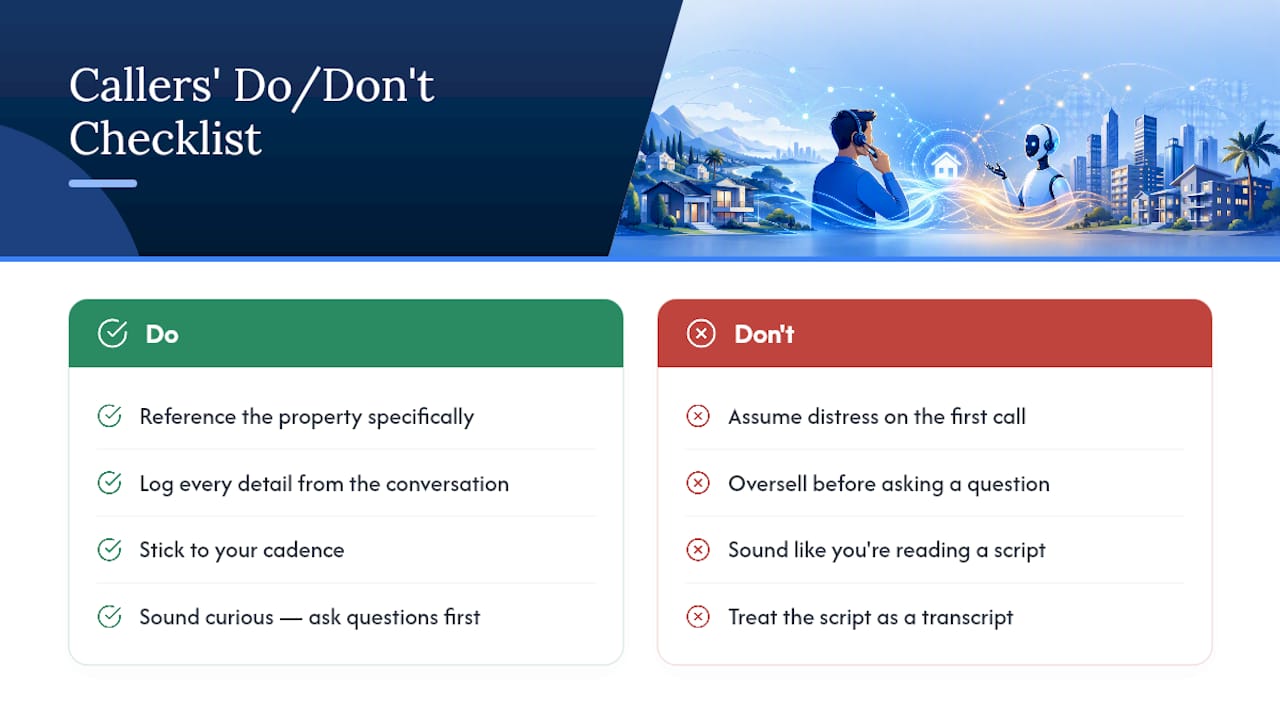
What gets missed most often isn’t the words in the script. It’s the pacing. Callers who sound like they’re reading get hung up on; callers who sound curious get answers. The fix isn’t memorizing a better line, it’s running enough reps that the line stops sounding like a line.
Keep it human. A script is a skeleton, not a transcript. Your job is filling in the details the owner gives you.
— Dave
Practice Out-of-State Owner Calls Before You Burn Real Leads
Every list, script, and cadence in this article only works if the person on the phone can execute it under pressure, and that’s the gap most callers never close. There are AI roleplay tools that simulate out-of-state owners, including the vacant, inherited, and absentee-landlord scenarios covered above, so you’re rehearsing the actual objections you’ll hear before a real seller ever picks up.
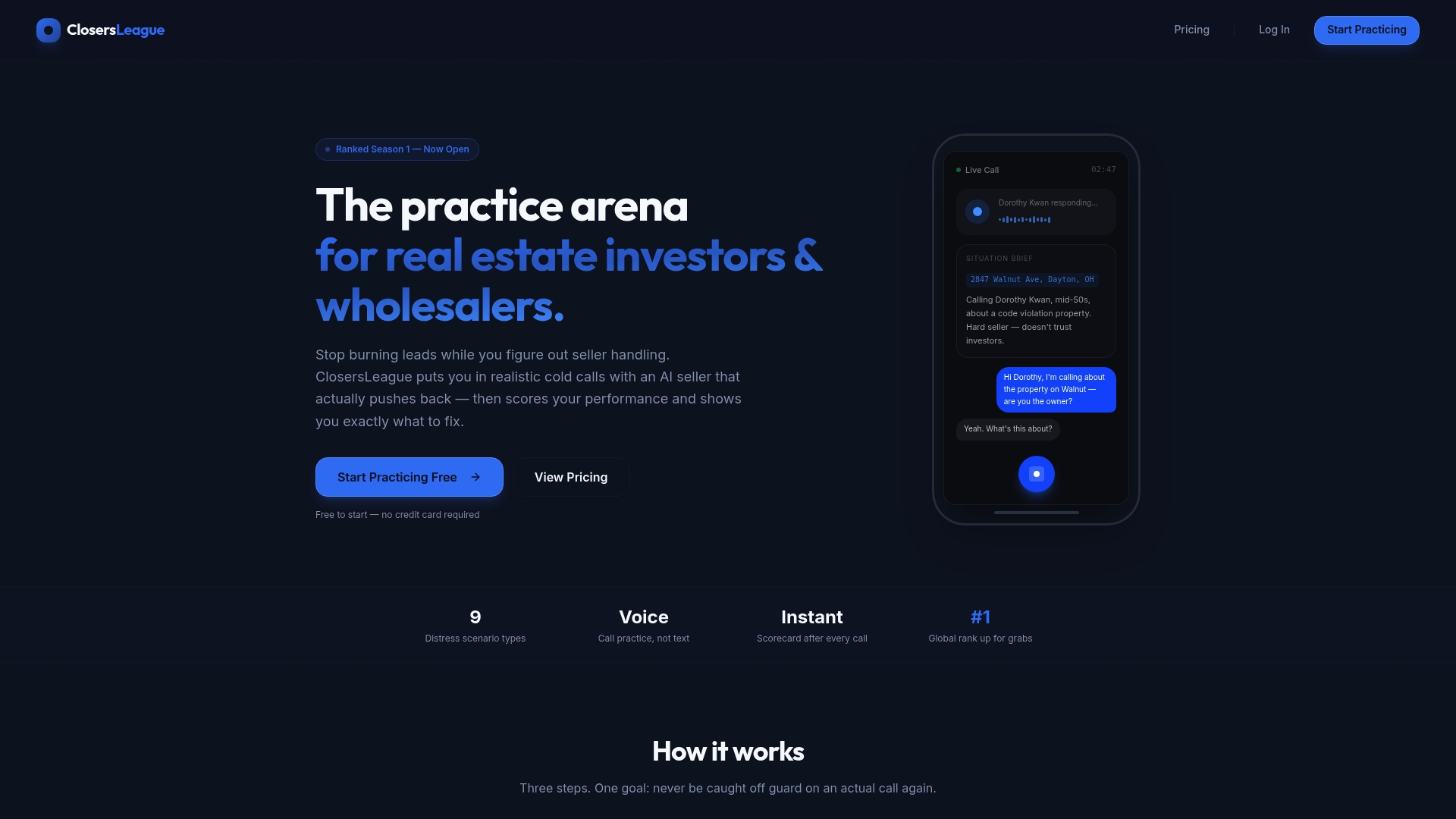
Each scenario comes with a scorecard that breaks down where a call went off track, whether that’s a weak opener, a missed qualifying question, or an objection you talked over instead of answering. Investors and wholesalers running inherited property calls can drill that specific scenario directly, while the broader cold calling practice platform covers every distressed seller type in this article and more.
Start with a free trial at ClosersLeague and run your first roleplay against an out-of-state owner scenario today.
Sources
- Calling Absentee Owners: Investor Guide | Enzo
- Absentee Owner Leads: How to Build Lists That Convert
- 7 Absentee Owner Outreach Mistakes to Avoid in 2026 | Televista Blog
- Absentee Owner Lists: Do They Convert? Real Data
FAQ
What’s the Best First Target for Out-of-State Owner Calls?
Owners flagged absentee in county records who also show vacancy, tax delinquency, or high equity convert at a noticeably higher rate than a raw absentee list alone.
How Much Does Skip Tracing Cost for Absentee Owner Lists?
Expect to pay roughly $0.03 to $0.18 per record, with hit rates commonly falling between 60% and 85%.
How Many Touches Does It Take to Convert an Absentee Owner?
Most conversions happen between the fourth and eighth touch, which is why a structured cadence across calls, voicemail, and mail matters more than any single call.
Is Texting Out-of-State Owners Compliant?
SMS outreach carries real TCPA risk and requires careful consent handling, so most campaigns lean on calls, voicemail, and mail as the primary sequence.
How Can I Improve My Out-of-State Owner Cold Calling Skills?
Short, focused practice drills followed by immediate scorecard review build skill faster than raw call volume, which is the exact structure AI roleplay tools like ClosersLeague are built around.