
An absentee owner is a property owner who does not live at the property and does not actively manage it on a daily basis. The formal term used in real estate and lending is “non-owner-occupant,” though “absentee owner” is the widely recognized label in investor circles. Public tax assessor records flag absentee ownership by comparing the property’s physical address against the owner’s mailing address. When those two addresses differ, the owner is classified as absentee. For real estate investors, that mismatch is one of the most reliable signals of a potentially motivated seller. Understanding what drives absentee owners, how they manage their properties, and what their ownership means for lenders and buyers gives you a real edge in acquisitions.
What is an absentee owner in real estate?
An absentee owner is defined by geographic separation from the property they own. Economist Thorstein Veblen first formalized this concept, describing absentee ownership as ownership outside the property’s local economic region, which forces reliance on intermediaries for management. That definition still holds today.
The practical test is simple. If the address where the owner receives mail differs from the property address, the owner is absentee. County tax assessor databases apply this test automatically. Real estate data platforms pull those records and make them searchable, which is why investors can build targeted lists in minutes.

Absentee ownership differs from owner-occupancy in ways that matter for lending and insurance. Owner-occupants live at the property, maintain it directly, and represent lower default risk. Absentee owners are classified differently for loan underwriting, often facing higher interest rates and stricter terms. The distinction also affects homestead exemption eligibility, which reduces property taxes for primary residents. Absentee owners do not qualify.
What types of absentee owners exist?
Absentee owners fall into five main categories, each with different motivations and management challenges:
- Out-of-state landlords. These owners relocated for work or lifestyle reasons but kept a rental property behind. Distance creates friction. Maintenance calls at midnight, tenant disputes, and local code compliance all become harder to manage from another state.
- Inherited property holders. Heirs who receive property through probate often have no desire to become landlords. They may lack the knowledge, capital, or motivation to manage the asset. This group frequently becomes motivated sellers.
- Accidental landlords. These owners could not sell at the price they wanted, so they rented the property instead. They never planned to be landlords and often resent the role.
- Corporate or LLC owners. Investment entities that hold property as a portfolio asset. They are professional operators but can still become motivated sellers when a property underperforms.
- Seasonal vacation homeowners. Owners who use the property part of the year and leave it vacant the rest. Vacancy creates maintenance risks and insurance complications.
These categories overlap frequently. An out-of-state owner might also hold the property through an LLC. An inherited property holder might rent it out, making them an accidental landlord simultaneously.
Pro Tip: Out-of-state landlords and inherited property holders tend to be the most motivated sellers. Management friction compounds over time, and many reach a breaking point where a fast, fair offer beats the ongoing headache of remote ownership.
How does absentee property management work in practice?
Absentee owners rely on third parties to handle what owner-occupants do themselves. The primary distinction between an absentee owner and a traditional landlord is not the number of properties owned. It is the complete reliance on intermediaries for physical oversight.
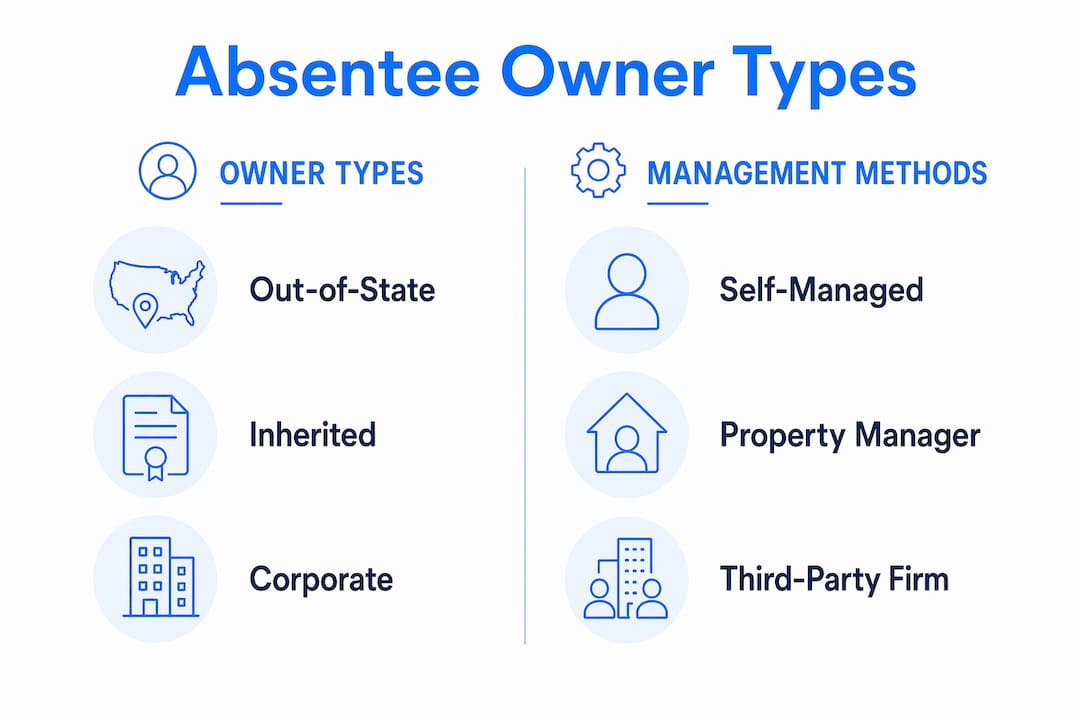
The most common management structure involves a professional property management company. These firms handle tenant screening, rent collection, maintenance coordination, and lease enforcement. They typically charge 8–12% of monthly rent, which cuts directly into cash flow. For an owner already dealing with a low-performing asset, that fee accelerates the path to a motivated sale.
Some absentee owners skip professional management and rely on a network of local contractors and a trusted neighbor or friend. This approach costs less but creates gaps. Maintenance requests get delayed. Tenant issues go unresolved. Properties managed this way often show signs of deferred maintenance, which affects both value and lender perception.
Common challenges absentee owners face include:
- Delayed response to maintenance emergencies
- Difficulty verifying tenant behavior and property condition
- Rent collection gaps when tenants pay late or stop paying
- Local code violations that go unnoticed until they become fines
- Insurance complications tied to vacancy or rental use
Pro Tip: When you call an absentee landlord, ask how long they have managed the property remotely. Owners past the five-year mark often have accumulated frustrations they have never voiced to anyone. That conversation can open doors that a direct offer letter never would. ClosersLeague trains investors to ask exactly these kinds of questions through AI-powered cold calling practice.
You can also review property management tasks that professionals handle, which helps you understand what an absentee owner is paying for and where their pain points concentrate.
What absentee ownership means for lenders, insurers, and investors
Lenders and insurers treat absentee ownership as a risk signal. Vacancy combined with absentee status is the strongest indicator of potential property distress in the eyes of underwriters. The reasoning is straightforward: no one on site means problems go undetected longer.
Lenders respond by requiring larger down payments, charging higher interest rates, and applying stricter debt-to-income requirements for non-owner-occupant loans. Insurers charge higher premiums for landlord or vacant property policies compared to standard homeowner policies. These added costs reduce the owner’s net return and can tip a marginally profitable rental into a money-losing asset.
For buyers and investors, absentee-owned properties carry specific due diligence requirements. Deferred maintenance is common. Tenant relationships may be strained. Lease terms may be informal or undocumented. A thorough inspection and a review of rent rolls and lease agreements are non-negotiable before any offer.
| Signal | What it means for investors |
|---|---|
| Mailing address mismatch | Owner is absentee; property is not primary residence |
| No homestead exemption | Confirms non-owner-occupant status in tax records |
| Long ownership duration (5+ years) | Owner has equity and may be fatigued by management |
| High equity percentage (30–40%+) | Room to negotiate a below-market cash offer |
| Vacancy + absentee status | Strongest combined signal for property distress |
Professional investors use filters like equity percentage, ownership duration, and mailing address mismatch together. Typical acquisition filters target 30–40% equity, five or more years of ownership, and no homestead exemption. That combination identifies owners with both the motivation and the financial flexibility to accept a discounted offer.
How to use absentee owner data for acquisitions and dispositions
Absentee owner data serves two distinct roles in real estate investing: finding motivated sellers and sourcing cash buyers. Most investors focus only on the acquisition side and miss the disposition opportunity entirely.
For acquisitions, build your list using these steps:
- Pull absentee owner records from your county tax assessor or a real estate data platform.
- Filter by equity percentage (target 30–40% or higher), ownership duration (five or more years), and absence of homestead exemption.
- Layer in additional distress signals: tax delinquency, code violations, or confirmed vacancy. Combining these signals produces the highest probability leads for motivated sellers.
- Segment your list by owner type. Out-of-state landlords and inherited property holders get one outreach script. Corporate or LLC owners get a different approach entirely.
- Make contact through direct mail, cold calling, or both. Cold calling produces faster feedback and lets you qualify motivation in real time.
For corporate or LLC-owned properties, advanced skip tracing is required to identify the actual decision-maker behind the entity. Reframe your outreach around portfolio performance rather than distress. A message focused on helping them exit an underperforming asset lands better than a distressed-seller pitch.
For dispositions, absentee owners who hold investment properties already have capital and operational infrastructure. They are natural cash buyers for wholesale deals. Filter your absentee owner list for multi-property holders and reach out with deals that fit their existing portfolio profile.
Pro Tip: Your disposition list and your acquisition list can come from the same data source. Absentee owners who are not ready to sell today may be ready to buy a deal you have under contract. Work both angles from every list you build.
For a deeper look at identifying property owners through public records, the investor’s guide to researching property owners covers the full process step by step.
Key Takeaways
Absentee ownership is the most reliable entry point for motivated seller leads because geographic separation creates management friction that compounds over time into a selling decision.
| Point | Details |
|---|---|
| Absentee owner definition | A property owner whose mailing address differs from the property address in tax records. |
| Most motivated seller types | Out-of-state landlords and inherited property holders face the most management friction. |
| Management structure | Most absentee owners rely on property managers or contractors, not direct oversight. |
| Lender and insurer risk | Absentee status triggers higher loan rates and insurance premiums due to vacancy and distress risk. |
| Dual data use | Absentee owner lists work for both acquisition leads and cash buyer sourcing for dispositions. |
Why management friction is the real story here
Real estate investors spend a lot of time debating which list is best: probate, tax delinquent, pre-foreclosure. Absentee owners deserve a permanent spot in that conversation, and not just because the data is easy to pull.
What makes absentee ownership genuinely interesting is the psychological arc. An owner who bought a rental property ten years ago with good intentions has often spent years quietly absorbing frustrations. A bad tenant. A roof repair they handled from 1,200 miles away. A property manager who stopped returning calls. None of those events individually triggers a sale. Together, they create an owner who is done.
When you call that person, you are not pitching a transaction. You are offering relief. That is a completely different conversation, and it requires a different skill set than reading from a script. The investors who convert absentee owner leads at the highest rate are the ones who ask good questions, listen well, and know how to handle the objection “I’m not sure I’m ready to sell yet.”
Property management technology has made remote ownership easier in some ways. Digital rent collection, virtual inspections, and online maintenance portals reduce friction. But technology does not fix a bad tenant relationship or a property that needs $40,000 in deferred repairs. The fundamentals of management friction still drive motivated sales.
Evaluate absentee-owned properties carefully before you close. Deferred maintenance is real and often underestimated. Build your repair estimates conservatively and verify lease terms in writing. The deal that looks great on paper can turn into a problem if you skip due diligence on a property no one has walked through in two years.
— Dave
Practice your absentee owner calls with ClosersLeague
Knowing what an absentee owner is gets you to the list. Knowing what to say when they pick up the phone is what closes deals.

ClosersLeague is an AI-powered cold calling training platform built for real estate investors and wholesalers. You can practice conversations with absentee landlords, inherited property holders, and other seller types in a realistic roleplay environment before you ever dial a real number. The AI scores your calls, flags weak spots, and helps you build the confidence to handle any objection. If you are serious about converting absentee owner leads, start practicing your calls with ClosersLeague today.
FAQ
What is an absentee owner in real estate?
An absentee owner is a property owner whose mailing address does not match the property address in public tax records. This classification indicates the owner does not live at or directly manage the property.
What is the difference between an absentee owner and an absentee landlord?
An absentee landlord is a specific type of absentee owner who rents the property to tenants but manages it remotely. All absentee landlords are absentee owners, but not all absentee owners are landlords since some properties may be vacant or used seasonally.
What are the most common types of absentee owners?
The five main types are out-of-state landlords, inherited property holders, accidental landlords, corporate or LLC owners, and seasonal vacation homeowners. Out-of-state landlords and inherited property holders tend to be the most motivated sellers due to management friction.
How do investors find absentee owner leads?
Investors pull absentee owner records from county tax assessor databases or real estate data platforms by filtering for mailing address mismatches. Adding filters for high equity, long ownership duration, and distress signals like tax delinquency produces the strongest motivated seller leads.
Do absentee owners pay higher taxes or loan rates?
Absentee owners do not qualify for homestead exemptions, which means they pay higher property taxes than owner-occupants in most states. Lenders also charge higher interest rates and require larger down payments for non-owner-occupant loans due to increased default risk.