The best pre-foreclosure script opens with empathy and a permission ask, not a pitch. State why you’re calling in one sentence, ask if now’s an okay time to talk, then move straight into open-ended discovery to learn whether the homeowner needs a sale, a modification, or a referral to a housing counselor. Sample scripts and a pre-call checklist follow below.
TL;DR:
- Effective pre-foreclosure calls prioritize empathy and permission, avoiding immediate offers and focusing on open-ended discovery questions.
- Understanding the homeowner’s delinquency stage, lender, and property details before calling improves conversation relevance and success chances.
- Responding calmly to objections and respecting do-not-call requests build trust and ensure compliance with legal guidelines.
- Practicing active listening and adapting to the homeowner’s emotional state are more important than rigidly following a script.
- Research and timing are crucial, with calls best made during local hours and follow-ups limited to three or four attempts to prevent burnout.
Table of Contents
- What Makes a Pre-Foreclosure Script Actually Work?
- Copy-Ready Sample Scripts for Common Pre-Foreclosure Calls
- How Do You Handle Objections Without Losing the Homeowner?
- How Should You Research a Lead Before You Call?
- When Should You Call and How Often Should You Follow Up?
- Why Active Listening Beats a Perfect Script
- The Overlooked Truth About Pre-Foreclosure Scripts
- Practice These Scripts Before You Use Them on a Real Lead
- Sources
- FAQ
What Makes a Pre-Foreclosure Script Actually Work?
Most cold calls to homeowners in pre-foreclosure fail before the second sentence, because the caller leads with an offer instead of a question. The homeowner hears “buy your house” and hangs up, assuming another investor is circling like a vulture. Effective scripts flip that order: empathy first, permission second, discovery third, and a solution only after you understand the actual problem. The CFPB’s guidance on mortgage servicing backs this sequence, noting that solutions-focused, open-ended questioning outperforms scripts built around an immediate buying offer.
A few structural pieces make this work in practice:
- Permission-based opening. Ask “Is now an okay time?” before anything else. It signals respect and buys you the next thirty seconds.
- A brief, honest reason for calling. Reference the public notice without sounding like a debt collector: “I saw a notice filed on your property and wanted to check in.”
- Open-ended discovery questions. “What’s your situation with the house right now?” tells you more in ten seconds than any script line you could read.
- Solutions-first language, not promises. Offer options (“some homeowners in your situation sell, some work with their lender, some talk to a counselor”) instead of guarantees.
- A simple, low-pressure call to action. Ask for a callback time, a follow-up text, or permission to send information.
Treat the script as a framework, not a transcript. The words matter less than the sequence.
Pro Tip: Practice the permission opener until it sounds unscripted. A flat, memorized “is now a good time” reads as fake faster than almost any other line in the call.
Copy-Ready Sample Scripts for Common Pre-Foreclosure Calls
Adapt these word for word or as a starting skeleton. Each one follows the same shape: opener, discovery, CTA.
-
Empathy-first script (homeowner-focused). “Hi, is this [Name]? My name is [Your Name] and I work with homeowners in [Area]. I saw a public notice tied to your property and wanted to reach out, not to sell you anything, just to check how you’re doing. Is now an okay time?” Follow with: “A lot of people in this situation are trying to figure out whether to sell, work things out with the lender, or explore other options. Where are you at with it?” Close with: “Would it help if I sent over a couple of options, or would you rather talk it through on a quick call this week?”
-
Direct offer script (motivated seller). “Hi [Name], this is [Your Name], I buy houses in [Area] and wanted to reach out about your property on [Street]. I know timing matters here. Is this something you’d consider selling, or are you working on keeping it?” If they’re open: “What would make this work for you, price, timeline, or just getting it off your plate?” Close with a specific next step: “Can I stop by this week or would a phone walkthrough work better?”
-
Absentee or inherited property variant. “Hi, I’m trying to reach [Name] regarding a property at [Address]. I understand it may have come to you through a family situation. Is this still something you’re handling?” Discovery: “Are you local, or managing this from a distance? What’s the biggest challenge with the property right now?” CTA: “I work with a few people in similar situations, would it help to talk through what selling as-is might look like?”
Pro Tip: Listen for hesitation after your discovery question. A long pause usually means denial or overwhelm, not disinterest, so slow down instead of jumping to your pitch.
Micro-templates worth memorizing: “What’s your ideal outcome here?” and “Would a short call this week work, or is text easier?” Both work across almost every script variant above.
How Do You Handle Objections Without Losing the Homeowner?
“I’m not interested” rarely means the conversation is over. It usually means the homeowner is guarding against pressure. A calm response like “Totally understand, most people I talk to feel that way at first. Can I ask what’s made you hesitant?” often reopens the door because it doesn’t argue, it invites clarification.
“I already have an agent” deserves a respectful exit ramp: “Good to know, that’s often the right move. If anything changes, feel free to reach out.” Pushing past this line burns trust and, in some cases, violates listing agreements.
When a homeowner asks you to stop calling, log it immediately and honor it. That’s not just courtesy, it’s the line the Do-Not-Call rules and TCPA framework exist to enforce.
A few ethical guardrails matter more than any clever rebuttal:
- Never promise a specific loan modification, sale price, or legal outcome.
- Never claim to “save” someone from foreclosure. Offer options, not guarantees.
- Refer legal or financial questions to a HUD-approved housing counselor rather than answering them yourself.
- Document every refusal and every consent to follow up, the same day, while details are fresh.
How Should You Research a Lead Before You Call?
Cold calling a pre-foreclosure lead without research wastes the call and the homeowner’s patience. A few minutes of prep before dialing changes the entire conversation.
- Check the delinquency stage and notice dates. Federal rules generally keep servicers from filing formal foreclosure until a loan is more than 120 days delinquent, so knowing where a homeowner sits in that window tells you how much runway they have left.
- Identify the lender, liens, and any probate markers. A property tangled in probate needs a completely different conversation than a straightforward single-owner delinquency.
- Scrub your list for duplicates and dead numbers, and confirm local time zones before you dial.
- Cross-check the Do-Not-Call registry and keep basic TCPA guardrails in mind before adding a number to your call list.
- Log every finding in your CRM, along with a next step, so the next caller (or your future self) isn’t starting from zero.
The highest-performing callers segment leads by delinquency stage and notice type, concentrating effort on the window between notice of default and sale date, where homeowner options are still genuinely actionable, as shown in this step-by-step guide on how to analyze a pre-foreclosure deal.
When Should You Call and How Often Should You Follow Up?
Timing shapes whether a homeowner picks up at all. Calling too early feels intrusive; calling too late means the lead has already gone cold or gone to sale.
- Call within reasonable local hours, roughly between 8 a.m. and 9 p.m., and never assume the area code matches the homeowner’s current time zone.
- Cap follow-up touches at three or four attempts before pausing outreach, and always leave room for the homeowner to reach back out.
- Log consents, promises, and next steps in your CRM the same day, not from memory a week later.
- For legal or loss-mitigation questions you can’t answer, refer the homeowner to a HUD-approved housing counselor or their own attorney rather than guessing. The NFCC specifically warns against paid foreclosure-prevention companies that charge upfront fees, so a referral to free counseling carries real weight with a skeptical homeowner.
- Escalate to a housing counselor when the homeowner mentions bankruptcy, active litigation, or a modification application already in process.
Why Active Listening Beats a Perfect Script
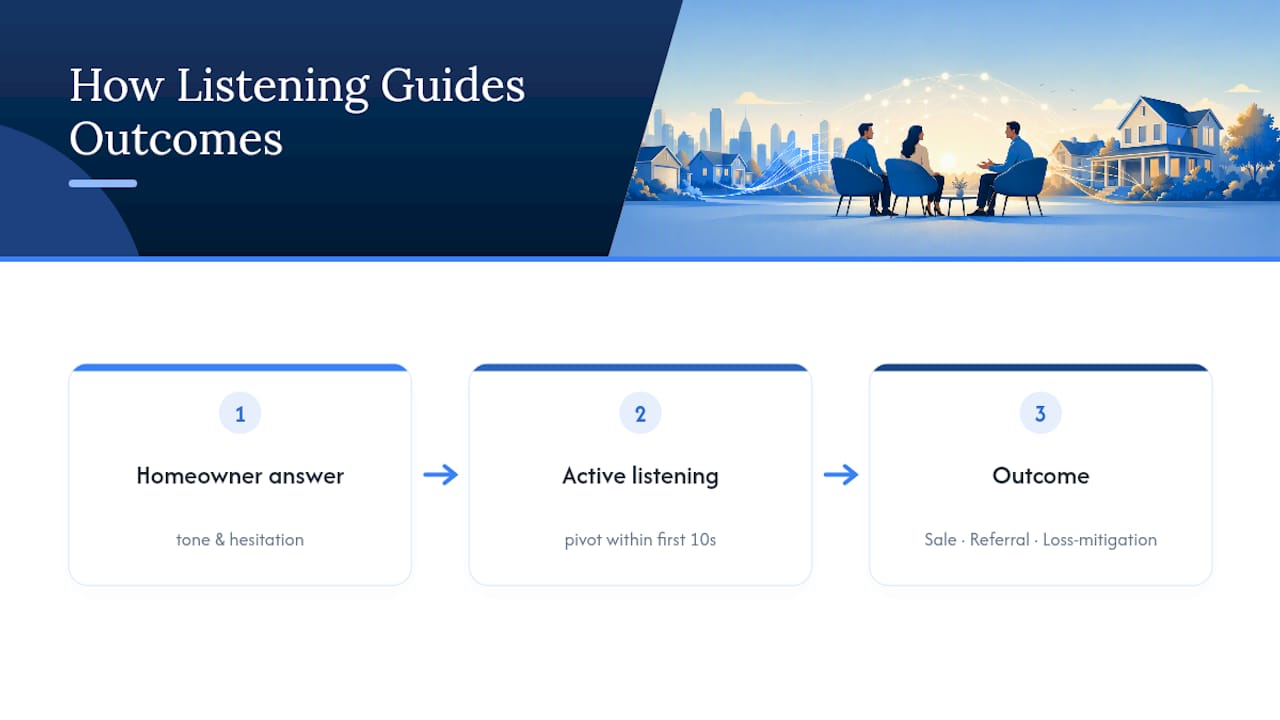
Experienced callers stop reading lines within the first ten seconds of a real answer. They pivot to active listening, letting tone and hesitation guide which of the three outcomes, sale, referral, or loss-mitigation help, actually fits. That pivot is the skill that separates a caller who converts from one who recites.
Building that instinct usually takes hundreds of live reps, which is expensive when the reps happen on real distressed homeowners. Structured roleplay against realistic seller objections and emotional states, the kind ClosersLeague built its platform around, compresses that learning curve without putting real leads at risk.
The Overlooked Truth About Pre-Foreclosure Scripts
The industry oversells the script itself and undersells the pause after the discovery question. Most training material treats a pre-foreclosure script as a fixed sequence of lines, but the actual skill is knowing when to abandon the script entirely. A homeowner in denial needs a different rhythm than one in open panic, and no single template covers both.
Conventional advice also underweights research. Callers get told to “personalize the opener,” but personalization without knowing the delinquency stage, the lender, or a probate flag is just guessing with more confidence. The homeowners who respond best are the ones who sense you already understand their situation before you finish your first sentence.
If you take one thing from this guide, prioritize the discovery question over the perfect opener. A mediocre opener followed by genuine listening outperforms a flawless opener followed by a canned pitch, every time. Scripts get you into the conversation. Listening is what gets you the deal, or the referral, or simply a homeowner who hangs up feeling respected instead of hunted.
— Dave
Practice These Scripts Before You Use Them on a Real Lead
Reading a script on paper and delivering it under pressure are two different skills, and the gap between them is where most calls fall apart. ClosersLeague’s free trial gives you scenario-based roleplay against AI homeowners in pre-foreclosure, tax delinquent, and inherited-property situations, with real-time coaching on tone, pacing, and compliance cues after every call.

If you’re an investor or wholesaler who wants to stress-test these scripts against a defensive or panicked “homeowner” before you dial a real one, start with the pre-foreclosure cold calling practice scenarios. Wholesalers working inherited or absentee leads can run the same drills through the inherited property cold calling practice track, and anyone building out a broader script library can explore ClosersLeague’s full platform to see the scoring, leaderboards, and objection breakdowns behind the training. Sign up for the trial and run your first call today.
Sources
- Trouble paying your mortgage or facing foreclosure | FTC
- How to prevent an impending foreclosure on your home | NFCC
FAQ
How long can a house stay in pre-foreclosure?
There’s no fixed timeline. It depends on state foreclosure procedures, the lender’s internal process, and whether the homeowner pursues options like forbearance or a loan modification; federal rules generally keep servicers from formally filing until a loan is more than 120 days delinquent, which gives homeowners a real window to act.
What are good cold calling scripts for pre-foreclosure outreach?
The most effective scripts open with a permission ask and empathy, move into open-ended discovery questions, and close with a low-pressure next step instead of an immediate offer, a structure the CFPB’s servicing guidance supports directly.
Can a homeowner pay off debt to clear pre-foreclosure?
Yes. Reinstatement, where the homeowner pays the missed amount in full, is one of several paths, alongside loan modification, forbearance, short sale, or bankruptcy; a Chapter 13 filing can also cure arrears over three to five years while an automatic stay halts the foreclosure process.
How does a homeowner get their home out of pre-foreclosure?
Options include catching up on missed payments, negotiating a modification with the lender, selling the property before the sale date, or filing bankruptcy to trigger an automatic stay; a HUD-approved housing counselor can help a homeowner sort through which option fits their situation.
Should investors use the same script for every distressed homeowner?
No. A pre-foreclosure homeowner in denial needs a slower, more empathetic pace than one already searching for a fast sale, which is why practicing script variants against different emotional states, the kind of drills ClosersLeague’s roleplay scenarios are built around, matters more than memorizing one perfect script.