
The probate seller cold call workflow that converts follows six steps: source leads from public court filings, wait 4–6 weeks after the filing date, open with a permission-based empathy-first line, qualify the decision-maker and situation, send a follow-up resource package, then nurture over a 3–6 month cadence. That’s the whole system. Everything below is the detail that makes each step work.

Your one-line opener (copy it now):
Before your next dial session, do these three things:
- Verify the contact’s role (personal representative, heir, or attorney) in the court filing before you pick up the phone.
- Set a follow-up task in your CRM the moment you hang up, regardless of the outcome.
- Prepare a physical mail package (probate timeline, vendor list, and a brief intro letter) so you can offer to send it on the first call.
Pro Tip: Don’t wait until you feel ready. Run three roleplay sessions with a partner or an AI tool before your first live dial. The opener above should feel automatic before you use it on a real contact.
Table of Contents
- Why does cold calling probate sellers still convert?
- What do you need to check before every dial?
- What are the primary goals for the first probate call?
- Full copy-ready scripts for every contact type
- How do you handle the most common probate seller objections?
- What does a 6-month probate follow-up sequence look like?
- How do you set up your CRM so probate leads don’t slip through?
- How do you work with probate attorneys, executors, and guardians?
- How do you practice probate cold calls before going live?
- Why are six-month probate leads worth more than you think?
- Key Takeaways
- What the best probate callers actually do differently
- ClosersLeague: practice probate calls before they cost you
- Useful sources
- FAQ
Why does cold calling probate sellers still convert?
Probate leads convert at higher rates than most distressed lists for a structural reason: the sellers aren’t just motivated, they’re often overwhelmed. Heirs and personal representatives are managing legal paperwork, family dynamics, and an unfamiliar process, all at once. They’re reachable through public court filings, which means your list is sourced from verified, actionable data rather than scraped databases. And because most callers either avoid probate entirely or approach it with a hard pitch, the bar for standing out is genuinely low.

Timing is where most callers get it wrong. Calling in the first 2–4 weeks after a probate filing almost always meets resistance. Families are still handling funeral arrangements and immediate estate matters. The 4–6 week window after the filing is the sweet spot: the initial shock has passed, the executor has started receiving paperwork, and practical questions about the property are beginning to surface.
Wait too long, and you face different tradeoffs. By month four or five, attorneys and agents are often already involved, and your position as a helpful early resource is gone. The window between weeks four and twelve is where the highest-quality first contacts happen.
The behavioral edge: Most investors who do call probate leads pitch too fast and too hard. Heirs are unfamiliar with probate timelines, Letters Testamentary, and what selling a property in probate actually involves. Offering educational resources about those steps builds more trust than any price offer on the first call.
Competition among empathetic, patient callers is thin. That’s the real opportunity.
What do you need to check before every dial?
Compliance isn’t optional, and it isn’t complicated if you build it into your pre-call routine. Here’s the checklist to run before every session.
List and data hygiene:
- Confirm the contact’s number came from a verified public probate filing, not a scraped or purchased list with no consent provenance.
- Scrub your list against the National Do Not Call Registry at least every 31 days. The registry holds over 250 million numbers.
- Cross-check against your internal DNC list. When anyone says “don’t call me,” that number goes on your internal list immediately and stays there permanently.
- Confirm the number belongs to the personal representative or executor, not a random heir who has no legal authority over the property.
Caller settings and timing:
- Use a real, verified phone number registered to your business. Spoofed or rotating unregistered numbers violate the Truth in Caller ID Act and trigger carrier-level blocking.
- Dial only between 8:00 AM and 9:00 PM in the contact’s local time zone, per federal TCPA rules. Several states are stricter — Texas, for example, restricts calls to 9:00 AM–9:00 PM Monday through Saturday.
- If you record calls, disclose it at the start of the call in states that require two-party consent.
- Do not use an autodialer or AI voice agent for cold outbound to cell phones without prior express written consent. Manual dialing is the safe default.
Pre-call operational checks:
- Confirm the correct decision-maker (personal representative name matches court filing).
- Log the contact attempt in your CRM before you dial, not after.
- Note the probate filing date and calculate how many weeks have passed.
What are the primary goals for the first probate call?
The first call has one job: build enough trust to earn a second conversation. You are not there to make an offer. You are there to confirm you’re speaking with the right person, express genuine empathy, and get permission to send a helpful resource or schedule a brief follow-up call.
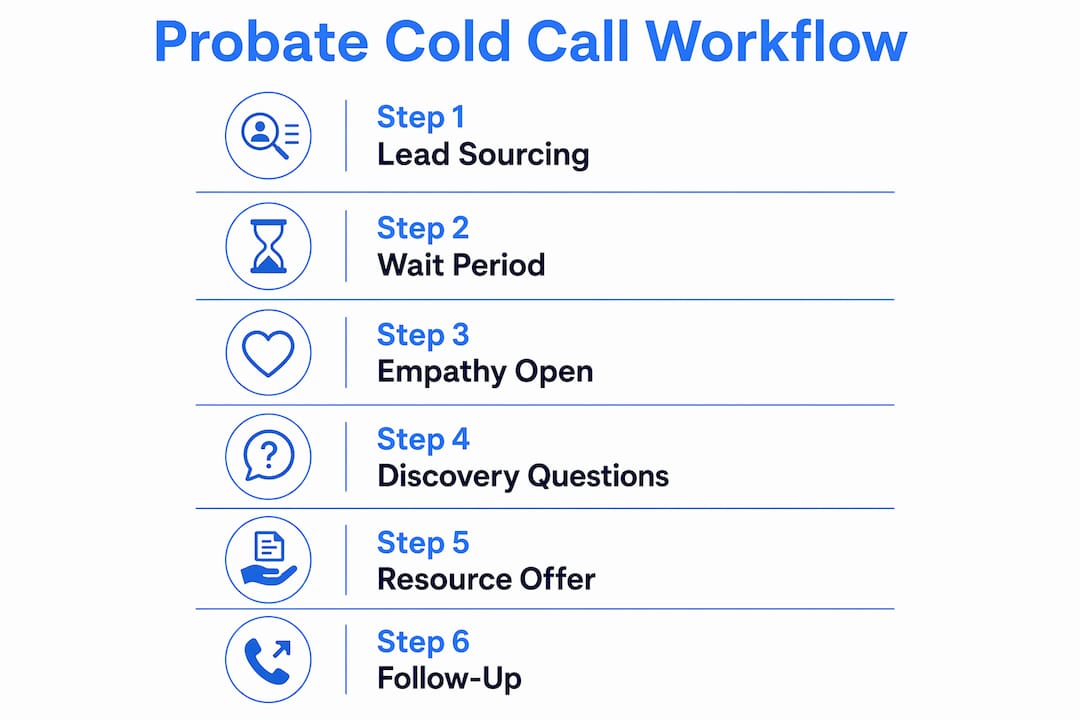
Callers who lead with empathy and offer help before asking for anything consistently produce better contact rates and longer-term trust than those who pivot to price within the first two minutes.
Three copy-ready permission-based openers:
Opener 1 — For the executor or personal representative:
“Hi, this is [Name] with [Company]. I know you’re probably managing a lot right now with the estate, and I don’t want to take up much of your time. I work with families going through probate and I have a short resource guide on the property side of things — would it be okay if I sent that over to you?”
Opener 2 — For a family heir (not the executor):
“Hi, my name is [Name]. I’m reaching out because I saw there’s an estate matter involving a property in [City], and I wanted to connect with whoever is handling that side of things. Is that you, or is there someone else I should speak with?”
Opener 3 — For an attorney’s office:
“Hi, I’m [Name] with [Company]. I work with investors who specialize in probate properties, and I’ve helped several attorneys’ clients navigate the sale process quickly. Would it be appropriate to send over a brief overview of how we work, in case it’s ever useful for your clients?”
Do/don’t checklist for tone and pacing:
- Do pause after expressing condolences. Give them a moment before moving forward.
- Do ask one question at a time. Stacking questions feels like an interrogation.
- Don’t mention price, offer, or “cash buyer” on the first call.
- Don’t rush through the opener. Slow down. Grief doesn’t move at sales pace.
- Do take notes in real time and read them back to confirm you understood correctly.
- Don’t argue if they say it’s too soon. Acknowledge it and offer to follow up later.
Pro Tip: When someone’s voice breaks or they go quiet, stop talking. A five-second pause feels long to you and natural to them. The callers who close probate deals are the ones who learned to sit in silence without filling it.
Full copy-ready scripts for every contact type
First live call script
Opening (use Opener 1, 2, or 3 from above based on who answers).
Three discovery questions (ask one, listen fully, then ask the next):
- “Can I ask — is the property currently occupied, or is it sitting vacant?”
- “Do you have a sense yet of whether the family is planning to sell, or is that still being figured out?”
- “Has anyone walked you through what the probate timeline typically looks like for a property sale?”
Transition to resource offer:
“Based on what you’ve shared, I think the guide I mentioned would actually be pretty useful for you. It covers the typical probate timeline, what Letters Testamentary allow you to do with the property, and a list of vendors who work with estates. Can I get your email or mailing address to send that over?”
If they say yes: “Perfect. I’ll get that out today. Would it be alright if I followed up in about two weeks to see if you had any questions about it?”
If they say not yet: “Completely understood. Would it be okay if I checked back in a month or so, just to see where things stand?” Log the date and set the CRM task immediately.
For additional probate call examples with varied emotional tones and pacing, the ClosersLeague blog covers common scenarios in detail.
Voicemail script (compassionate tone)
“Hi [Name], this is [Your Name] with [Company]. I’m reaching out because I work with families navigating the property side of probate, and I wanted to offer a free resource guide that explains the process. No pressure at all — if it’s useful, great. You can reach me at [Number]. I’ll try you again in a few days. Take care.”
Short text follow-up (send 24–48 hours after a voicemail)
“Hi [Name], this is [Your Name] — I left a voicemail yesterday. I have a free probate property guide I’d like to send you. No strings attached. Reply here or call me at [Number] if you’d like it.”
Follow-up email template
Subject: A quick resource for the [Last Name] estate
"Hi [Name],
I reached out by phone recently and wanted to follow up with the resource I mentioned. Attached is a short guide covering the probate property timeline, what a personal representative can authorize, and a list of local vendors who work with estates.
If you have questions or want to talk through the property situation, I’m happy to help — no obligation. You can reply here or call me at [Number].
[Your Name]
[Company] | [Phone]"
Follow-up mail package checklist:
- A one-page personal intro letter (handwritten signature preferred)
- A probate property timeline (one page, plain language)
- A vendor referral list (title company, estate attorney, cleanout crew)
- A local market snapshot (one page, recent comparable sales)
- Your business card
Direct-mail letters consistently outperform postcards for probate lists. Send letters at weeks 0, 3, and 10, with postcards as lighter-touch follow-ups between those milestones.
How do you handle the most common probate seller objections?
Lead with empathy, keep your reply short, and always end with a next action. The goal of every rebuttal is to keep the door open, not to win the argument.
| Objection | Empathetic one-line response | Next action |
|---|---|---|
| “It’s too soon, we’re still grieving.” | “I completely understand. I’m not here to rush anything. Would it be okay if I checked back in a month?” | Set a 30-day follow-up task in CRM. |
| “We’re already working with an attorney/agent.” | “That’s great — having good counsel makes a big difference. I work alongside attorneys often. Would it be okay if I sent a resource just in case it’s ever useful?” | Send mail package. Log as “Attorney-managed.” |
| “How did you get my number?” | “Probate filings are public record, and I use them to find families who might need help with the property side. I’m happy to take you off my list if you’d prefer.” | If they say remove, do it immediately. If not, continue. |
| “We want to keep the property.” | “That makes total sense. If that changes or you want a sense of what it’s worth, I’m happy to help with a free home valuation too.” | Log as “Not ready — wants to keep.” Schedule a 60-day check-in. |
| “We already have offers.” | “Good to hear there’s interest. If you ever want a second opinion or a faster close, feel free to reach out.” | Log as “Has offers.” Set a 14-day follow-up. |
Disengage rules: If someone says “don’t call me again” in any form, remove them from your list immediately and log it as “Do-not-contact” in your CRM. Never transfer a hostile contact to a senior caller without flagging the emotional state first. Some leads simply aren’t ready, and respecting that is what builds your reputation in a market.
What does a 6-month probate follow-up sequence look like?
Automation is the operational difference between a one-off deal and a repeatable probate pipeline. Without a system, you will lose a large portion of your opportunities to missed follow-ups. Here’s the full cadence:
- Day 1 (first contact): Live call attempt. Leave voicemail if no answer. Send text within 24 hours.
- Day 3: Send the physical mail package (intro letter, probate timeline, vendor list, market snapshot).
- Day 7: Second call attempt. Reference the mail package in your opener.
- Week 3: Second letter (check-in, offer to answer questions, no pitch).
- Week 4: Call attempt. Ask if they received the materials. Offer a free property valuation if appropriate.
- Week 6: Email follow-up. Include a local market update or a relevant resource.
- Week 10: Third letter (postcard or short note). Keep it brief and warm.
- Week 12: Call attempt. Requalify: “Has anything changed with the property situation?”
- Month 4: Email with a new resource (updated market snapshot or probate FAQ).
- Month 5: Call attempt. If no response after three attempts this month, slow cadence to monthly.
- Month 6: Final requalification call. If no engagement, move to a quarterly check-in or close the lead.
Mail package timing: Send letters at weeks 0, 3, and 10. Postcards work well as lighter touches between those milestones.
CRM automation triggers:
- If a contact opens your email but doesn’t reply, trigger a call task within 48 hours.
- If a contact requests a valuation, escalate immediately to a human follow-up call.
- If there’s been zero engagement after 90 days, slow cadence to one touch per month and flag for requalification.
- If a contact says “call me back in X months,” set a hard date task and don’t contact them before it.
For a deeper look at multi-channel follow-up strategies that work across distressed seller lists, the ClosersLeague blog covers automation setup and cadence in detail.
How do you set up your CRM so probate leads don’t slip through?
The CRM is where your workflow either holds together or falls apart. Tracking the right fields and enforcing next-action deadlines is what separates investors who close probate deals consistently from those who lose leads to inaction.
Required CRM fields for every probate lead:
- Probate filing date
- Court case number
- Personal representative name and contact info
- Attorney name and contact info (if applicable)
- Contact’s role (executor, heir, guardian, attorney)
- Property address and occupancy status
- Title flags (unknown heirs, liens, Medicaid claims noted)
- Mailings sent (date and type)
- Last contact date and outcome
- Next action date and type
- Disposition status
Disposition taxonomy:
| Disposition | Definition | Next action |
|---|---|---|
| Not ready | Acknowledged contact, not open to selling yet | Follow-up call within 3–6 months cadence |
| Interested, resource sent | Accepted mail package or email | 7-day call to confirm receipt |
| Ready to schedule | Expressed interest in a walkthrough or offer | Schedule within 48 hours |
| Attorney-managed | Attorney is primary contact | Send resource to attorney; 30-day check-in |
| Do-not-contact | Requested removal | Remove immediately, log permanently |
Tracking probate-specific fields like court case number, personal representative name, and title flags materially improves conversion and reduces lead leakage. The property lead checklist from ClosersLeague covers the full data capture framework for distressed seller leads.
Key metrics to track:
- Call-to-contact rate: How many dials result in a live conversation? A healthy call-to-contact rate for probate lists is often modest, varying with list quality and timing.
- Permission-to-send rate: Of live contacts, how many agree to receive your resource package? This is your primary first-call conversion metric.
- Appointment conversion rate: Of leads who received your package, how many schedule a walkthrough or call?
- Months-to-close: Probate deals often take 3–6 months from first contact to close. Track this to calibrate your pipeline expectations.
- Follow-up adherence rate: What percentage of scheduled follow-up tasks are completed on time? Anything below 80% signals a system problem, not a lead quality problem.
Stat to know: Automation improves pipeline conversion by preventing a significant portion of probate opportunities lost to missed manual follow-ups.
How do you work with probate attorneys, executors, and guardians?
Position yourself as a resource, not a vendor. Attorneys and executors deal with enough people who want something from them. The ones who earn referrals are the ones who show up with solutions.
What to offer attorneys:
- A clear explanation of how you work (fast close, as-is purchase, no agent commission friction)
- A vendor referral list they can pass to clients (cleanout, estate sale, title)
- A willingness to handle title complications that slow conventional sales
What to ask for (and how to ask):
“I work with a lot of families going through probate, and I’ve found that having a good attorney in the loop makes the process smoother for everyone. If you ever have a client who needs a quick property solution, I’d love to be someone you can refer. Would it be okay if I sent over a one-page overview of how I work?”
Professional gatekeeper script (for attorney’s assistant):
“Hi, I’m [Name] with [Company]. I work with investors who specialize in probate properties, and I wanted to introduce myself to [Attorney Name] as a potential resource for clients who need to sell estate property quickly. Could I send a brief overview to the right person?”
Do-not-promise list:
- Never guarantee a specific sale timeline. Probate court controls the schedule.
- Never offer legal advice or interpret the will, Letters Testamentary, or court orders.
- Never promise a price before seeing the property and reviewing title.
- Never imply you can bypass the court process.
Practical referral swaps: Offer to refer clients to the attorney for estate planning or probate guidance in exchange for property referrals. A mutual referral relationship is far more durable than a one-sided ask. Title complications like unknown heirs, liens, and Medicaid claims are common in probate deals — investors who build attorney relationships close more reliably because they have a direct line to resolve those issues fast.
How do you practice probate cold calls before going live?
Stop winging it. Start drilling. The callers who perform consistently on probate leads aren’t naturally gifted at handling grief-adjacent conversations. They practiced until the opener felt automatic and the objections stopped catching them off guard.
The drill structure that works:
Run three 5-minute roleplay sessions per practice block, each with a different objection scenario:
- Session 1: Contact says “It’s too soon, we’re still grieving.”
- Session 2: Contact says “We’re already working with an attorney.”
- Session 3: Contact asks “How did you get my number?”
After each session, score yourself on four dimensions: tone (empathetic, not salesy), permission ask (did you ask before offering anything?), pause-to-listen (did you stop talking when emotion appeared?), and next action (did you log a follow-up task?).
ClosersLeague’s AI roleplay modules are built specifically for probate scenarios. You can vary the emotional tone of the simulated contact, practice pacing, and get scored feedback without burning real leads. It’s the fastest way to compress the learning curve on a call type that punishes unprepared callers.
Review checklist (self-score after every session):
- Did I open with empathy before any business language?
- Did I ask permission before offering a resource?
- Did I pause when the contact showed emotion?
- Did I avoid mentioning price or offer on the first call?
- Did I log the next action before ending the session?
Pro Tip: Record every roleplay session and listen back at 1.25x speed. You’ll catch filler words, rushed pacing, and missed pauses that you never notice in the moment. Review with a coach or peer once a week.
For callers who also work other distressed lists, ClosersLeague offers parallel AI roleplay for divorce property scenarios, which share similar emotional dynamics and help build the same empathy-first muscle.
Why are six-month probate leads worth more than you think?
Most probate conversions don’t happen on the first call, or the second, or even the third. The families who eventually sell often take three to six months to reach a decision. They’re waiting on court approvals, family consensus, and the emotional readiness to let go of a property that carries real meaning. The investors who close those deals are the ones who stayed in the conversation without being a nuisance.
Persistent, value-led follow-up is what separates a one-deal investor from someone building a real probate pipeline. Each touch should deliver something useful, not just a check-in call that signals you’re still waiting for them to say yes.
Monthly touch content themes:
- Month 1: Probate timeline and process overview (educational)
- Month 2: Local market snapshot (comparable sales in the area)
- Month 3: Vendor referral list update (cleanout, estate sale, title)
- Month 4: Probate FAQ (common questions about selling during probate)
- Month 5: A brief personal check-in call with no agenda
- Month 6: Requalification call with a direct but gentle question about their plans
Requalification rules:
- Pause cadence if a contact explicitly asks you to wait. Set a hard date and honor it.
- Remove from pipeline if they’ve requested no contact or if three consecutive months of outreach produce zero engagement and no response to a direct requalification question.
- Reactivate cold contacts by leading with new information (a market update, a change in probate law, or a new resource) rather than a generic “just checking in” message.
The long-game reality: Probate leads that convert after five or six months of nurturing often produce the cleanest deals. By that point, the family has made a decision, the attorney has cleared the path, and you’re the trusted contact they’ve been hearing from consistently. That’s not luck. That’s a system.
Key Takeaways
A structured, empathy-first probate seller cold call workflow, built on the 4–6 week timing window, permission-based openers, and automated multi-channel follow-up, is what converts probate leads into closed deals over a 3–6 month pipeline.
| Point | Details |
|---|---|
| Timing is the first variable | Wait several weeks after the probate filing before first contact; calling too soon almost always meets resistance. |
| First call goal: earn a second call | Confirm the decision-maker, express empathy, and get permission to send a resource. Never pitch on call one. |
| Multi-channel follow-up prevents lost deals | Combine calls, letters, texts, and emails across a 6-month cadence; automation prevents the missed follow-ups that cost you deals. |
| CRM fields drive conversion | Track filing date, court case number, role, title flags, and disposition status to keep every lead moving forward. |
| ClosersLeague accelerates skill acquisition | AI roleplay modules built for probate scenarios let you drill objections and pacing before burning real leads. |
Your 48-hour checklist:
- Pull your probate list and verify each contact’s role against the court filing.
- Build your initial mail package template (intro letter, timeline, vendor list, market snapshot).
- Set up CRM dispositions using the taxonomy above.
- Schedule your first dial block (minimum 90 minutes, uninterrupted).
- Run three roleplay sessions using the objection scenarios above before your first live call.
- Use Opener 1 on your first live contact and Voicemail Script 1 on your first no-answer.
What the best probate callers actually do differently
The conventional wisdom on probate cold calling is that it’s a numbers game. Dial more, close more. That framing is wrong, and it’s why most investors who try probate leads quit after two weeks of rejection.
The callers who build real probate pipelines treat it as a relationship game with a long clock. They don’t measure success by how many offers they made on day one. They measure it by how many contacts agreed to receive a resource, how many follow-up tasks were completed on time, and how many leads moved from “Not ready” to “Interested” over a 60-day window.
When you scale from 10 leads to 100, the thing that breaks first is follow-up discipline. At 10 leads, you can track everything in a spreadsheet. At 100, you start missing callbacks, forgetting who you mailed, and losing track of where each contact is in the process. The fix isn’t working harder. It’s building the CRM fields, disposition taxonomy, and automation triggers described above before you scale, not after.
ClosersLeague training is built around exactly this kind of deliberate practice. The AI roleplay modules let you run probate scenarios repeatedly, vary the emotional tone of the simulated contact, and get scored feedback on the specific moments where most callers lose the conversation. That feedback loop is what compresses the ramp time from “uncomfortable with probate calls” to “consistent and confident.”
ClosersLeague: practice probate calls before they cost you
Cold calling probate sellers is one of the highest-skill outreach types in real estate investing. The emotional stakes are real, the objections are unpredictable, and one fumbled opener can close a door that took weeks to find. ClosersLeague gives you a faster path to competence: AI-powered roleplay built specifically for probate scenarios, so you can drill the opener, the objections, and the follow-up transitions before you’re on a live call with a grieving family member.
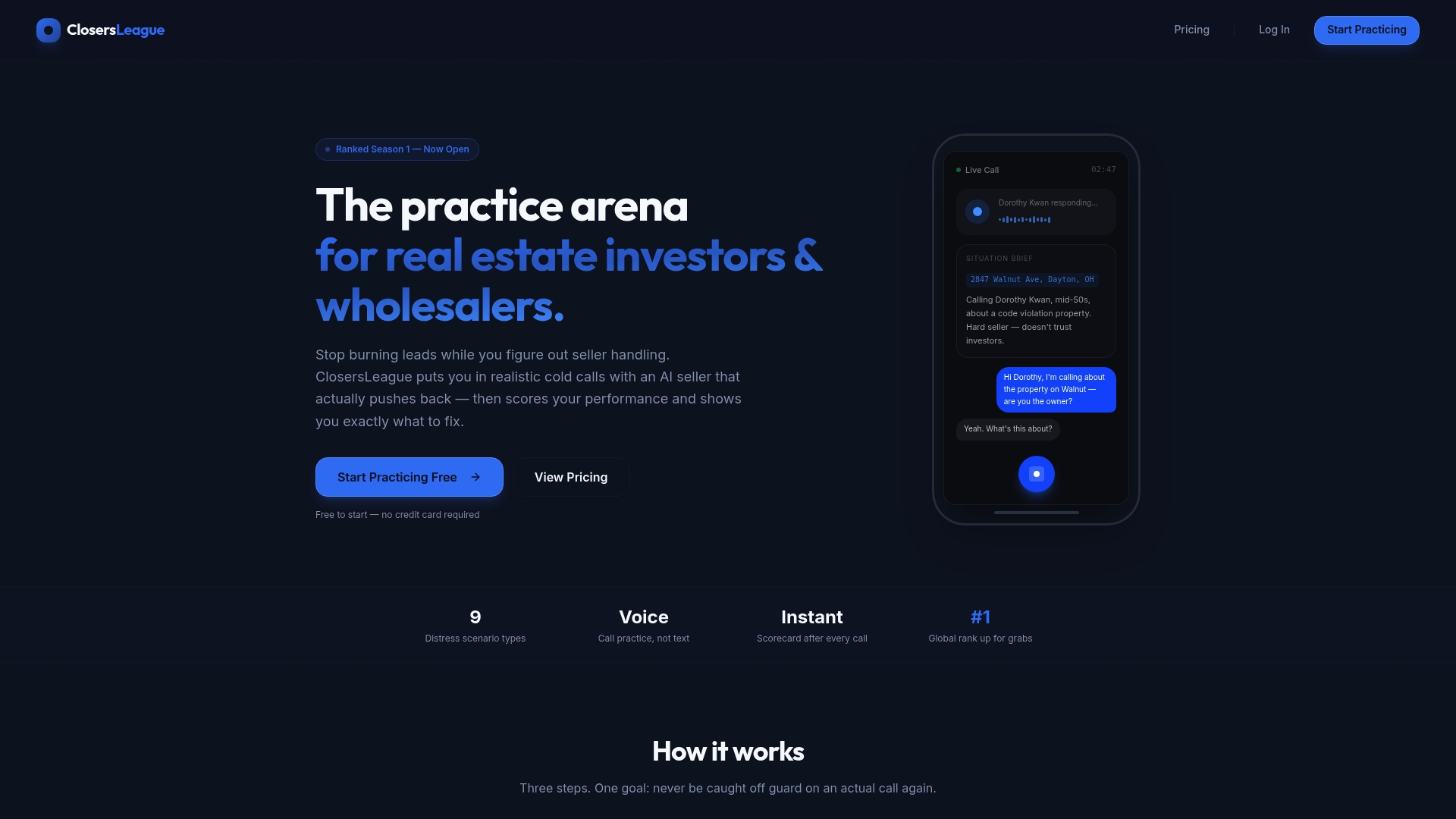
The probate roleplay module includes simulated contacts with varied emotional tones, a script library aligned with empathy-first outreach, and scored feedback on tone, pacing, and next-action logging. You practice the exact scenarios covered in this article, in a low-stakes environment where mistakes are learning data, not lost deals.
If you’re serious about building a probate pipeline that converts, the next step is simple: start your AI roleplay practice and run three probate scenarios before your next dial session.
Useful sources
- ProbateData — Cold Calling Probate Leads Guide: Timing guidance and outreach best practices for probate lead calling, including the 4–6 week sweet spot recommendation.
- Televista — Cold Calling Inherited Property Leads: Practitioner-level guidance on empathy-first openings, objection handling, and sensitivity protocols for inherited property outreach.
- Lonergan Law Firm — Finding and Closing Probate Deals: Attorney perspective on educating heirs about probate terminology, Letters Testamentary, and the legal steps that affect property sales.
- CloseDaily — Probate Real Estate Niche Guide: Automation, pipeline management, and the operational case for multi-channel nurture sequences in probate outreach.
- REmail Direct — Probate Leads and Direct Mail: Direct-mail cadence data for probate lists, including letter vs. postcard performance and recommended send timing.
- eCFR — Telemarketing Sales Rule (16 CFR Part 310): The federal regulatory text governing DNC compliance, caller ID requirements, and outbound call conduct.
- 47 U.S.C. § 227 — TCPA: The Telephone Consumer Protection Act, governing autodialer use, prerecorded voice, and cell phone consent requirements.
- ClosersLeague — Probate Cold Calling Practice: AI roleplay modules and probate-specific practice tools for real estate investors and wholesalers.
- ClosersLeague — Probate Call Examples Guide: Script examples, call transcripts, and tone guidance for probate outreach aligned with high-conversion, empathy-first methodology.
FAQ
What are the five stages of a probate cold call?
The five stages are: open with empathy and ask permission, confirm the decision-maker’s role, ask one to three discovery questions about the property and timeline, offer a specific resource (mail package or guide), and set a concrete next step (follow-up call or mailing). Never pitch price or make an offer during stage one.
What are the three C’s of cold calling?
Definitions vary across sales frameworks, but a practical version for probate outreach is: Clarity (know exactly who you’re calling and why), Compassion (lead with empathy before any business language), and Consistency (follow up on schedule across a 3–6 month cadence). All three are required for probate calls specifically.
What are the biggest cold calling mistakes in probate outreach?
The most common errors are calling too early (within the first 2–4 weeks after filing), pitching price on the first call, failing to set a follow-up task before hanging up, and using an autodialer on cell phone numbers without prior express written consent. Prioritizing volume over strategy and skipping homework on the contact’s role are also frequent mistakes.
What do you say on a real estate probate cold call?
Open with your name, a brief acknowledgment of the situation, and a permission ask before offering anything. A proven opener: “Hi, my name is [Name]. I know this may be a difficult time, and I don’t want to intrude — would it be okay if I shared a quick resource that might help you navigate the property side of things?” From there, ask one discovery question and listen fully before moving forward.
How long does it take to close a probate lead?
Most probate deals close 3–6 months after first contact, depending on court timelines, family consensus, and title complexity. Leads that convert after five or six months of consistent, value-led follow-up often produce the cleanest transactions because the legal and emotional groundwork is already done by the time you make an offer.
Recommended
- Probate Call Examples for Real Estate Investors: 2026 Guide
- Probate Cold Calling Practice — AI Roleplay for Real Estate Investors & Wholesalers
- Boost Real Estate Deals with a Proven Investor Script Workflow – ClosersLeague Blog
- Real Estate Cold Calling Practice — AI Roleplay for Every Seller Type | ClosersLeague