
A cold calls workflow for real estate is the structured sequence of timing, tools, scripts, and follow-ups that determines how many motivated sellers you actually reach and convert. Without a deliberate schedule for your real estate cold calls workflow, you are burning hours on low-connect windows, winging conversations, and leaving appointments on the table. The investors and wholesalers who consistently close distressed deals, whether foreclosure, probate, divorce, or tax delinquent properties, run their calling like a repeatable system. This article breaks down exactly how to build that system, from the best calling windows to dialer technology, daily structure, scripting, and troubleshooting.
What are the best times and days to schedule cold calls for motivated sellers?
Timing is the single fastest fix most real estate investors overlook. Optimal calling windows fall on Tuesday through Thursday, between 10–11 AM and 2–3 PM local time, boosting connect rates from 4% to 14%. That is a 3x improvement from a scheduling change alone, with no script changes required.
The reason these windows work is behavioral. Homeowners in distress, facing foreclosure or probate deadlines, are more likely to answer an unfamiliar number mid-morning or early afternoon. Monday mornings find people mentally catching up on the week. Friday afternoons find them mentally checked out. Both are low-yield calling windows you should cut from your schedule entirely.
Local timezone awareness is non-negotiable. If you are calling a list of probate leads spread across three states, your power hour in the Eastern timezone is 7 AM in California. Dialing without timezone filters means you are calling people before they are legally reachable in many states, and burning your list.
- Tuesday through Thursday: highest connect rates across all seller types
- 10–11 AM local time: sellers are settled into their day but not yet at lunch
- 2–3 PM local time: post-lunch window before the late-afternoon wind-down
- Avoid: Monday before 10 AM and Friday after 2 PM
- Avoid: Early mornings and evenings unless you have prior consent
Pro Tip: Track your own connect data by day and hour inside your CRM for 30 days. Your specific list, whether tax delinquent or divorce leads, may show a slightly different peak window. Let your data refine the benchmark.
What tools and technology stack enhance cold calling workflow efficiency?
The right tools do not just save time. They change what is physically possible in a single calling session. Parallel dialers allow agents to reach 40–80+ contacts per hour compared to 8–12 manually. That is not a marginal gain. It is the difference between sampling a list and actually working it.

A power dialer can compress calling 200 leads from a full day down to 2–3 hours. For expired listings or fresh foreclosure filings where speed matters, that compression is a competitive edge. Investors who call manually while competitors use dialers are simply slower to the same motivated seller.
Here is how the core tool categories break down:
| Tool Type | Purpose | Examples |
|---|---|---|
| Power/Parallel Dialer | Increase call volume per hour | Mojo Dialer, BatchDialer |
| Real Estate CRM | Organize leads, track follow-ups | Follow Up Boss, kvCORE |
| AI Call Scoring | Assess seller motivation level | ClosersLeague AI practice modules |
| Voicemail Drop | Leave pre-recorded messages instantly | Built into most dialers |
| Calendar Automation | Send invites and reminders post-call | Calendly, Google Calendar |
| SMS/Email Follow-up | Reinforce appointment after the call | CRM automation sequences |
AI tools are now part of a serious calling stack. Platforms like ClosersLeague use AI to score your calls, identify where you lost momentum, and help you practice distressed seller scenarios before you dial live leads. That kind of feedback loop accelerates skill development faster than call volume alone.
The CRM is the backbone of your workflow for cold calling. Follow Up Boss and kvCORE both integrate directly with popular dialers, so every call is logged, every callback is scheduled, and no lead falls through the cracks. Without CRM integration, you are managing your pipeline in spreadsheets and memory, which fails at scale.
How to structure a daily cold calling workflow for maximum focus and conversion
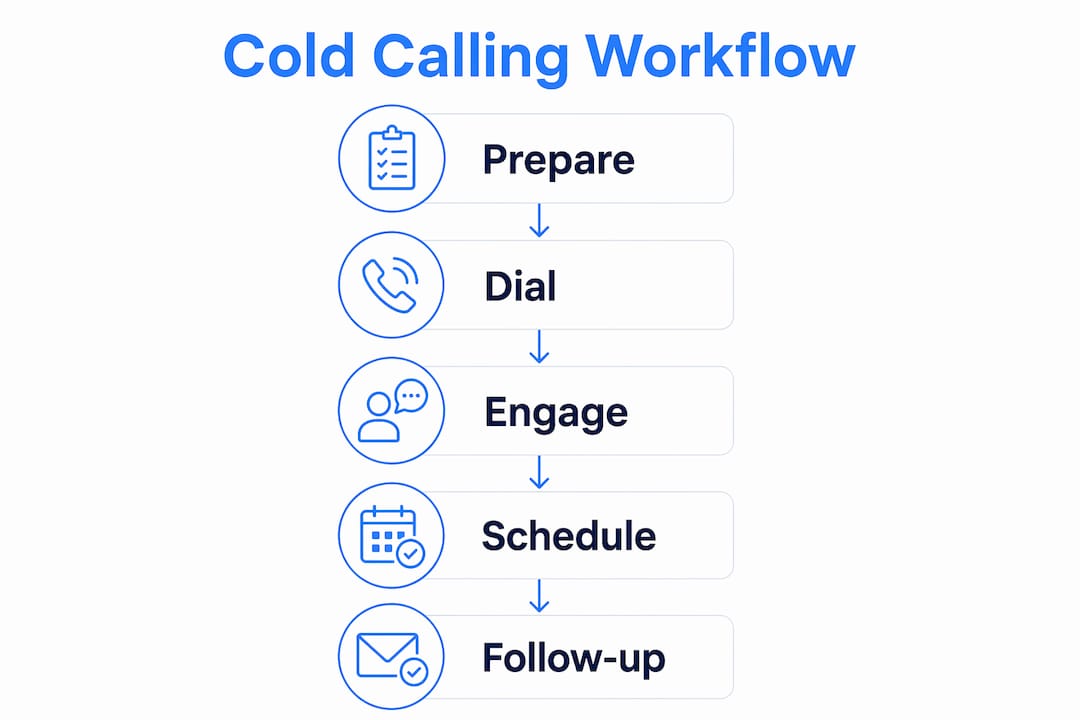
A structured daily schedule is what separates investors who call consistently from those who call when they feel like it. The night before is where your session actually starts. Night-before preparation means organizing your lists, reviewing your scripts, and eliminating decision fatigue before you ever pick up the phone. When you sit down to call, your only job is to dial and talk.
Here is a proven daily structure for real estate lead generation calls:
- Night before (15 minutes): Pull your prioritized call list. Review your script for the lead type you are calling tomorrow, whether probate, foreclosure, or divorce. Set your daily call target.
- Morning prep (10 minutes): Open your CRM and dialer. Confirm your list is loaded. Do a 2-minute vocal warm-up. Get water. Remove distractions.
- Power hour block 1 (60–90 minutes): Dial your highest-priority leads first. Do not cherry-pick. Work the list in order. Calling sessions beyond 90 minutes lead to fatigue, reduced voice quality, and lower conversions.
- Break (15 minutes): Step away from the screen. Walk, stretch, or eat. Do not check social media. This break is recovery, not distraction.
- Power hour block 2 (60–90 minutes): Return to your list. Handle callbacks from block 1. Continue with new contacts.
- End-of-session review (10 minutes): Log outcomes in your CRM. Schedule all callbacks. Note any objections you struggled with.
The systematic calling order matters more than most investors realize. Cherry-picking “warm” leads and skipping “cold” ones destroys your data and creates false confidence. Work the list in order and let the numbers tell you the truth.
Pro Tip: Set a daily call target based on your dialer type. With a parallel dialer, 100–150 dials per session is realistic. Manually, 40–60 is a strong day. Measure dials, not hours.
What are the best scripting and appointment-setting strategies within this workflow?
Scripts are not scripts in the traditional sense. Successful agents treat scripts as modular playbooks, mixing and matching openers, discovery questions, and closing lines based on the seller type and situation. A probate call opens differently than a foreclosure call. Treating them the same is the first scripting mistake.
The biggest mistake in cold calling is winging it. Successful callers use scripts flexibly to guide authentic conversations rather than reading verbatim. The goal is to sound like a human who knows what they are doing, not a robot reciting a paragraph.
A proven conversation flow for distressed seller calls follows four stages:
- Open: Introduce yourself, confirm you have the right person, and state a clear reason for calling. Keep it under 20 seconds.
- Clarify: Confirm the property address and basic situation. “I understand you may have a property on Elm Street. Is that still the case?”
- Discover: Ask open questions about their timeline, motivation, and situation. Listen more than you talk.
- Invite: Ask for the appointment directly. Do not ask “What times work for you?” That open-ended question creates friction.
Offering two specific appointment slots forces a binary choice and increases acceptance rates compared to open-ended questions. Say “I have Thursday at 2:15 or Friday at 10. Which works better?” The seller picks one. The meeting is set.
After the call, send the calendar invite within five minutes. Booking appointments live with immediate calendar invites and same-day confirmations significantly improves show rates. Follow up with a short SMS confirmation an hour later and an email reminder the morning of the appointment. These three touchpoints cut no-shows dramatically.
For distressed seller scripts that are already built around foreclosure, probate, and divorce scenarios, ClosersLeague has frameworks you can adapt directly into your calling workflow.
How to troubleshoot common pitfalls in scheduling and executing cold calls workflows?
Low connect rates are the most common complaint from investors who are otherwise doing everything right. The fix is usually timing or list quality, not the script. If you are connecting with fewer than 5% of dials, check whether you are calling within the Tuesday through Thursday windows and whether your list has been scrubbed for disconnected numbers.
Call reluctance is real and it compounds. The first 100 cold calls are critical for building muscle memory and learning patterns. A 1–2% conversion rate is the industry standard. That means 98 out of 100 calls will not convert immediately. Investors who quit before 100 calls never get the data they need to improve.
Common pitfalls and how to fix them:
- Low connect rate: Shift calls to Tuesday through Thursday, 10–11 AM or 2–3 PM. Scrub your list for disconnected numbers.
- Call reluctance: Practice objection handling with AI roleplay tools before live sessions. Confidence comes from repetition, not motivation.
- No-shows: Add a same-day SMS reminder and a morning-of email. Confirm the appointment twice before the meeting time.
- Burnout: Cap sessions at 90 minutes. Take real breaks. Track your energy levels alongside your call metrics.
- Ineffective follow-up: Use CRM automation to trigger SMS and email sequences after every call. Manual follow-up fails at volume.
Pro Tip: Review your CRM data weekly, not daily. Daily fluctuations mislead you. Weekly trends show you whether your timing, list, or script needs adjustment.
Your CRM analytics are your feedback loop. Track connect rate, conversation rate, and appointment rate separately. Connect rate tells you about timing and list quality. Conversation rate tells you about your opener. Appointment rate tells you about your close. Each metric points to a different fix.
Key Takeaways
A disciplined schedule for real estate cold calls, built on proven timing windows, the right dialer technology, and a modular scripting approach, is the most direct path to consistent appointments with motivated distressed sellers.
| Point | Details |
|---|---|
| Best calling windows | Tuesday through Thursday, 10–11 AM and 2–3 PM local time, maximize connect rates. |
| Use a power dialer | Parallel dialers reach 40–80+ contacts per hour versus 8–12 manually. |
| Structure your day in blocks | Cap calling sessions at 90 minutes to prevent fatigue and protect voice quality. |
| Script as a playbook | Use modular openers and closings by seller type; never read verbatim. |
| Set appointments with two options | Offer two specific time slots to force a binary choice and increase acceptance. |
What I have learned from building a cold calling schedule that actually works
The investors I see struggle most are not the ones with bad scripts. They are the ones who call inconsistently and then wonder why their pipeline is dry. A cold calling schedule is a commitment, not a suggestion. When you treat your power hours like non-negotiable appointments, your results compound over weeks, not days.
The metric that changed how I think about this work is conversion rate versus call volume. Early on, I obsessed over dials. More dials felt like more progress. But the real signal is how many conversations turn into appointments. You can dial 200 numbers and have five real conversations, or you can dial 80 numbers in the right window and have 20. Timing and list quality matter as much as volume.
The other thing I would tell any investor starting this process: your first 100 calls are tuition, not failure. You are learning which objections come up most, how distressed sellers talk about their situations, and where your script breaks down. That data is worth more than any single deal. The investors who stick through the first 100 calls and adjust based on what they learn are the ones who build real pipelines.
Stay adaptable. If your connect rate drops, change the window before you change the script. If your appointment rate drops, change the close before you change the opener. Isolate variables. The real estate prospecting process rewards systematic thinkers, not guessers.
— Dave
ClosersLeague: practice the calls before you make them live
Cold calling distressed sellers, whether they are facing foreclosure, dealing with probate, or going through a divorce, requires a different kind of preparation than standard outreach. ClosersLeague is an AI-powered cold calling training platform built specifically for real estate investors and wholesalers who need to get sharp before they dial real leads.
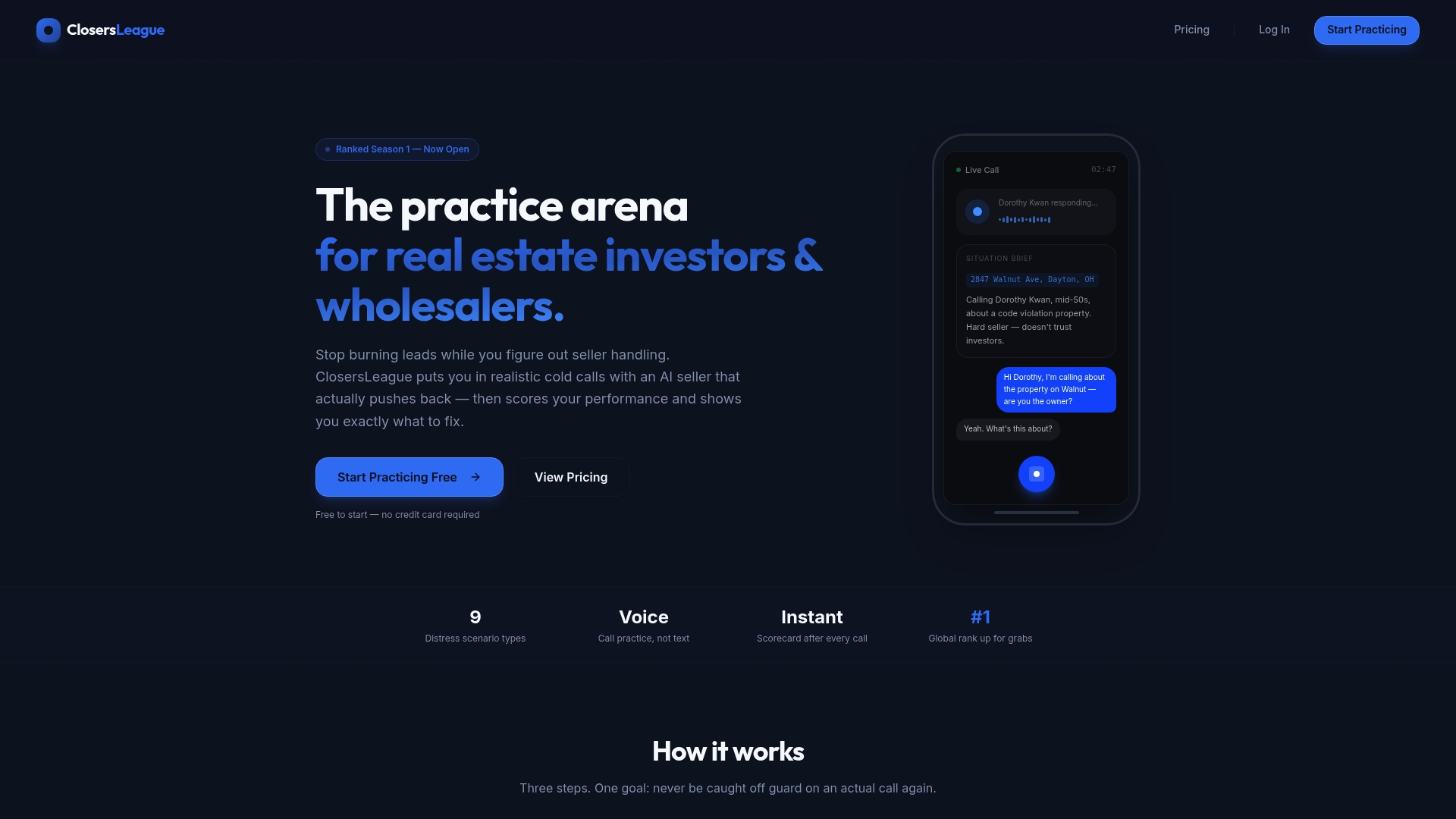
The platform offers AI roleplay scenarios built around the exact seller types you are targeting. Practice inherited property cold calls with AI that responds the way real sellers do, including objections, emotional responses, and hesitation. Every session is scored so you know exactly where to improve. If you want to build the muscle memory that makes your live calls convert, start practicing on ClosersLeague before your next calling session.
FAQ
What is the best time to cold call motivated sellers?
Tuesday through Thursday between 10–11 AM and 2–3 PM local time produces the highest connect rates. Avoid Monday mornings and Friday afternoons entirely.
How many calls should I make per day?
With a parallel dialer, 100–150 dials per session is realistic. Manually, 40–60 dials is a strong daily target. Cap each calling block at 90 minutes to avoid fatigue.
What is a realistic conversion rate for real estate cold calls?
A 1–2% conversion rate is the industry standard. The first 100 calls build the pattern recognition and muscle memory that improve that rate over time.
How do I reduce no-shows after setting an appointment?
Send a calendar invite within five minutes of the call, follow with an SMS confirmation within an hour, and send an email reminder the morning of the appointment. Immediate calendar invites and same-day confirmations significantly improve show rates.
How should I structure a script for distressed seller cold calls?
Use a four-stage flow: Open, Clarify, Discover, and Invite. Treat the script as a modular playbook, not a paragraph to read aloud. Adapt your opener and close based on whether you are calling a foreclosure, probate, or divorce lead.
Recommended
- Vacant Property Cold Calling Practice — AI Roleplay for Real Estate Investors & Wholesalers
- Turn Cold Calls Into Deals: A Lead Conversion Guide – ClosersLeague Blog
- Real Estate Cold Calling Practice — AI Roleplay for Every Seller Type | ClosersLeague
- 10 proven cold calling tips for real estate investors – ClosersLeague Blog