The moment a seller says “send me an offer,” acknowledge the request, pause, and secure one small commitment before you name a number. Don’t hang up with a price attached to nothing. That single move protects your margin and keeps you, not the seller, steering the call.
Here’s a script you can read almost word for word on your next call:
“Absolutely, I can put something together for you. Most sellers get a fair number faster when I know a couple quick things first, like the condition of the roof and whether you’re still living there. Got two minutes?”
That’s it. Ten seconds, one soft ask, zero anchoring. This is the same logic behind MEDDPICC, the sales qualification framework that forces reps to identify decision criteria and pain before proposing a solution. Gong’s call-analytics research backs the same instinct: reps who slow down before proposing terms consistently close at higher rates than reps who quote numbers cold. If you want to drill this exact exchange until it’s automatic, ClosersLeague built its AI roleplay engine around precisely this kind of moment.
- Acknowledge the request warmly, never defensively.
- Ask one qualifying question tied to condition, timeline, or occupancy.
- Propose a short next step (a walkthrough or five-minute call) instead of a dollar figure.
- Never let the pause turn into silence. Fill it with a reason the seller benefits from waiting.
Key Takeaways
The diagnostic pause, applied consistently and paired with a real follow-up cadence, is what turns “send me an offer” from a stall into a closed deal.
| Point | Details |
|---|---|
| Pause before quoting | Acknowledge the request, ask one qualifying question, and propose a short next step instead of a number. |
| Use the three signals | Check buying stage, decision maker clarity, and deal size before deciding to fast-track or pause. |
| Send scope, not price | A lightweight one-page document with no dollar figure protects you and forces a follow-up meeting. |
| Build CRM guardrails | Require a completed discovery call before your pipeline lets a deal move to “Offer Sent.” |
| Practice with ClosersLeague | Rehearse pushback scenarios through AI roleplay so the pause feels natural on a live call. |
Table of Contents
- Why “Send Me An Offer” Usually Isn’t a Final Demand
- When to Send Fast vs. When to Pause
- The Diagnostic Pause: Scripts and Questions That Work
- The Lightweight Proposal Template for Insistent Sellers
- Follow-Up Cadence and CRM Guardrails
- When the Seller Pushes Back Hard
- Practice These Scripts Before You Need Them
- Why This Playbook Holds Up in the Field
- Rehearse This Playbook With ClosersLeague
- Sources
- FAQ
Why “Send Me An Offer” Usually Isn’t a Final Demand
Sellers rarely mean “give me a binding number right now.” Most of the time, they’re testing whether you’re a serious buyer or fishing for a ballpark to compare against three other investors who called that same week. Comply instantly and you’ve anchored yourself to a number before you know the roof needs replacing, the title has a lien, or the seller isn’t even the decision maker.
That’s the real cost of skipping the pause. Once you say a figure out loud, it becomes the floor of every future negotiation, whether or not it reflects the property’s actual condition. Retipster’s breakdown of the Maximum Allowable Offer formula makes this point directly: acknowledging the request and asking a diagnostic question before quoting anything keeps you positioned as an advisor instead of a vending machine.
Two frameworks make this reframe concrete:
- The 3 C’s (Clarify, Connect, Close): Televista’s cold-calling research sequences urgency, education, and relationship building in that order, treating “send me an offer” as a cue to clarify before anything else.
- P.A.U.S.E.: Pause, Ask, Understand, Summarize, Engage. A structured way to slow the call down without sounding evasive.
Industry wholesalers describe this pattern the same way MNREIA does in its breakdown of the MAO formula: treat the phrase as an opening, not a rejection, and use it to gather the details that actually determine your number.
Statistic callout: Sales research consistently finds that a short value preview before a formal proposal correlates with higher follow-up engagement and stronger win rates, a pattern PulseRevOps documents in detail across B2B sales cycles, including CRM automation built specifically to enforce the pause.
When to Send Fast vs. When to Pause
Not every “send me an offer” deserves the same response. Three signals tell you which lane you’re in.
- Buying stage and urgency. A seller who’s already had an inspection and just needs a number moves faster than one who called out of curiosity after seeing a bandit sign.
- Buying committee. Is there a spouse, adult child, or estate executor who also has to approve this? If you can’t identify who signs off, you’re not ready to send anything final.
- Deal size relative to your margin tolerance. A small assignment fee on a low-value property carries less risk than a six-figure acquisition where a rushed number could wipe out your spread.
For quick, low-risk situations, a fast-track guardrail works: verified urgency, single owner-occupant, straightforward title, and a deal small enough that a rough range won’t hurt you if the details shift slightly. Everything else, meaning larger deals, unclear ownership, probate or divorce situations with multiple stakeholders, or any unverified urgency, gets the mandatory diagnostic pause. Memorize this checklist:
- Is the seller the sole decision maker? If unsure, pause.
- Has the property been seen (by you, a photo, or a recent inspection)? If not, pause.
- Is the deal size within your comfort range for a same-call estimate? If not, pause.
- Did the seller state a real timeline, or just “soon”? Vague timelines mean pause.
The Diagnostic Pause: Scripts and Questions That Work
Here’s the verbatim version for a call where the seller pushes harder:
“I hear you, and I want to get you a real number, not a guess. The fastest way to do that is a quick walkthrough or a few photos, because roof age and foundation condition swing the price more than anything else. Can we set fifteen minutes this week?”

That’s roughly 30 seconds, and it does three things: it acknowledges the request, it explains why you’re not quoting blind, and it moves toward a concrete next step. Alex Berman’s wholesaling scripts make the same recommendation, framing the walkthrough as the natural bridge between “send me an offer” and an actual number.
From there, a handful of discovery questions surface what you actually need to know:
- “What’s the main reason you’re considering selling right now?” (uncovers urgency)
- “Is anyone else involved in this decision, like family or a co-owner?” (identifies the economic buyer)
- “If the numbers work, what timeline are you hoping for?” (confirms decision criteria)
- “Has anything major been replaced or repaired in the last few years?” (property condition, informs your range)
Pro Tip: Let silence do the work after you ask a question. Most callers rush to fill dead air, but a two or three second pause after “What timeline are you hoping for?” almost always gets a more honest answer than filling the gap yourself.
The Lightweight Proposal Template for Insistent Sellers
Some sellers, especially those working with an agent or comparing multiple offers, will insist on something in writing before they’ll talk numbers. Send a lightweight scope document instead of a priced offer. No dollar figure means no anchor, and it forces a follow-up conversation to unlock pricing.
| Section | What it should contain |
|---|---|
| Executive summary | One paragraph confirming you understand the property and situation |
| Scope of purchase | What you’re buying, as-is condition acknowledged, closing timeline range |
| Next steps | A required brief call to walk through the offer and finalize price |
| Expiry date | A short window (5-7 days) that creates gentle urgency without pressure |
Keep the subject line simple and specific: “Next Steps for [Property Address]” reads as professional and expected, not salesy. Structure the document as a single page. Sellers skim, and a dense multi-page PDF gets ignored while a clean one-pager gets opened twice.
Follow-Up Cadence and CRM Guardrails
The pause only works if your follow-up system reinforces it instead of undoing it. A seven-touch cadence over roughly ten days keeps the deal warm without pressuring a premature number.
| Day | Touch | Purpose |
|---|---|---|
| 1 | Call plus text recap | Confirm the walkthrough or discovery call |
| 3 | Short value email | Share a case study or comparable sale |
| 5 | Phone call | Answer questions, gauge remaining urgency |
| 7 | Scope document sent | If insisted upon, no price attached |
| — | Text check-in | Confirm document was received and opened |
| — | Proposal Q&A call | Walk through scope, present the actual number |
| — | Final follow-up | Renew urgency or close the loop |
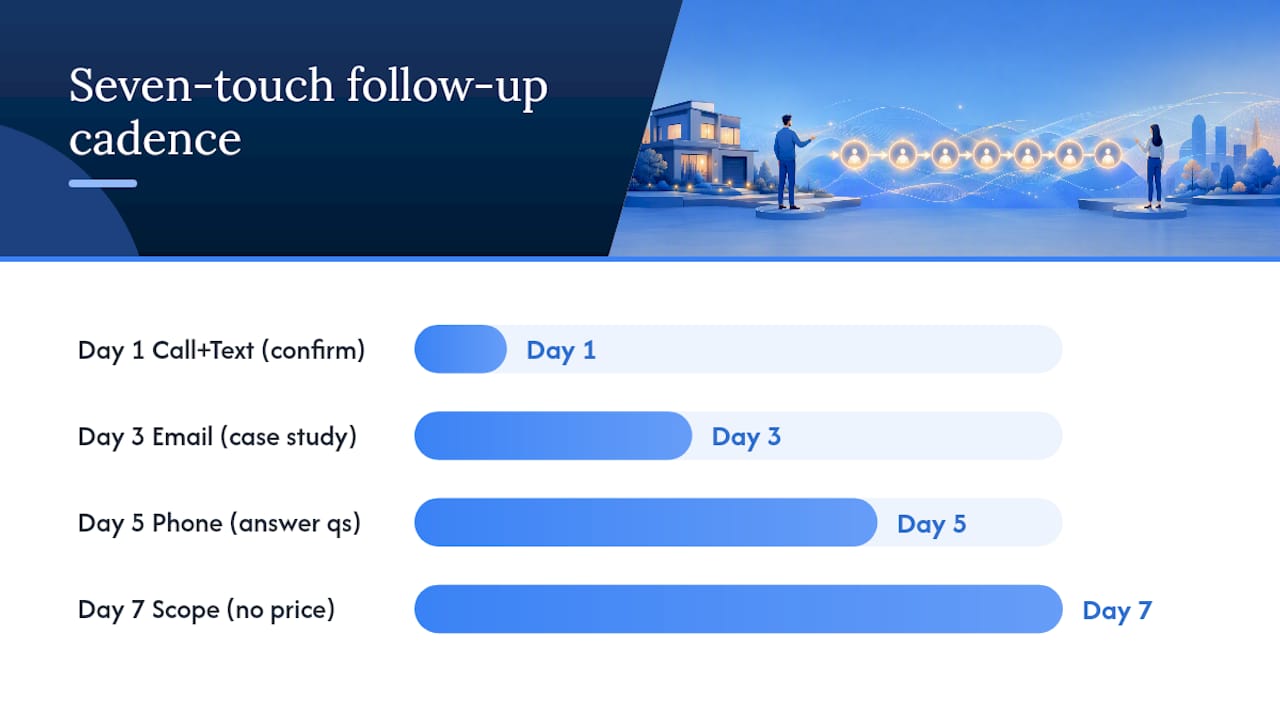
PulseRevOps documents this kind of automated 1/3/5/7-day sequence, paired with flagging deals that show low engagement so reps know where to focus.
Two CRM guardrails keep your team honest:
- Salesforce validation rule: block the “Offer Sent” stage from saving unless a “Discovery Call Completed” checkbox is marked true.
- HubSpot workflow: create a “Proposal Request” deal stage that requires a “Value Presentation Completed” field before the deal can advance, a pattern PulseRevOps recommends specifically to stop premature sends.
Recording tools like Gong can flag calls where “send me an offer” appears without a corresponding discovery question in the transcript, giving managers a simple way to catch reps skipping the pause.
When the Seller Pushes Back Hard
Some sellers get frustrated when you don’t just name a number. A few scripts defuse that without giving up control:
- “I completely understand the frustration. I want this to be accurate, not just fast, so let’s get you a real number instead of a guess.”
- “I hear you, and I’m not trying to waste your time. Fifteen minutes gets you a legitimate offer instead of a placeholder.”
- “Totally fair to be annoyed. If a walkthrough doesn’t work, even three photos of the kitchen and roof would help me move faster.”
If the seller hangs up or gets abusive, drop the call and log it as a hard no rather than pushing further. If they stay engaged but skeptical, offer the low-effort alternative (photos, a shorter call) and schedule a specific follow-up time before ending the call.
After any tense interaction, log these fields in your CRM: a risk flag for future callers, the seller’s preferred follow-up channel, and a note if the situation involves probate, divorce, or another party (like an agent or attorney) who should be looped in going forward.
Practice These Scripts Before You Need Them
Reading a script for the first time on a live call with a distressed seller almost always sounds stiff. Rehearse these four scenarios until the pause feels natural:
- An early-stage stall from a curious seller who isn’t seriously ready to sell.
- A procurement-style demand from a seller working with an agent who wants everything in writing.
- An angry seller who feels stonewalled by your refusal to quote a price.
- A fast-track small deal where a quick range is actually the right call.
Score each rep on three things using a simple three-level rubric: tone (calm and confident vs. defensive), question completeness (asked all four discovery items vs. skipped some), and next-step secured (walkthrough booked vs. call ended with no commitment).
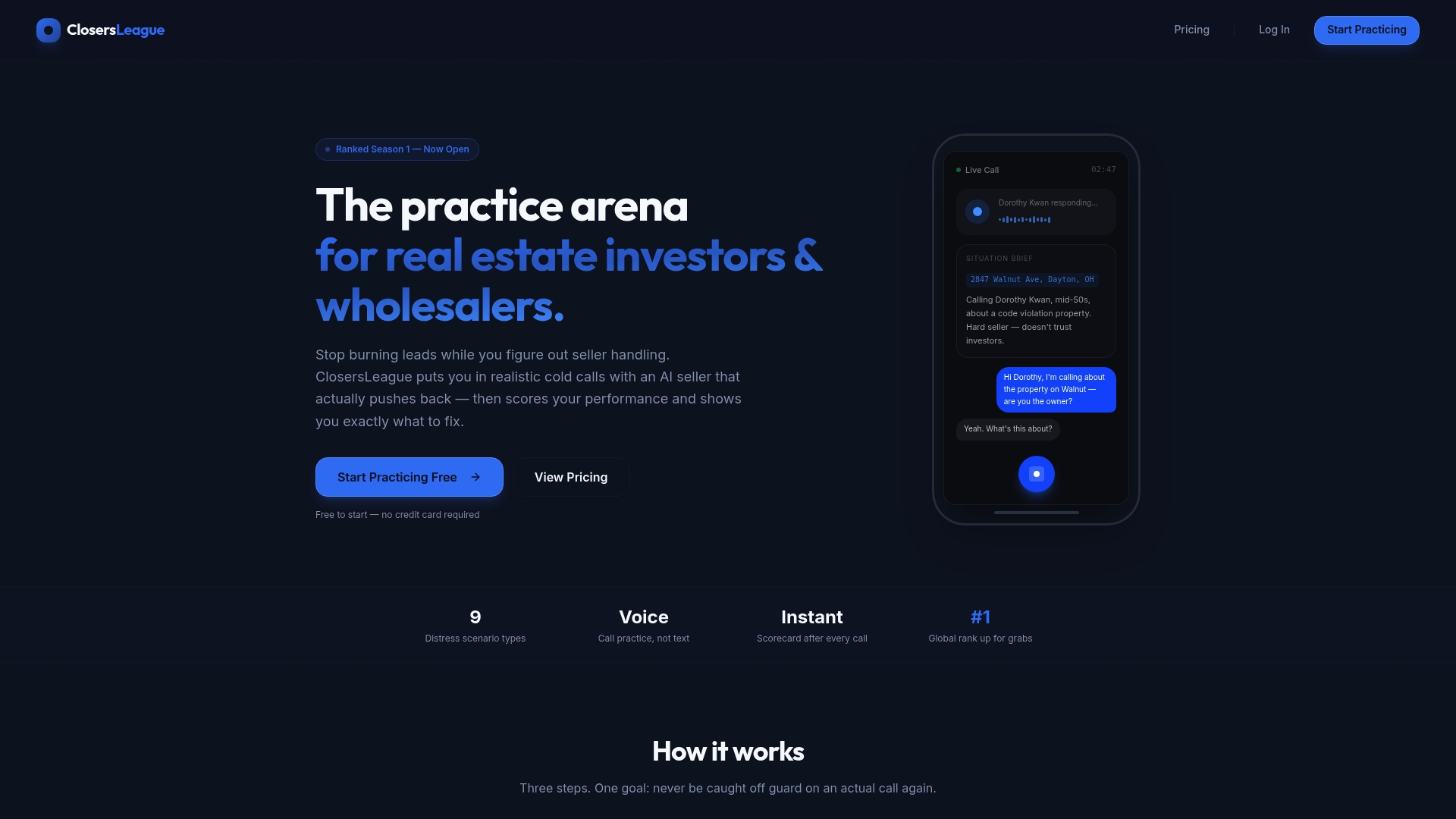
ClosersLeague’s AI roleplay environment is built to simulate exactly these pushback scenarios, complete with scorecards that track whether you actually asked the qualifying question instead of caving to the anchor. Practicing against an AI seller who pushes back the way a real distressed homeowner does beats reading a script cold on your next dial.
Why This Playbook Holds Up in the Field
The reps who consistently win deals aren’t the ones with the fastest math. They’re the ones who ask one good question before they say a number out loud. Every framework in this piece, from the 3 C’s to the diagnostic pause, exists to buy you thirty seconds of information that changes your offer from a guess into a number you can defend.
[Dave’s credentials and field results to be inserted here]
The lesson that holds up call after call: sellers respect a caller who slows down for a reason, not one who slows down out of hesitation. Practice the pause until it sounds like confidence, not stalling.
Rehearse This Playbook With ClosersLeague
Reading these scripts is one thing. Saying them out loud to a seller who’s annoyed, skeptical, or pushing hard for a number is another. ClosersLeague gives you a way to close that gap before it costs you a deal, using AI roleplay built specifically around distressed seller scenarios like probate, pre-foreclosure, and divorce.
- Rehearse the diagnostic pause against an AI seller trained to push back exactly the way real homeowners do.
- Score your follow-up cadence with performance scorecards that flag when you skip discovery questions or cave to anchoring.
- Scale practice across your team with a shared scenario library and leaderboards that show who’s actually improving.
Start a session on the real estate cold calling practice page and run the “send me an offer” scenario until the pause feels automatic.
Sources
- When a prospect says ‘just send me a proposal’ — PulseRevOps
- Maximum Allowable Offer (MAO) — Retipster
- 7 Best Cold Calling Tips for Real Estate Investors 2026 — Televista Blog
- Wholesaling cold call scripts that actually work — Alex Berman
- The MAO Formula: A Wholesaler’s Best Friend — MNREIA
FAQ
What should I say when a seller says “send me an offer”?
Acknowledge the request, then ask one qualifying question about condition or timeline before proposing a short walkthrough or call, rather than naming a number immediately.
Why shouldn’t I just send an offer right away?
Quoting a number without seeing the property or knowing the timeline anchors your negotiation to a figure that may not reflect real condition or urgency, which typically hurts your margin.
What is the Diagnostic Pause?
It’s a short verbal technique where you acknowledge a seller’s request for an offer, ask one focused discovery question, and propose a brief next step instead of quoting a price on the spot.
When is it okay to give a fast offer on the call?
Fast-tracking works for low-value, straightforward deals with a verified sole decision maker and clear urgency; anything larger or more complex calls for the diagnostic pause first.
How can I practice these scripts before using them on real calls?
ClosersLeague’s AI roleplay lets you rehearse pushback scenarios like angry sellers and procurement-style demands, with scorecards that track whether you asked the right questions before conceding a number.