
What actually happens during the seller closing call process
The seller closing call process is the final execution step where you sign documents, confirm funds, and officially transfer ownership of your property. Most sellers walk in expecting a blur of paperwork and walk out with proceeds in hand. That’s essentially right, but knowing what to expect at each stage makes the difference between a smooth close and a stressful scramble.
Closing day appointments typically last 1–2 hours, with sellers signing the deed, affidavit of title, and settlement statements. Most sellers receive their funds either on the same day or within a few business days, depending on escrow type.
Who’s in the room:
- Title agent or escrow officer — manages document flow, confirms recording, and disburses funds
- Real estate agent — your advocate, available to clarify anything before you sign
- Real estate attorney — required in some states; reviews legal documents on your behalf
- Buyer (and their lender representative) — signs their own documents, often in a separate session
What happens at the table:
- You sign the deed transferring ownership to the buyer
- You review and sign the settlement statement (HUD-1 or Closing Disclosure)
- You hand over keys, garage openers, and access codes
- The title company confirms funds and initiates disbursement
Sellers can expect last-minute buyer issues to surface right up until the final signature. Treat the table like a business meeting, not a celebration, until the ink is dry.
Step-by-step closing process for sellers
Walking into closing without a clear sequence is where delays start. Here is the full real estate closing procedure from preparation through final signature.
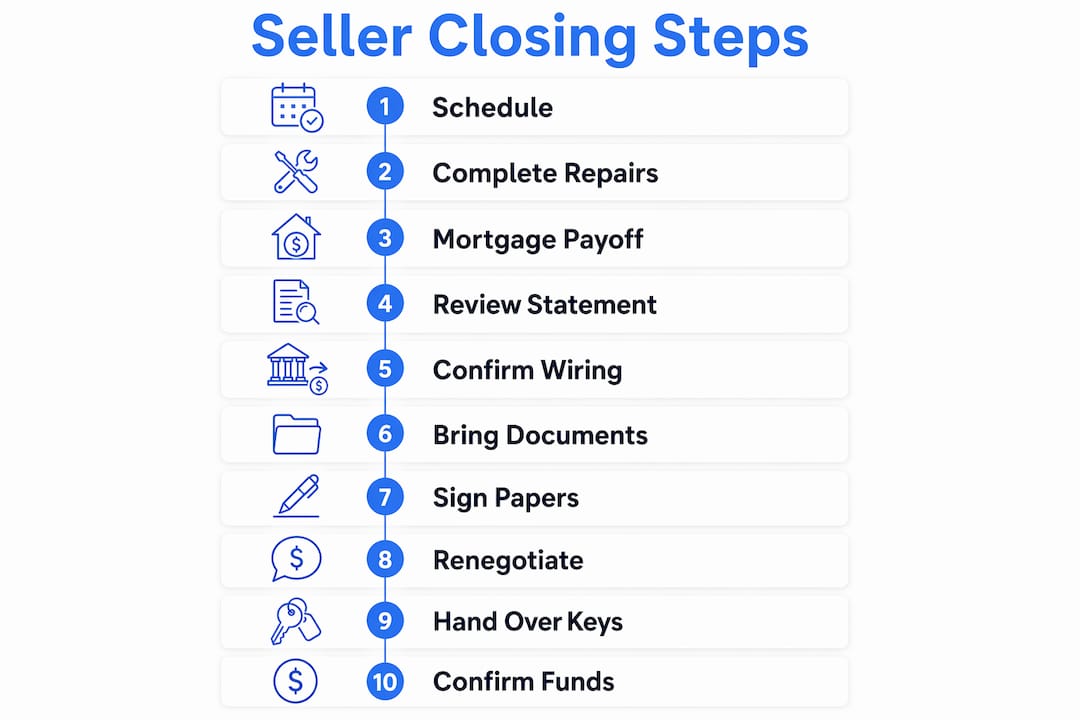
1. Schedule the closing and request the agenda
Confirm your closing date with the title company and your agent. Ask for the closing agenda and a document checklist at least 48 hours before the appointment. Knowing what you will sign in advance removes surprises at the table.
2. Complete all agreed repairs before the final walkthrough
The buyer’s final walkthrough typically happens within 24 hours of closing. Any unresolved repair discovered during that walkthrough can force renegotiation or delay the loan. Finish repairs at least a week early and keep receipts.
3. Request your mortgage payoff statement
Contact your lender to get the exact payoff amount, including interest through the closing date. Ask about prepayment penalties. Your title company needs this figure to prepare the settlement statement accurately.
4. Review the settlement statement before closing day
The title company sends a preliminary settlement statement (also called the Closing Disclosure) before your appointment. Go through every line: sale price, prorated taxes, agent commissions, and net proceeds. Flag discrepancies with your agent before you arrive, not at the table.
5. Confirm wire transfer instructions
If you are receiving proceeds by wire, verify the instructions directly with the title company. Wire fraud is a real risk in real estate transactions. Never rely on instructions forwarded through email without a direct phone confirmation.

6. Arrive prepared with all required documents and ID
Bring a valid government-issued photo ID, your document checklist, and any physical keys or access devices. Sellers typically arrive first and begin signing before the buyer’s session starts.
7. Sign the deed and closing documents
The title agent walks you through each document. The deed transfers legal ownership. The affidavit of title confirms there are no undisclosed liens. The settlement statement shows your final financial picture. Read before you sign, especially the settlement statement.
8. Address any last-minute renegotiations carefully
Buyers can raise concerns right up until they sign. If a buyer requests a price reduction at the last minute, understand that any price change requires a loan amendment, which can delay closing by days or weeks. Small concessions like appliances or gift cards are faster to resolve than price changes.
9. Hand over keys and access items
Once documents are signed, transfer all keys, garage door openers, gate passes, and security codes. Create a simple written list of everything transferred and have both parties sign it. This prevents disputes after closing.
10. Confirm fund disbursement timing
Ask the title agent exactly when your proceeds will be released. Same-day disbursement is common in many states. In escrow states, funds may be held until the deed records, which takes 1–3 business days.
Documents sellers need to bring and sign on closing day
A missing document can push your entire closing to another day. Use this checklist to arrive ready.
Documents to bring:
- Valid government-issued photo ID (driver’s license, passport, or state ID)
- Mortgage payoff statement from your lender
- Any warranties for appliances, systems, or recent renovations
- HOA documents, if applicable (estoppel letter, bylaws, pending assessments)
- Receipts and invoices for agreed repairs
Documents you will sign at the table:
- Warranty deed — transfers legal title to the buyer
- Affidavit of title — confirms you have the right to sell and discloses any known liens
- Settlement statement (Closing Disclosure or HUD-1) — itemizes all financial transactions
- Property condition disclosure — confirms the property’s condition as represented
- Loan payoff authorization — authorizes the title company to pay off your mortgage from proceeds
- Transfer tax forms — required in most states to record the ownership change
For a thorough seller document checklist, review what each form covers before your appointment so nothing catches you off guard.
Can’t attend in person? Sellers are not required to be physically present at closing. Remote online notarization (RON) and power of attorney are both valid alternatives. Confirm your state’s rules with your attorney or title company.
How and when sellers receive their funds after closing
Your proceeds do not always hit your account the moment you sign. The timing depends on your state’s closing rules and the type of transaction.
Common disbursement methods:
- Wire transfer — fastest and most common; funds typically arrive same day if the wire is sent before the title company’s cutoff (usually 2:00–3:00 PM local time)
- Cashier’s check — issued at the closing table; you can deposit it immediately, though your bank may place a hold on large amounts
Timing factors that affect when you get paid:
- Wet funding states — funds disburse the same day documents are signed; most states operate this way
- Dry funding states (California, Oregon, Washington, Alaska, Hawaii, Nevada, New Mexico, Arizona) — the title company holds funds until the deed records, which takes 1–3 business days after signing
- Escrow delays — if the buyer’s lender wire arrives late (after the cutoff), disbursement shifts to the next business day
One critical detail most sellers overlook: do not cancel your homeowners insurance until after the deed officially records at the county office. Recording takes 1–3 business days post-closing. If something delays the recording, you need that coverage in place.
Pro Tip: Call the title company the morning of closing to confirm the buyer’s wire has been received. A wire that hasn’t arrived by 10:00 AM is a red flag worth addressing before you sit down to sign.
Post-closing notifications and seller final tasks
Closing day ends the transaction, but your responsibilities don’t stop at the table. These tasks protect you legally and financially in the weeks that follow.
Notifications to send immediately:
- USPS change of address (forward mail to your new address)
- Banks, credit card companies, and financial institutions
- Employer, insurance providers, and subscription services
- IRS and state tax authorities (update your address for tax correspondence)
Property and utility wrap-up:
- Transfer or close utility accounts (electricity, gas, water, internet) effective on the closing date
- Cancel any local service accounts tied to the property (lawn care, security monitoring, HOA auto-pay)
- Confirm with your lender that the mortgage has been paid off and request a payoff confirmation letter
Document retention:
- Keep copies of the settlement statement and deed for at least seven years for tax purposes
- Store the closing disclosure, title insurance policy, and repair receipts in a secure location
- Confirm deed recording with the county recorder’s office within 1–2 weeks of closing
Potential post-closing issues:
- If a buyer raises a claim about undisclosed property conditions, your signed property disclosure and repair receipts are your primary defense
- Confirm that all prorated taxes, HOA dues, and utility bills were settled correctly on the settlement statement before you close those accounts
Intake call vs. closing call: what sellers and investors need to know
One of the most common points of confusion in real estate transactions is mixing up the intake call with the closing call. They serve completely different purposes, and treating one like the other costs deals.
The intake call is where qualification happens. Its job is to surface motivation, timeline, and pricing expectations quickly. Effective intake calls use open-ended questions to identify urgency signals like foreclosure, probate, or divorce within the first three minutes. The goal is to determine whether a deal is worth pursuing, not to execute it. For investors and wholesalers, understanding what a seller discovery call involves is the foundation of a consistent pipeline.
The closing call is execution. Documents are signed, funds are confirmed, and ownership transfers. There is no qualification happening here. The deal has already been made.
Common pitfalls when the two get mixed up:
- Sellers arrive at closing expecting to renegotiate price (that conversation should have ended weeks earlier)
- Investors treat the closing call like a discovery session, creating confusion and eroding trust
- Agents skip pre-call preparation because they assume the seller already knows what to expect
What experts recommend for closing call preparation:
- Send the closing agenda and document checklist 48 hours before the appointment so all parties arrive aligned
- Confirm wire transfer details 24 hours prior
- Call all parties the morning of closing to confirm attendance and fund status
For investors who want to sharpen their intake call skills and learn to qualify real estate leads before ever reaching the closing table, systematic practice is what separates consistent closers from everyone else.
Pro Tip: Record your intake calls (with consent) and review them for missed urgency signals. A seller who mentions a court date or a lender deadline in passing is telling you exactly how motivated they are. Catching that detail on call one changes your entire offer strategy.
Want to close more deals before you ever reach the table?

The seller closing call process starts long before closing day. It starts with the first conversation. ClosersLeague is an AI-powered cold calling training platform built for real estate investors and wholesalers who want to get better at handling seller calls, from the first intake conversation through the final close.
Practice inherited property cold calling with AI roleplay that scores your calls, surfaces your blind spots, and builds the muscle memory to handle any seller situation with confidence. Stop winging it. Start drilling.
Key Takeaways
The seller closing call process requires preparation, document readiness, and a clear understanding of fund disbursement timing to avoid delays.
| Point | Details |
|---|---|
| Closing day duration | Seller appointments typically last 1–2 hours; most sellers receive funds the same day or within 1–3 business days. |
| Document preparation | Bring government-issued ID, mortgage payoff statement, repair receipts, and HOA documents to avoid delays. |
| Fund timing by state | Wet-funding states disburse same day; dry-funding states hold funds until deed recording, which takes 1–3 business days. |
| Insurance cancellation | Never cancel homeowners insurance until the deed records at the county office, which occurs 1–3 business days post-closing. |
| Intake vs. closing call | Intake calls qualify motivation and timeline; closing calls execute the transaction. Mixing the two creates confusion and delays. |
FAQ
What is the closing process for the seller?
The seller closing process involves signing the deed, affidavit of title, and settlement statement, then handing over keys and confirming fund disbursement. Appointments typically last 1–2 hours, with proceeds arriving the same day or within 1–3 business days.
What is the 3-day rule for closing?
The 3-day rule refers to the TILA-RESPA Integrated Disclosure requirement that buyers receive the Closing Disclosure at least three business days before closing. Sellers benefit from this rule because it gives all parties time to review final loan terms and flag discrepancies before the signing appointment.
Who signs first at closing?
The seller typically arrives first and signs their documents before the buyer’s session begins. The title company staggers arrival times so each party’s paperwork is ready when they sit down.
What should sellers not do during closing?
Avoid making last-minute price concessions that require a loan amendment. Any significant price change forces the lender to rerun the loan package, which can delay closing by days or weeks. Also, do not cancel homeowners insurance before the deed records.