Yes, TCPA applies to your outbound calls and texts, and the exposure is real. Under 47 U.S.C. § 227, autodialed calls, texts, and AI or prerecorded voice messages to cell phones require prior express consent. Scrub your lists against the Do Not Call Registry, document every consent and opt-out, and treat every unverified purchased lead as a liability waiting to happen.
TL;DR:
- Using autodialers, AI voices, or bulk texts to cell phones without verified prior express consent exposes investors to liability, even if no call is answered.
- Recordkeeping of signed consent, timestamps, and clear opt-out procedures are essential to defend against TCPA violations, especially with purchased leads.
- Vendors must provide documentation on how their systems dial, generate voices, and handle opt-outs to reduce compliance risks; lack of logs or attestations increases exposure.
- Scrubbing against the Do Not Call Registry and promptly honoring all opt-out requests are mandatory to avoid substantial fines and penalties.
- Walking through a disciplined compliance workflow before each campaign and practicing proper caller training significantly lowers the risk of costly TCPA violations.
Table of Contents
- TCPA basics: what triggers liability for investor outreach
- Consent, EBR, and lead generation: when a number is safe to call
- Autodialers, AI voice, and ringless voicemail: vendor risks
- Do Not Call rules and honoring opt-out requests
- Penalties and enforcement: what violations actually cost
- Operational checklist: your compliance workflow before you call
- Expert application: how better calls reduce compliance risk
- Why compliance protects your deals, not just your legal standing
- ClosersLeague: train your team to call with confidence
- Sources
- FAQ
TCPA basics: what triggers liability for investor outreach
The TCPA gives consumers a private right of action, meaning a homeowner who receives an unwanted call can sue you directly, no regulator required. That single fact should change how you run outbound campaigns.
Three technology triggers matter most for investors. First, an autodialer (often called an ATDS) that stores or produces numbers using a random or sequential generator and dials them without a human manually placing each call. Courts have narrowed this definition over the years, but many predictive dialers used in real estate lead generation still qualify, and the safest assumption is that if a system dials in bulk, it counts. Second, artificial or prerecorded voice messages, including voicemail drops and AI-generated voices. Third, text messages, which the FCC and courts treat as “calls” under the statute, meaning a mass SMS blast to a purchased homeowner list carries the same consent obligations as a phone call.
The FCC has been direct about where AI fits into this picture. In a statement confirming TCPA coverage of AI voice technologies, the agency made clear that voice cloning and AI-generated speech are treated the same as traditional prerecorded messages. If you or a vendor use an AI voice to reach a seller, that call needs prior express consent, a clear identification of who is calling, and a working opt-out method. There is no carve-out for “it sounded human” or “it was generated by software, not a person.”
For investors building outreach at scale, the practical takeaway is simple: any tool that dials automatically, plays a recording, or sends bulk texts puts you inside TCPA’s reach.

Consent, EBR, and lead generation: when a number is safe to call
Not all consent is equal, and this is where investors get tripped up most often. Prior express consent lets you make informational or non-telemarketing calls. Telemarketing calls or texts made with an autodialer or prerecorded voice require prior express written consent, meaning the homeowner has to have signed or otherwise clearly agreed in a documented way, not just picked up a call once before.
The Established Business Relationship exception offers a narrow window, and it is far narrower than most investors assume. Under the FTC’s Telemarketing Sales Rule, an EBR exists only for a completed transaction within the last 18 months, or an inquiry or application within the last 3 months. Once those windows close, the relationship no longer shields you.
This matters enormously for anyone buying leads. FTC staff guidance has warned that lead-generator consent is frequently weak or improperly obtained, and the agency’s advisory opinion makes clear that purchasing a list does not transfer a clean compliance record to you. You, the caller, carry the burden of proving valid consent exists, not the vendor who sold you the data.
Recordkeeping is your defense here. Save the consent capture method, the timestamp, the exact language the homeowner agreed to, and the source of the lead. If a lead generator cannot produce that paper trail on request, treat the number as cold and unverified rather than betting your compliance record on someone else’s process.
Autodialers, AI voice, and ringless voicemail: vendor risks
Your compliance exposure does not stop at your own dialing habits. It extends to every vendor whose technology touches your calls. Courts and the FCC have both wrestled with what qualifies as an ATDS, and the safest posture for investors is to assume any bulk-dialing or auto-queueing system carries risk unless a vendor can document otherwise.
Ringless voicemail deserves specific attention because some providers market it as a workaround, implying it “isn’t really a call.” The FCC has ruled otherwise, finding that ringless voicemail drops to wireless numbers use an artificial or prerecorded voice and require the same consent as a live robocall. If a vendor tells you ringless voicemail sidesteps TCPA, that vendor is wrong, and you inherit the liability, not them.
Before signing with any dialer, AI voice, or voice AI platform, get these in writing:
- A vendor attestation describing exactly how the system dials, queues, and generates voices.
- Access to raw dialer logs for audit purposes, not just summary reports.
- Documented opt-out handling and how fast suppression requests get processed.
- Confirmation of where consent records are stored and how you can retrieve them.
Our guide to AI cold calling tools walks through how these systems work and where the compliance lines sit for AI-assisted outreach.
Do Not Call rules and honoring opt-out requests
Two separate suppression obligations apply to every investor running outbound campaigns, and confusing them is a common mistake. The first is the National Do Not Call Registry, a federal list you must download and scrub against before any telemarketing call. FTC guidance is explicit that sellers, not just call centers, are responsible for removing registered numbers from their calling lists, regardless of who dials the phone.
The second obligation is entity-specific: once a homeowner tells you directly to stop calling, you must honor that request and document it, even if their number was never on the national registry. This internal suppression list needs to update in real time, not once a week during a batch cleanup.
State Attorneys General add another layer of risk. Many states run their own do-not-call statutes with separate penalties, and enforcement has increased as state regulators watch federal TCPA litigation grow. A campaign that technically clears federal scrutiny can still draw a state complaint if local rules are stricter.
Our breakdown of DNC obligations for real estate outreach covers how these federal and entity-specific lists interact in practice. The operational fix is straightforward: scrub against the national registry before every campaign, build a same-day process for entity-specific opt-outs, and never let a “do not call” request sit in an inbox unprocessed.

Penalties and enforcement: what violations actually cost
The dollar figures are what get investors’ attention, and they should. 47 U.S.C. § 227 sets statutory damages at $500 per violation, and a court can treble that to $1,500 per violation if the conduct was willful or knowing. Those numbers apply per call or text, not per lawsuit, which is why TCPA class actions against high-volume callers can escalate quickly.
Most claims trace back to one of a few triggers: calls to numbers without documented consent, continuing to call after an opt-out request, using an autodialer or prerecorded voice without written consent for telemarketing, or ignoring the National DNC Registry.
Your best defense is not a clever legal argument, it is boring, thorough documentation. Timestamped consent records, prompt opt-out processing, and signed vendor agreements that clarify who is responsible for what all make a difference when a complaint surfaces. The FCC, FTC, and state Attorneys General all have enforcement authority here, and each has shown willingness to act on investor-specific complaints in recent years.
Operational checklist: your compliance workflow before you call
Treat this as the sequence to run before every outbound campaign, not a one-time setup task.
- Scrub your data first. Check every number against the National DNC Registry and your own entity-specific suppression list before dialing.
- Capture consent properly. Any telemarketing call or text made with an autodialer or prerecorded voice needs documented, timestamped written consent, stored where you can retrieve it later.
- Vet every vendor in writing. Get a signed attestation on dialer behavior, logging access, and opt-out handling before you sign a contract.
- Build disclosure into your script. State who you are, why you are calling, and how to opt out, every time, without burying it.
- Process revocations fast. Set your CRM to flag and suppress a number within a short, auditable window after any stop request.
- Keep your audit trail intact. Retain call logs, consent records, dates, and vendor agreements, because these are what protect you if a complaint escalates.
- Never assume a purchased lead is pre-cleared. Require disclosure documentation from lead generators and treat every list as cold until you verify consent yourself.
Pro Tip: Build your suppression list update into your daily CRM routine, not your weekly one. A number that opts out on Monday and gets called again on Thursday is the exact fact pattern that turns into a lawsuit.
None of these steps are complicated individually. The risk comes from skipping one under time pressure, especially the vendor attestation step, which most investors treat as optional paperwork rather than the liability shield it actually is.
Expert application: how better calls reduce compliance risk
Compliance rules tell you what not to do. Training tells you how to execute the calls you are allowed to make without generating complaints in the first place. A script that clearly states who you are and why you are calling, without sounding scripted or evasive, does double duty: it satisfies disclosure requirements and it builds the kind of trust that keeps a homeowner from hanging up and filing a complaint out of irritation.
We coach investors and wholesalers through scenario-based roleplay covering distressed seller types like pre-foreclosure, probate, and tax delinquent properties, with scorecards that flag aggressive phrasing or rushed disclosures before they become habits. Lower caller aggression correlates with fewer complaints, and a documented training program is itself part of your audit trail, showing that your team was coached on proper identification and opt-out handling, not just told to “make calls.”
Our pre-foreclosure roleplay module is a practical example of how scenario-specific practice sharpens both compliance and conversion.
Why compliance protects your deals, not just your legal standing
Most investors treat TCPA compliance as a legal chore separate from closing deals. That framing is backward. A seller who feels respected, clearly informed, and given an easy way to opt out is more likely to engage with you honestly, even if the answer is no for now. Compliance and receptivity are not competing goals.
The investors who scale without getting burned are the ones who bake consent checks and suppression scrubbing into every campaign setup, the same way they bake in list pulls and script review. Legal controls and caller training work together, not as a substitute for each other.
— Dave
ClosersLeague: train your team to call with confidence
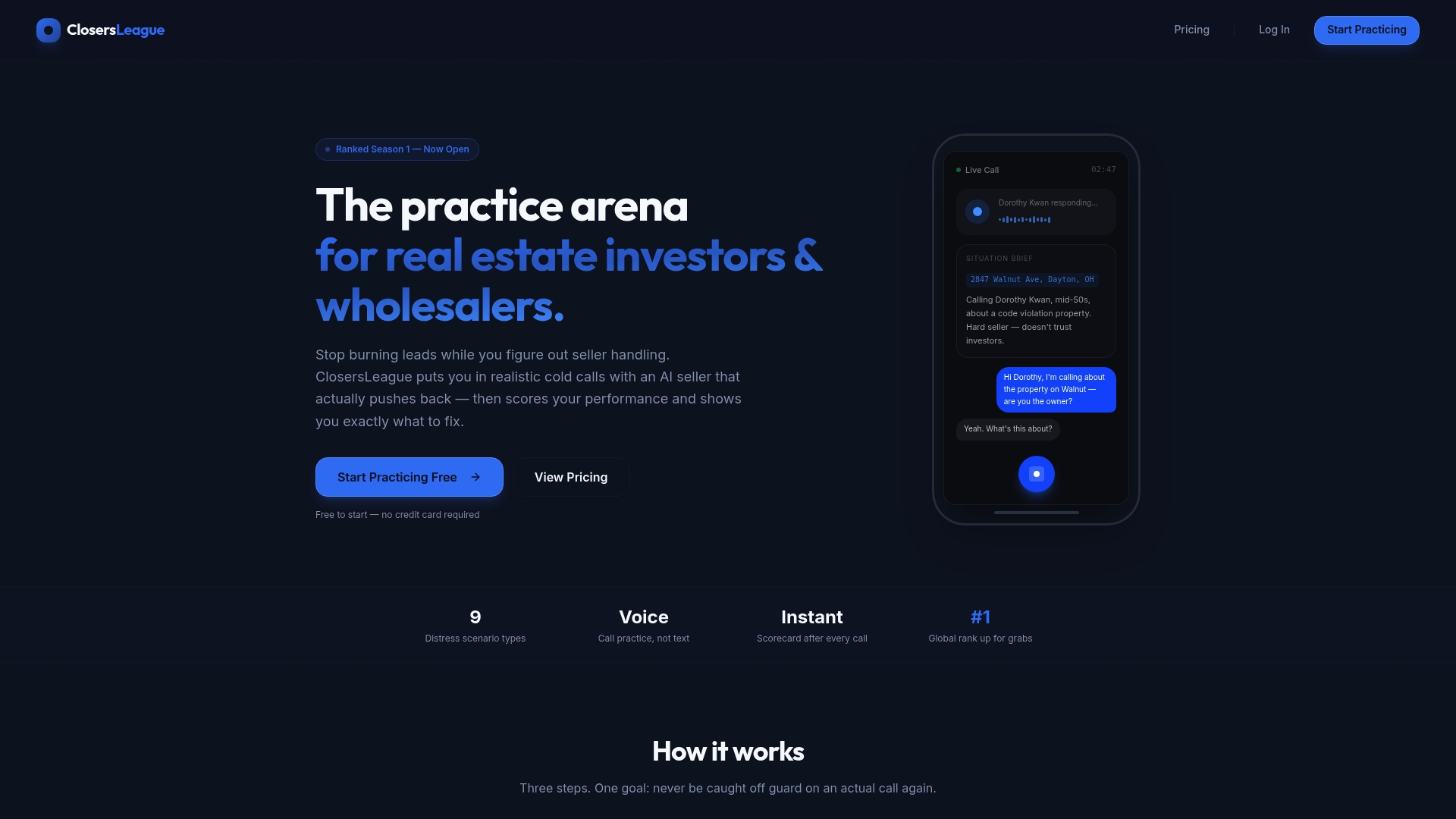
Compliance controls tell you who you can call. Training determines how well that call goes once you dial. Our platform gives investors and wholesalers a way to practice real seller conversations, probate, pre-foreclosure, tax delinquent, divorce, and more, through AI roleplay that scores your delivery and flags what needs work before you ever pick up a real phone.
What you get:
- Scenario-based AI roleplay across multiple distressed seller types, so you practice the actual objections you will hear.
- Real-time scorecards and skill drills that show where your script or tone needs adjustment.
- Leaderboards and detailed feedback that help turn practice into measurable improvement over time.
Sharper calls tend to draw fewer complaints, and a documented training habit strengthens your compliance posture alongside your close rate. Check Starter, Growth, and Pro pricing to find the plan that fits your call volume, or see the full platform overview to get started today.
Sources
- 47 U.S.C. § 227 – Restrictions on use of telephone equipment
- FCC confirms TCPA applies to AI technologies that generate human voices — Rosenworcel statement
- Complying with the Telemarketing Sales Rule — Federal Trade Commission
FAQ
Who must comply with TCPA rules?
Anyone making telemarketing calls or texts to U.S. consumers, including real estate investors, wholesalers, and the vendors or dialing platforms they use, must comply with TCPA requirements. Liability follows the caller and the business on whose behalf the call is made, not just the person dialing the phone.
What are common types of TCPA violations?
Common violations include calling or texting a cell phone with an autodialer or prerecorded voice without proper consent, continuing to call after a homeowner opts out, ignoring the National Do Not Call Registry, using AI-generated voices without disclosure, and relying on unverified purchased leads. Each of these can trigger statutory damages of $500 per violation, up to $1,500 if willful.
What are the newest TCPA rules affecting investors?
Recent FCC rulemaking has clarified consent and revocation requirements, including a rule extension on how quickly callers must implement revocation requests, and confirmed that AI-generated voices fall under the same consent rules as traditional prerecorded calls. The FCC has also tightened restrictions around lead-generator consent practices.
What exemptions exist under the TCPA?
Exemptions are narrow and mostly built around an Established Business Relationship, which under the FTC’s Telemarketing Sales Rule applies only to a transaction within 18 months or an inquiry within 3 months. Purchased leads generally do not create this exemption for the buyer, so investors should not assume a lead list gives them a legal pass to call.