
Open with a property-first line, confirm ownership and vacancy in one breath, and lock in a follow-up cadence of 90 to 180 days if the owner isn’t ready. Stay inside TCPA and Do-Not-Call rules on every dial. Then drill the calls you’re weak on using AI roleplay from a platform like ClosersLeague so the next conversation goes better than the last one.
TL;DR:
- Manual dialing is safest under FCC rules since autodialers require documented consent, especially for purchased lead lists, which are now regulated more strictly.
- Confirm property vacancy through recent records and prioritize out-of-state or distressed properties for higher motivation among owners.
- Use property-first openers and keep voicemails concise, with follow-up texts focusing on acknowledgement of early contact or specific circumstances like probate.
- Handle objections with validation, reframing, and a discovery question, avoiding arguments and maintaining gradual softening in follow-up plans.
- Regular roleplay practice, tracking key metrics weekly, and testing small script variations improve call performance and compliance.
Table of Contents
- High-impact tactics that change call results with vacant owners
- Ready-to-use scripts and openers for vacant-property calls and voicemails
- Common objections and exact phrasing to move the call forward
- Legal and compliance essentials for calling vacant property owners
- Practice plan and roleplay: building skill with a 90 to 180 day cadence
- Measuring results, testing scripts, and scaling outreach responsibly
- What trainers see most often and a 30-day starter checklist
- ClosersLeague training: practicing vacant seller calls before you dial
- Sources
- FAQ
High-impact tactics that change call results with vacant owners
A “property-first” opener beats a business introduction because it answers the owner’s first unspoken question immediately: why is this person calling me? Say “I’m calling about the property on Maple Street” before you say your name or your company, and the owner stays on the line longer because you sound like you know something specific about them, not like a script reading off a list.
Before you dial, run a quick checklist so you’re not wasting minutes on dead numbers or breaking rules you didn’t know applied; using practical lead generation tactics can also improve your contact list quality.
- Confirm the property still looks vacant through recent tax records, utility shutoffs, or a drive-by note from your list provider.
- Check whether the number is a cell phone or landline, since that changes which dialing method is safe to use.
- Skip autodialers on any number without documented consent, and dial manually instead.
- Prioritize out-of-state owners, tax-delinquent parcels, and visibly neglected properties first, since these owners tend to be more motivated.
Late morning and early evening tend to get more live answers than midday, when owners are at work. If you hit voicemail, leave one short message with your name, the property address, and a callback number: never a hard sell, never a second message stacked on the first the same day.
Ready-to-use scripts and openers for vacant-property calls and voicemails
Three openers cover most vacant-property situations. Adjust the tone to match who’s likely picking up.
- Property-first opener: “Hi, this is Dave. I’m calling about the property on [street name]. Are you still the owner?” Wait for the answer before saying anything else.
- Neighborhood-check opener: “I noticed the house on [street] has been sitting empty for a while. I work with owners in situations like this, is that something you’re dealing with?”
- Compassionate check-in: “I wanted to reach out about the property on [street]. Sometimes when a home sits vacant it’s tied to something like probate or a job move, is that what happened here?”
Once they confirm ownership, ask one qualifying question about vacancy status before pitching anything: “How long has it been sitting empty?” That single question does more work than a paragraph of pitch.
For voicemails, keep it under 20 seconds. A short info message (“Hi, this is Dave calling about your property on Maple Street, give me a call back at…”) outperforms an urgent-check version (“I wanted to make sure everything’s okay with the house on Maple Street”) for most vacant leads, though the urgent version can work well for storm-damaged or code-violation properties. Follow up any voicemail with a one-line text: “Hi, this is Dave, left you a message about your property on [street], call or text anytime.” For heirs, mention probate directly. For out-of-state owners, acknowledge the distance early since it explains the vacancy without you having to ask. These templates and more live in ClosersLeague’s cold calling scripts for distressed sellers.
Common objections and exact phrasing to move the call forward
Owners of vacant properties raise a predictable set of objections. Handle each with the same three-step move: validate the concern, reframe it, then ask one discovery question.
- “How did you get my number?” Validate their concern about privacy, then explain you research public property records, then ask if now’s a bad time to talk.
- “I’m not interested.” Acknowledge it, then ask what their plan for the property is, since many owners haven’t actually made one.
- “I’m already working with someone.” Wish them well, then ask if they’d want a backup option in case that falls through.
- “What would you even offer me?” Explain that it depends on the property’s condition and their timeline, then ask what timeline they’re hoping for.
Pro Tip: Never argue an objection. Validate it, reframe it, and ask a question that moves the conversation forward instead of defending your call.
If the owner isn’t ready, don’t push. Ask permission to check back in 90 to 180 days, since vacant-property situations (probate, job relocation, inherited homes) often resolve on their own timeline. ClosersLeague’s guide to vacant seller objections breaks down more phrasing by scenario.
Legal and compliance essentials for calling vacant property owners
Cold calling vacant properties still falls under the same federal rules as any outbound sales call. The FCC’s guidance on unwanted communications limits autodialed and prerecorded calls under the TCPA and requires prior consent for most automated outreach, so manual dialing is the safer default for investors without a documented consent trail.
The FCC’s one-to-one consent rule closed a major loophole for purchased leads. Under the FCC’s Second Report and Order, autodialed or prerecorded marketing calls now require prior express written consent tied to a specific seller, not a batch of sellers bundled under one generic form. If you buy lead lists, verify that consent is documented per seller or plan to dial those numbers manually.
The FTC’s National Do-Not-Call Registry fee announcement confirms telemarketers must check the registry before calling and pay for access, and the FCC’s implementation details extend blocking and reporting requirements to illegal texts as well. Keep a simple log of consent sources, dial manually where consent is unclear, and never leave prerecorded voicemails.

Practice plan and roleplay: building skill with a 90 to 180 day cadence
Ad-hoc practice with a colleague rarely mirrors how a real owner reacts. Realistic objection branching and instant feedback matter more than reciting a script out loud once before your shift.
A simple weekly plan works for solo investors and teams alike:
- Run two roleplay sessions a week focused on a single seller type, like probate or absentee landlords.
- Review one recorded live call per session and score it against your own scorecard.
- Track connection rate, appointment rate, and close rate weekly, not monthly, so you catch slumps early.
Pro Tip: Score every practice call the same way you’d score a live one. Consistency in scoring is what tells you whether you’re actually improving.
ClosersLeague builds scenario-based roleplay specifically for vacant, probate, pre-foreclosure, and other distressed seller types, with instant scorecards and drills targeted at the objections you’re weakest on. That combination of realistic practice and objective scoring is hard to replicate with a coworker reading lines off a page. Explore the AI roleplay practice platform for a sense of how the sessions are structured.
Measuring results, testing scripts, and scaling outreach responsibly
Three numbers tell you most of what you need: connection rate (answered calls divided by dials), appointment rate (appointments divided by connections), and close rate (deals divided by appointments). Track them weekly and compare scripts against each other, not against a vague sense of “it felt better.”
To A/B test scripts, change one variable at a time, the opener or the qualifying question, and run each version for at least a week before comparing results.
- Train new callers on your best-performing script before letting them freelance.
- Centralize consent records in one place so nobody dials a number without a documented source.
- Pilot new lists on a small sample before a full rollout to catch bad data early.
- Add dialer technology only after confirming it supports manual dialing and consent logging, not just speed.
ClosersLeague’s cold calling tips for real estate investors cover more on measurement and script iteration.
What trainers see most often and a 30-day starter checklist
The three mistakes that show up most: skipping the vacancy confirmation question, pitching before qualifying, and giving up after one no instead of scheduling a 90 to 180 day follow-up.
A 30-day starter checklist: clean your lead data weekly, build three scripts and rotate them, run two roleplay sessions a week, log every consent source, and set follow-up reminders on every vacant lead that isn’t ready yet.
— Dave
ClosersLeague training: practicing vacant seller calls before you dial
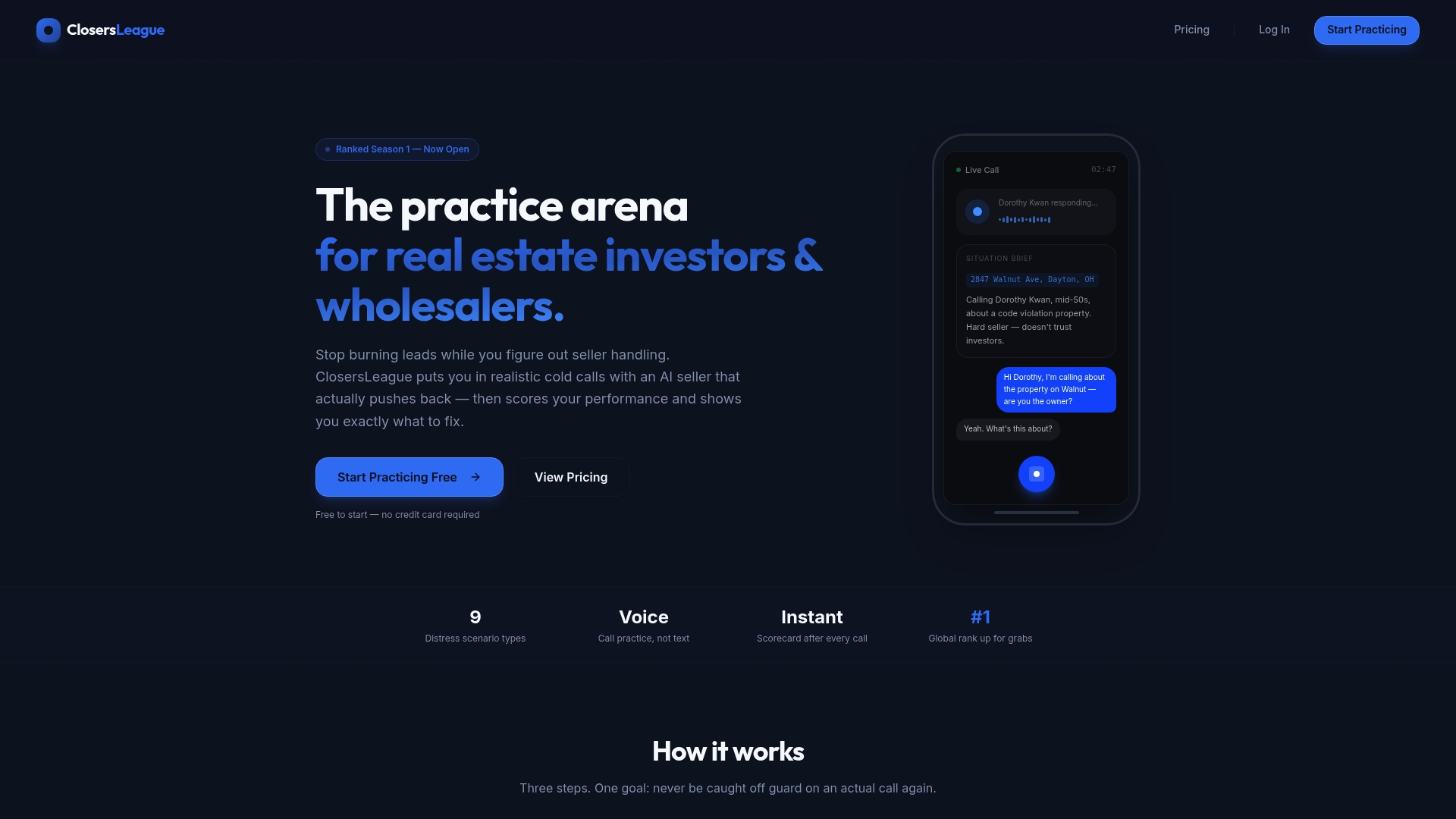
Scripts get you started, but the callers who close consistently are the ones who’ve rehearsed the objection before it happens live. ClosersLeague built scenario-specific AI roleplay for vacant properties alongside probate, pre-foreclosure, tax delinquent, and other distressed seller types, so you can practice the exact conversation you’re about to have and get an instant scorecard on how you handled it. Investors and wholesalers doing outbound vacant-property outreach use it to sharpen weak spots between real calls instead of guessing what went wrong. Plans start with monthly subscriptions at entry, intermediate, and advanced levels, with current details available on the pricing page. Try a session and see how your next vacant-property call sounds.
Sources
- Unwanted communications: robocalls, caller ID spoofing, and Do-Not-Call registry | Federal Communications Commission
- One-to-One Consent Rule for TCPA Prior Express Written Consent (FCC Second Report and Order)
- FTC announces 2027 telemarketer fees to access the National Do Not Call Registry | Federal Trade Commission
FAQ
Is cold calling dead for real estate investors?
No, cold calling still works for reaching vacant property owners, though it requires stricter compliance and sharper scripts than it once did. The FCC’s consent rules have raised the bar, but manual, well-targeted calls remain effective for direct-to-seller outreach.
What is the 80/20 rule in cold calling?
It’s a prioritization principle rather than a strict formula.
What is the 3-3-3 rule in real estate cold calling?
The 3-3-3 rule generally means making three calls, sending three texts, and trying three different times of day before writing off a lead. Definitions vary by trainer, but the core idea is persistence across multiple contact methods before giving up.
What are the five stages of a cold call?
A typical cold call moves through opening, qualifying, handling objections, presenting a next step, and closing or scheduling a follow-up. For vacant properties, the qualifying stage usually centers on confirming ownership and vacancy status early.
How often should I follow up with a vacant property owner who isn’t ready?
A follow-up cadence of 90 to 180 days works well for vacant-property owners, since situations like probate or relocation often resolve on their own timeline. Logging the follow-up date at the end of each call keeps your pipeline organized without repeated cold outreach.
Recommended
- Vacant Property Cold Calling Practice — AI Roleplay for Real Estate Investors & Wholesalers
- Foreclosure Cold Calling Practice — AI Roleplay for Real Estate Investors & Wholesalers
- Pre-Foreclosure Cold Calling Practice — AI Roleplay for Real Estate Investors & Wholesalers
- AI Cold Call Simulator Real Estate: 2026 Guide