When a vacant-property owner says “not interested,” the correct response is: “I hear you. Most owners feel that way at first. Can I ask what’s kept you from listing it so far?” Speed and certainty beat price on almost every vacant deal, because these sellers are usually paying to own something they no longer use. The next move is always the same: get to a quick, no-obligation number and a real closing date.
TL;DR:
- Most vacant-property owners are primarily concerned with quick sale certainty and are paying ongoing costs, making speed more important than price.
- Over 80% of vacant deals close between 30 and 180 days, so persistent follow-up and scheduled touches are essential for success.
- Handling objections involves diagnosing the real motivation and responding with specific data, patience, or future contact, not arguments.
- Always respond to safety and legal concerns with clear, reassuring explanations about inspections, access, and proper consent.
- Respecting a secluded owner’s boundaries and maintaining ethical transparency build trust and increase chances of closing the deal later.
Table of Contents
- What Are the Most Common Vacant Property Seller Objections?
- The Two-Stage Framework for Handling Objections
- Ready-to-Use Scripts for Vacant Property Calls
- The 90 to 180 Day Follow-Up System
- Why These Tactics Work: The Psychology Behind Seller Resistance
- Handling Safety and Access Concerns on Vacant Properties
- Legal and Ethical Lines When Negotiating With Vacant Owners
- Using Market Data to Support Price Conversations
- Turning Objections Into Buying Signals
- Reading Readiness and Reluctance Beyond the Script
- Three Rules for Closing More Vacant Deals
- Practice the Scripts With ClosersLeague
- Sources
- FAQ
What Are the Most Common Vacant Property Seller Objections?
Vacant-property owners object differently than owner-occupants. They’re not worried about where they’ll sleep tonight. They’re worried about getting taken advantage of, leaving money on the table, or dealing with a hassle they’ve already avoided for months. Once you hear the objection as a stand-in for one of three things, financial fear, emotional attachment, or a timing and control issue, the right reply gets a lot easier to find.
Below are the twelve objections you’ll hear most on vacant-property calls, what each one usually signals, and a line you can use today.
-
“I’m not interested.” Usually a reflex, not a decision. What it means: they haven’t connected the property to their actual problem yet. Reply: “Totally fair. Most people I call feel the same way until they see the number. Mind if I ask what’s kept the property sitting empty?” On voicemail, skip the pitch and just ask the probing question, then follow with a text repeating it.
-
“Your offer is too low.” This is almost always an anchoring problem. What it means: they’ve seen a Zestimate or a neighbor’s sale price and assumed it applies to their property. Reply: “That’s a fair question. Can you tell me how you landed on that number?” That single question, supported by negotiation research from DealMachine, turns a standoff into a factual conversation about condition, comps, and carrying costs.
-
“Let me think it over.” Usually stalling, sometimes genuine caution. What it means: they’re weighing loss aversion against relief. Reply: “Makes sense. While you’re thinking, is it the price, the timeline, or something else you want to weigh?” Naming the categories often surfaces the real objection immediately.
-
“I already have an agent” or “I have another buyer.” What it means: they’re testing the market, or protecting a relationship. Reply: “Good, that’s smart to have options. If that deal falls through or takes longer than expected, would it help to have a backup cash number on file?” Never argue against the agent. Position yourself as insurance.
-
“I need to talk to my spouse (or the family).” What it means: real decision-making friction, especially common with inherited vacant homes. Reply: “Of course. Would it help if I put the numbers in writing so you can share them exactly?” Offer to hop on a three-way call rather than waiting passively.
-
“The property needs too much work.” What it means: fear that repairs will eat any profit. Reply: “That’s actually the exact reason cash buyers exist. We factor the repairs into the number so you don’t have to spend a dime fixing it.” This flips condition from a liability into your value proposition.
-
“There are taxes or liens on it.” What it means: confusion or shame about back taxes, sometimes a genuine legal tangle. Reply: “That’s common with vacant properties and it doesn’t have to stop a sale. We can work the payoff into closing so it’s handled at the table.” Avoid any accusatory phrasing here, a warning echoed in cold-calling guidance for tax-delinquent owners from BatchDialer, since shaming a seller about taxes shuts the call down fast.
-
“How did you get my number?” What it means: a trust and privacy concern, not necessarily hostility. Reply: “Public property records, since the county lists your property as vacant. I focus on owners in situations like yours.” A calm, factual answer usually satisfies this in one sentence.
-
“I’m waiting for the market to improve.” What it means: they’re betting on appreciation outweighing carrying costs. Reply: “That’s possible. What’s it costing you each month to hold onto it while you wait, taxes, insurance, maintenance?” Let the math, not your opinion, make the case.
-
“I don’t trust cash buyers.” What it means: past bad experience or general skepticism. Reply: “That’s fair, there are bad actors out there. I’m happy to send references or walk you through exactly how the closing works before you commit to anything.”
-
“It’s not for sale.” What it means: often a boundary test more than a final answer. Reply: “Understood. If that changes, would it be okay if I check back in a few months?” Leaving the door open costs nothing and keeps the lead alive.
-
“Just leave me alone.” What it means: fatigue from other investors calling, or genuine disinterest. Reply: “I won’t push. I’ll take you off my active list and just send a card once a year in case anything changes.” Respecting a hard no protects your reputation and keeps the door from slamming permanently.
The Two-Stage Framework for Handling Objections
Every one of those twelve lines fits into a repeatable process instead of a memorized script. That process runs on two stages: listen and diagnose, then respond and tie down. Skipping stage one is why so many callers get stuck arguing with the objection instead of solving the problem behind it.
- Listen and validate. Let the seller finish the sentence. Then use a phrase that lowers resistance without agreeing or conceding: “That makes sense,” or “I hear that a lot.” This isn’t filler, it signals you’re not another pushy caller, which buys you the next ten seconds.
- Diagnose the motivation. Ask one clarifying question aimed at financial, emotional, or timing and control categories. “Is it more about the price, or is it the timing that’s off?” DealMachine’s objection framework treats this diagnostic step as the difference between a script that works once and one that adapts to any seller.
- Match the response to the real objection. A financial objection gets numbers. An emotional objection gets patience and validation. A timing objection gets a low-pressure future touchpoint.
- Tie down and schedule. Every call should end with a specific next step attached to a date: “I’ll text you the number by Thursday, does that work?” Vague endings like “I’ll follow up soon” waste the rapport you just built.
Pro Tip: Write your tie-down line before the call, not during it. Callers who improvise the close tend to trail off with “well, let me know,” which kills momentum right when the seller is most engaged.
Here’s a compressed version of that flow in action. Seller: “I’m not interested.” You: “Totally get it. Can I ask, is the property just sitting because of the repairs, or is it more about not having time to deal with it?” Seller: “Repairs, honestly, it needs a new roof.” You: “Got it, that’s exactly the kind of property we buy as-is. Would it help if I sent a no-obligation number by end of day so you have it on file?” That’s four exchanges from objection to a scheduled deliverable, and it works because each line responds to what the seller actually said, not a rehearsed rebuttal.
Ready-to-Use Scripts for Vacant Property Calls
Scripts work best as scaffolding, not word-for-word scripture. Adjust tone to match the seller’s energy, but keep the structure intact.
Cold-call opener: “Hi, is this [name]? This is [your name], I’m a local investor and I noticed the property at [address] looks like it might be vacant. Is that still the case?” Leading with the vacancy itself, rather than a generic “are you interested in selling,” gets a faster yes or no and respects that the owner already knows their own situation.
Price objection: “I understand that number feels low. Can you walk me through how you got to your figure? I want to make sure I’m not missing something about the property.” This mirrors the anchoring-reduction tactic DealMachine documents in seller negotiations.
“Need to think about it”: “Of course. While you’re deciding, is there anything specific holding you back, the price, the timeline, or something about the process?” A dedicated rebuttal guide for this exact objection breaks down follow-up phrasing if the seller goes quiet after this line.
“I have an agent”: “That’s great, agents do good work. If your listing sits longer than expected or falls through, would you want a backup number on file just in case?”
Spouse or family approval: “Makes sense, big decisions like this should be a team call. Want me to send the numbers in writing, or would a quick three-way call work better?”
“How did you get my number?”: “Public property records, your property showed up as vacant. I focus specifically on situations like yours.”
“Waiting for the market to improve”: “That’s a reasonable bet. What’s the property costing you monthly right now, taxes, insurance, upkeep, while you wait it out?”
Voicemail template: “Hi [name], this is [your name]. I buy properties in [area] and wanted to reach out about [address]. No pressure at all, just wanted to see if a cash offer might be useful to have on file. My number is [number].”
Text follow-up: “Hi [name], following up on the voicemail I left about [address]. Happy to send a quick no-obligation number if that’s helpful, no strings attached.”
Before rehearsing live, run through this quick checklist: time each call segment (opener under 20 seconds, diagnosis under 30), test at least three common stalls per session, and log whether you reached a tie-down. The full six-step script for price objections specifically is worth memorizing separately, since low-offer pushback is the single most frequent objection on vacant calls.
The 90 to 180 Day Follow-Up System
Vacant deals close slower than most callers expect. Roughly 80% of motivated-seller deals close between Day 31 and Day 180, and vacant leads often stretch even longer because owners tend to exhaust other options, listing with an agent, asking a relative to manage it, before taking a cash offer seriously. Give up before month three and you’re abandoning most of your future pipeline.
- Day 1 to 7: Initial call plus same-day text and voicemail if no answer. Message theme: introduce yourself and confirm vacancy status.
- Day 14: Second touch. Message theme: cost-of-carry, mention taxes, insurance, and upkeep adding up monthly.
- Day 30: Third touch. Message theme: offer a free, no-obligation valuation, framed exactly as Jamil Academy recommends for absentee owners.
- Day 60: Fourth touch, switch channels (text if you’ve only called, mail if you’ve only texted). Message theme: quick close, flexible possession date.
- Day 90 to 120: Fifth and sixth touches. Message theme: reintroduce yourself as if fresh, situations change fast for vacant owners.
- Day 150 to 180: Final scheduled touches before moving to a long-term drip. Message theme: last no-pressure check-in before you shift to quarterly contact.
Multitouch sequences of three to five contacts consistently outperform one-off outreach on vacant campaigns specifically.
Your CRM should capture more than contact history:
- Motivation category (financial, emotional, timing) so future touches match tone.
- Stated timeline for selling, even a vague one.
- Flexibility on price or possession date, noted verbatim.
- Escalation triggers, a tax notice, code violation letter, or a call where the seller sounds warmer than before.
Escalate any lead the moment you spot a trigger. A tax notice or code violation means the carrying-cost pain just increased, and your next call should reference it directly rather than repeating the same script from day 30. A structured follow-up guide covers additional cadence variations if your lead volume is high enough to need automation.
Why These Tactics Work: The Psychology Behind Seller Resistance
Every objection on this list traces back to a handful of well-documented mental shortcuts. Loss aversion means owners feel the pain of a “low” offer more sharply than they feel the relief of solving their problem, which is why arguing price rarely works. The endowment effect makes people overvalue something simply because they own it, even a vacant house they haven’t seen in a year. Status quo bias keeps owners doing nothing, even when nothing is actively costing them money every month. Anchoring locks a seller onto whatever number they saw first, a Zestimate, a neighbor’s sale, regardless of whether it applies to their property’s actual condition.
Owners weigh losses more heavily than equivalent gains, which is why framing an offer as relief from ongoing costs works better than framing it as a windfall. A seller who hears “sell and gain $40,000” resists more than one who hears “stop losing $600 a month starting this week.”
Research on loss aversion in property decisions backs this pattern directly, and it maps cleanly onto the objections above. Loss aversion shows up as “your offer is too low.” Endowment effect shows up as “it’s not for sale.” Status quo bias shows up as “let me think it over.” Anchoring shows up almost word-for-word as “your offer is too low,” but responds specifically to the “how did you arrive at that number” question rather than a counteroffer.
Handling Safety and Access Concerns on Vacant Properties
Vacant properties raise a second layer of objection that has nothing to do with price: physical risk. Owners sometimes hesitate because they’re worried about liability if someone gets hurt walking the property, or they’re uneasy about strangers accessing a home nobody’s watching. Address this directly rather than waiting for it to surface as a vague stall.
If a seller asks how you plan to view the property, be specific: “I’d do a quick walk-through from the outside first, and if we move forward, I can arrange an inspection at a time you approve, or send someone licensed to do it without you needing to be present.” That answer solves the access question and the liability question in one line.
Some vacant owners worry about squatters, vandalism, or code violations they haven’t addressed, and they assume you’ll judge the property’s condition harshly. Reassure them early: “We buy properties in whatever shape they’re in, so nothing you’d need to clean up or fix before we talk.” This removes the incentive to avoid your call out of embarrassment.
If the property sits in a rough area or has structural damage, never downplay real safety risks to yourself either. Daytime visits, a second person present, and confirming the address with the seller beforehand are basic precautions that also, incidentally, reassure the seller that you’re organized and professional rather than a random stranger showing up unannounced.

Legal and Ethical Lines When Negotiating With Vacant Owners
Vacant-property negotiations touch several legal gray areas that deserve a straight answer instead of hedging. You are never entitled to enter a vacant property without the owner’s explicit permission, regardless of how empty it looks or how long it’s sat unattended. Trespassing laws apply the same way to an investor as to anyone else, and a seller who feels their property was accessed without consent will burn the deal and possibly the relationship with every investor after you.
Disclosure obligations vary by state, but the ethical baseline is consistent: never misrepresent your identity, your intentions, or the true value of the property. If a seller asks whether you’re planning to resell quickly, answer honestly. Wholesalers in particular should be transparent about assignment contracts and disclose that the buyer of record may differ from the person negotiating the deal, since several states have tightened rules around this exact practice.
Tax delinquency and lien situations require extra care. Never pressure a seller by exaggerating the urgency of a tax deadline or implying a foreclosure timeline that isn’t confirmed. Verify claims against public county records before repeating them to the seller. Pressure built on inaccurate information isn’t just unethical, it can expose you to legal liability if the seller later claims they were misled into a bad decision.
Using Market Data to Support Price Conversations
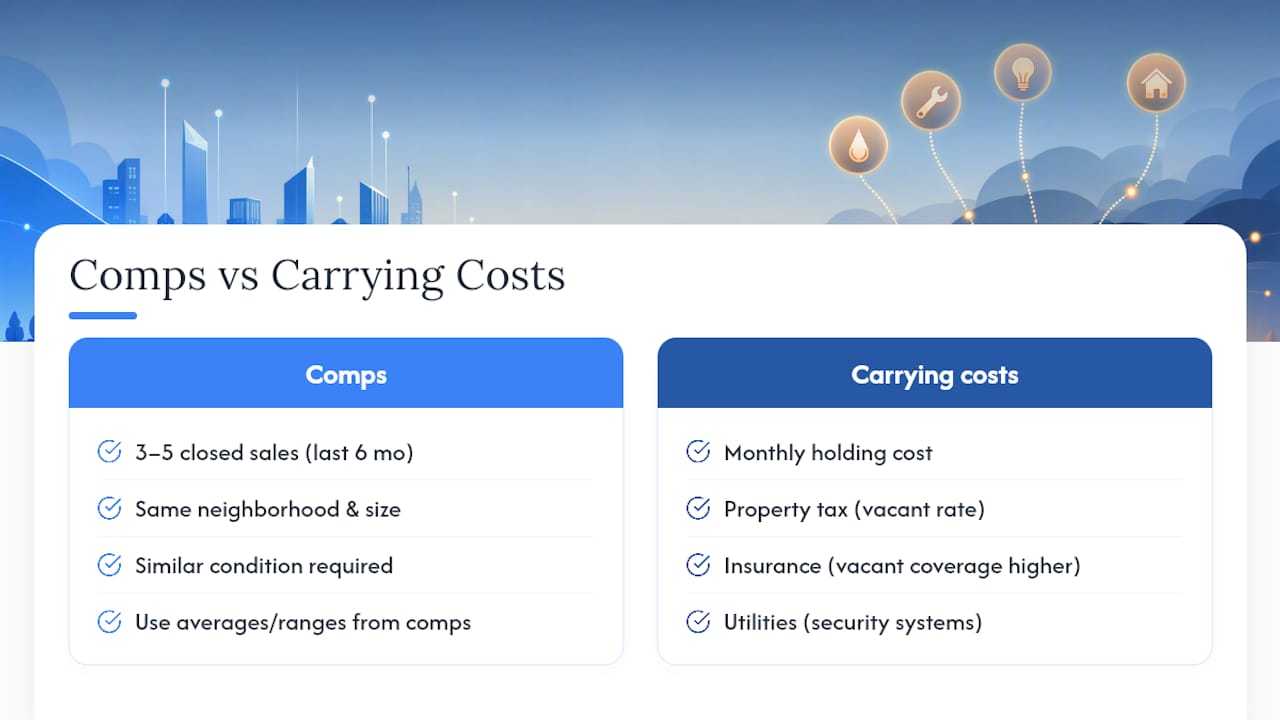
Price objections dissolve faster when you bring numbers instead of opinions. Pull three to five comparable sales within the last six months, same neighborhood, similar square footage, similar condition, and have them ready before you dial. When a seller pushes back with “your offer is too low,” respond with the comp data directly: “The three closest sales on your street this year averaged [range], and those were move-in ready. Yours needs a roof and updated electrical, which is why the number lands where it does.”
Vacant properties specifically benefit from carrying-cost math layered on top of comps. Calculate the seller’s monthly holding cost, property tax, insurance (often higher for vacant coverage), utilities kept on for security systems, and basic maintenance, then multiply it by how many months they’ve likely been carrying it. A seller who’s paid $7,200 in carrying costs over the past year sees your offer differently once that number is on the table next to the comps.
Avoid citing a Zestimate or similar automated estimate as if it were a comp; sophisticated sellers know the difference, and less sophisticated ones will anchor to a number that doesn’t reflect the property’s actual condition. If the seller cites one, acknowledge it and pivot to actual closed sales: “Zillow’s estimate doesn’t know about the roof or the vacancy period, but here’s what actually sold nearby.” Reviewing broader negotiation tactics for presenting comps persuasively can sharpen how you sequence this data during the call itself.
Turning Objections Into Buying Signals
Almost every objection on the list above is, underneath the words, a request for more information rather than a rejection. “I need to think about it” means the seller hasn’t ruled you out, they’ve paused to weigh something specific. “I have another buyer” means they’re actively evaluating offers, which puts you in competition, not out of the running. Reframing objections this way changes how you respond in real time.
The clearest signal hides in specificity. A seller who says “just not interested” and hangs up is a genuine no. A seller who says “not interested, but what would you even offer for something like this?” has just asked a buying question while pretending not to. Answer the real question, not the dismissal wrapped around it.
Objections about repairs or condition are almost always buying signals in disguise, since a seller who didn’t care about selling wouldn’t bother explaining what’s wrong with the property. Treat every detail they volunteer, the roof, the tenant who moved out, the inheritance dispute, as information they want you to use, not a wall they’re building.
The fastest way to misread a signal is to treat every hesitation as a hard no and hang up too early. The six-question motivation framework is built specifically to help callers tell the difference between a seller who’s stalling and one who’s genuinely done.
Reading Readiness and Reluctance Beyond the Script
Words only tell part of the story on a cold call. Tone, pace, and what a seller volunteers unprompted usually say more than their stated objection. A seller who answers questions quickly and asks their own questions back, “how fast could you close,” “would you cover closing costs”, is signaling readiness even while technically still objecting.
Reluctance shows up differently than a flat no. Long pauses before answering, one-word responses, or repeatedly redirecting to a spouse without offering to loop them in are signs the seller isn’t ready, not signs they’ve decided against you. Push too hard here and you confirm every fear they had about pushy investors.
Watch for a shift mid-call: a seller who opened defensively but starts asking process questions has moved from resistance to evaluation. That’s your cue to slow down and answer thoroughly rather than rushing to close, since over-eagerness at this exact moment can spook a seller who’s just starting to trust you. The homeowner objection taxonomy guide breaks down several of these subtler signals if you want a deeper reference for calibrating tone on the fly.
Three Rules for Closing More Vacant Deals
Respect comes first, every time. A seller who feels handled, not helped, will remember your name and warn the next investor who calls. Lead with cost-of-carry math instead of your own opinion of what the property is worth; numbers persuade where arguments stall. And persist on a fixed schedule rather than a feeling, since vacant deals reward the callers who show up on day 90 as reliably as they did on day one.
The instinct to push harder when a seller hesitates is almost always wrong. Momentum comes from consistency, not pressure, calling back when you said you would, sending the number you promised, asking the question you said you’d ask. That’s the whole playbook.
— Dave
Practice the Scripts With ClosersLeague
Reading a script is nothing like defending it against a seller who’s annoyed, distracted, or testing you mid-call, which is exactly the gap ClosersLeague was built to close. Instead of running through these objections for the first time on a live lead, ClosersLeague lets you rehearse against AI roleplay tuned specifically to vacant-property sellers, absentee owners, tired landlords, and every emotional state in between, then scores your tie-down rate, follow-up rate, and objection handling on a real scorecard after every session.

The framework in this article, listen, diagnose, respond, tie down, maps directly onto ClosersLeague’s practice drills, so you’re not learning a separate system on top of what you just read. Run 30 minutes of roleplay against the twelve objections above, log where you stalled, and repeat until your tie-down rate climbs. If you’re already calling distressed and vacant leads and just need sharper scripts to test in roleplay, the distressed seller cold calling scripts library pairs well with practice sessions. Start with the Starter plan at $5 per month to get a feel for the drills, or explore the full AI roleplay experience across every seller type before committing to a tier.
Sources
- Behavioral studies on loss aversion in property decisions (Columbia Business School extract)
- Vacant property leads: how to find and close them in 2026 — iSpeedToLead
FAQ
What Are the Five Major Objections in Sales?
In real estate cold calling, the five most common objections are price (“your offer is too low”), timing (“let me think about it”), trust (“how did you get my number”), competing options (“I have an agent”), and authority (“I need to talk to my spouse”). Each maps to a financial, emotional, or timing-based motivation underneath the stated words.
What Is the 3-3-3 Rule in Real Estate?
There’s no single, universally recognized “3-3-3 rule” in real estate cold calling; definitions vary by source and market. If you’ve heard it referenced for follow-up cadence, treat it as informal shorthand rather than an established standard, and rely on a documented cadence like the Day 31 to Day 180 close window instead.
What Are the Three Golden Rules for Objection Handling?
Listen before responding, diagnose the real motivation behind the stated objection, and always end the call with a specific, scheduled next step. This mirrors the two-stage framework DealMachine documents for matching responses to financial, emotional, or timing concerns.
What Are the Four Types of Objections?
Vacant-property objections generally fall into four categories: financial (price, taxes, liens), emotional (attachment, distrust), timing and control (waiting for the market, needing approval from others), and access or safety concerns (worry about property visits or liability). Identifying the category first determines which script or reply fits.
How Much Does ClosersLeague Cost?
ClosersLeague offers three plans: Starter at $5 per month, Growth at $10 per month, and Pro at $18 per month, each tiered by the number of AI practice calls included.