The fastest safe way to improve your cold-call results is to run small, single-variable A/B tests, changing one script element at a time, while logging compliance fields on every call. Pick a variable and a metric before you dial. Confirm your call window and Do-Not-Call scrubbing first. Build your process around the Telemarketing Sales Rule and rehearse variants before you take them live.
TL;DR:
- Running at least 100 calls per variant across multiple days reduces the risk of biased results caused by list quality or timing differences.
- Testing one script element at a time, such as openers or discovery questions, helps identify which change genuinely improves call outcomes.
- Log every call with detailed fields, including variant ID, call disposition, and consent, to ensure accurate analysis and compliance.
- Use AI roleplay to rehearse and scale winning scripts across the team, minimizing the risk of a poor rollout and ensuring consistent messaging.
- Ensure all calling practices adhere to legal hours, do not guarantee results, and retain call records for at least five years to stay compliant and avoid liability.
Table of Contents
- Which script elements to test first
- How to design a valid experiment
- Measuring results without a statistics degree
- Legal and ethical checklist before you dial
- Three starter tests you can run this week
- How we rehearse and scale winning variants
- Rehearse your winning scripts with Closers League
- FAQ
- Sources
Which script elements to test first
Not every line in your script carries equal weight. Some elements decide whether a homeowner stays on the phone at all, others shape whether they book a meeting. Test in this order of impact:
- Openers: a permission-based opener (“Is now an okay time to talk for two minutes?”) against a direct identification opener (“Hi, this is Dave, I buy houses in your area.”)
- Permission requests: asking before pitching versus launching straight into your reason for calling.
- Discovery questions: an exploratory question about their situation versus a direct question about selling intent.
- Anchor offers: how you frame your interest in the property, cash offer language versus flexible-terms language.
- Objection handlers: your response to “I’m not interested” or “how did you get my number.”
Isolate one element per test. Changing the opener and the closing line in the same run makes it impossible to know which change moved the needle, and with the call volumes most small teams run, a multi-variable test just produces noise. Our distressed seller cold calling scripts page has variant examples worth adapting for your own testing.
One more thing before you write a single line: strip out any phrasing that promises to stop foreclosure, guarantee a sale, or imply you represent a government program. That language is a legal liability, not a conversion tactic, and we cover why in the compliance section below.
How to design a valid experiment
A test only tells you something true if it is set up correctly. Follow these steps before you make a single call:
- Set a sample size floor. Aim for at least 100 to 150 dialed attempts per variant before drawing conclusions. Smaller teams can hit this over one to two weeks of normal dialing volume.
- Randomize by batch, not by gut feel. Rotate variants by list segment or by calling day rather than letting a caller choose which script to use, which removes a major source of bias.
- Watch for time-of-day skew. If Variant A gets called mostly mornings and Variant B mostly evenings, your results reflect timing as much as script quality.
- Run tests across multiple days, not just one. A single day’s results can swing on list quality or a bad batch of numbers.
- Log every call the same way, regardless of outcome.
Your log needs these fields on every single call: variant ID, caller ID, the called party’s local time, call disposition, call duration, and a consent flag. These fields aren’t just for analysis, they’re close to what the TSR’s recordkeeping rule expects you to retain anyway, so building them into your test log from day one saves you a second system later.
Pro Tip: Run tests in rolling multi-week blocks rather than single-day sprints. It smooths out day-of-week and list-churn effects that can make a mediocre script look like a winner.
Measuring results without a statistics degree
You don’t need a data science background to read an A/B test, you need the right metrics and a healthy respect for small samples. Track these for each variant:
- Live-answer rate: how many dials connect to a real person.
- Conversation rate: how many connects turn into an actual conversation past the opener.
- Appointment-set rate: how many conversations result in a booked follow-up.
- Lead-to-offer rate: how many appointments progress to a real offer conversation.
- Hang-up and complaint rate: a variant that converts well but generates more hang-ups or complaints isn’t actually winning.
To calculate lift, take the difference between two variants’ conversion rates and divide by the baseline variant’s rate. As a field rule of thumb, treat differences under 2 to 3 percentage points as noise unless each variant has cleared at least 100 to 150 calls, since smaller samples swing wildly from a handful of calls.
Watch for confounders: a caller with more experience naturally outperforms a newer one regardless of script, a stale list depresses every metric, and testing both variants on the same caller and similar list quality controls for most of it. Once a variant shows a durable, repeatable edge, that’s your signal to move it from test into standard training and into AI roleplay so your full team can rehearse it before using it live.

Legal and ethical checklist before you dial
Compliance isn’t a side task here, it’s part of the experiment design. Before any test goes live, confirm:
- Calling window: outbound calls to residential numbers must fall between 8:00 a.m. and 9:00 p.m. in the called person’s local time, per 16 C.F.R. §310.4, which also defines abusive practices like ignoring Do-Not-Call requests.
- List scrubbing: check every number against Do-Not-Call status before dialing, every time, not just once per campaign.
- Recordkeeping: retain scripts, call records, and dispositions as outlined in 16 C.F.R. §310.5, which covers what telemarketers must keep on file.
- No guaranteed outcomes: avoid language promising to stop foreclosure or guarantee results. CFPB and FTC enforcement actions against foreclosure-relief scams show this kind of language draws regulatory attention.
- Consent for automated contact: get prior express written consent before any autodialed call, text, or prerecorded message.
A reminder call can matter more than a clever script. A RAND study found that follow-up reminder calls raised return rates for mailed consent packets from 52% to 61%, a reminder that persistence through a legitimate follow-up often beats a flashier pitch.
Three starter tests you can run this week
Start simple with lead generation ideas for real estate pros. Each test below needs roughly 100 to 150 calls per variant and about one to two weeks:
- Test A, openers: permission-based opener versus quick-ID opener. Primary metric: conversation rate.
- Test B, discovery questions: direct “Are you thinking about selling?” versus exploratory “Can you tell me about your plans for the property?” Primary metric: appointment-set rate.
- Test C, closing action: offering an appointment on the call versus offering to send information first. Primary metric: lead-to-offer rate.
Log variant, caller, timestamp, disposition, and consent on every call regardless of which test you’re running. If a variant wins clearly across two full weeks, roll it into your standard script and retire the loser rather than running it indefinitely.
How we rehearse and scale winning variants
Once a variant wins, the real risk is rolling it out cold. We built AI roleplay so your team can rehearse a winning script against realistic seller objections and emotional states before using it on a live homeowner. That rehearsal step matters most with distressed sellers, where transparency and consent aren’t optional extras, they’re the difference between a conversation and a complaint.
— Dave
Rehearse your winning scripts with Closers League
Once an A/B test gives you a real winner, the fastest way to scale it across your team is rehearsal, not just a script update email. A platform offers scenario-specific AI roleplay across various distressed seller types, instant scorecards, and targeted drills so every caller can practice the new variant before using it on a homeowner.
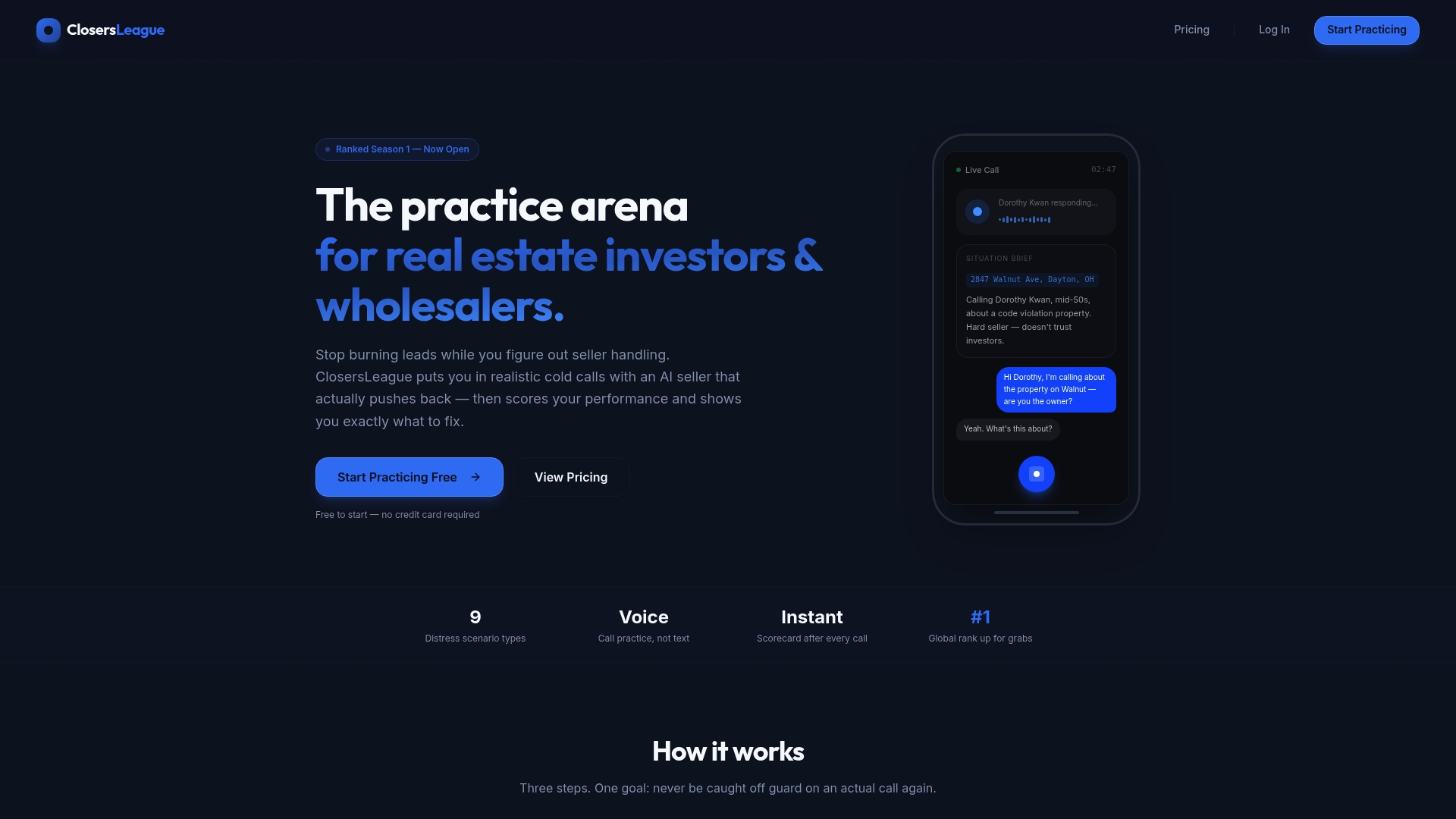
- Practice winning variants against realistic AI sellers before going live.
- Get instant scorecards and feedback on each call.
- Scale a tested script across your whole team with consistent drills.
Check our Starter, Growth, and Pro plans starting at $5 a month and start rehearsing your next winning script today.
FAQ
How many calls do I need before trusting an A/B test result?
Aim for a sufficient number of dialed attempts per variant before drawing conclusions, since smaller samples can swing heavily on list quality and caller variation. Run the test across multiple days or weeks rather than a single session to smooth out timing bias.
What hours can I legally call distressed homeowners?
Outbound calls to residential numbers must fall between 8:00 a.m. and 9:00 p.m. in the called person’s local time under 16 C.F.R. §310.4. This rule also treats ignoring Do-Not-Call requests as an abusive telemarketing practice.
What script language should I avoid when testing offers?
Avoid any phrasing that promises to stop foreclosure, guarantees a sale, or implies affiliation with a government program. Enforcement actions from the CFPB and FTC against foreclosure-relief scams show this kind of language draws regulatory scrutiny regardless of intent.
How long do I need to keep call records and scripts?
Telemarketing recordkeeping rules under 16 C.F.R. §310.5 call for retaining substantially different scripts, call records, and dispositions for five years. Build these fields into your test log from the start rather than reconstructing them later.
How do I practice a new script before using it on real sellers?
Rehearsing against realistic objections before a live rollout reduces the risk of a clumsy delivery undoing a script that tested well. Our AI roleplay platform lets you drill a winning variant against scenario-specific seller types before your team uses it on actual homeowners.
Sources
- 16 CFR §310.4 – Abusive telemarketing acts or practices. | e-CFR | LII / Legal Information Institute
- Complying with the Telemarketing Sales Rule | Federal Trade Commission
- 16 CFR §310.5 – Recordkeeping requirements. | e-CFR | LII / Legal Information Institute
- RAND follow-up reminder phone calls study
- CFPB, FTC and states announce sweep against foreclosure-relief scammers