Use these eight moves to build rapport in the first 60 seconds of a cold call, before the prospect decides you’re not worth their time. Each one is a single action or line you can use on your very next dial.
- Pattern interrupt: skip the scripted greeting and say something the prospect doesn’t expect to hear from a stranger.
- Quick relevance: name the specific reason you’re calling them, not a generic pitch.
- Clear outcome: tell them in one sentence what this call is and isn’t.
- Tone anchor: slow down, drop your pitch slightly, and sound like you have nowhere else to be.
- One low-resistance question: ask something easy to answer that opens a story, not a checklist.
- Listen and label: reflect back what you hear (“sounds like the timing’s been rough”) before you ask anything else.
- Match their pace: mirror their energy and speed rather than pushing your own.
- Confirm the next step: end with a specific, small commitment, not a vague “I’ll follow up.”
Pro Tip: Say the prospect’s name once in the first 15 seconds and once again before you close. It’s a small move that signals you’re talking to a person, not reading a list.
Key Takeaways
Building rapport on a cold call requires specific pre-call research, a tested opener, active listening, and a confirmed next step, all within the first 60 seconds.
| Point | Details |
|---|---|
| Lead with specificity | Reference a real detail about the property or owner in your first ten seconds. |
| Listen more than you talk | Track your listen-to-talk ratio; top reps ask questions and listen rather than pitch. |
| Handle blocks and stalls differently | Acknowledge a stall, offer a smaller ask for a block, and never argue against resistance. |
| Close with a specific commitment | End every call with a named next step, not a vague promise to follow up. |
| Practice with realistic drills | ClosersLeague’s AI roleplay scenarios let reps rehearse these exact steps against resistant seller types before a live call. |
Table of Contents
- Building Rapport Cold Calls Steps: Why the First Minute Decides Everything
- Pre-Call Prep: A 2-Minute Checklist That Sets Up Rapport
- What to Say in the First 60 Seconds of a Cold Call
- Core Techniques: Tone, Pace, and Active Listening on the Phone
- Questions That Open Stories, Not Checklists
- How to Handle Resistance Without Losing Rapport
- How to Practice These Steps Until They Feel Natural
- Follow-Up Cadence: Building Rapport Between Calls
- Common Cold-Calling Mistakes That Kill Rapport
- Why Rapport Is Built Together, Not Delivered by a Script
- A Trainer’s Note on Practicing Rapport at Scale
- Practice the Exact Steps in This Article Before Your Next Call
- Sources
- FAQ
Building Rapport Cold Calls Steps: Why the First Minute Decides Everything
Rapport on a cold call isn’t a personality trait some reps have and others don’t. It’s a sequence of small, repeatable moves, and the research on buyer-seller rapport backs that up: rapport-building behaviors are foundational to sales outcomes, and they transfer directly to phone and virtual selling. The eight steps above work because they front-load specificity and respect for the prospect’s time, the two things that determine whether someone stays on the line past the first 30 seconds.
The steps to connect with prospects don’t require charisma. They require preparation, a handful of tested phrases, and the discipline to listen more than you talk. That’s the entire premise of effective cold call techniques: reduce the guesswork in the moments that matter most, then practice the sequence until it sounds unscripted.
Pre-Call Prep: A 2-Minute Checklist That Sets Up Rapport
Rapport starts before you dial. A generic opener signals a cold list; a specific one signals you did your homework, and that’s often the entire difference between a hang-up and a conversation.
Spend two to three minutes on each lead checking:
- Property or company detail (address, ownership length, recent permit or tax activity).
- Any recent activity: a listing that expired, a code violation notice, a probate filing, a foreclosure notice.
- CRM history: has anyone from your team called this contact before, and what happened?
- A quick disqualifier check: is this clearly not a fit (wrong owner, already under contract, do-not-call flagged)?
If a lead fails that last check, log the reason in your CRM immediately and move on. Chasing a dead lead for the sake of activity numbers wastes the one resource cold calling actually runs on: your energy for the next call.
Pro Tip: Build a two-line CRM note template (“Last touch: [date] / Key detail: [fact] / Objection: [note]”) so every rep pulls the same shorthand before dialing. It turns five minutes of digging into a 20-second glance.
What to Say in the First 60 Seconds of a Cold Call
The first 30 seconds of a cold call are almost entirely about signaling that this isn’t a mass-dialed script. Field research on real estate cold calls finds that specificity and a direct respect for the prospect’s time are the fastest rapport drivers available in that window. A prospect who hears a specific detail about their own property decides, almost instantly, that you’re worth another ten seconds.
Three openers that work, by seller type:
- Distressed seller: “Hi [Name], this is [Rep] with [Company]. I saw the property on [Street] has a code violation on file from last month. I work with owners in that situation. Got a quick minute?”
- Expired listing: “Hi [Name], this is [Rep]. I noticed your listing on [Street] came off the market last week. I’m not calling to relist it. I buy properties directly. Can I ask what happened?”
- Absentee owner: “Hi [Name], this is [Rep] with [Company]. You own the property on [Street] but the mailing address shows [City]. I work with out-of-state owners who’d rather not manage a property remotely. Do you have a minute?”
Each opener follows the same shape: your name, a specific fact, a one-line outcome, and a low-resistance ask. Asking for “a quick minute” instead of “is now a good time” matters more than it sounds, since practical guidance on early-call rapport notes that “quick minute” framing reduces the instinct to say no on reflex.
Pro Tip: Never open with “How are you today?” It’s the fastest way to sound like a robocall. Lead with the specific fact instead.
Core Techniques: Tone, Pace, and Active Listening on the Phone
Once the prospect is still on the line, rapport becomes a matter of vocal delivery and listening discipline, not word choice alone. Phone calls strip away every visual cue, so tone and pacing carry weight they wouldn’t in person.
Tone and pacing:
- Smile before you speak. It changes the shape of your voice even though the prospect can’t see you.
- Speak slightly slower than feels natural. Rushed pacing reads as pressure, even when your words are calm.
- Use a downward inflection at the end of statements. An upward inflection on every sentence makes you sound uncertain or like you’re selling.
Mirroring without parroting: match the prospect’s energy and speed, not their exact words. If they’re clipped and direct, tighten your sentences. If they’re relaxed and chatty, let the conversation breathe. Repeating their phrases back verbatim reads as manipulative; matching their rhythm reads as natural.
Active listening moves that build rapport in real time:
- Label the emotion: “Sounds like this has been a stressful few months.”
- Paraphrase, don’t repeat: restate the gist in your own words to confirm you followed.
- Use silence: let a pause sit for a second or two after they finish talking. Jumping in immediately signals you were waiting to talk, not listening.
- Summarize before transitioning: “So the property’s been vacant since your dad passed, and you’re not sure what to do with it yet. That’s exactly the kind of situation I help with.”
HubSpot’s analysis of phone-based selling finds that top-performing reps build trust faster largely because they ask targeted questions and listen more than they talk, not because they have a better script.
Pro Tip: Record yourself for one full day of calls and count how many seconds you talk versus how many the prospect talks. Most reps are shocked at how lopsided it is.

Questions That Open Stories, Not Checklists
A good cold-call question does one thing: it invites the prospect to talk about their situation, not answer a yes/no screener. “Are you the owner?” gets you data. “What’s the plan for the property these days?” gets you a story, and a story is where rapport actually happens.
Six script snippets you can adapt on the next call:
- Opener pivot: “I’m not calling to pressure you into anything. I just want to understand where things stand with the property.”
- Discovery probe: “What made you decide to look into selling now, versus a year ago?”
- Emotional check: “That sounds like a lot to manage on top of everything else. How’s that been going?”
- Timeline question: “If things lined up the right way, is this something you’d want handled in the next few months, or is there no rush?”
- Objection softener: “Totally fair; a lot of folks feel that way at first. What’s your biggest concern about a call like this?”
- Soft close: “Based on what you’ve told me, I think I can put together some numbers. Would it make sense to grab 15 minutes later this week?”
A short call sequence, in order: opener (specific fact) → discovery probe (open question) → listen (silence, no interrupting) → label (“sounds like…”) → soft close (specific next step). That five-step sequence is the entire engine behind steps to connect with prospects that actually convert to a meeting.
Pro Tip: Ban yourself from asking two closed questions in a row. If your last question could be answered with “yes” or “no,” your next one needs an open frame.
How to Handle Resistance Without Losing Rapport
Prospects rarely say “no” outright on a first call. Instead they produce what conversation researchers call blocks and stalls, verbal moves that resist the sales attempt without fully shutting it down. A study of cold-call resistance identifies these as recognizable patterns: hedging (“I’m not really sure”), deflection (“send me something in an email”), and delay proposals (“call me back next month”). Learning to hear the difference matters, because a stall (delay) responds to a different move than a block (flat resistance).
Three response patterns that hold rapport together:
- Acknowledge, then reframe: “Totally understand. A lot of owners feel that way before they see the numbers. Would it help if I just laid out what I could offer, no obligation?”
- Offer a smaller ask: if a meeting feels too big, ask for permission to text one follow-up question instead.
- Name the stall directly: “No problem if now’s not right. Is there a better time this week, or should I check back next month?”
Never argue with a block. Pushing against resistance head-on is one of the fastest ways to lose rapport you just built.
Pro Tip: When you hear a stall, repeat it back before responding. “Next month, got it.” That half-second of acknowledgment keeps the conversation collaborative instead of adversarial.
How to Practice These Steps Until They Feel Natural
Reading a script is not the same skill as delivering it under pressure. Reps improve fastest through roleplay reps, recorded call review, and small measurable goals, not through memorizing more scripts.
Set a weekly rhythm: roleplay two or three scenarios before your shift, record a handful of live calls, and review one recording a day against a short scorecard (listen ratio, number of open questions asked, whether you confirmed a next step). Track a listen-to-talk ratio and a connect-to-meeting rate as your two core numbers. If your meeting rate stalls, the recording almost always shows you talking too much or skipping the labeling step.
Pro Tip: Score just one call per day instead of trying to review everything. A single focused review beats an hour of unreviewed dialing.
Follow-Up Cadence: Building Rapport Between Calls
Rapport doesn’t end when you hang up. A simple three-touch cadence extends what you built on the call and often repairs a weak first conversation.
- Touch 1 (same day): a short text or email referencing something specific they said. “Hey [Name], following up on our call. Hope the situation with [detail] gets easier this week.”
- Touch 2 (3 to 5 days later): a value-add message, not a pitch. “Saw that a similar property on [Street] sold recently. Thought you’d want to know.”
- Touch 3 (10 to 14 days later): a direct but low-pressure check-in on timeline.
Both templates work because they reference the prior call by name and add something useful, rather than restating your offer. That pattern lines up with the connect-communicate-convert cadence common in investor cold-calling frameworks, which treats the follow-up sequence as an extension of rapport, not a separate sales push.
Pro Tip: If a call went poorly, your first follow-up text should apologize for rushing or not listening well, not pitch again. Owning a bad first impression rebuilds more trust than pretending it didn’t happen.
Common Cold-Calling Mistakes That Kill Rapport
Most rapport failures trace back to a handful of repeatable mistakes. Fix these first:
- Fake small talk: skip “How’s your day going?” and use a real detail instead.
- Rushed tempo: slow down; sounding rushed reads as disinterest.
- Talking over silence: let pauses breathe instead of filling them.
- Ignoring what they said: if you don’t reference their last sentence, they notice.
- Overusing pressure language: words like “opportunity” and “act now” trigger defensiveness.
- Asking “is now a good time?”: it invites an easy no.
- Skipping the outcome statement: if they don’t know why you called, they’ll assume the worst.
- No clear next step: ending vague (“I’ll follow up”) wastes the rapport you built.
Pro Tip: After every call, pick the one mistake from this list you’re most guilty of and drill against just that one for a week before adding another.
Why Rapport Is Built Together, Not Delivered by a Script
A conversation-analysis study of verbal rapport found that rapport isn’t a fixed state one person creates and hands to another. It’s an interactive, sequential accomplishment, built through reciprocal moves like mutual assessments and short affiliative exchanges (agreeing, trading small pieces of information, echoing sentiment).
That finding has a direct implication for cold calling: a monologue pitch, however well-written, can’t produce rapport on its own. Rapport shows up in the back-and-forth, in the moments you trade a small agreement (“yeah, that makes sense”) for another.
A quick implementation checklist:
- Trade information instead of only extracting it (share one relevant fact about your own experience).
- Seek small verbal agreements throughout the call, not just at the close.
- Reciprocate an assessment: if they say something’s frustrating, briefly agree before moving on.
A Trainer’s Note on Practicing Rapport at Scale
Watching hundreds of reps run the same eight-step sequence makes one thing obvious: the reps who improve fastest aren’t the naturally charismatic ones. They’re the ones who treat rapport as a set of drills, not a personality test. Scripts get people in the door, but the labeling, the pacing, the silence tolerance, those only sharpen through repetition and honest feedback on what actually happened on the call, not what the rep remembers happening.
Pro Tip: Drill one skill at a time, not the whole call. Spend a week on silence tolerance alone before adding pace-matching. Stacking too many new habits at once is why most rapport training doesn’t stick.
Practice the Exact Steps in This Article Before Your Next Call
Reading eight steps is one thing. Saying them out loud, under pressure, with a seller pushing back, is a different skill entirely, and that gap is where most reps lose deals. ClosersLeague built its AI roleplay platform specifically to close that gap: instead of waiting for live leads to test your rapport moves, you drill them against realistic seller scenarios and get scored on exactly what this article measures, listen ratio, question quality, and whether you confirmed a next step.
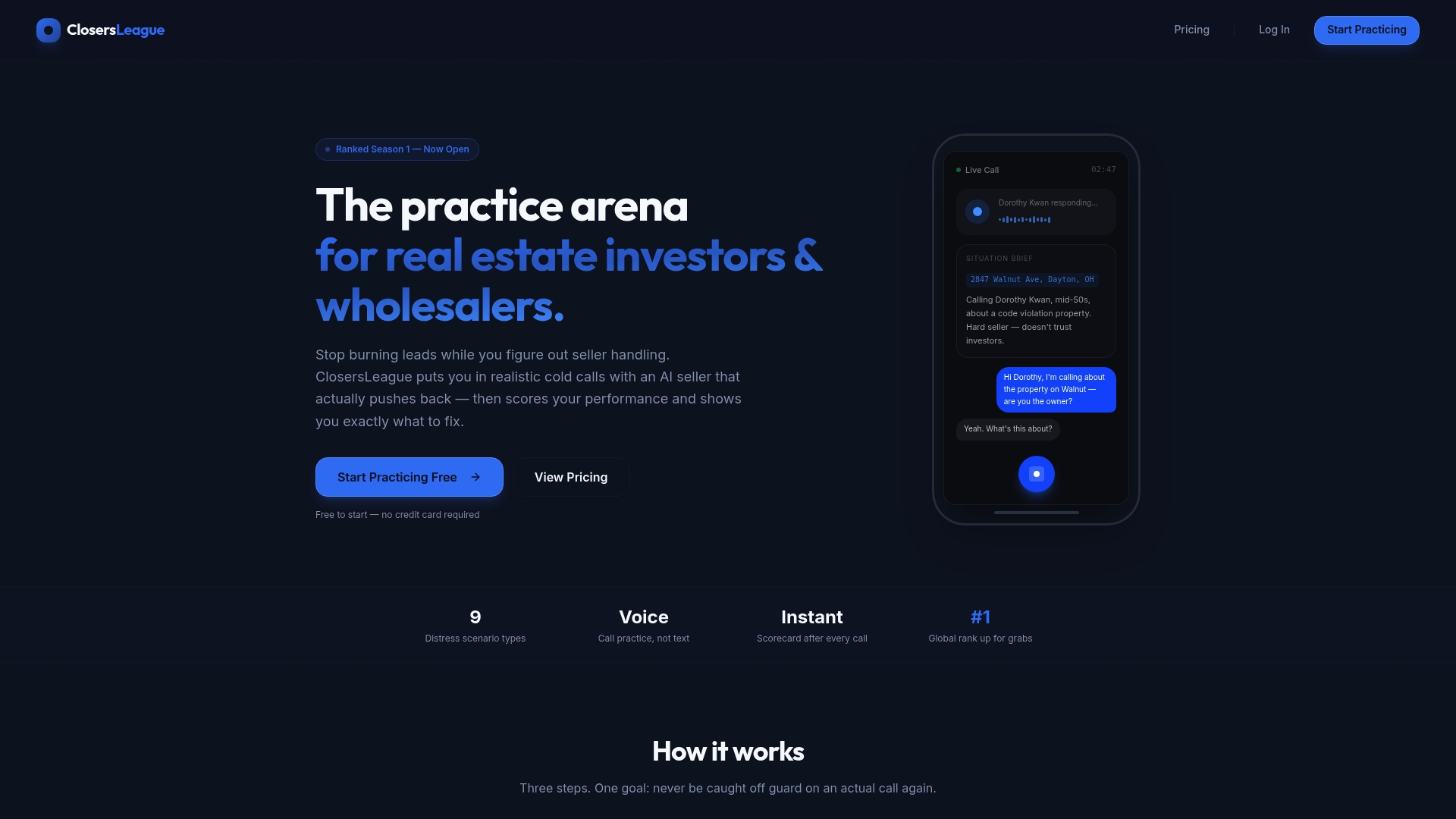
A typical drill mirrors the first-60-seconds sequence above: the AI plays a distressed or absentee owner, you run the opener-question-label-close pattern, and you get a scorecard showing where the call actually broke down. If inherited property calls are where your team struggles most, the inherited property practice module drills that scenario specifically, with objection patterns and emotional cues built around real seller behavior.
Start with a free trial run on the main cold calling practice platform and put today’s eight steps to the test against a scenario built to resist you.
Sources
- Rapport building during sales interactions — Journal of Personal Selling and Sales Management (2023)
- Building rapport over the phone — HubSpot Sales Blog
FAQ
What Is the 80/20 Rule in Cold Calling?
It generally refers to spending more time listening than talking, a ratio that lines up with research on phone-based rapport showing top performers listen more than they pitch.
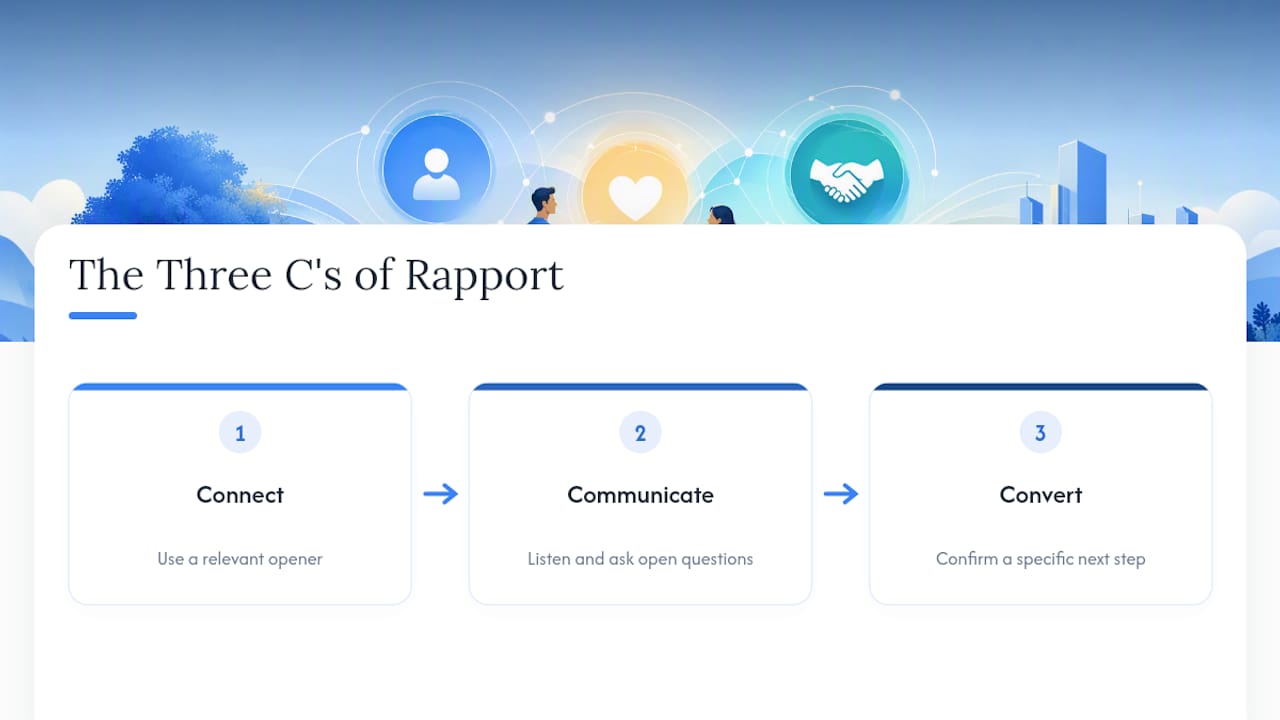
What Are the Three C’s of Rapport Building?
A common framework is connect, communicate, and convert: connect through a relevant opener, communicate by listening and asking open questions, then convert by confirming a specific next step.
What Are the 7 Steps of a Sales Call?
Definitions vary by framework, but most versions include: research, opener, rapport-building, discovery questions, presenting the offer, handling objections, and closing with a next step.
What Are the Biggest Mistakes in Cold Calling?
The most damaging ones are rushing the opener, ignoring what the prospect just said, overusing pressure language, and ending the call without a clear next step.
How Long Should Pre-Call Research Take?
Two to three minutes per lead is enough to find one specific, relevant detail, which is what separates a rapport-building opener from a generic one.
Can Practicing on AI Roleplay Actually Improve Real Cold Calls?
Structured roleplay lets reps rehearse the exact opener, question, and objection sequences covered here before facing a live seller, and platforms like ClosersLeague score those drills against measurable rapport benchmarks.