
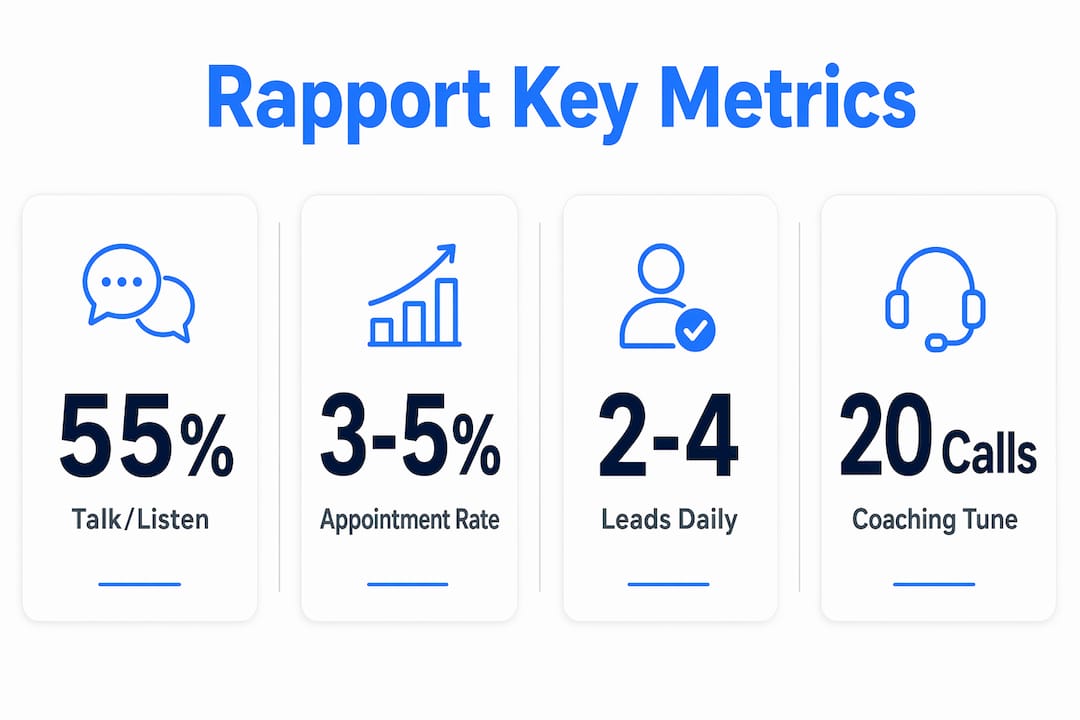
Rapport is the difference between a seller who hangs up and one who tells you everything. On a distressed-property cold call, functional rapport determines whether an owner discloses their real motivation, timeline, and barriers — and that disclosure is the gateway to appointments and deals. Three things you can do right now: research one property-specific fact before you dial, open with a single empathy-led question, and then stop talking. Top-performing callers speak roughly 45% of the time and let the owner carry 55%, which correlates with higher transparency and information disclosure.
- Do the research first. Pull the Notice of Default date, probate filing, or a recent comp on the block before you call.
- Ask one open discovery question. “What’s been the hardest part of dealing with this property?” beats any pitch.
- Let silence work. After you ask, stop. The seller’s answer is where the deal lives.
Table of Contents
- Why rapport changes everything on a distressed-seller call
- How to build rapport in the first 30–60 seconds
- A call framework that keeps rapport intact
- How to handle objections without losing the seller
- How to measure rapport and improve it fast
- Daily and weekly drills to make rapport automatic
- Key Takeaways
- Why rapport-first training changes your results
- ClosersLeague trains the skill that sets appointments
- Useful sources
- FAQ
Why rapport changes everything on a distressed-seller call
Distressed sellers — facing foreclosure, probate, divorce, or tax delinquency — carry real shame and fear. They won’t share accurate information with someone who feels like a stranger or a threat. Rapport removes that barrier. When an owner feels understood, they move from denial to exploring options, and that shift is where your appointment gets set.
The direct outcomes are concrete:
- More accurate disclosure: Owners share real timelines, mortgage balances, and family dynamics instead of deflecting.
- Higher appointment conversion: Personalized empathy scripts produce an 8.3% connect-to-appointment rate versus 2.1% for generic “I buy houses” openers.
- Better show rates: A seller who trusts you keeps the appointment. One who felt pressured ghosts you.
Academic research on rapport in B2B sales confirms that strong initial rapport can compensate for minor interaction weaknesses later in a conversation. That means a great opener protects the whole call.
“Rapport is the starting point for a relationship, while trust comes at a later stage. As the foundation for relationships, rapport building is particularly important in sales contexts.” — Kaski, Niemi & Pullins, Industrial Marketing Management, 2017
Pro Tip: Don’t confuse likability with trust. A seller who laughs at your joke but doubts your competence won’t give you an appointment. Professional empathy plus demonstrated knowledge of their situation beats generic charm every time.
How to build rapport in the first 30–60 seconds

The 3-second window is real: front-load one property-specific fact in your opener to signal competence and earn permission to keep talking, as explained in How Real Estate Agents Drive Better Negotiation Outcomes. Generic small talk reads as a script to distressed homeowners and kills rapport before it starts.
Three opener structures that work:
- Local-advisor opener: “I noticed the Notice of Default filed on your property last month — I work with homeowners in this situation and wanted to reach out before things got further along.”
- Empathy-first opener: “I know this kind of situation can be really stressful. I’m a local investor and I’ve helped a few families in [neighborhood] figure out their options.”
- Curiosity-led opener: “I saw the property on [street] has been vacant for a while. I’m curious — is selling something you’ve been thinking about, or is there a plan in place?”
Listening is where rapport compounds. Match the seller’s tempo. Paraphrase what they say before you respond. Ask one high-value open question and then stay quiet. The 45/55 talk/listen ratio — top callers speak about 45% of the time, listening 55% — isn’t a suggestion. It’s a discipline.
Avoid these language traps:
- “I buy houses” with no context
- Weather or weekend small talk
- “Is now a good time?” (hands them an exit)
Pro Tip: The moment a seller reveals something emotional — shame about an underwater mortgage, grief over an inherited property — acknowledge it in one sentence before you probe for facts. “That sounds like a really tough spot, and I appreciate you sharing that.” Then ask the factual follow-up. This lowers defenses and improves the accuracy of everything they tell you next.
A call framework that keeps rapport intact
Structure your calls so discovery comes before qualification. Rushing to price or timeline before the seller feels heard destroys rapport fast.
| Stage | Duration | Talk/Listen Target | Goal |
|---|---|---|---|
| Opener | 30 sec | 45% caller / 55% seller | Signal competence, earn permission |
| Discovery | 2–4 min | 45% caller / 55% seller | Uncover motivation, timeline, barriers |
| Qualification | 1–2 min | — | Confirm fit, set agenda |
| Next step | 30–60 sec | 45% caller / 55% seller | Appointment or soft follow-up |
Sample openers by distress type:
- Probate: “I work with families going through probate who aren’t sure what to do with the property — is that something you’re still figuring out?”
- Pre-foreclosure: “I saw the filing date and wanted to reach out before the window closes. Have you had a chance to explore your options?”
- Inherited: “Inherited properties can be complicated, especially when there are other family members involved. What’s the situation looking like on your end?”
Bring price only after you understand motivation. Offer options before you make an offer. Pause after any significant question and let the seller process. For more on cold calling foreclosure properties, the sequencing principles apply across all distress types.
How to handle objections without losing the seller
Most objections from distressed sellers aren’t rejections. They’re tests. The seller wants to know if you’ll pressure them or actually listen.
- “I’m not interested.” → “Totally fair. Can I ask — is it that you’ve already got a plan, or just not the right time to talk?”
- “I’m already working with someone.” → “That’s great. I’m not here to compete — I’m just curious what you’re hoping to get out of that situation.”
- “I don’t have time right now.” → “I’ll keep it under two minutes. What’s the biggest question you have about your options?”
- “I’m embarrassed about the situation.” → Acknowledge first: “A lot of people I talk to are in similar spots — you’re not alone in this.” Then ask one factual question.
Acknowledgment-first scripts consistently outperform logic-first scripts in connect-to-appointment metrics. Lead with their pain, not your solution.
Don’t do these:
- Argue about your offer’s value
- Over-explain your process before they’ve asked
- Rush to price after the first objection
For a full playbook on the most common pushback, see how to handle “I’m not interested” on real estate cold calls.
How to measure rapport and improve it fast
You can’t fix what you don’t track. These KPIs tell you where rapport is breaking down:
| KPI | What It Measures | Target |
|---|---|---|
| Talk/listen ratio | Caller discipline | 45% caller / 55% seller |
| Connect-to-appointment rate | Opener and discovery quality | 3–5% of connects |
| Appointment show rate | Trust built during call | Track weekly trend |
| Disclosure quality | Did seller share timeline/motivation? | Qualitative, per call |
| Callback requests | Seller-initiated re-engagement | Track as micro-conversion |
Trained callers average 2–4 solid leads per day, with appointment rates of 3–5% of connects. If you’re below that, the gap is usually in the opener or the listening discipline.
Review recordings and score for: paraphrase use, empathy phrases, and whether you cited a property-specific fact in the opener. A/B test one variable at a time — opener wording, lead-with-research vs. lead-with-empathy, follow-up cadence.
Pro Tip: Coach 20 calls, change one variable, measure over two weeks. Small sample, fast feedback. That loop beats a month of guessing.
Daily and weekly drills to make rapport automatic
Rapport isn’t a personality trait. It’s a skill, and skills are built through repetition. Serious teams invest roughly 40 hours learning distressed-seller psychology before live calls.
Daily (15 minutes):
- Opener-only rehearsal: record yourself, listen back, cut anything that sounds scripted.
- Three paraphrase drills: practice restating a seller’s objection in your own words.
- Tone-matching exercise: listen to a recorded call and mirror the seller’s pace and register.
Weekly full-call roleplays:
- Probate scenario: seller is overwhelmed, hasn’t decided what to do with the property.
- Pre-foreclosure scenario: seller is defensive, embarrassed, and short on time.
- Inherited property scenario: seller has out-of-state family members complicating the decision.
Use this scoring rubric (1–5 per category):
| Category | What to Score |
|---|---|
| Opener relevance | Did you cite a property-specific fact? |
| Listening discipline | Did you hit the 45/55 ratio (45% caller, 55% seller)? |
| Empathy accuracy | Did you acknowledge the seller’s emotional state? |
| Next-step clarity | Did the call end with a clear next action? |
ClosersLeague’s AI roleplay platform runs these exact scenarios with real-time scoring so you can drill probate, pre-foreclosure, and inherited-property calls without burning live leads.
Key Takeaways
Rapport on a distressed-property cold call is a functional skill: it determines disclosure, appointment rates, and show rates — and it’s built through research, listening discipline, and empathy, not charm.
| Point | Details |
|---|---|
| Disclosure drives deals | Owners share real motivation and timeline only when they feel understood, not pressured. |
| Talk/listen ratio matters | Top callers speak 45% of the time; letting the seller carry 55% increases transparency. |
| Opener quality is decisive | Personalized empathy scripts produce a 8.3% connect-to-appointment rate vs. 2.1% for generic openers. |
| Measure conversation quality | Track disclosure quality and appointment show rate, not just raw connect volume. |
| ClosersLeague accelerates practice | AI roleplay with real-time scorecards lets you drill distressed-seller scenarios before live calls. |
Why rapport-first training changes your results
Most callers practice the wrong thing. They rehearse their pitch when they should be rehearsing their listening. The callers who consistently set appointments with distressed sellers aren’t the smoothest talkers — they’re the ones who make the seller feel heard in the first 60 seconds.
The shift from “salesperson” to “problem-solver” isn’t a mindset exercise. It’s a behavioral one. It shows up in whether you cite a specific fact in your opener, whether you pause after a hard question, and whether you acknowledge shame before you probe for facts. Those behaviors are trainable. The fastest way to build them is deliberate repetition against realistic scenarios — not live calls where a real seller pays the price for your learning curve.
At ClosersLeague, the training approach prioritizes trust over pitch from the first drill. AI roleplay puts you in front of a probate seller, a pre-foreclosure owner, or an inherited-property situation and scores your empathy accuracy, listening discipline, and next-step clarity in real time. That feedback loop compresses months of trial-and-error into weeks of focused practice.
ClosersLeague trains the skill that sets appointments
Cold calling distressed sellers is one of the hardest conversations in real estate. The owners are guarded, the situations are sensitive, and generic scripts fail fast. ClosersLeague gives you a faster path to confidence: scenario-based AI roleplay built specifically for probate, pre-foreclosure, inherited, and other distressed-seller calls, with real-time scorecards that show exactly where your rapport breaks down.
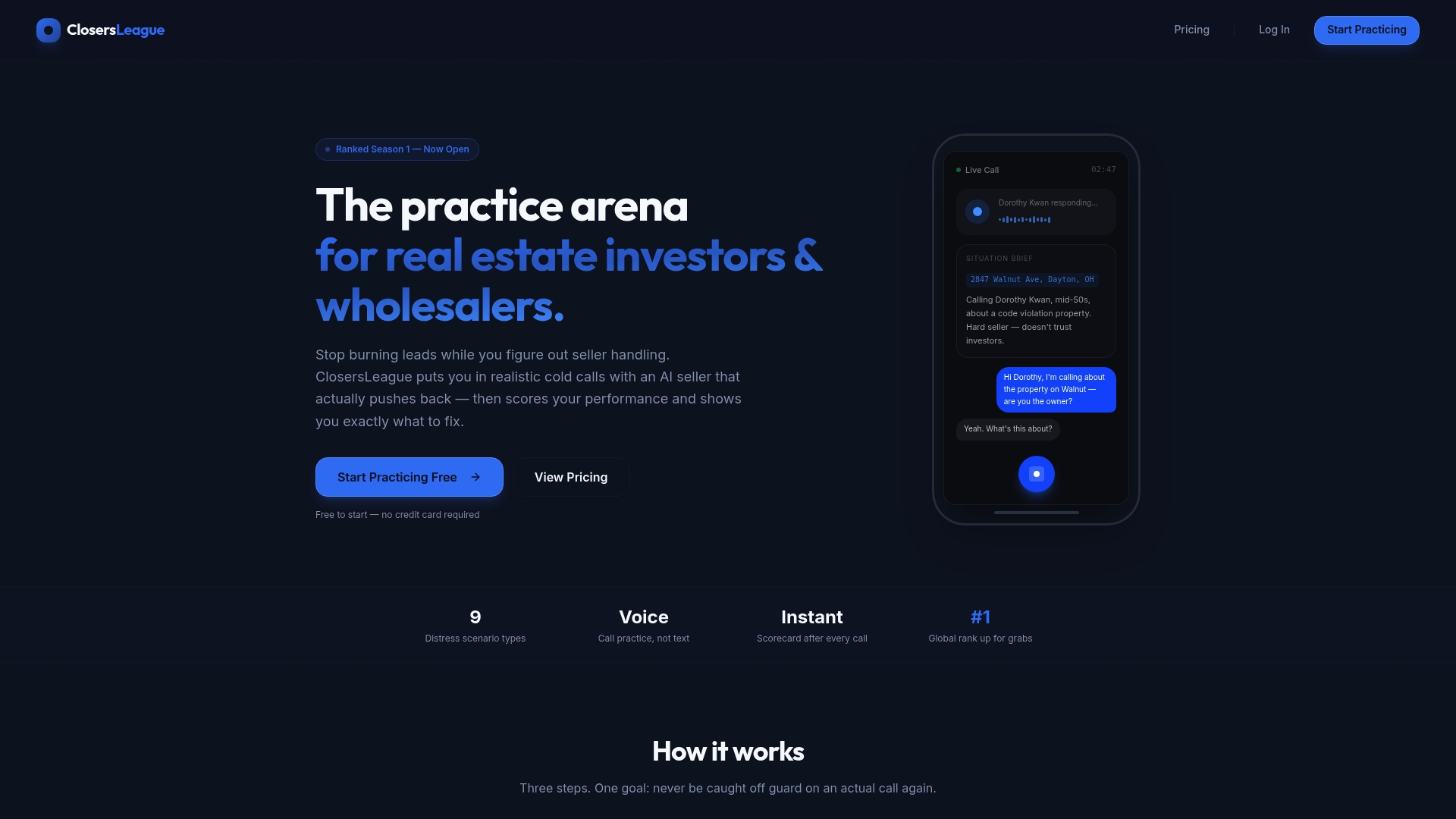
You get targeted drills, performance scoring, and the repetition it takes to make rapport automatic before you burn live leads. Start with inherited property AI roleplay and see where your score lands on your first call.
Useful sources
- How Do You Build Rapport in Cold-Calling Real Estate? — Calling Agency — Industry guidance on the 45/55 talk/listen ratio and why generic small talk fails with distressed sellers.
- Cold Calling Distressed Properties: Best ROI in 2026 — Televista Blog — Connect-to-appointment data, acknowledgment-first script performance, and training volume benchmarks.
- 7 Best Cold Calling Tips for Real Estate Investors 2026 — Televista Blog — The 3-second window principle and leading with property-specific facts.
- Rapport Building in Authentic B2B Sales Interaction — ResearchGate — Academic foundation for rapport as a prerequisite to trust and value co-creation.
- Managing Prospect Affiliation and Rapport in Real-Life Sales Encounters — Sage Journals — Conversation-analysis research showing how verbal affiliation sequences affect sales outcomes.
- Outreach Scripts for Every Distress Signal — Texas Signals — Value-first language and transparency principles for distressed-seller outreach.
- Salesperson Rapport: A Literature Review — Journal of Personal Selling and Sales Management — Four decades of rapport research synthesized into a conceptual model for buyer-seller relationships.
FAQ
What is the role of rapport in sales calls with distressed sellers?
Rapport determines whether a distressed owner discloses their real motivation, timeline, and barriers. Without it, sellers deflect or hang up; with it, they share the information that makes an appointment and a deal possible.
How does the talk/listen ratio affect rapport on cold calls?
Top-performing callers speak roughly 45% of the time and let the seller carry 55%, which correlates with higher disclosure and transparency. Dominating the conversation signals pressure, not partnership.
What’s the fastest way to build rapport in the first 30 seconds?
Lead with one property-specific fact (a Notice of Default date, a recent comp, a probate filing), acknowledge the seller’s situation with a single empathy line, then ask one open question and stop talking.
How can I practice rapport skills before live calls?
Roleplay against realistic distressed-seller scenarios — probate, pre-foreclosure, inherited property — and score yourself on empathy accuracy, listening discipline, and opener relevance. ClosersLeague’s AI roleplay platform runs these scenarios with real-time feedback so you improve without burning live leads.
Which KPIs tell me if my rapport is improving?
Track connect-to-appointment rate, appointment show rate, and disclosure quality (did the seller share timeline and motivation?). A rising show rate is usually the clearest signal that trust is building on your calls.