A call leaderboard works when it ranks the right few numbers, over a fixed period, and rewards quality as well as volume. For investors and wholesalers, that means scoring conversations, appointments and contracts, not just dials. The board shows who is winning. Deliberate practice is what changes who wins next week. That is why we pair a leaderboard with scored practice calls: reps climb by getting better, not by dialing more.
This guide covers what to put on the board, how to score it, how to avoid the traps that make callers quit, and how to connect the board to real skill-building.
TL;DR
- Rank one measure per board over one fixed period (weekly or monthly), and only measure what is logged reliably.
- Blend activity (conversations, appointments set) with quality (appointment rate, contract rate) so nobody wins by dialing fast and talking badly.
- Rank what callers control. Closed deals depend on price, timing and the seller, so score them lightly or keep them on a separate board.
- Add a “most improved” board so new callers have something to win.
- Feed the board with scored practice calls too, so reps can improve the skills the board measures before the live dials.
Table of Contents
- What a call leaderboard actually does
- What to rank: metrics that matter for investors and wholesalers
- Leaderboard design that keeps people motivated
- A starter scoring model you can copy
- Keep public scoring from backfiring
- Turn the ranking into coaching
- Perspective: why we pair leaderboards with practice
- Put it into practice with ClosersLeague
- FAQ
- Sources
What a call leaderboard actually does
A leaderboard ranks callers on a measure over a set period and updates as they work. One real estate team guide explains the basics: one measure per board, one fixed period, and a board only counts what is logged in the CRM. If your callers skip logging, the board lies, and a lying board kills trust fast. Fix logging before you turn it on. Our own guide to a real estate CRM and its best practices covers the setup.
Why bother? Cold calling for distressed sellers is lonely, repetitive and full of rejection. A visible board gives the work a scoreboard. In a case study of a real estate brokerage, Inman reported that daily number reviews, a highly visible leaderboard and simple contests run automatically from the CRM drove the team’s results. Treat the size of any promised lift as team-specific, not a guarantee. The mechanism is what carries over: visible numbers, updated often, tied to actions people can take today.
What to rank: metrics that matter for investors and wholesalers

The most common mistake is ranking dials. Dials are easy to count and easy to fake. Baseline data shows why raw volume misleads: in a Baylor University study of 50 agents making 6,264 cold calls, only 28% of calls were answered, and the 1,774 answered calls produced 19 appointments. Most dials never become conversations, so the number that separates your callers is what they do with the conversations they get.
Build the board from three layers.
| Layer | Example metrics | What it tells you |
|---|---|---|
| Activity | Dials, conversations (live talk over a set length), talk time | Effort and consistency |
| Conversion | Conversations to appointments set, appointments set to held | Skill on the phone |
| Outcome | Offers made, contracts signed | Business results, with luck mixed in |
Salesforce advises including behavioral KPIs so reps earn points for small actions like cold calls made and meetings booked, while keeping rules simple and not over-rewarding bare-minimum activity. Another source recommends a weighted model, for example 5 points for a new conversation, 15 for a meeting booked, 25 for a meeting held and 50 for an opportunity created. Adapt those weights to your funnel: for a wholesaler, “meeting booked” might be a scheduled offer conversation, and “opportunity” might be a signed purchase agreement.
Pair volume with a quality number
If the board shows only call count, your fastest dialer wins while saying the least. Show volume next to conversion so nobody can top the activity chart with a pile of low-quality calls. A simple rule: a caller only ranks on the conversion board after a minimum number of conversations, so one lucky call does not put a new rep at 100%.
Rank what callers control
Salesloop warns against ranking outcomes reps cannot control, such as deals closed, which can demotivate the team. That fits distressed-seller calling. A caller can run a strong conversation with a pre-foreclosure homeowner and still lose the deal to a number that does not work. Reward the call, then let outcomes be a bonus.
Define the metrics before you launch
Write one sentence for each metric: what counts as a conversation, what counts as an appointment, who logs it and when. Our guides on scorecard metrics for real estate cold calls and performance scorecard metrics break down the categories you can grade on every call.
If you also buy or generate leads from outside sources, lead quality affects every rep’s numbers. Understanding how lead intent scoring works helps you judge whether a low conversion rate comes from the caller or from the list.
Leaderboard design that keeps people motivated
Keep it simple and short-cycle
Pick weekly or monthly boards. Salesforce suggests distinct weekly, monthly and quarterly point categories, which gives everyone a fresh start. A quarter-long contest tells a new caller on day ten that the race is already over.
Give new callers a way to win
A broker in Omaha found that long gross-sales contests failed because new agents cannot win and one big closing can end the contest early. His team gamified personal KPIs such as calls, contacts and appointments instead. For your team, add:
- Most improved: this week’s conversion rate against the caller’s own last four weeks.
- Quality board: appointment-to-held rate, ranked only above a minimum volume.
- Streaks: consecutive days hitting the conversation target.
- Practice board: scores on practice calls, open to every caller from their first day.
Blend individual and team goals
Individual boards drive effort. A shared team target, such as total appointments for the month with a reward everyone earns, keeps top callers sharing scripts instead of hoarding them. Salesloop suggests mixing individual sprints with quarterly team challenges where everyone shares the reward.
Respect different personalities
A coach quoted by Dotloop found that straight-up sales contests motivate dominant personality types but can demotivate people who value networking or precision. Multiple boards solve this. The caller who is steady and accurate can win quality. The competitor wins volume. The newcomer wins most improved.
Keep rewards modest and automatic
The Inman case study paid cash prizes for a short contest and scored points automatically: 10 points per conversation, 100 per appointment and 500 per client under contract. Use it as a model for how to structure points, not a price list. Small prizes, a trophy, a pick of the best lead batch or a bonus work. Automation matters more than the prize because manual scoring gets abandoned.

A starter scoring model you can copy
Here is a simple weekly model for a small wholesaling team. Adjust to your numbers.
- Conversation (live talk of 2+ minutes): 5 points.
- Appointment or offer call booked: 15 points.
- Appointment held: 25 points.
- Contract signed: 50 points.
- Practice call scored 80+ on your scorecard: 5 points, capped at 5 per day.
Then add a quality gate: only callers with at least 20 conversations that week appear on the conversion board. Cap points from any single metric at a share of the total so no one grinds one number. Review weekly, change one rule at a time, and tell the team why.
Keep public scoring from backfiring
Public ranking can sting. A Harvard Business Review case study on a home builder’s inside sales team found that a fantasy-sports-style framing made public scoring feel normal, and that the office TVs showed leaderboards without spotlighting poor performance. Practical takeaways:
- Show the top five and each person’s own trend, rather than a ranked list of everyone down to last place.
- Celebrate improvement as loudly as first place.
- Review the numbers in a short daily or weekly huddle and attach coaching to them.
- Use the board to find the skill gap, then fix it with practice, not pressure.
That last point is where most boards stop short. A board tells you who is behind. It does not tell them what to say differently to a probate heir who is grieving, or a homeowner who snaps “I’m not interested.”
Turn the ranking into coaching
Look at the funnel the board exposes. A real estate scorecard approach says to work on the lowest conversion ratio first, for example conversations to appointments. If one caller books plenty of appointments that never show, the problem is the close of the call, not the dial count. If another gets hung up on in the first 15 seconds, the opener needs work.
Then build a routine:
- Pick each caller’s weakest scorecard category.
- Run drills on that single skill, such as handling “how did you get my number?” or asking about the timeline.
- Re-score the same scenario until the result holds.
- Check the live conversion rate two weeks later.
A team can also run call calibration sessions so everyone grades calls the same way, and use a 30/60/90 onboarding checklist so new callers know what rank to expect and when. Our article on the cold caller leaderboard goes deeper on the board itself.
Perspective: why we pair leaderboards with practice
Most leaderboards we see are built around dials and appointments, because those are easy to count. The trouble is that a live seller call is an expensive place to learn. A caller who freezes on the first objection from a probate heir loses that lead, and then loses the next one the same way.
That is why ClosersLeague puts the leaderboard on practice calls as well. Callers run scenario-based voice roleplay against AI sellers across nine distressed situations, including probate, pre-foreclosure, tax delinquent, divorce and vacant properties. Each call ends in an instant scorecard with multi-category grading, and targeted drills go after the weak spots. Because the board ranks scored practice, a new caller can climb it from day one, and a veteran can see exactly which category is holding them back.
Stop winging it. Start drilling. Rank the activity that matters, practice the skill behind it, and let the board show your team getting better every week.
Dave
Put it into practice with ClosersLeague
If you want a leaderboard your callers can compete on before they ever dial a live seller, ClosersLeague is built for that. You get scenario-specific AI roleplay, instant scorecards, skill drills and competitive leaderboards designed for real estate investors and wholesalers. Plans are billed monthly: Starter is $5 per month, Growth is $10 and Pro is $18, tiered by the number of AI practice calls, and the free trial includes a limited number of calls.
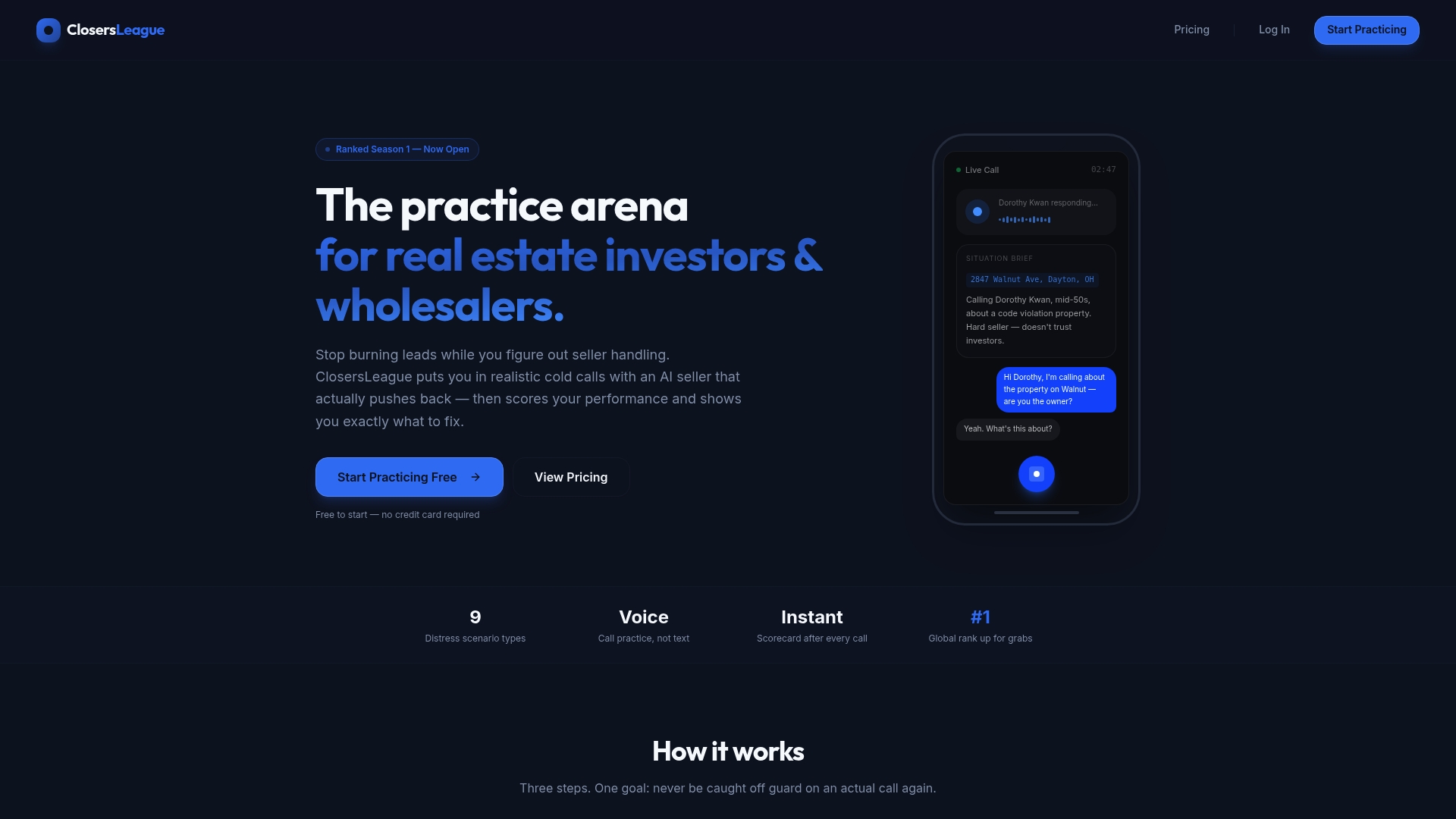
Start on the ClosersLeague home page, run your first scored call, and see where you rank.
FAQ
What should a real estate cold call leaderboard track?
Track conversations, appointments set, appointments held and contracts signed, and show conversion rates next to raw volume. Dials alone reward speed over skill. Add a practice-score board so new callers can compete early.
How often should the leaderboard reset?
Weekly or monthly works best for most small teams. Short cycles give everyone a fresh start and keep new callers in the game. Keep one long-running board for cumulative results if you want to recognize consistency.
Won’t a leaderboard stress out my callers?
It helps to show the top performers and each caller’s own trend rather than a full ranking. Add a most improved board and pair every number with coaching. Case studies of sales teams show that framing scoring like a sport made public ranking feel normal.
How do I stop callers from gaming the numbers?
Use a quality gate and a minimum number of conversations, cap points from any single metric, and score from the logged CRM data. Review a sample of recorded calls each week so a logged appointment matches a real one.
Sources
- How a sales leaderboard works in a real estate team
- A Simple Way To Double Your Agents’ Production This Summer (Inman)
- Keller Center Research Report, Baylor University
- Learn How to Use a Sales Leaderboard (Salesforce)
- SDR Leaderboard Success (Salesloop)
- Gamification in Sales (RocketScreens)
- How to Boost Agent Performance Using Gamification (Dotloop)
- Clayton Homes case study (HBR via Ambition)
- Real estate agent scorecard and KPI dashboard (Uplevel)