
A call calibration session, in the context of AI-assisted cold-call practice for real estate investors and wholesalers, is a structured group meeting where your team runs AI roleplay calls against distressed-seller scenarios, scores each call against a shared rubric, and aligns on what “good” sounds like before it hits a real homeowner. To start one today, assign a facilitator, load a scenario (probate, foreclosure, or inherited), and run two AI roleplay rounds before your next team meeting. As ClosersLeague CEO Justin Benson put it, AI should handle the repetitive coaching work — weekly accountability, roleplay, and progress tracking — so human leaders can focus on the interventions that actually require judgment. Teams that commit to that consistency see results: according to Phillip Gagnon, agents receiving consistent, personalized coaching tend to outperform the market by approximately 30% year-over-year.
Key Takeaways
Consistent, scored call calibration sessions are the fastest way to standardize outbound seller calls and measure rep improvement across your investing or wholesaling team.
| Point | Details |
|---|---|
| Define your cadence first | Weekly for active dialers, biweekly for mixed teams, monthly for small teams under 3 reps. |
| Use a weighted scorecard | Score seven fields (opener through tone) on a 0–100 scale; composites below 60 trigger a coaching conversation. |
| Rotate scenario types | Cover probate, inherited, code violation, foreclosure, divorce, and vacant across your first eight sessions. |
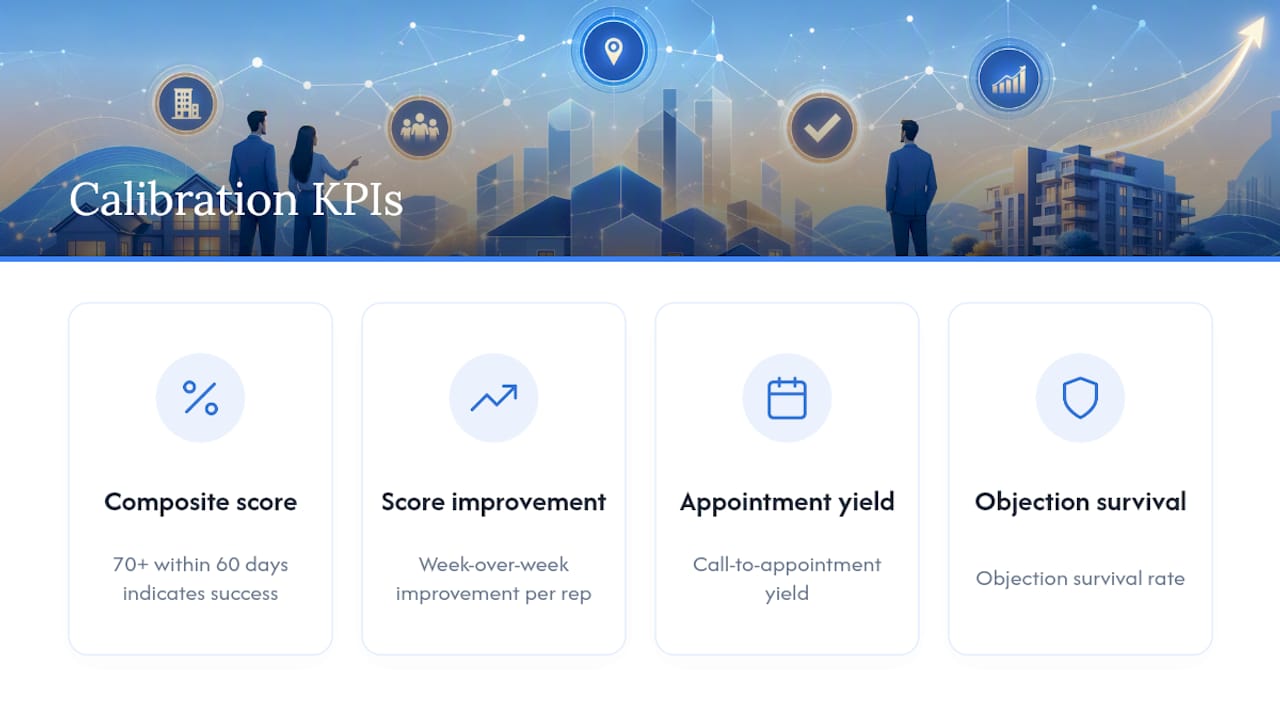
| Track five core KPIs | Monitor composite score average, score improvement rate, call-to-appointment yield, objection survival rate, and leaderboard velocity. |
| ClosersLeague runs the workflow | Scenario libraries, auto-scoring, and leaderboards let your team arrive at each session with scored calls already in hand. |
Table of Contents
- Why should you calibrate your real estate cold calls?
- Who attends a calibration session and what does each person do?
- What cadence and session length actually work?
- What does a timed session agenda look like?
- How do you build a scorecard that actually standardizes ratings?
- How do you run calibrations using AI roleplay and scenario libraries?
- Which KPIs tell you if calibration is actually working?
- What problems will you hit, and how do you fix them?
- How do you roll out a 30/60/90-day pilot?
- Copy-ready templates and assets you can use right now
- Why most calibration programs fail before they start
- ClosersLeague makes running these sessions faster
- Sources
- FAQ
Why should you calibrate your real estate cold calls?
Stop winging it. Every rep who improvises a different opener on a probate call is creating a different result, and you can’t coach what you can’t measure. Calibration fixes that by giving your team a shared standard.
Primary benefits of regular call calibration include:
- Consistency across reps: Everyone works from the same opener, discovery sequence, and close, regardless of experience level.
- Measurable skill gain: Scores move from session to session, giving you a concrete number to track instead of a gut feeling.
- Scalable accountability: AI handles the repetitive scoring and replay so you don’t need a full-time coach for every rep.
- Coaching escalation signals: Low scores on objection handling or motivation identification surface the reps who need one-on-one time.
Traditional one-on-one coaching can cost upward of $2,000 per month per rep. Weekly AI-driven calibration sessions deliver personalized, scored practice at a fraction of that, and the role of coaching in wholesaling is too significant to skip just because the budget isn’t there for a private coach.
Who attends a calibration session and what does each person do?
Keep headcount tight. Five to eight people is the sweet spot — enough perspectives to catch scoring drift, small enough to stay focused.
Recommended attendees and their roles:
- Facilitator (host): Runs the agenda, cues roleplay rounds, keeps time, and leads the calibration discussion. Prepares the scenario and scorecard 24 hours in advance.
- Reps (2–4 callers): Each completes at least one AI roleplay call before the session and brings their auto-score report. During the session, they score a peer’s call independently before the group discussion.
- Team lead or manager: Observes, flags coaching escalations, and assigns post-session action items.
- Compliance SME (as needed): Reviews calls for TCPA consent language and Do Not Call list adherence, especially when onboarding new reps.
Before, during, and after responsibilities:
- Before: Facilitator selects the scenario and distributes the scorecard template. Reps complete one solo AI practice call.
- During: Each attendee scores the selected call independently, then the group compares ratings and resolves divergence.
- After: Facilitator logs final scores, assigns one coaching action per rep, and updates the leaderboard.
Rotate the facilitator role every four to six sessions. Reps who run a session internalize the rubric faster than those who only receive feedback.
What cadence and session length actually work?
Match your cadence to how often your team is dialing. More dials mean more data, which means faster improvement.
- Weekly (active dialers, 50+ calls/week): 45-minute sessions, two roleplay rounds per rep reviewed.
- Biweekly (mixed teams): 60-minute sessions, three calls reviewed, one per scenario type.
- Monthly (small teams, under 3 reps): 75-minute deep-dive, full scorecard review and scenario rotation.
Per-person time budget: plan roughly 10–12 minutes per rep reviewed, including scoring and debrief. A four-rep team fits cleanly into 60 minutes at biweekly cadence.
Pro Tip: *Schedule sessions as recurring calendar blocks with mandatory attendance.
The AI coaching guide for real estate reinforces this: structured, recurring practice cycles produce compounding skill gains that ad hoc review sessions simply don’t replicate.
What does a timed session agenda look like?
Here is a plug-and-play agenda your facilitator can run without prep time:
- 0:00–0:05 — Check-in: Facilitator states the scenario type and today’s scoring focus (e.g., “We’re calibrating discovery questions on inherited-property calls today”).
- 0:05–0:20 — Roleplay round 1: One rep runs a live AI roleplay call while others observe silently and score independently.
- 0:20–0:30 — Individual scoring window: Each attendee completes their scorecard before any discussion.
- 0:30–0:45 — Calibration discussion: Facilitator reads scores aloud, identifies the widest gap, and the group discusses the specific moment that caused divergence.
- 0:45–0:55 — Roleplay round 2 (optional): Second rep runs a call, or the group re-scores the first call after discussion to test alignment.
- 0:55–1:00 — Action assignments: Each rep leaves with one named skill to drill before the next session.
Facilitator script snippets:
- Opening: “Today we’re calibrating [scenario]. Score independently — don’t share until I ask.”
- Pausing roleplay: “Let’s pause here. What would you say next, and why?”
- Calibration discussion: “I see scores ranging from 62 to 84 on objection handling. Who scored it lowest, and what specifically dropped it?”
For remote sessions, add two minutes at the start for tech checks and mute discipline. In-person sessions can cut that buffer and use the time for a second rep’s call.
How do you build a scorecard that actually standardizes ratings?
A good scorecard makes scoring a disagreement productive, not personal. These are the core fields, suggested weightings, and a three-level rubric:
Score each field 0–100, then apply the weighting to get a composite. A composite below 60 triggers a mandatory coaching conversation. Scores of 60–79 get one targeted drill assigned. Scores of 80+ are shared on the leaderboard as a model call. ReadyDeals’ five-script framework — opener, discovery, objection handling, price anchoring, and close — maps directly onto these fields and is worth reviewing when building your first scorecard version.

How do you run calibrations using AI roleplay and scenario libraries?
The workflow is straightforward once you’ve run it twice:
- Select a scenario from your platform’s library (probate, pre-foreclosure, inherited, code violation, divorce, vacant/out-of-state landlord, or tired landlord).
- Reps complete solo AI roleplay calls before the session and submit their auto-score reports.
- Facilitator selects one call (typically the median score, not the best or worst) for group calibration.
- Group scores independently, then the facilitator leads the calibration discussion.
- Update the scorecard baseline with the session’s average and note any rubric adjustments.
Scenario types to rotate across your first eight sessions:
- Probate and inherited property (high emotional sensitivity, pacing matters)
- Pre-foreclosure (urgency framing, avoiding pressure tactics)
- Code violation (municipal context, credibility building)
- Divorce (neutral tone, avoiding taking sides)
- Vacant or out-of-state landlord (absentee motivation, logistics objections)
ClosersLeague’s inherited property practice module and code violation module include scenario-specific objection flows that feed directly into calibration discussions. Look for a platform that offers mid-call feedback, auto-transcripts, and a leaderboard — those three features alone cut facilitator prep time significantly.
A brief compliance note: U.S. cold calls to homeowners are governed by the Telephone Consumer Protection Act (TCPA). Confirm that your list is scrubbed against the National Do Not Call Registry, that you have a documented consent basis for each contact, and that your script includes a clear opt-out path. A compliance SME should review your opener and opt-out language before you scale beyond a pilot.
Pro Tip: Rotate scenario types every two sessions. Reps who only practice probate calls develop blind spots on code violation or divorce calls, where the emotional register is completely different.
Which KPIs tell you if calibration is actually working?
Track these five metrics from session one:
- Composite scorecard average (per rep, per session)
- Score improvement rate (week-over-week delta per rep)
- Call-to-appointment yield (appointments booked per 100 dials)
- Objection survival rate (percentage of calls where rep handles first objection and keeps the call alive)
- Leaderboard velocity (how fast reps move up the ranking)
For reporting, run a weekly snapshot (individual scores, one coaching action per rep) and a monthly trend (team average, appointment yield, top/bottom performers). Transcripts, keyword flags, and leaderboards convert those scores into prioritized coaching escalations and pipeline improvements.
That projection is your ROI case for continuing the program.
| KPI | Reporting Cadence | Target Threshold |
|---|---|---|
| Composite score average | Weekly | 70+ within 60 days |
| Score improvement rate | Weekly | +3 points per rep per month |
| Call-to-appointment yield | Monthly | Baseline + 10% by day 90 |
| Objection survival rate | Monthly | 65%+ by end of pilot |
What problems will you hit, and how do you fix them?
- Low attendance: Make sessions mandatory, calendar-blocked, and 45 minutes max. Optional calibration dies within a month.
- Score divergence: Run a “blinded replay” — strip the rep’s name from the call before scoring. Divergence drops sharply when personal bias is removed.
- AI mis-scoring: Audit one call per session manually. If the auto-score disagrees with the group’s consensus by more than 15 points, flag it and adjust the rubric weighting.
- Platform outages: Keep a backup recording of the previous session’s top-scoring call. If the live platform is down, calibrate against the backup.
- Noisy recordings: Set a minimum audio quality standard (no speakerphone, headset required) and reject calls that don’t meet it rather than scoring through the noise.
Pro Tip: Watch for reps who memorize the rubric and perform for the scorecard rather than for the seller. The fix is to add one unannounced “live call review” per month where a real recorded call (with consent) replaces the AI roleplay. Real calls expose habits the rubric can’t catch.
How do you roll out a 30/60/90-day pilot?
Days 1–30: Design and launch
- Select three scenario types for the pilot (recommended: probate, pre-foreclosure, inherited).
- Baseline each rep’s composite score with one solo AI call before the first group session.
- Configure scorecard fields and weightings in your platform.
- Train the facilitator on the agenda template and calibration discussion script.
- Run four calibration sessions (weekly cadence).
Days 31–60: Measure and adjust
- Review score trends after session four. If average composite hasn’t moved, audit the rubric for scoring drift.
- Add two additional scenario types (code violation, divorce).
- Introduce the leaderboard and share it with the full team.
- Go/no-go gate: average composite score must reach 65+ to proceed to full rollout.
Days 61–90: Scale
- Expand to the full team and shift to biweekly cadence.
- Assign a permanent facilitator rotation schedule.
- Present the 90-day KPI report to leadership with appointment yield data.
- Archive session recordings and scorecard data for ongoing benchmarking.
Copy-ready templates and assets you can use right now
Assets to build or download before your first session:
- Scorecard CSV with the seven fields, weightings, and three-level rubric from the table above
- Session agenda doc (the timed template from Section 5)
- Facilitator script: opening, roleplay pause, and calibration discussion prompts
- Scenario pack: two AI roleplay scenarios per distressed seller type (probate, inherited, code violation, foreclosure, divorce, vacant)
Script snippets for common seller objections:
- “I’m not interested”: “I completely understand. Can I ask — is the timing just not right, or is it more that you haven’t heard an offer that made sense yet?”
- “What’s your offer?”: “I’d love to get there. Before I can give you a number that’s actually fair, I need to understand the property a little better. How long have you owned it?”
- “I already have an agent”: “That’s great. Are you working with them on a traditional listing, or are you open to a faster, off-market option as well?”
Version your templates. Label each scorecard and agenda with a version number and date (e.g., Scorecard v1.2, June 2026). When the team’s average score plateaus, that’s the signal to review and update the rubric, not to run more sessions with the same standard.
Why most calibration programs fail before they start
Most teams skip calibration because it feels like overhead. They’d rather dial. That instinct is understandable and wrong. The reps who dial the most without a feedback loop are the ones who entrench bad habits fastest, and those habits compound over thousands of calls.
The teams that make calibration stick treat it as a non-negotiable part of the dialing week, not a training add-on. They assign a permanent facilitator, protect the calendar block, and tie the leaderboard to something real — recognition, first pick of leads, or a simple public ranking. The AI cold call simulator guide makes the case clearly: the reps who practice with structured feedback close more appointments, and the gap between them and the reps who don’t widens every month.
One pattern worth watching: teams often run strong for the first 30 days, then let sessions slip to monthly, then quarterly, then never. The fix isn’t motivation — it’s structure. Lock the cadence into your operating rhythm before the pilot ends, and the program survives leadership changes, busy seasons, and the inevitable “we’re too busy to calibrate right now” moment.
ClosersLeague makes running these sessions faster
ClosersLeague is built for exactly this workflow. The platform gives you a scenario library covering every distressed seller type — probate, inherited, code violation, pre-foreclosure, divorce, vacant, and more — so your facilitator doesn’t have to build scenarios from scratch. Auto-scoring and mid-call feedback mean reps arrive at each session with a scored call already in hand. Leaderboards surface your top performers automatically, and the scorecard data feeds directly into your coaching escalation decisions.
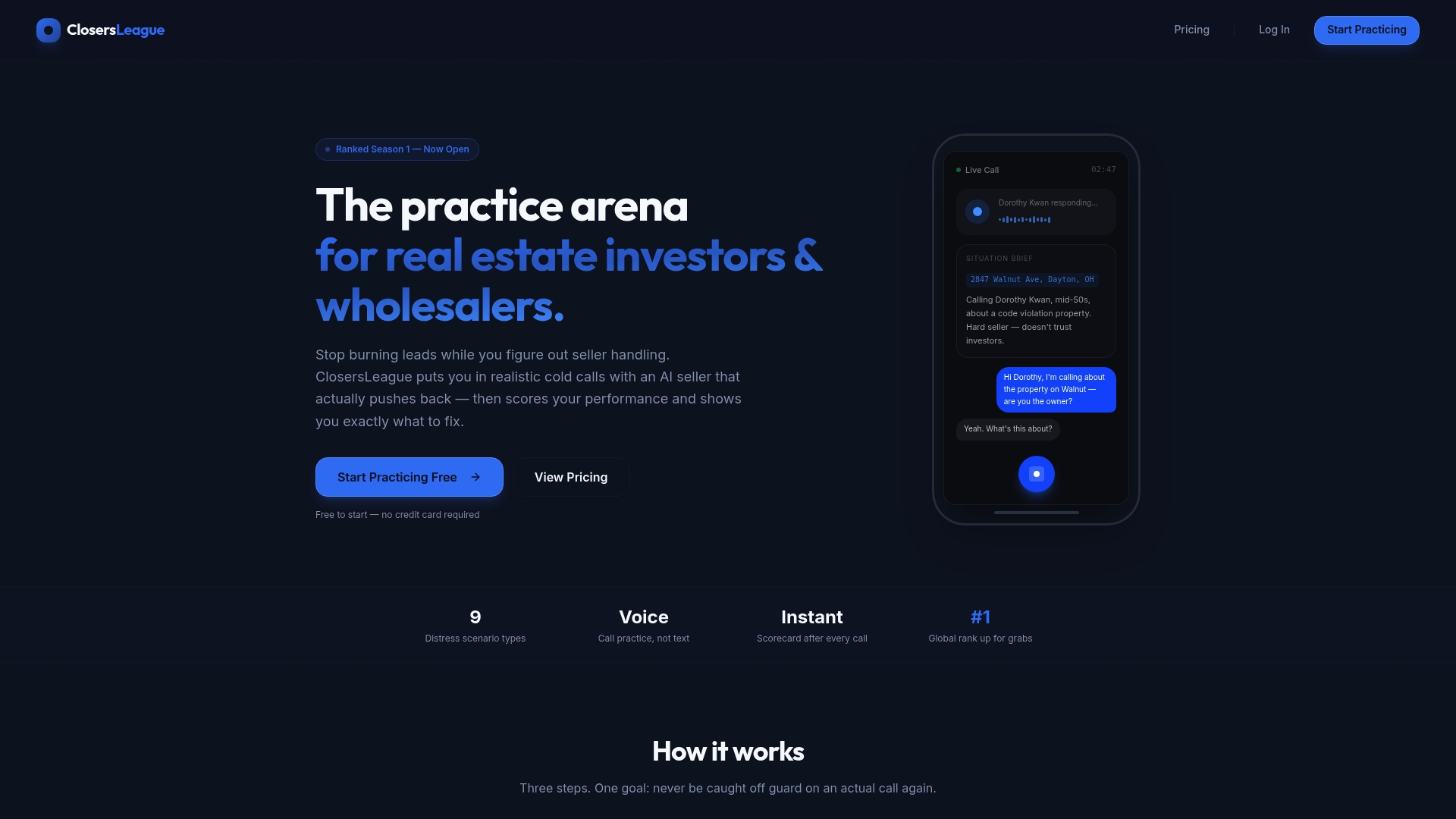
Start your free trial on ClosersLeague and run your first calibration session this week. Load a scenario, complete two AI roleplay rounds, and bring the auto-scores to your next team meeting. The first session takes 45 minutes. The improvement starts the same day.
Sources
- Can AI Solve The Real Estate Industry’s Coaching Problem? | Inman Real Estate News
- Meet the AI platform giving every agent a personal coach
FAQ
What is a call calibration session for real estate investors?
A call calibration session is a structured group practice meeting where investors and wholesalers run AI roleplay calls against distressed-seller scenarios, score each call against a shared rubric, and align on what a strong call sounds like before dialing real homeowners.
How often should you run call calibration sessions?
Active dialing teams benefit from weekly 45-minute sessions. Smaller or mixed teams typically run biweekly 60-minute sessions, with monthly deep-dives for teams of three or fewer reps.
Which scenarios should you include in a calibration session?
Rotate across probate, inherited, pre-foreclosure, code violation, divorce, and vacant or out-of-state landlord scenarios. ClosersLeague’s inherited property and code violation modules include scenario-specific objection flows built for calibration use.
What KPIs measure whether calibration is working?
Track composite scorecard average, week-over-week score improvement per rep, call-to-appointment yield, and objection survival rate. A composite score reaching 70+ within 60 days is a reliable early indicator that the program is producing real skill gains.
How does AI improve the call calibration process?
AI handles repetitive scoring, auto-transcription, and progress tracking so human facilitators can focus on the calibration discussion rather than logistics. As Justin Benson noted, that division of labor is what makes consistent, personalized coaching scalable without a full-time coaching budget.