Yes, leave the voicemail. Keep it under 25 seconds, lead with something specific, say your number twice, and follow up with an email within 15 minutes. Do this for no more than two attempts per prospect. What follows are the scripts, the timing, and the data behind why this exact formula outperforms both silence and rambling.
TL;DR:
- Pair short, relevant voicemails with a quick follow-up email within 15 minutes to more than double reply rates.
- Limit voicemail attempts to two per prospect to avoid decreasing response likelihood due to repetition.
- Keep voicemail messages between 18 and 25 seconds, prioritizing clarity and pacing over length.
- Focus on delivering a scripted, structured message that opens with relevance and includes one specific value point.
- Track voicemail response rates and transcription quality weekly to refine timing, scripts, and delivery.
Table of Contents
- Cold Call Voicemail Basics: What Separates a Good One From Dead Air
- Cold Call Voicemail Best Practices: A Checklist You Can Use Today
- Cold Call Voicemail Scripts You Can Use Right Now
- How to Practice Your Voicemail Delivery Before It Counts
- Handling Gatekeepers and Objections When You Only Get a Voicemail
- Tailoring Your Voicemail Script by Industry and Buyer Type
- When Is the Best Time to Leave a Cold Call Voicemail?
- Tracking Voicemail Data to Improve Outreach Over Time
- When Voicemail Is the Right Call (and When to Skip It)
- Practice Cold Call Voicemails With ClosersLeague’s AI Roleplay
- Sources
- FAQ
Cold Call Voicemail Basics: What Separates a Good One From Dead Air
A cold call voicemail is not a mini pitch. It is a primer. Its job is to make the next touch, usually an email, land harder than it would on its own. Sales teams that treat voicemail as a standalone conversion event set themselves up to be disappointed, because that is not the metric that moves.
Here is the industry-standard framing you need to understand before scripts matter: voicemail drop strategy in modern outbound sales measures success downstream, not on the call itself. Gong’s analysis of cold call data found that pairing a voicemail with a follow-up email sent within about 15 minutes lifts email reply rates from roughly 2.73% to 5.87%. That is more than double. The voicemail itself rarely triggers an immediate callback. It triggers curiosity that gets satisfied when the email lands.
There is a real ceiling on how often this works, though. A synthesis of 300 million cold calls from Prospeo shows one or two targeted voicemails per prospect improve response, but three or more voicemails start dragging reply rates below baseline. Sales reps call this the voicemail cliff, and it is not a minor drop. Repeated, ignored voicemails train a prospect to recognize your number and let it ring through to voicemail automatically, which quietly kills your future connect rate on that same lead.
Length matters just as much as frequency. Aggregated sales call data shows messages in the 18 to 25 second range get materially better callback and completion rates than anything running past 30 seconds. Part of the reason is behavioral: most people don’t listen to a full voicemail anymore. They read the transcription.
- Voicemails work as a primer for email, not a replacement for it.
- Two voicemails per prospect is the practical ceiling before returns turn negative.
- Messages between 18 and 25 seconds outperform longer ones.
- Transcription behavior means your opening seconds get read as text, not heard as tone.
Only about a quarter of outbound calls result in a live connection, according to Gangly’s sales call data, which means the other roughly 72% is voicemail territory. If you’re not optimizing for it, you’re ignoring most of your outbound activity.
Cold Call Voicemail Best Practices: A Checklist You Can Use Today
Good voicemails follow a structure, not a mood. Winging it is how you end up rambling for 45 seconds and burying your number somewhere in the middle. Here is the sequence that holds up across scripts, industries, and call volumes.
1. Open with relevance, not your name. The first 8 to 10 seconds carry the entire message because that is what shows up in the transcription preview on most phones. Prospeo’s analysis of large call datasets found that front-loaded relevance, not a formal introduction, is what earns a callback. Say why you’re calling before you say who you are.
2. State one specific reason or value point. Not three. One. “I noticed your property near Route 9 has been vacant for a few months” beats “I wanted to reach out about potential opportunities we might be able to explore together” every time. Specificity signals you did homework; vagueness signals a script you’re reading off a spreadsheet.
3. Say your phone number twice, slowly. This sounds obvious and gets skipped constantly. Say it once at a normal pace, then repeat it slower the second time, digit group by digit group. If a prospect has to replay your voicemail to catch the number, you’ve already lost some of them.
4. Close with a low-friction next step. “Call me back” is weak. “Call or text me back, or I’ll try you again Thursday” gives the prospect an easy out and sets an expectation.
5. Keep the whole thing to 15 to 22 seconds. Time yourself. Read the script out loud with a stopwatch running before you ever leave it live. Most reps think their scripts are 15 seconds until they clock in at 40.
Pro Tip: Record yourself leaving the voicemail to your own phone first. Play back the transcription your carrier generates. If it reads like garbled nonsense, your pacing or diction needs work before your prospects ever hear it.
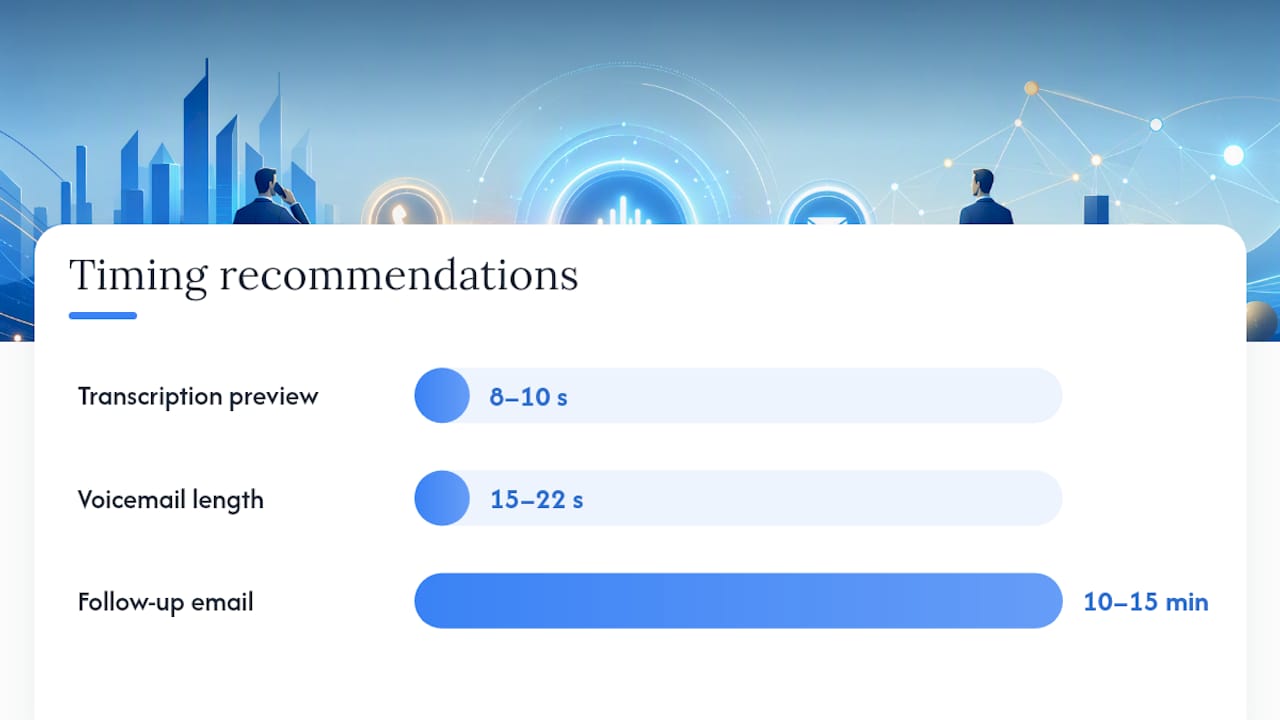
Pairing voicemail with email is where the real lift happens, as explained in lead nurturing explained: Boost conversions with effective strategies. Send the follow-up email within 10 to 15 minutes of the voicemail, not at the end of the day. Gong’s data shows that speed is part of what drives the reply lift. Use a subject line like “Just left you a voicemail” and reference the exact same reason you gave on the call. Consistency between the two touches is what makes the sequence feel intentional instead of scattershot.
Cadence discipline matters as much as message quality:
- Leave a maximum of two voicemails per prospect before shifting tactics.
- Space the two attempts by several days rather than back-to-back calls.
- If you continue outreach after two voicemails, rotate to a different channel (text, LinkedIn, a different email angle) instead of a third voicemail.
- If you’re calling from a multi-line dialer, rotate outbound numbers periodically so no single number gets flagged.
A few operational items get overlooked and quietly sabotage good scripts. Register your outbound numbers with CNAM so your business name (not “Spam Likely”) shows up on caller ID. Keep your contact data clean. Stale numbers and duplicate records waste voicemail attempts on dead leads. And watch your connect rates over time. Prospeo’s research points out that carrier filtering and spam labeling often explain a sudden drop in pickups far more than anything wrong with your script. Fix the data problem before you rewrite the message for the fifth time.
Cold Call Voicemail Scripts You Can Use Right Now
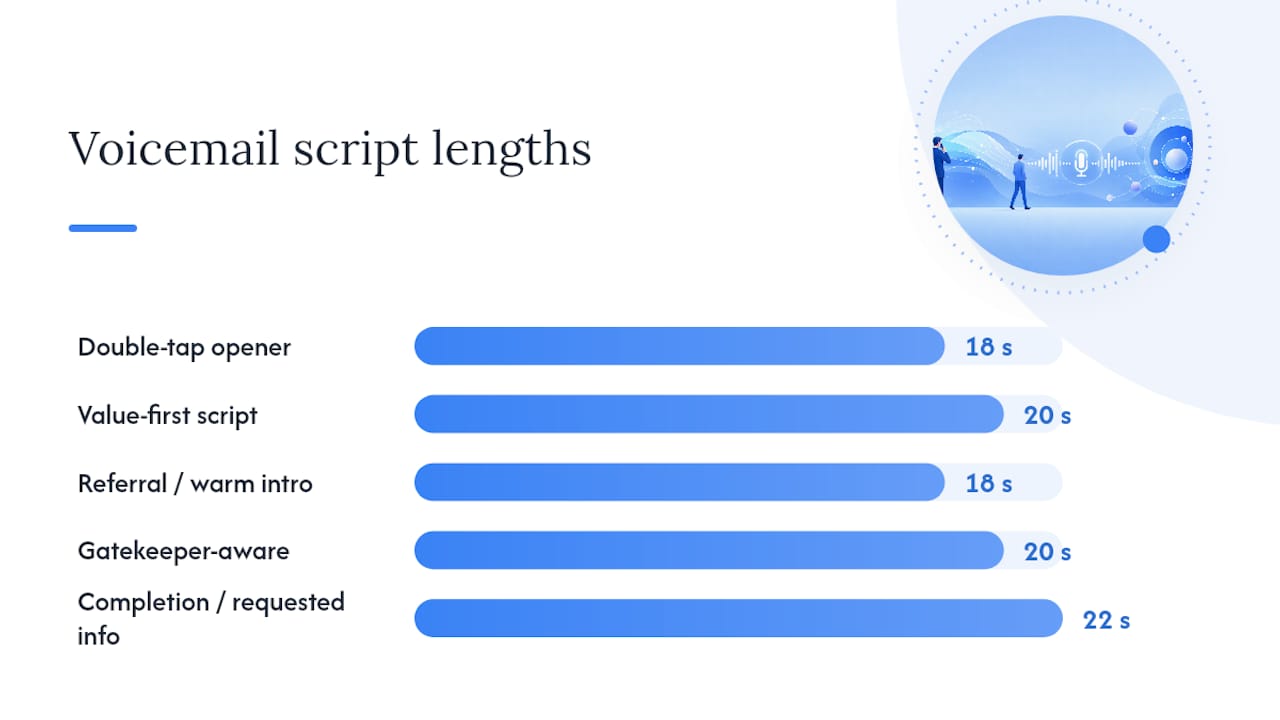
Below are five voicemail script templates built around real seller and buyer scenarios. Each one respects the 15 to 22 second window, front-loads the reason for calling, and repeats the phone number. Adapt the specifics to your situation, but keep the skeleton intact.
1. The double-tap opener (works for most cold calls, 18 seconds).
“Hi, this is [Name] with [Company]. I’m calling about the property on [Street Name], I think there might be an opportunity to help you out with it. My number is [number], again that’s [number, spoken slower]. Call or text anytime.” Pause briefly after the address before moving to the number. Follow with an email subject line: “Left you a voicemail about [Street Name].”
2. The value-first script (mentions a specific result, 20 seconds).
“Hi [Name], this is [Name] with [Company]. We recently helped a homeowner in [neighborhood] close on their property in under three weeks with no repairs needed. Wanted to see if that’s something that could help you too. Call me at [number], one more time that’s [number].” Slow down noticeably on the closing line and the number. Follow-up email subject: “Closed in 3 weeks, no repairs, thought of you.”
3. The referral or warm intro script (18 seconds).
“Hi [Name], this is [Name] with [Company]. [Referral source] mentioned you might be dealing with [situation, e.g., an inherited property], and thought I could help. Give me a call at [number], that’s [number] again.” The referral name should land in the first five seconds. This is one place where naming a person actually earns attention instead of feeling like an intrusion. Follow-up email subject: “[Referral source] suggested I reach out.”
4. The gatekeeper-aware script (for numbers where an assistant or family member might pick up first, 20 seconds).
“Hi, this is [Name] with [Company], calling for [prospect name] about the property at [address]. It’s regarding a potential offer, nothing urgent, but I’d love to connect. My direct line is [number], again [number].” Naming the exact reason reduces the chance it gets treated as a nuisance call and discarded before reaching the intended person. Follow-up email subject: “Following up on a message for [prospect name].”
5. The completion or requested-info script (for prospects who already asked for details, 22 seconds).
“Hi [Name], it’s [Name] with [Company] following up like I promised, with the information on [specific topic] we talked about. I’ll also send it over by email right now so you have it in writing. If you have questions before then, reach me at [number], one more time [number].” This script runs slightly longer because it references a prior conversation, which justifies the extra few seconds. Follow-up email subject: “Here’s that info I promised.”
Every one of these leans on the pattern Cognism’s script roundup and other industry sources converge on: relevance opener, one specific value line, repeated number, low-friction close. If you’re calling on distressed properties specifically, these cold calling scripts for real estate investors show how to adapt the opener for probate, pre-foreclosure, and inherited property situations where the reason for calling needs extra tact.
How to Practice Your Voicemail Delivery Before It Counts
Scripts fail on delivery more often than on wording. A flat, rushed voice reads as a robocall even when the words are perfect. Fix delivery with a short, repeatable drill instead of hoping you improve by accident on live calls.
Start with a 30 to 60 second vocal warmup before any calling block. Read a paragraph out loud at double your normal pace, then again at half speed, exaggerating consonants. This wakes up your mouth and prevents the mumbled first ten seconds that kill transcription clarity. A longer warmup routine built specifically for investor calling sessions walks through the full sequence if you want more structure.
Record every practice voicemail, not just your live ones. Play back the transcription your own phone generates. If key words like your number or the property address come through garbled, that is a pacing problem, not a bad phone connection. Fix it before it costs you a callback.
Run a three-call roleplay drill: leave the same script three times, varying only your pace, your energy, and where you place the pause before the phone number. Listen back and score each on clarity, and whether a stranger could jot down your number without replaying the message.
- Warm up your voice for 30 to 60 seconds before any calling block.
- Record and transcribe your own practice voicemails.
- Run three variations of the same script and compare playback clarity.
- Track email reply rate within 24 hours, transcription accuracy, and callback rate over each week.
Pro Tip: Score your own voicemails the way you’d score a rep on your team. If you wouldn’t coach someone else to leave it, don’t leave it yourself.
Handling Gatekeepers and Objections When You Only Get a Voicemail
Sometimes the “gatekeeper” isn’t a person, it’s the voicemail system itself, screening every call before a human ever hears it. Your message has to survive that filter without sounding evasive or overly salesy, because vague voicemails get deleted at the same rate as obvious spam calls.
If you know a call is likely routed through an assistant or family member first, name the actual prospect by first and last name early in the message. This does two things: it signals you’re not a mass robocall, and it gives whoever screens messages a clear reason to pass it along instead of trashing it.
Avoid stacking objection rebuttals into a voicemail. You cannot argue with someone who isn’t there. If your instinct is to preempt “I’m not interested” with a counter, drop that instinct entirely; save objection handling for the live call. A voicemail’s only job is to earn the callback, not win the argument in advance.
One underused move: reference a specific, low-stakes detail that makes the message feel personal rather than templated. “I noticed the property’s been vacant since spring” lands differently than “I’m interested in your property.” The first sounds like you looked something up. The second sounds like a form letter with blanks filled in.
If a call keeps getting intercepted by the same gatekeeper, vary your calling window across a few different times of day rather than assuming the message itself is the problem. Sometimes the fix isn’t the script, it’s when you’re calling and who happens to be near the phone at that hour.
Tailoring Your Voicemail Script by Industry and Buyer Type
A voicemail written for a probate lead should not sound like one written for a tired landlord managing four rentals. The reason for calling changes, and so should the tone.
For pre-foreclosure and tax delinquent situations, urgency without pressure works best. Reference the timeline gently (“I understand there’s a deadline coming up”) without sounding like you’re circling a distressed situation for profit. Compassionate specificity outperforms generic urgency here.
For probate and inherited property leads, slow the pace down and soften the opener. These prospects are often grieving or managing an estate they didn’t ask for. A script that sounds transactional will get deleted immediately. Lead with acknowledgment, not the deal.
For divorce situations, keep the message neutral and brief. Avoid any language implying you know details of the split. Reference only the property, and keep the tone businesslike rather than sympathetic, since sympathy from a stranger can feel intrusive.
For out-of-state or absentee owners, lean into convenience. These owners are often juggling a property they can’t easily manage in person, so a script emphasizing a remote-friendly, low-hassle process tends to land better than one focused on price.
For code violation or vacant property owners, specificity about the property’s condition (without judgment) builds credibility fast. Mentioning the actual issue shows you’ve done your homework rather than blasted a list.
The skeleton stays the same across all of these: relevance opener, one specific line, repeated number, easy close. Only the emotional register shifts.
When Is the Best Time to Leave a Cold Call Voicemail?
Timing affects both connect rates and voicemail effectiveness, though the effect is more about consistency than finding one magic hour. Early morning calls (roughly 8 to 9 AM) and late afternoon calls (around 4 to 5 PM) tend to catch people between fixed obligations, whether that’s a work schedule or household routine. Midday calls compete with lunch and errands, which is part of why connect rates dip in that window across most outbound sales data.
Day of week matters similarly. Tuesday through Thursday consistently outperforms Monday (too much backlog) and Friday (mental checkout starts early for a lot of people). This isn’t a strict rule, it’s a pattern that shows up across enough outbound campaigns that it’s worth building your calling blocks around it rather than ignoring it.
If your first voicemail attempt lands on a Tuesday morning, don’t repeat the exact same time slot for your second attempt. Vary it, try a Thursday afternoon instead. This does double duty: it increases the odds of catching the prospect during a different part of their routine, and it avoids training them to expect (and screen) your call at a predictable moment.
None of this replaces good targeting. A perfectly timed voicemail to the wrong prospect still gets deleted. But once your list is solid, shaving inefficiency out of your calling schedule is a low-effort way to improve your numbers without changing a single word of your script.
Tracking Voicemail Data to Improve Outreach Over Time
You can’t improve what you don’t measure, and voicemail is one of the most under-tracked parts of most outbound programs. Reps log calls and connects, but rarely track voicemail-specific metrics separately from the rest of the funnel.
Three numbers matter most. First, email reply rate within 24 hours of a paired voicemail, since this is the metric Gong’s research shows moves the most. Second, voicemail completion and transcript quality, meaning whether your message plays cleanly and reads coherently when transcribed. Third, raw callback rate, which matters but shouldn’t be the only number you watch, since it undersells voicemail’s real function as an email primer.
Track these weekly, not monthly. Voicemail performance shifts fast when you change even one variable, your opener, your pacing, your number placement, and monthly reviews bury that signal under too much noise. If reply rates dip for two weeks straight after you change a script, that’s a fast enough signal to revert or adjust before the change compounds across your whole pipeline.
A simple spreadsheet tracking date, script version, time of day, and 24-hour email reply outcome will surface patterns most CRMs don’t isolate on their own. If you’re running enough volume that manual tracking gets unwieldy, that’s usually the point where structured practice and performance scoring start paying for themselves, something worth revisiting once you’ve validated your script manually first.
When Voicemail Is the Right Call (and When to Skip It)
Voicemail earns its place in your sequence when you have a specific reason to call, a fast follow-up email ready to go, and the discipline to stop after two attempts. Skip it when you have nothing specific to say. A vague voicemail is worse than no voicemail. It burns one of your two shots and teaches the prospect to ignore your number before you’ve said anything worth hearing.
Prioritize voicemail for prospects where you have real information, a specific address, a known situation, a referral name, because that specificity is what makes the message worth transcribing and reading. For cold, thin leads with no distinguishing detail, a text or a second call attempt might serve you better than a generic message.
The bigger lever isn’t calling more. It’s calling better. Most reps chase volume when the data points to practicing delivery, tightening the first ten seconds, and pairing every voicemail with an immediate email.
— Dave
Practice Cold Call Voicemails With ClosersLeague’s AI Roleplay
Reading a script is one thing. Delivering it at 20 seconds flat, with the right pace and no dead air, takes repetition most reps never get outside of live calls with real prospects on the line. Our platform provides a way to build that muscle: AI-powered roleplay scenarios built specifically around real estate seller situations, with real-time coaching on pacing, tone, and delivery.
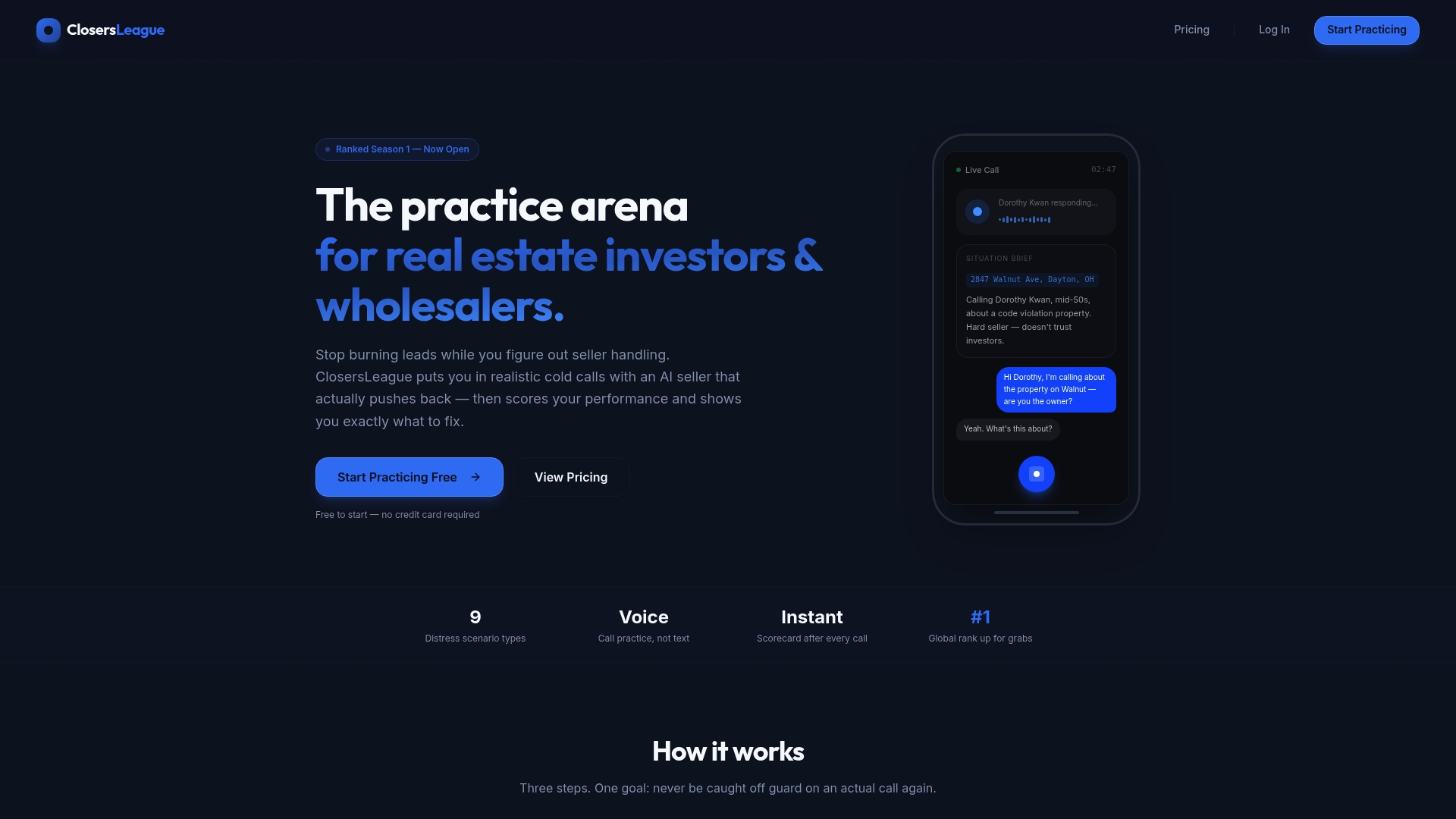
The platform scores your calls against scoring categories and tracks your progress on a leaderboard, so you can see whether your 20 second voicemail is actually landing at 20 seconds or creeping toward 40. A good first drill: run a three-call sequence practicing the double-tap opener script against three different seller emotional states, then review your scorecards for pacing and clarity before you take the script live. If you’re already closing consistently and just need sharper scripts, the cold calling tips for real estate investors guide might be all you need. If you want structured reps before your next calling block, start practicing with ClosersLeague and run your first scored session today.
Sources
- Should you leave voicemails when cold calling? Here’s what the data says — Gong
- Cold Call Voicemail Strategies: What 300M Calls Prove — Prospeo
- Sales Call Statistics 2026: Data Every Rep and Manager Needs — Gangly Blog
- 10 of the best voicemail scripts for cold calling in 2026 — Cognism
FAQ
Should I leave voicemails when cold calling?
Yes. Short, specific voicemails paired with a fast follow-up email more than double email reply rates, according to Gong’s analysis, but stop after two attempts per prospect to avoid the voicemail cliff.
What are the best opening lines for a cold call voicemail?
Lead with a specific, relevant reason for calling rather than your name and company first, since the opening seconds are what most prospects read as a transcription before deciding whether to listen further.
What is a good script for leaving a voicemail?
A strong script opens with relevance, states one specific value point, repeats your phone number slowly, and closes with a low-friction next step, all within 15 to 22 seconds total.
What is the 80/20 rule in cold calling?
Definitions vary, but the version most relevant to voicemail strategy holds that a small share of your scripts, openers, or timing choices drive most of your callbacks, which is why tracking performance by script version matters more than raw call volume.
How many voicemails should I leave one prospect?
Two at most. Data from Prospeo’s 300M-call analysis shows a third voicemail tends to reduce response rates instead of improving them, so shift to email or text after two attempts.