
A foreclosure prospecting checklist is a structured set of criteria and outreach steps that investors and wholesalers use to identify, qualify, and convert distressed homeowners before a property reaches auction. The most effective version combines equity filtering, lead timing, multi-channel outreach, and objection handling into one repeatable system. Platforms like BatchData, EquityTier, and PropStream have made it easier than ever to build this kind of process at scale. What separates investors who close deals from those who burn through lists is not the size of their lead pool. It is the discipline of working a proven checklist every single time.
1. What are the essential criteria to filter foreclosure leads effectively?
Effective pre-foreclosure filtering starts with a minimum 20–30% equity threshold. Properties below that level rarely produce profitable deals once you account for mortgage balances, closing costs, and repair estimates. Exclude them early and protect your time.
Beyond equity, focus your homeowner prospecting checklist on these property and owner traits:
- Property type: Single-family homes are the most liquid and easiest to wholesale or flip. Exclude corporate-owned and bank-owned properties since those sellers rarely negotiate outside formal channels.
- Lien status: Multiple liens signal complexity. A second mortgage or IRS lien can kill a deal at closing. Pull lien data before you dial.
- Vacancy indicators: A vacant property signals urgency. The owner is likely paying a mortgage on a home they no longer occupy, which increases motivation to sell.
- Owner occupancy: Absentee owners facing foreclosure are often more willing to negotiate than occupants who still hope to stay.
Segmenting leads by equity tiers (High, Moderate, Low, No) lets you tailor your offer strategy before the first call. High-equity leads are candidates for traditional cash purchases. Moderate-equity leads may work for subject-to deals. Low and No equity leads are generally unproductive unless you are pursuing short sales, which require a different skill set entirely.
Pro Tip: Filter out No-equity leads before they enter your CRM. Chasing them wastes follow-up capacity that belongs on your best prospects.

2. How can investors source and maintain an efficient foreclosure lead list?
Building a reliable foreclosure leads guide starts with knowing where the data originates. Public records like county recorder filings, Notices of Default (NOD), and Lis Pendens documents are the earliest signals that a homeowner is in trouble. Here is a practical sourcing sequence:
- Pull county recorder filings weekly. NOD and Lis Pendens data is public record in most states. Many counties post updates online. Set a calendar reminder to pull new filings every Monday.
- Use a data aggregation platform. Tools like PropStream, BatchLeads, and EquityTier compile nationwide foreclosure data updated daily. They save hours of manual courthouse research.
- Build smart searches with automated alerts. Most platforms let you save filter sets and receive notifications when new properties match your criteria. This keeps your list fresh without manual effort.
- Layer in skip tracing. Raw NOD data rarely includes phone numbers. Services like BatchSkipTracing or integrated skip tracing within PropStream append owner contact information so you can actually reach people.
- Drive for dollars in target neighborhoods. Physical observation catches vacant and distressed properties that may not yet appear in data feeds. Pair this with an app like DealMachine to log and research properties on the go.
- Network with foreclosure attorneys and title companies. These professionals often know about distressed situations before public filings appear. A single referral relationship can generate consistent deal flow.
- Load all leads into a CRM immediately. Tools like REsimpli, Podio, or Follow Up Boss let you tag leads by equity tier, filing date, and outreach stage. Without a CRM, follow-up falls apart.
Successful investors treat prospecting as a systematic, repeatable business process rather than a one-time activity. Your list is only as good as the system you use to work it.
3. What is the best outreach strategy to convert foreclosure prospects?
Timing is the single biggest variable in foreclosure marketing strategies. Start outreach within 30 days of the NOD filing. Investors who mail once and move on lose deals to competitors who stay in front of the homeowner consistently.
Your outreach sequence should include multiple channels:
- Day 1: Send a direct mail postcard. Keep the message simple, empathetic, and solution-focused. Avoid language that feels predatory or alarmist.
- Day 3: Make a cold call. Introduce yourself, acknowledge the situation without judgment, and ask open-ended questions about their plans.
- Day 5: Send a text message. Short and direct. “Hi, this is [name]. I sent you a letter about your property. Happy to talk if you have questions.”
- Day 7: Follow up with a handwritten letter. This stands out in a pile of generic mail and signals genuine interest.
- Days 14, 21, 30+: Continue with monthly check-ins via call or mail until the property sells, is lost to auction, or the owner resolves the situation.
A rigorous multi-step follow-up schedule at these specific intervals significantly improves closing odds. Most deals close after the fifth or sixth contact, not the first.
Objection handling is where most investors lose momentum. When a homeowner mentions a loan modification, do not retreat. Loan modifications succeed in less than 40% of cases and typically take 3–6 months to process. Position yourself as a backup plan. Tell them you respect their decision and ask if you can stay in touch in case things change.
AI-assisted outreach improves lead qualification by 30% and closure rates by 10–15% when paired with genuine human contact. That combination is the current best practice for serious investors.
Pro Tip: Record your cold calls and review them weekly. You will catch tone problems, missed objection responses, and pacing issues that cost you deals.
4. How do timing and lead age influence foreclosure prospecting success?
Lead age is one of the most underused filters in a property investment checklist. Leads aged 14–60 days after filing represent the sweet spot for homeowner motivation. The homeowner has had time to absorb the shock of the filing but still has enough runway to consider options.
Here is how lead age shapes your approach:
- 0–14 days (too new): Many homeowners are still in denial. They believe the bank will work with them or that the filing was a mistake. Outreach at this stage often gets rejected. You can still mail, but do not expect callbacks.
- 14–60 days (sweet spot): The homeowner is starting to feel real pressure. They are more open to conversations and more likely to respond to empathetic outreach. This is your highest-priority window.
- 60+ days (approaching auction): Urgency is high, but so is stress. Messaging needs to shift toward speed and certainty. Homeowners at this stage need to know you can close fast and without complications.
Homeowner mindset shifts significantly across these stages. Early contact builds trust over time. Last-minute aggressive pitches rarely work and can damage your reputation in a market. Consistent early outreach wins more deals than any single high-pressure call.
5. What tools and data points should be on your checklist?
A complete foreclosure prospecting checklist is only as strong as the data behind it. Before you make a single call, you need specific numbers in front of you.
| Data Point | Why It Matters | Recommended Source |
|---|---|---|
| Estimated equity and LTV | Determines deal viability before outreach | PropStream, BatchLeads |
| Mortgage balance and liens | Reveals total debt load and deal complexity | County recorder, EquityTier |
| Property tax status | Delinquent taxes add to seller urgency | County assessor records |
| Owner contact info | Skip tracing accuracy drives connection rates | BatchSkipTracing, PropStream |
| Filing date | Sets your outreach timing and message tone | County NOD/Lis Pendens data |
| Property condition indicators | Affects ARV and offer price | Driving for dollars, MLS comps |
| CRM outreach history | Prevents duplicate contacts and tracks follow-up | REsimpli, Podio, Follow Up Boss |
Advanced investors filter leads by real-time equity tiers and prioritize outreach accordingly. Knowing LTV before you dial tells you whether to pursue a cash purchase, a subject-to deal, or skip the lead entirely. That decision takes seconds when your data is clean and current.
AI coaching tools and cold call simulators add another layer. Practicing your pitch against realistic objections before live calls sharpens your delivery and reduces the hesitation that kills deals. ClosersLeague builds this kind of practice environment specifically for foreclosure and pre-foreclosure scenarios.
6. How to build consistent prospecting habits that sustain deal flow
Consistency in prospecting routines produces more deals than any single burst of intense activity. Investors who work their checklist daily, even for 90 minutes, outperform those who sprint for a week and then disappear.
The most effective real estate prospecting tips are not complicated. Block time on your calendar for lead review, outreach, and follow-up every weekday. Treat it like a sales job because it is one. Set weekly targets for new leads added, calls made, and follow-ups completed. Track those numbers in your CRM and review them every Friday.
Mixing active prospecting with passive channels like social media and content builds both short-term leads and long-term pipeline. A Facebook post about a recent deal or a short video explaining how you help homeowners avoid foreclosure generates inbound interest that costs nothing beyond your time. Combine that with your direct outreach system and you create multiple paths to the same motivated seller.
The investors who build the most consistent pipelines treat their foreclosure leads process as a business system, not a hustle. Systems scale. Hustle burns out.
Key takeaways
A foreclosure prospecting checklist works when it combines precise equity filtering, timed outreach starting within 30 days of NOD filing, and a persistent multi-channel follow-up sequence.
| Point | Details |
|---|---|
| Filter by equity first | Target properties with at least 20–30% equity to make deals financially viable. |
| Time your outreach carefully | Leads aged 14–60 days post-filing offer the highest homeowner motivation. |
| Use multiple contact channels | Combine calls, texts, postcards, and handwritten letters across a 30-day sequence. |
| Segment leads by equity tier | High, Moderate, Low, and No equity tiers each require a different offer strategy. |
| Practice objection handling | Loan modifications fail over 60% of the time; position yourself as the backup plan. |
What I have learned about foreclosure prospecting after years in the trenches
Most investors fail at foreclosure prospecting not because they lack data or tools. They fail because they treat it like a lottery instead of a process.
I have watched investors spend thousands on PropStream subscriptions and BatchLeads data, then mail a list once and wonder why the phone never rang. The data is not the problem. The follow-up discipline is. The homeowners who sell to you are rarely the ones who called back on day three. They are the ones you stayed in front of for 45 days while every other investor moved on.
The equity tiering piece changed how I work more than any other single adjustment. Once I stopped chasing No-equity leads, my call-to-conversation ratio improved immediately. I was spending the same amount of time but talking to people who actually had options. That shift alone is worth more than any new tool or script.
The other thing I would push back on is the idea that AI tools and human empathy are in conflict. They are not. AI helps you practice, qualify faster, and stay consistent. But the homeowner on the other end of that call is facing one of the most stressful moments of their life. The investors who close deals are the ones who sound like they genuinely want to help, not the ones with the slickest script. Use the tools. Practice hard. Then show up on the call like a human being.
— Dave
Sharpen your foreclosure calls with ClosersLeague
Knowing your checklist is one thing. Executing it under pressure on a live call is another. ClosersLeague is an AI-powered cold calling training platform built specifically for real estate investors and wholesalers. You can practice realistic pre-foreclosure cold calling scenarios that simulate real homeowner objections, emotional responses, and difficult conversations before they happen on a real deal.
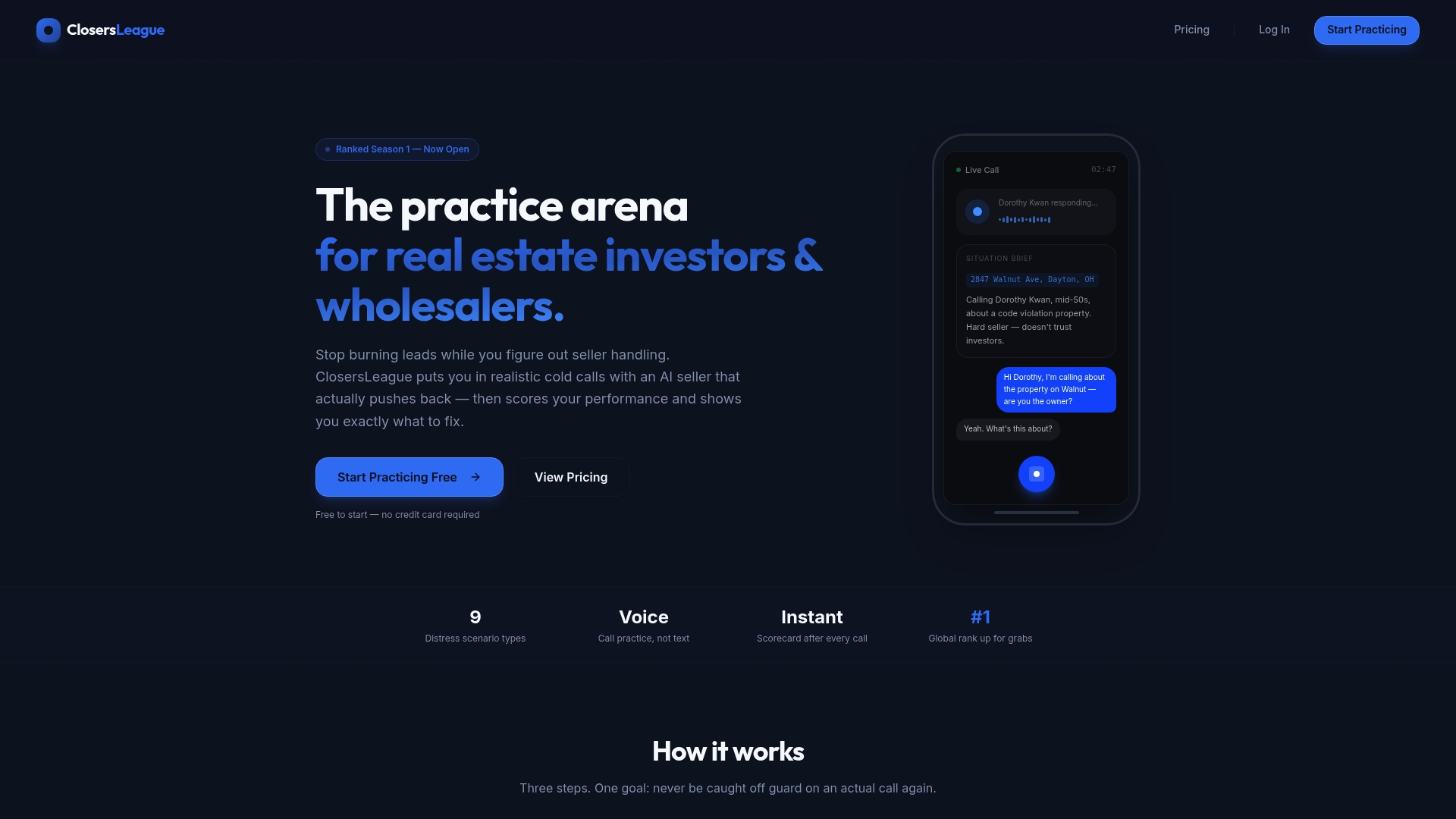
Stop winging your foreclosure calls. Start drilling them. Visit ClosersLeague to practice foreclosure prospecting conversations, score your performance, and build the confidence that converts motivated sellers into closed deals.
FAQ
What is a foreclosure prospecting checklist?
A foreclosure prospecting checklist is a structured set of criteria and outreach steps investors use to identify, qualify, and contact distressed homeowners before a property reaches auction. It covers lead sourcing, equity filtering, outreach timing, and follow-up cadence.
How much equity should a foreclosure lead have?
Target properties with a minimum of 20–30% equity. Properties below that threshold rarely produce profitable deals after accounting for mortgage balances and closing costs.
When is the best time to contact a pre-foreclosure homeowner?
The best window is 14–60 days after the Notice of Default filing. Homeowners at this stage are motivated but still have time to consider options, making them more receptive to outreach.
How many times should I follow up with a foreclosure lead?
Follow up at days 1, 3, 5, 7, 14, 21, and 30, then monthly after that. Most deals close after the fifth or sixth contact, not the first.
What should I say when a homeowner mentions a loan modification?
Acknowledge their plan and position yourself as a backup option. Loan modifications succeed in less than 40% of cases and take 3–6 months to process, so staying in the conversation keeps you top of mind if the modification falls through.