The instant a homeowner turns hostile, stop talking and start validating: acknowledge the anger out loud, ask one soft question, then redirect to a small next step. Drop your tone half a register and slow your pace. Never argue back or defend the call. Either end with a low-pressure micro-ask (“Is it okay if I follow up in writing?”) or exit politely and log exactly what triggered the reaction.
TL;DR:
- Validating homeowner anger by acknowledging their feelings and asking an open question helps reduce hostility and makes them more receptive.
- Keeping silent for one to two seconds after venting shows respect and prevents escalation, increasing the chance for a productive micro-commitment.
- Starting calls with permission-based introductions avoids triggering defensiveness, and responses to objections should be treated as data rather than defeat.
- Ending calls immediately after threats, repeated hang-ups, or direct “leave me alone” requests prevents escalation and protects compliance integrity.
- Practicing handling angry calls through roleplay drills and AI simulations builds quick reflexes and improves effectiveness in real hostile situations.
Table of Contents
- Handling Angry Homeowners: A Step-by-Step De-Escalation Framework
- What to Say When a Homeowner Gets Angry: Scripts That Work
- When Should You End a Call With an Angry Homeowner?
- How Closers League Trains Callers to Handle Angry Homeowners
- Why Empathy-First Calling Wins
- Practice This Until It’s Reflexive
- Sources
- FAQ
Handling Angry Homeowners: A Step-by-Step De-Escalation Framework
Most callers freeze or fight back when a homeowner snaps. Both reactions make things worse. The fix is a repeatable sequence you can run on autopilot, even when your own heart rate spikes.
1. Validate first, every time. Say something like, “You have every right to be frustrated. I probably would be too.” This isn’t a script trick. It’s grounded in NAR’s research on the psychological toll of foreclosure, which found that homeowners in distress often carry shame and grief long before they carry paperwork. Validating gives them permission to stop performing anger and start actually talking.
2. Ask one clarifying question. Not “Do you want to sell?” Try “What’s been the hardest part of dealing with this?” Open questions pull the conversation out of fight mode.
3. Redirect to a micro-commitment. Don’t chase a yes on the property. Chase a yes on the next tiny step: “Would it help if I just sent over some information you can look at later?” This Validate → Question → Redirect pattern shows up across practitioner cold-calling frameworks because it keeps the door open without forcing a decision the homeowner isn’t ready to make.

Your voice matters more than your words here. Leave a full one to two seconds of silence after they finish venting. Silence reads as respect. Interrupting reads as another person trying to control the situation.
Once the temperature drops, ask for something small: permission to text a one-pager, or a better time to call back. That’s your out. A calendar note beats a hard close every time on a first hostile call.
Follow-up cadence matters as much as the call itself:
- Send a short, neutral note within an hour if you have contact info.
- Check back in 7 to 10 days, not sooner. Practitioners tracking pre-foreclosure timelines describe a narrow window where receptivity spikes once a homeowner has run out of other options, so patience often outperforms urgency.
- If two follow-ups get no response or a repeat hostile reaction, move the lead to an internal do-not-call list rather than a fourth attempt.
Document every hostile call the same day: what triggered it, what you said, how it ended. Retain recordings where your state allows it. Flag escalation patterns for your team lead so nobody else walks into the same landmine unprepared. Our guide to talking with distressed homeowners breaks down more of this cadence in detail.
Pro Tip: Write your redirect line down and read it out loud five times before your next call session. Under real anger, you will default to whatever phrasing is already in muscle memory, not whatever sounded good on paper.
What to Say When a Homeowner Gets Angry: Scripts That Work
Words matter, but sequencing matters more. Open with permission, not filing language. Never lead with “I saw your notice of default” or “I know you’re in foreclosure.” That framing puts the homeowner on the defensive before you’ve said your name.
A safer opener: “Hi, this is [Name] with [Company]. I work with homeowners in your area who are exploring their options on a property. Is now an okay time, or should I try later?” It’s honest, it’s low pressure, and it gives them an easy exit that doesn’t require anger.
Different hostile reactions need different responses:
- Accusatory (“How did you get my number?”): “Totally fair question. Public records show properties in transition, and I reach out because a lot of homeowners in your situation want options they didn’t know existed.”
- Hang-up threat: “I’ll let you go. If it’s ever useful, feel free to call me back. No pressure.” Then stop talking. Reversing the pressure often keeps them on the line longer than pushing does.
- Direct hostility or a raised voice: Lower yours, pause, and say, “I hear you. I’m not here to make this harder.” Then wait.
Voicemail on sensitive lists needs the same restraint. Keep it neutral and informational, never mentioning filings, deadlines, or legal status. According to pre-foreclosure calling guidance, referencing official foreclosure filings in a voicemail is one of the fastest ways to trigger a complaint, since the homeowner never agreed to hear that information from a stranger.
When you hit an objection, treat it as data, not defeat. “I understand, this isn’t the right time” plus a question, “Can I check back in a few weeks instead?”, turns a wall into a door.
Pro Tip: Swap “I can help you avoid foreclosure” for “I can walk you through your options.” The second version is not just safer under state foreclosure-consultant statutes; it’s also more accurate about what you’re actually offering on a first call.
When Should You End a Call With an Angry Homeowner?
Some calls need to end, not de-escalate. Know the hard stops before you dial:
- Threats of any kind. End the call immediately and document it. No exceptions.
- A direct “leave me alone” or “don’t call again.” That’s a legal instruction, not just frustration. Add them to your internal do-not-call list the same day.
- Repeated hang-ups after two attempts. Move on. Persistence past this point reads as harassment, not diligence.
Compliance isn’t optional context here. Scrub every list against the national and state Do Not Call registries before dialing, since TCPA violations carry real financial exposure. Disclose honestly who you are and why you’re calling. Record calls where state law permits one-party or two-party consent, and retain them for your compliance file, a practice pre-foreclosure calling research flags as essential given how legally sensitive this seller category is. Our foreclosure prospecting checklist covers list scrubbing in more depth.
Escalate to a senior agent or your compliance lead the moment a call involves a threat, a legal statement from the homeowner, or a request you’re not trained to handle.
How Closers League Trains Callers to Handle Angry Homeowners
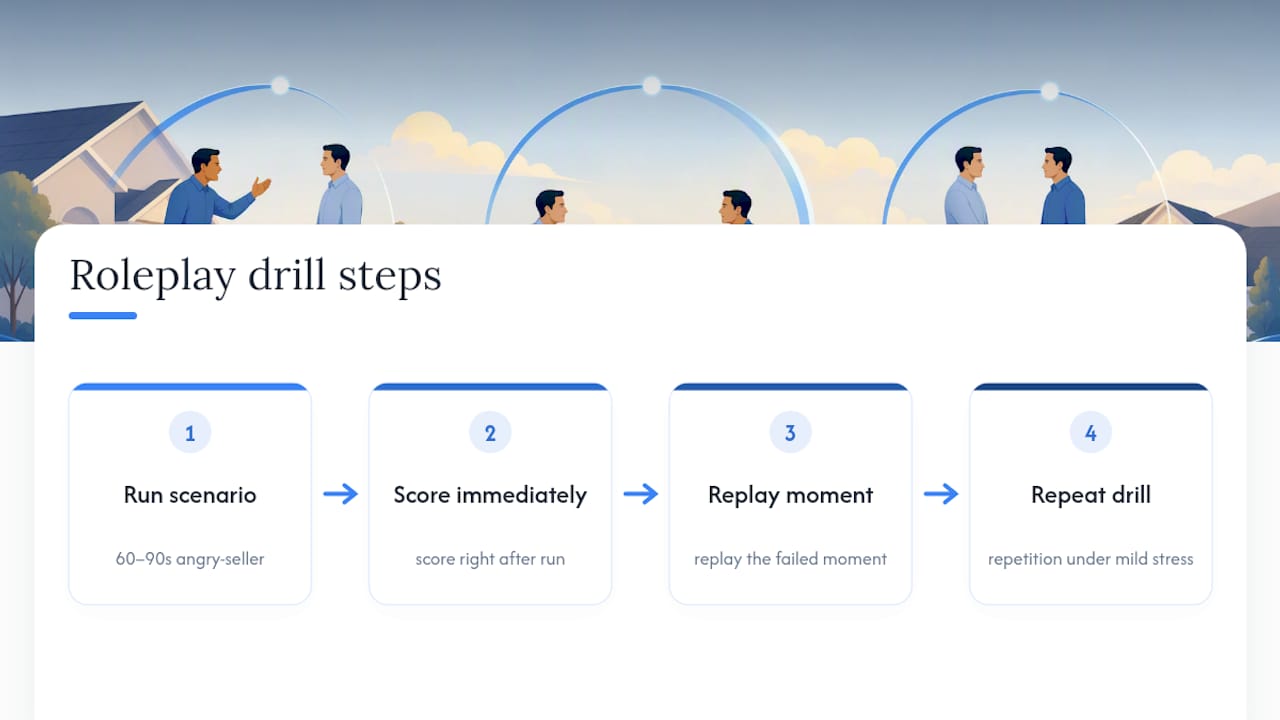
Reading a script and running it live under pressure are different skills. That gap is why roleplay drills work: run a 60 to 90 second angry-seller scenario, score it immediately, then replay the exact moment that went sideways. Repetition under mild stress builds the reflex faster than any amount of note reading.
Track three things in every review: how many escalation moments happened, how long it took the caller to validate, and whether the redirect landed. New callers should handle general distress leads first. Route pre-foreclosure and probate calls, the most legally and emotionally loaded categories, to your most experienced agents.
Why Empathy-First Calling Wins
Shame and the Ostrich Effect keep distressed homeowners from answering calls at all. Empathy is what earns you the conversation. Treating anger as engagement, not rejection, protects both the deal and your reputation.
— Dave
Practice This Until It’s Reflexive
Reading scripts on a page and running them live under real anger are two different skills, and the gap between them is where deals get lost. The platform was built to close that gap with AI-powered roleplay that throws realistic hostile-seller scenarios at you, scores your Validate → Question → Redirect execution in real time, and drills the exact seller type you’re weakest with, whether that’s pre-foreclosure, probate, or divorce.

You can start with the free trial and run your first angry-homeowner scenario today, no scheduling, no roleplay partner needed. If you’re working inherited property leads specifically, that scenario track is built to match. Once you know your gaps, compare the Starter, Growth, and Pro plans and pick the call volume that matches how often you’re actually dialing. If you’d rather see the full platform first, the cold calling practice overview walks through every seller-type track available.
Sources
For deeper background, review NAR’s foreclosure mental-health research, Asset Resolution Advisors on psychological equity loss, and Sayso’s cold-calling script guide. If lead generation is thin, real estate SEO services can help fill your calling pipeline.
FAQ
What’s the fastest way to calm an angry homeowner on a call?
Validate their frustration out loud, lower your tone and pace, then ask one open question instead of defending yourself. This Validate → Question → Redirect sequence is documented across practitioner cold-calling frameworks as the most reliable way to reopen a hostile conversation.
Should I mention foreclosure or legal status in my opener?
No. Leading with filing details or foreclosure status increases defensiveness and complaint risk. Pre-foreclosure calling guidance recommends permission-based openers that focus on options, not legal status.
When should I stop calling an angry homeowner?
Stop immediately after any threat, a direct “leave me alone” request, or two consecutive hang-ups. Log the outcome and move them to your internal do-not-call list rather than trying again.
How can I practice handling angry homeowners before a real call?
Roleplay drills with immediate scoring build the reflex faster than reading scripts alone. ClosersLeague’s AI roleplay lets you run angry-seller scenarios by property type and get instant feedback, with plans starting at $5 per month.
Is it legal to call homeowners in pre-foreclosure?
It can be, but only with proper Do Not Call scrubbing, honest disclosure, and careful avoidance of phrases that resemble foreclosure-consultant services under state law. Review the specific statutes for your state before dialing this list, as detailed in pre-foreclosure cold calling rules.