
A homeowner objection is any expression of concern or hesitation from a property owner that signals they need more information, trust, or reassurance before agreeing to sell or move forward with a contract. In real estate sales, these objections are not refusals. They are requests for clarity. The industry recognizes five universal objection categories: price, timing, comparison shopping, decision-maker involvement, and trust-related hesitation. Investors and wholesalers who train on all five categories consistently achieve close rates of 40% or higher. Understanding what drives each objection is the first step toward closing more deals.
What is a homeowner objection in real estate sales?
A homeowner objection is a verbal signal that something in the conversation has not yet earned full buy-in. The term “sales objection” is the standard industry label for this concept. In real estate investing and wholesaling, you will hear it called a homeowner objection because the seller is a property owner, often in a distressed situation such as foreclosure, probate, or divorce.
Objections are not dead ends. They are the homeowner’s way of testing whether you are worth trusting with one of the largest financial decisions of their life. Objections test your value as a professional, and how you respond determines whether the conversation continues or collapses. Investors who treat every objection as a question to answer, rather than an obstacle to push past, build stronger relationships and close more deals.
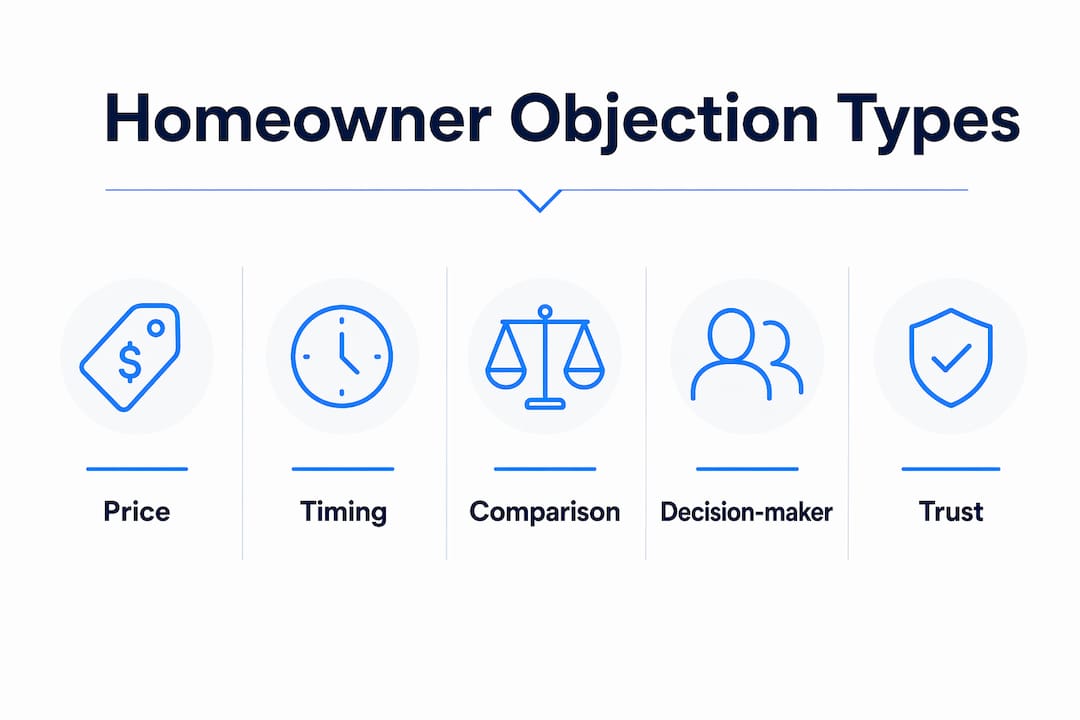
The five categories cover nearly every concern a homeowner will raise. Price objections question whether your offer is fair. Timing objections reflect uncertainty about when to act. Comparison objections signal the homeowner wants to explore other options. Decision-maker objections arise when a spouse or family member is not present. Trust objections show up as vague stalls like “I need to think about it.”
What are the common types of homeowner objections?
Each objection category has a distinct profile. Recognizing the type quickly lets you respond with precision instead of guessing.

| Objection type | Typical homeowner statement | What it really means |
|---|---|---|
| Price | “Your offer is too low.” | They question the value or fairness of your number. |
| Timing | “Now isn’t a good time.” | They feel uncertain or unprepared to commit. |
| Comparison shopping | “I want to get other quotes first.” | They lack confidence that your offer is the best available. |
| Decision-maker | “I need to talk to my spouse.” | A key decision-maker was not part of the conversation. |
| Trust or thinking time | “I need to think about it.” | They are masking a deeper concern they have not voiced. |
The most misread objection is “I need to think about it.” This phrase masks another concern 90% of the time. It is rarely genuine reflection. It is a polite exit that protects the homeowner from an awkward moment. If you accept it at face value and schedule a follow-up call, you will likely lose the deal.
Common homeowner objection examples from distressed seller calls include:
- “I already have a real estate agent.”
- “My neighbor sold for more than that.”
- “I’m not sure I’m ready to sell yet.”
- “My son handles all of this for me.”
- “Let me pray on it and get back to you.”
Each statement maps to one of the five categories. Recognizing the category is the diagnostic step that makes your response relevant and credible. You can sharpen this skill by reviewing distressed seller scripts built around real objection patterns.
Why do homeowners raise objections?
Homeowners raise objections as a form of self-protection. Most objections are protective reflexes masking underlying fears about affordability, trust, or value rather than outright rejection. A homeowner facing foreclosure may say “the price is too low” when the real fear is embarrassment about their financial situation. A probate seller may say “I need to think about it” when they are actually grieving and not ready to let go of the property.
“The most common deal failures arise not from price or product but from a lack of genuine connection and honest communication.” — questionfirstgroup.com
Homeowners also raise objections to avoid social discomfort. They do not want to say “I can’t afford to wait” or “I don’t trust you yet” because those statements feel vulnerable. So they use polite stalls instead. Homeowners often mask true concerns to avoid appearing unable to afford a deal or to prevent awkward interactions during the call.
Understanding this psychology changes how you listen. When a homeowner objects, your job is not to rebut. Your job is to diagnose. Ask yourself which of the five categories this objection belongs to, then respond to the real concern underneath the words.
Pro Tip: Before you respond to any objection, pause for two seconds. That pause signals confidence and gives you time to identify the real category of concern rather than reacting to the surface statement.
Objections also serve as relationship checkpoints. Responding with empathy builds trust and leads to better client relationships and repeat business. Responding with defensiveness ends the conversation. Every objection is a chance to prove you are different from the last investor who called.
How to handle homeowner objections effectively
Effective objection handling follows a clear sequence: diagnose, acknowledge, respond, confirm. Skipping any step reduces your close rate.
- Diagnose the real concern. Ask a clarifying question before responding. “When you say the price feels low, is it more about the number itself or about what you’d walk away with after costs?” This surfaces the true objection.
- Acknowledge without agreeing. Say “I completely understand” or “That makes sense given your situation.” This lowers defensiveness without conceding your position.
- Respond to the root concern. Address the actual fear, not the surface statement. If the real concern is trust, share a specific example of a deal you closed in similar circumstances.
- Involve all decision-makers early. Involving all decision-makers at the first conversation prevents the “I need to talk to my spouse” objection and avoids duplicate appointments that waste everyone’s time.
- Pre-empt comparison objections. Provide a written breakdown of your offer and process upfront. Detailed feature sheets neutralize comparison shopping objections and position you as transparent and credible before the homeowner even asks.
- Confirm resolution. After responding, ask “Does that address your concern?” or “Does that make sense?” Confirmation closes the loop and moves the conversation forward.
Pro Tip: Open every call with an honest agreement. Say something like: “If at any point this doesn’t feel like the right fit, I’d rather you tell me directly than feel like you have to be polite. Fair enough?” This shifts the dynamic from pressure to collaboration and reduces polite stalls later in the call.
Price objections deserve special attention. Never discount immediately. Price objections reflect perceived lack of value, not just sticker shock. Investors who immediately lower their offer train homeowners to negotiate every time, which damages your credibility and your margins. Instead, communicate value. Walk the homeowner through what your offer includes: fast closing, no repairs, no agent commissions, no uncertainty. You can also review proven investor script workflows to build responses that hold your position while keeping the homeowner engaged.
Common pitfalls when addressing homeowner objections
Most investors lose deals not because the offer was wrong but because they mishandled the objection conversation. These are the errors that kill close rates most often:
- Treating objections as attacks. Responding defensively signals insecurity. Homeowners read defensiveness as a sign that your offer cannot stand on its own merits.
- Discounting on the first price objection. Dropping your number immediately tells the homeowner that your original offer was inflated. It also invites further negotiation on every future call.
- Ignoring the decision-maker issue. If you complete a full appointment without confirming who else needs to approve the sale, you risk losing the deal to an absent spouse or family member who was never part of the conversation.
- Accepting “I need to think about it” without probing. This is the most expensive mistake in real estate cold calling. Letting a polite stall end the conversation without diagnosing the real concern means you will never get a second chance to address it.
Pro Tip: When a homeowner says “I need to think about it,” respond with: “Of course. Just so I can make sure I’ve given you everything you need, what specifically would you want to think through?” This question surfaces the real objection without pressure.
Overcoming homeowner objections requires you to stay curious, not combative. The investors who close the most deals are the ones who ask the best questions, not the ones with the sharpest rebuttals. Build your cold calling skills around diagnosis and empathy, and your close rate will reflect it.
How planning objections differ from sales objections
Homeowner objections also appear in a completely different context: formal planning and development processes. These are written submissions made by property owners during public consultations on nearby construction or development projects. They are legally distinct from sales objections but can directly affect real estate transactions.
Planning objections are valid only when based on material planning considerations such as privacy loss, overshadowing, or traffic impact. Non-material concerns like property value loss generally carry no weight with planning authorities.
Key differences between planning objections and sales objections:
- Planning objections are formal written documents submitted to local authorities.
- Sales objections are verbal expressions of hesitation during a negotiation.
- Planning objections can delay development timelines, which may affect a seller’s willingness or urgency to close.
- Sales objections can be resolved in a single conversation with the right response.
Strategic negotiation on design details yields better outcomes than blanket opposition in planning contexts. A homeowner who focuses on influencing window placement or boundary setbacks is more likely to achieve a meaningful result than one who simply objects to the entire project. For real estate investors, understanding this distinction matters when a seller’s timeline is affected by a nearby development dispute.
Key takeaways
Homeowner objections are diagnostic signals, and the investor who reads them correctly closes more deals than the one who simply pushes harder.
| Point | Details |
|---|---|
| Five universal objection types | Price, timing, comparison, decision-maker, and trust cover nearly every concern a homeowner raises. |
| “Think about it” is a mask | This phrase hides a real objection 90% of the time; always probe before accepting it. |
| Diagnose before responding | Ask a clarifying question first to identify the root concern, then tailor your response. |
| Never discount on price first | Communicate value instead; immediate discounting trains homeowners to negotiate every call. |
| Involve all decision-makers early | Confirm who else must approve the sale at the start to prevent last-minute delays. |
What I’ve learned about objections after years on the phone
The biggest shift in my thinking came when I stopped treating objections as problems to solve and started treating them as information to collect. Every “no” or stall a homeowner gives you is a data point. It tells you exactly what they need to feel safe enough to say yes.
The investors I’ve seen struggle the most are the ones who respond to every objection with a rebuttal. They win the argument and lose the deal. The ones who close consistently are the ones who get quiet, ask one good question, and let the homeowner talk. That one question almost always reveals the real concern, and the real concern is almost always something you can address directly.
Pre-empting objections with an honest agreement at the start of the call is the single highest-leverage habit I’ve seen. When you tell a homeowner upfront that you want them to be direct with you, most of them will be. That honesty agreement changes the entire tone of the call. You stop getting polite stalls and start getting real conversations. Real conversations close.
Mastering objection handling also does something that most investors underestimate. It builds your reputation. Homeowners talk to their neighbors, their family members, their attorneys. When you handle a tough objection with empathy and professionalism, that homeowner remembers it. Referrals come from those moments, not from the deals where everything went smoothly.
— Dave
Practice objection handling with ClosersLeague
Reading about objection handling builds awareness. Practicing it builds skill. ClosersLeague is an AI cold calling training platform built specifically for real estate investors and wholesalers. You can run live roleplay scenarios covering every objection type, from price pushback on a foreclosure call to a trust stall on an inherited property conversation.

The platform scores your responses in real time and gives you feedback on tone, phrasing, and objection diagnosis. You can drill the same scenario repeatedly until your response feels natural, not rehearsed. If you want to sharpen your full cold calling approach, the ClosersLeague practice platform covers every seller type and objection scenario in one place. Stop winging it. Start drilling.
FAQ
What is a homeowner objection in simple terms?
A homeowner objection is any concern or hesitation a property owner expresses during a sales conversation that signals they need more information or reassurance before agreeing to sell.
What are the five types of homeowner objections?
The five universal types are price, timing, comparison shopping, decision-maker involvement, and trust-related hesitation. Training on all five leads to close rates of 40% or higher.
Why do homeowners say “I need to think about it”?
This phrase is a polite stall that masks a real concern 90% of the time. Ask a follow-up question to surface the actual objection before ending the conversation.
How do you handle a price objection without discounting?
Communicate value instead of lowering your number. Walk the homeowner through what your offer includes, such as fast closing, no repairs, and no agent fees, before adjusting any figures.
What is the difference between a sales objection and a planning objection?
A sales objection is a verbal hesitation during a negotiation. A planning objection is a formal written submission to a local authority during a development consultation, valid only when based on material planning considerations.