Mirroring means repeating the last one to three words someone said, in a slight upward tone, to get them talking more. Labeling means naming their emotion out loud, “It sounds like you’re worried about the timeline,” to bring the temperature down. Use mirroring when you need more information and labeling when you need to calm the room. Then stop talking. The pause after either move is doing half the work.
TL;DR:
- Mirroring should be used primarily to gather more details by repeating key words with a rising tone, especially early in conversations or objections.
- Labeling effectively lowers emotional tension by naming feelings out loud, which activates neural mechanisms that reduce stress and improve reasoning capacity.
- Silence after each technique is crucial and should last at least three seconds to maximize the calming and information-gathering effects.
- Overusing mirrors, distractions like filler words, or premature problem-solving can diminish the effectiveness of these techniques.
- Practice drills involving the rule of three, neutralizing negative labels, and combining mirrors with calibrated questions accelerate skill development and readiness.
Table of Contents
- What Are Mirroring and Labeling in Negotiation?
- Why Does Labeling Calm People Down?
- How Do You Mirror and Label a Conversation Step by Step?
- What Mistakes Ruin Mirroring and Labeling?
- How Do You Practice Mirroring and Labeling Before a Real Call?
- How ClosersLeague Applies These Drills at Scale
- When Should You Mirror Instead of Label, and Vice Versa?
- Do Mirroring and Labeling Work the Same Way for Every Personality?
- How Do Mirroring and Labeling Fit With Calibrated Questions?
- Where These Tactics Stop and Manipulation Starts
- Want to Practice These Techniques on Real Seller Scenarios?
- Sources
- FAQ
What Are Mirroring and Labeling in Negotiation?
Mirroring is repetition with a purpose. You take the last one to three words your counterpart used, echo them back with a slight question mark in your voice, and let silence do the rest. It’s borrowed directly from Chris Voss’s mirroring exercise, the former FBI hostage negotiator whose framework has become the backbone of modern tactical empathy training. Say a homeowner tells you, “I just don’t have the money to fix this place up.” You mirror: “Fix this place up?” That’s it. No follow up question, no advice. You wait, and almost always, they keep talking.
Labeling works differently. Instead of repeating words, you name what you think the other person is feeling or dealing with, using a soft opener: “It seems like this decision is more complicated than just the money.” “It sounds like you’ve been carrying this alone.” “It looks like there’s some history here with this property.” You’re not diagnosing them. You’re offering a hypothesis about their emotional state, and giving them room to correct you if you’re wrong.
Here’s the practical split:
- Use mirroring when you want more detail. It costs the other person almost nothing to keep talking after a mirror, so it’s ideal early in a call or when you sense there’s an unspoken reason behind a stated objection.
- Use labeling when the emotional temperature needs to drop. Anger, defensiveness, grief, and anxiety respond well to being named out loud. Fear shrinks when it’s spoken.
- Combine them in sequence. Mirror to get the story, label to calm the reaction to the story, then mirror again to dig deeper.
Most people default to asking direct questions when tension rises, which tends to make a defensive person more defensive. Mirroring and labeling let you gather the same information, or defuse the same reaction, without ever putting someone on the spot.
Why Does Labeling Calm People Down?
Labeling isn’t a soft communication trick. It has a measurable effect on the brain’s threat response, and that’s the part most negotiation advice skips entirely.
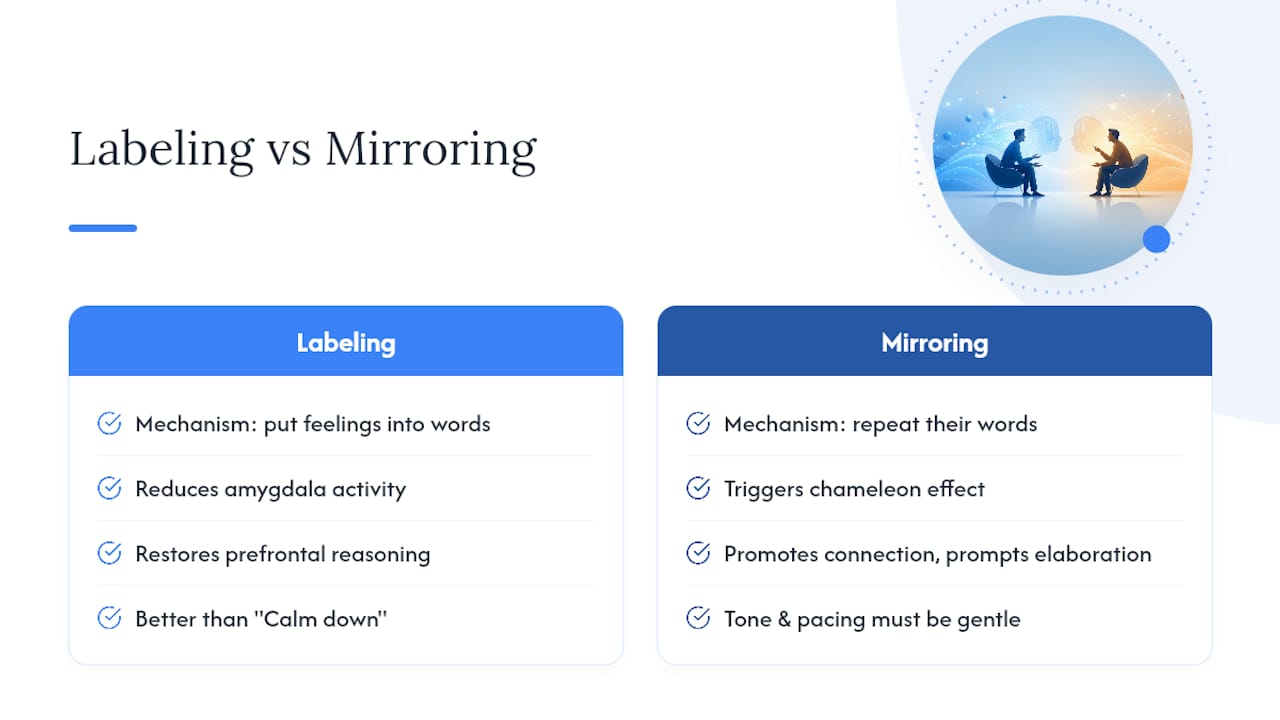
Putting feelings into words measurably calms the brain’s alarm system. Research from the UCLA Semel Institute on affect labeling shows that naming an emotion reduces activity in the amygdala, the region responsible for triggering fight-or-flight responses. When someone is flooded with anger or fear, their prefrontal cortex, the part of the brain that reasons and negotiates, goes offline. Naming the emotion out loud brings some of that reasoning capacity back online.
That’s the mechanism behind why “It sounds like you’re feeling stuck” works better than “Calm down” or “I understand.” The label gives the emotion somewhere to go instead of just circulating.
Mirroring works on a different lever. Repeating someone’s own words back to them taps into something close to the chameleon effect, the well-documented tendency for people to feel more connected to those who reflect their language and behavior. When you mirror, the other person unconsciously registers that you’re tracking closely with them, and the natural response is to elaborate rather than shut down.
Tone and pacing matter as much as word choice, making social media messaging strategies a relevant example of applying mirroring principles across channels. A flat, rushed delivery cancels out the effect of a well-chosen label. Slowing your pace, dropping your pitch slightly, and tolerating a few seconds of silence after you speak signals safety to a nervous system that’s currently scanning for threat. Silence isn’t dead air here. It’s the mechanism doing its job.
How Do You Mirror and Label a Conversation Step by Step?
Both techniques are simple to describe and genuinely hard to execute under pressure, mostly because our instinct in a tense conversation is to fill silence, defend ourselves, or jump straight to solving the problem. Here’s the sequence that actually works in real calls.
Mirroring, step by step
- Listen for the load-bearing words. As the other person talks, isolate the one to three words carrying the most emotional or informational weight, what negotiation trainers call the Rule of 3. Not the whole sentence. Just the phrase that seems to matter most.
- Repeat it back with a slight upward inflection. Turn it into a soft question, not a statement. “The lawyers are involved?” lands differently than a flat “The lawyers are involved.”
- Stop talking. This is the step people skip. The mirror only works if you let the silence sit there and pull more words out of the other person.
- Repeat as needed. A single conversation might use three or four mirrors in a row before you ever ask a direct question.
Labeling, step by step
- Pick your opener. Stick to observational language: “It seems like…”, “It sounds like…”, “It looks like…”. Avoid “I think” or “I feel,” which shifts the focus onto you instead of them.
- Name the emotion or dynamic, not the fact. Don’t label the house. Label the person’s relationship to the situation: “It sounds like this has been dragging on longer than you expected.”
- Pause and let it land. Don’t soften the label with a quick follow up question. Let the silence stretch, even if it feels uncomfortable. Five seconds is longer than it sounds and it’s usually exactly what’s needed.
- Accept correction gracefully. If they say “No, it’s not that, it’s…” you just got better information than a direct question would have produced.
Delivery matters more than script
Voss famously teaches what he calls a “late night FM DJ voice,” slow, low, and calm, for both mirrors and labels. Match the other person’s energy at first, then bring your own intensity down slightly rather than matching their heat exactly. Avoid “I” statements almost entirely during this phase. “I understand how you feel” centers you; “It sounds like you’ve had a rough few months” centers them. And resist the urge to solve anything before the emotional temperature has actually dropped. Offering a fix while someone is still activated usually gets ignored or rejected outright, not because the fix is wrong, but because they’re not in a state to evaluate it yet.
Pro Tip: Record yourself on a practice call and count the seconds of silence after each label. If you’re pausing less than three seconds, you’re probably talking through the moment where the technique actually works.
A quick phone script
Caller: “I don’t even know why I’m still dealing with this house. My brother won’t return my calls.”
You (mirror): “Won’t return your calls?”
Caller: “No, and I’m the one paying the taxes on it every year while he just ignores everything.”
You (label): “It sounds like you’re carrying the weight of this by yourself.”
Caller: “Exactly. Nobody else seems to care.”
Notice you learned about the sibling conflict and the tax burden in under thirty seconds, without asking a single direct question. That’s the entire point of the sequence.
What Mistakes Ruin Mirroring and Labeling?
The techniques fail less often because they’re wrong and more often because they’re rushed, overused, or delivered with the wrong intent behind them. Here’s what tends to go sideways.
- Overusing mirrors. Mirroring every single sentence starts to sound like an echo chamber and the other person will notice. Space them out and mix in genuine questions.
- Saying “I understand.” It’s the single most common substitute people reach for instead of labeling, and it does the opposite of what a label does. It shifts focus to you and invites the reply “No, you don’t.”
- Filling silence with filler. “Right, right, totally, yeah” after a mirror kills the effect. The quiet is the tool.
- Problem solving too early. Jumping to a solution before someone’s emotional state has settled reads as dismissive, even when the solution is good.
- Treating a label like it has to be perfect. It doesn’t. A mislabel often prompts a correction, and that correction is genuinely useful information you didn’t have before.
If a label clearly misses and the person shuts down instead of correcting you, don’t double down. Acknowledge it briefly (“Fair enough, tell me more about that”) and shift back to mirroring until you’ve got a clearer read. Treat every label as a hypothesis, not a verdict, and you’ll recover from a bad guess almost every time.
How Do You Practice Mirroring and Labeling Before a Real Call?
These skills degrade fast under real pressure if you’ve only read about them. Deliberate, timed practice is what separates someone who understands the concept from someone who can actually use it on a tense call. Three drills cover most of what you need.
- The Three Mirrors drill. Grab a practice partner or a recorded conversation. Your only job for five minutes is to respond to everything with a mirror, no questions, no comments, just repeating the last one to three critical words. Aim for at least three consecutive mirrors before you allow yourself a direct question. This trains the instinct to repeat instead of ask.
- The negative label neutralizer. Have your partner voice a frustrated or resistant statement (“This is a waste of my time”). Your job is to label the emotion behind it within five seconds: “It sounds like you feel like this call isn’t worth it.” Run this ten times and track how many labels land without triggering more pushback.
- The no-oriented question and label sequence. Ask a question designed to get a “no” (“Would it be a bad idea to walk through the numbers together?”), then label whatever response follows. This combination surfaces objections people wouldn’t state directly, and the label after the “no” usually reveals the real concern underneath it.
Track your sessions the same way you’d track any other skill. Time your silences. Note which labels got a correction versus a confirmation. Count how many words of elaboration you pulled out of a single mirror. The goal isn’t perfection on the first attempt, it’s a visible trend line over ten or twenty repetitions. Reading about how to uncover seller motivation helps you know what to listen for once the drills get you comfortable staying quiet long enough to hear it.
How ClosersLeague Applies These Drills at Scale
Reading about the Rule of 3 is one thing. Running it against a live, unpredictable voice on the other end of the line, forty times a week, is what actually builds the reflex. That’s the gap most negotiation content leaves open: plenty of theory, almost no repeatable practice environment.
The skill isn’t knowing what a label sounds like. It’s having said one out loud, badly, enough times that the good version becomes automatic under pressure.
ClosersLeague’s roleplay training puts investors and wholesalers through AI-driven seller scenarios, probate, pre-foreclosure, divorce, tired landlord, and scores each call on objection handling and emotional read, so a mirror that falls flat or a label that lands well shows up in the data instead of just a gut feeling. That’s the same feedback loop the practice drills above are built around, just run against a distressed seller voice instead of a training partner.
When Should You Mirror Instead of Label, and Vice Versa?
Context decides which tool you reach for, and misreading it is the most common execution error. If someone is still explaining their situation and hasn’t shown much emotion yet, mirror. You’re still gathering the map of their circumstances, and a label at this stage can feel presumptuous, like you’re rushing to a conclusion before you’ve earned it.
Once emotion surfaces, frustration, grief, defensiveness, shift to labeling. A homeowner who snaps “I don’t need a lecture from someone half my age” is not asking for more facts. They’re signaling that something under the surface got triggered, and a label (“It sounds like you’ve had people talk down to you about this before”) addresses the actual obstacle instead of the words on the surface.
In fast-moving phone conversations, the two often alternate every ten to fifteen seconds. In slower, higher-stakes conversations, like an in-person negotiation over a family estate, you might spend several minutes purely mirroring before a single label is warranted, because trust has to build before a label won’t feel intrusive.
One reliable signal: if a direct question would sound intrusive or premature, that’s exactly the moment a mirror or label belongs instead. Direct questions demand an answer. Mirrors and labels invite one, which is why they work in situations where a straightforward interrogation would shut the conversation down.
Do Mirroring and Labeling Work the Same Way for Every Personality?
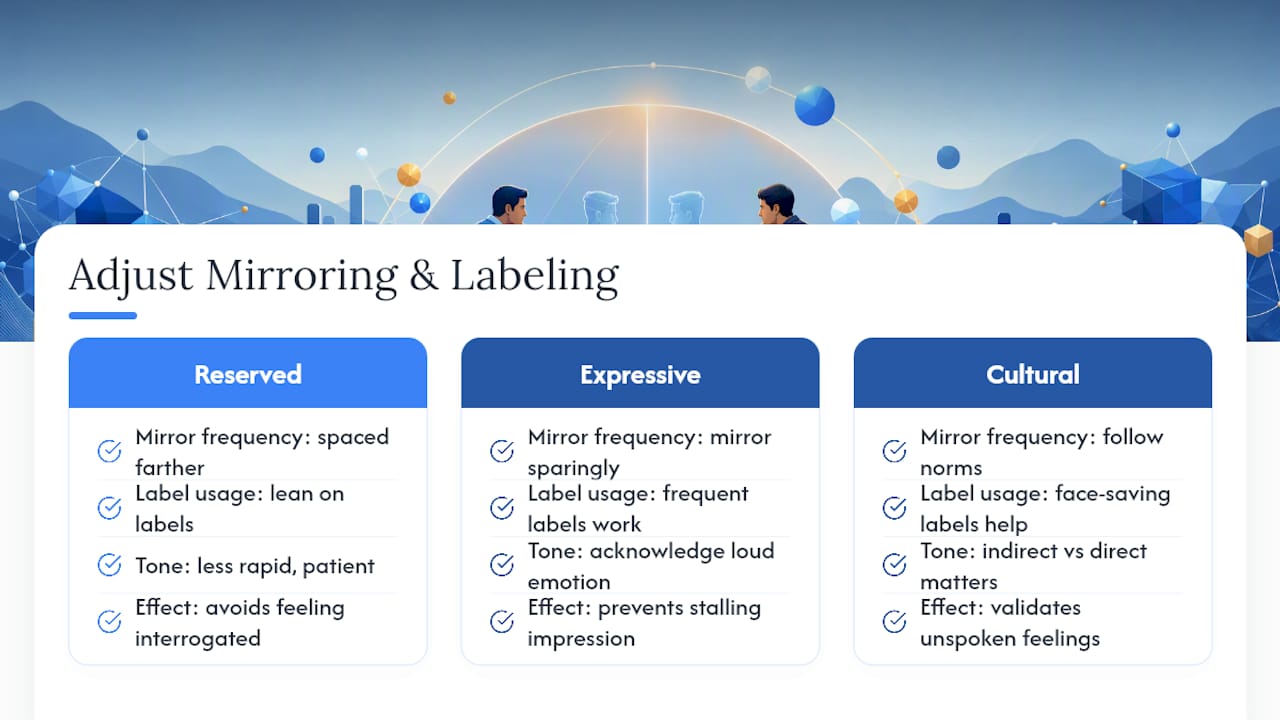
Not quite, and adjusting for the person in front of you matters more than sticking rigidly to a script. Some people, often more analytical or reserved types, find rapid-fire mirroring intrusive, almost like being interrogated in slow motion. With that kind of counterpart, space your mirrors further apart and lean more heavily on labels, which feel less like repetition and more like genuine attentiveness.
Highly expressive or emotionally forward people, by contrast, often respond extremely well to frequent labels, since they’re already broadcasting their internal state and want it acknowledged. Mirror them sparingly. Too much repetition with an already talkative person can come across as stalling rather than listening.
Cultural context shifts the calculus too. In cultures or family dynamics where indirect communication is the norm, a well-placed label can do double duty, it validates the unspoken feeling while giving the person a face-saving way to confirm or correct it without stating things bluntly. In more direct communication cultures, a slightly more assertive label (“This sounds frustrating”) lands better than an overly tentative one.
The rule that holds across every personality type: never let the technique feel like a script. If a label sounds rehearsed, the effect collapses, because the whole mechanism depends on the other person feeling genuinely heard, not processed. Adjust your pacing and word choice to the person, not the other way around.
How Do Mirroring and Labeling Fit With Calibrated Questions?
Mirroring and labeling aren’t a complete toolkit on their own. They’re the front half of a sequence that typically ends with a calibrated question, an open-ended, “how” or “what” question that hands the other person the responsibility for solving a problem, without ever putting them on the defensive.
A workable sequence looks like this: mirror to draw out detail, label to name and lower the emotional charge, then use a calibrated question to move the conversation toward a decision. “It sounds like the repairs feel overwhelming right now” (label), followed by silence, followed eventually by “What would need to happen for this to feel manageable?” (calibrated question).
Paraphrasing belongs in this stack too, though it plays a distinct role. Mirroring repeats a few exact words to invite elaboration; paraphrasing restates the fuller idea in your own words to show you’ve processed it. Effective negotiators layer both together with labeling and calibrated questions rather than treating any single technique as sufficient on its own.
The order matters. Calibrated questions asked before someone feels heard tend to get short, guarded answers. The same question, asked after a label has done its job, tends to open the door to a real answer. If you’re still getting one-word responses to your “how” and “what” questions, the fix usually isn’t a better question. It’s a missing label somewhere upstream.
Where These Tactics Stop and Manipulation Starts
Mirroring and labeling work because they make someone feel heard. The moment you use them to make someone feel heard while intending to steer them toward a decision that isn’t actually good for them, you’ve crossed from tactical empathy into manipulation, and most people can sense that shift even if they can’t name it.
There are conversations where these tools aren’t the right response at all. If someone is in genuine crisis, grieving, in danger, or clearly needs professional support rather than a negotiation tactic, the right move is to listen without an agenda or point them toward real help. A label is not a substitute for a social worker, a therapist, or a hotline.
Used honestly, mirroring and labeling simply slow a conversation down enough for both people to think clearly. If you want a place to start, run the Three Mirrors drill from earlier this week, five minutes, no questions, just repetition. It’s the fastest way to feel the technique work before you ever need it on a real call.
— Dave
Want to Practice These Techniques on Real Seller Scenarios?
Most people trying to build these reflexes practice on friends, coworkers, or nobody at all, which means the first time a mirror or label gets tested for real is on an actual seller call, with real money on the line. That’s a rough way to learn timing.

An AI roleplay platform can close that gap by providing a scored breakdown of how one handles objections and reads emotional cues across scenarios like probate, pre-foreclosure, divorce, and inherited property calls, the exact situations where mirroring and labeling matter most because sellers are dealing with real loss or pressure. Every rep gets logged, so silence timing and elaboration rate can be tracked in a way similar to practice drills, just against an unpredictable AI voice instead of a scripted partner.
If you’re working inherited or probate leads specifically, the inherited property cold calling practice scenarios are built around exactly the emotional dynamics this article covers. Start a free trial call and see how many mirrors it takes before the seller starts telling you what actually matters to them.
Sources
The techniques and evidence in this guide draw on a small set of sources worth going back to directly if you want to go deeper.
- Exercise: Mirroring and Labeling | Chris Voss Teaches the Art of Negotiation
- UCLA affect labeling research (Semel Institute teams page)
- Active Listening in Negotiation: Hear What They’re Really Saying – Academy of Negotiation
FAQ
What Are Examples of Mirroring Behavior?
Mirroring shows up as repeating someone’s last one to three words with a slight upward tone, like echoing “the closing date?” after someone mentions a deadline, to invite them to keep talking without asking a direct question.
How Can You Tell if Someone Is Mirroring You?
You’ll notice them repeating your own phrasing back to you, often as a soft question, followed by a pause instead of their own opinion or a new question, which is a sign they’re drawing more information out of you rather than making small talk.
Is the Mirroring Method a Red Flag?
Mirroring itself is a neutral listening technique, not a warning sign; it only becomes concerning if someone uses it to manufacture false rapport while steering you toward a decision that clearly benefits them and not you.
What Does Mirroring Mean in Sales?
In sales and negotiation, mirroring means repeating a prospect’s key words back to prompt elaboration, a technique popularized by Chris Voss’s mirroring exercise and used across real estate cold calling to surface the real reason behind an objection instead of just the stated one.