
Mirroring on calls means repeating a seller’s own words back to them, in their tone, to keep them talking and build trust fast. It has nothing to do with screen mirroring or connecting phones. It’s conversational: you listen for the last one to three words a seller says, repeat them back with a curious, upward inflection, then go silent. That’s it. This single move, borrowed from FBI hostage negotiator Chris Voss’s mirroring technique, works because it proves you’re listening and it makes silence do the heavy lifting.
- Seller says: “I just don’t have the energy for this anymore.”
- You mirror: “The energy for this?”
- Then you stop talking. Count to two. Let them fill the gap.
Key Takeaways
Mirroring on calls works because echoing a seller’s last few words, then staying silent, prompts them to reveal motivation and timeline without you asking directly.
| Point | Details |
|---|---|
| Use the one-move technique | Repeat the seller’s last one to three words with an upward inflection, then pause for two seconds. |
| Mirror emotion, not facts | Save mirrors for loaded or emotional phrases; skip them on plain factual statements. |
| Stick to verbal mirrors on calls | Body mirroring doesn’t translate over the phone; word and tone mirroring do. |
| Practice in stages | Build pace, then vocabulary, then integrated mirrors over a few weeks before going live. |
| Drill with ClosersLeague | Use AI roleplay and call scorecards to practice mirroring against realistic distressed-seller scenarios and track improvement. |
Table of Contents
- Why Verbal Mirroring Works on Distressed Seller Calls
- How to Mirror on Calls: Step-by-Step Technique
- Mirroring Scripts for Probate, Pre-Foreclosure, and Landlord Calls
- Practice Drills to Build Mirroring Reflex
- Common Mirroring Mistakes and Ethical Lines Not to Cross
- A Coach’s Take on Why This Technique Sticks
- Practice Mirroring With ClosersLeague’s AI Roleplay
- Sources
- FAQ
Why Verbal Mirroring Works on Distressed Seller Calls
Distressed sellers, whether they’re handling a probate, sitting on a pre-foreclosure notice, or exhausted from managing a rental nobody wants to fix, are bracing for a pitch the second they hear “investor” or “cash offer.” Mirroring interrupts that script. It costs you nothing, requires no persuasion, and signals you actually heard what they said instead of waiting for your turn to talk.

The mechanics matter more than the psychology. When you echo the last few words and then hold silence, you create a small conversational vacuum. Most people can’t stand dead air, so they fill it, usually with more detail than they intended to give. Salesforce’s research on sales mirroring notes that mirroring shifts conversations from defensive to collaborative when it acknowledges the emotional weight behind what’s being said, not just the facts.
One distinction matters for phone calls specifically: body mirroring (posture, gestures, matching how someone sits) is a video or in-person tool. On a call, the seller can’t see you, so trying to “mirror” anything visual is wasted effort. SalesArmor’s breakdown of mirroring risk makes the case plainly: deliberate behavioral mirroring is fragile and easy to botch, while verbal mirroring is low-risk because it’s nearly invisible when done right.
- Verbal mirrors work across every call type.
- Behavioral mirrors require visual cues you don’t have on the phone.
- Obvious mimicry (repeating everything, copying their exact cadence) reads as fake and kills trust instantly.
How to Mirror on Calls: Step-by-Step Technique
Mirroring is a skill you build through repetition, not a script you memorize once. Here’s the sequence that works on live seller calls.
- Listen for the loaded phrase. Skip mirroring on flat facts like “I bought it in 2003.” Save it for emotionally charged statements: “It’s been sitting empty,” “My mom passed and left it to us,” “I can’t keep up with the payments.”
- Echo the last one to three words as a question, with an upward inflection. Not a statement, a genuine question.
- Pause. Count to two in your head. This is the hardest part. Most new callers rush to fill silence and kill the mirror’s effect before it works.
- Note what they give you. The elaboration usually contains motivation, timeline, or condition details you’d otherwise have to dig for with direct questions.
- Move into your qualifying framework once they’ve expanded, connecting their answer to motivation, price sensitivity, condition, and timeline.
Tone matters as much as timing. Keep your volume moderate, match their energy subtly (a hurried seller gets a slightly faster mirror, a quiet one gets a softer echo), and never parrot back more than three words. Anything longer stops being a mirror and starts sounding like an interrogation.
Vocabulary mirroring works alongside word-echoing. If a seller calls the property “the burden” instead of “the house,” use their word. Don’t correct their terminology or inject real estate jargon like “as-is” or “assignable contract” into a conversation they’re framing emotionally. Pipedrive’s guidance on phone-specific mirroring points out that voice calls strip away every visual cue, so your words and tone are the entire signal you’re sending.
A simple permission opener sets up the mirror naturally: “Do you mind if I ask a few questions about the property?” Once they say yes, the door is open for mirrors like “A few questions?” or later, “Sitting empty?” Each one invites more than a yes or no.
Pro Tip: Resist the urge to mirror every single sentence. One well-placed mirror per two or three minutes of conversation lands harder than five mirrors in a row, which starts to sound like a verbal tic.
Mirroring Scripts for Probate, Pre-Foreclosure, and Landlord Calls
Context changes how a mirror lands. Here’s how it plays out across three common distressed-seller situations, with the qualifying framework of motivation, timeline, condition, and price in mind.
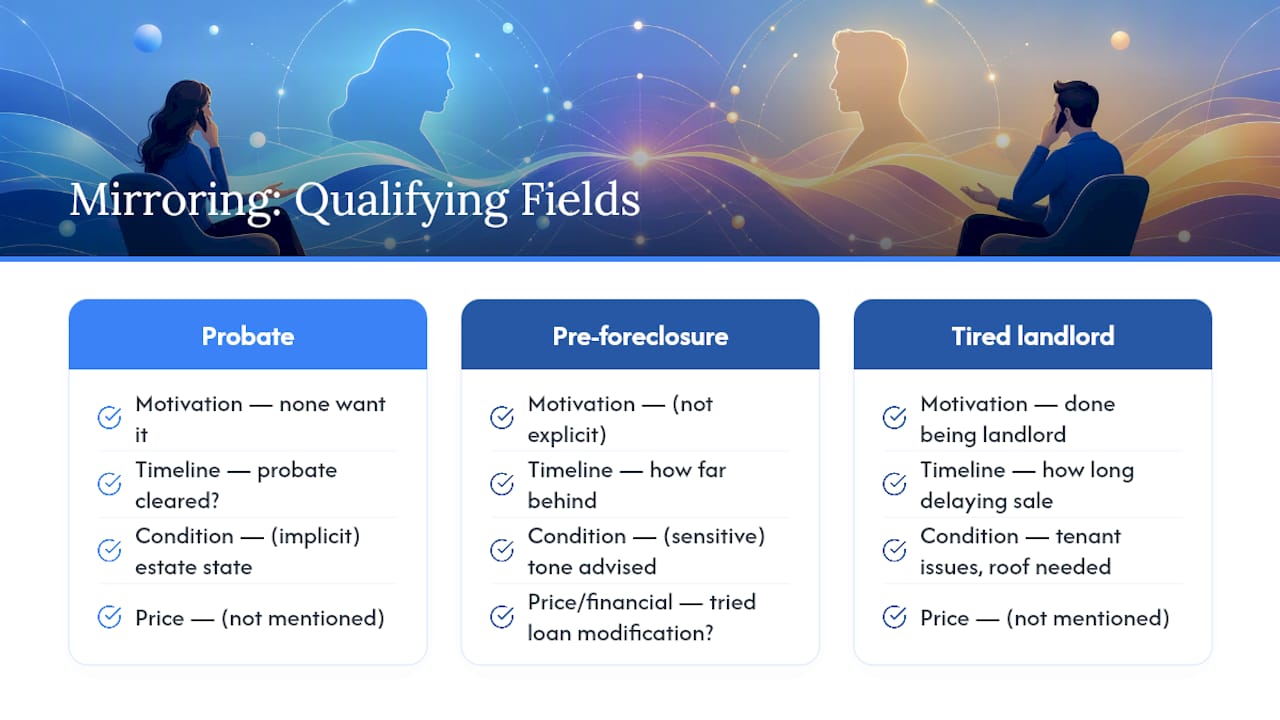
Probate: Seller says, “We inherited it from my dad, and none of us want to deal with it.” You mirror, “None of you want to deal with it?” She responds with who’s involved, whether the estate has cleared probate, and whether siblings disagree on selling. That single mirror often surfaces motivation and timeline in one breath.
Pre-foreclosure: Seller says, “The bank sent another letter last week.” You mirror, “Another letter?” He explains how far behind he is and whether he’s already tried a loan modification. This is sensitive territory, so keep your tone soft, not curious in a probing way.
Tired landlord: Seller says, “I’m just done being a landlord.” You mirror, “Done being a landlord?” She unloads about a tenant who stopped paying, a roof that needs work, and how long she’s been putting off selling. That’s condition and timeline handed to you unprompted.
Now the failure case. A caller mirrors every sentence: “We inherited it.” / “Inherited it?” … “From my dad.” / “From your dad?” That’s not mirroring, it’s mimicry, and sellers notice within seconds. The fix is spacing mirrors out and letting normal conversation happen between them.
The best mirrors don’t feel like technique at all. They feel like someone finally listening.
Practice Drills to Build Mirroring Reflex
Mirroring only becomes reliable through repetition under pressure, which is why a structured drill beats hoping you remember it mid-call.
- Week 1: Pace. Practice matching a partner’s speaking speed on five-minute calls, no mirrors yet, just rhythm.
- Week 2: Vocabulary. Add word mirroring, echoing the seller’s own terms for their property and situation.
- Week 3: Integrated mirrors. Combine pace, vocabulary, and the full echo-pause sequence on mock calls covering probate, pre-foreclosure, and vacant properties.
- Week 4: Live application. Run real calls, then score them afterward for mirror placement and seller response quality.
This staged approach follows the practice progression Pipedrive recommends: one skill at a time, tracked against outcomes, rather than trying to master everything in a single week.
Track three numbers weekly: your connect rate, the percentage of calls where a mirror produced usable motivation or timeline data, and your appointment-set rate. If the second number isn’t climbing, you’re probably mirroring flat statements instead of loaded ones.
AI roleplay speeds this up considerably because it gives you unlimited reps against a seller voice that reacts realistically, with a scorecard showing exactly where your mirrors landed and where you talked over the silence.

Common Mirroring Mistakes and Ethical Lines Not to Cross
Mechanical mirroring, repeating every phrase or copying a seller’s exact speech pattern, sounds manipulative because it is noticeable, and noticeable technique breaks trust immediately. Skip mirroring entirely when a seller is agitated, discussing legal specifics of a foreclosure, or stating plain facts with no emotional charge. In those moments, paraphrase instead: “So the auction date is set for next month” works better than an echo.
- Never mirror to manufacture false rapport before pushing a lowball offer.
- Stay compliant with do-not-call and TCPA rules regardless of how well a call is going.
- If mirroring stalls, fall back to a direct question. It’s not a failure, it’s just a different tool.
Pro Tip: If you’re unsure whether a mirror will land, default to a summary statement instead: “It sounds like the timing has been rough.” It carries the same empathy without the risk of sounding scripted.
A Coach’s Take on Why This Technique Sticks
Verbal mirroring is the rare sales skill that costs nothing and can’t be overdone if you space it out. I’ve seen callers uncover a seller’s real timeline in one mirrored phrase after ten minutes of direct questions got nowhere. It works because it doesn’t feel like a technique to the seller.
Try this: run 10 calls this week, mirror one loaded phrase per call, and write down what each mirror revealed. You’ll see the pattern fast.
— Dave
Practice Mirroring With ClosersLeague’s AI Roleplay
Reading about mirroring gets you halfway there. The other half comes from repetition against a voice that reacts the way a real seller does, and that’s exactly what ClosersLeague’s AI roleplay is built for. You practice mirroring against scenario-specific sellers, probate, pre-foreclosure, vacant, tired landlord, and get a scorecard showing where your mirrors landed and where silence got broken too soon.

A focused practice pack on probate and inherited property calls is the fastest way to drill mirroring against the exact objections and emotional cues you’ll hear from real sellers, without burning live leads while you’re still building the reflex. Every session includes real-time feedback and a leaderboard, so you can see whether your mirror-to-elaboration ratio is actually improving week over week. Start a free trial and run your first ten mirrored calls before your next real one.
Sources
- Chris Voss negotiating tactics — mirroring and labeling (Inc.)
- What is sales mirroring? (Salesforce blog)
- Sales mirroring strategies and phone-specific guidance (Pipedrive blog)
- Separation of effective verbal mirroring and risky behavioral mirroring (SalesArmor)
FAQ
What Is Mirroring on Calls?
It’s a verbal technique where you repeat the last one to three words a seller says, in a curious tone, then stay silent to prompt them to elaborate.
Does Mirroring Work on Phone Calls Without Body Language?
Yes. Verbal mirroring relies entirely on words and tone, which makes it more reliable on phone calls than body mirroring, which requires visual contact.
How Long Should I Pause After Mirroring?
About two seconds. That short silence is what pushes the seller to fill the gap with more detail than a direct question would draw out.
Can Mirroring Feel Manipulative to Sellers?
Only when overused or mechanical. Space mirrors out and use them on emotionally charged phrases, not every sentence, to keep the technique invisible.
Where Can I Practice Mirroring Before Using It Live?
ClosersLeague’s AI roleplay lets you drill mirroring against realistic seller scenarios like probate and pre-foreclosure calls, with scorecards that show what’s working.