Negative reverse selling is a Sandler Selling System technique that uses a softening statement, a negative frame, and a qualifying question to remove pressure from the conversation — so prospects either defend the purchase themselves or give you a fast, honest no. Instead of pushing harder when a deal stalls, you pull back. The result: the prospect does the selling, or you both stop wasting time.
A quick example: a homeowner says, “I need to think about it.” You respond, “That makes sense. Honestly, this might not be the right time for you — does it even make sense to keep talking?” Most prospects who are genuinely interested will push back. Those who aren’t will tell you clearly, and your pipeline gets cleaner immediately.

The technique is formally known within the Sandler Selling System as “negative reversing,” though practitioners and marketers often use the broader term “negative reverse selling” interchangeably.
Key Takeaways
Negative reverse selling works because it removes pressure, restores buyer autonomy, and forces a real answer — making it one of the most efficient tools for clearing stalled pipelines and surfacing honest objections fast.
| Point | Details |
|---|---|
| Three-element structure | Every negative reverse uses a softener, a narrow negative frame, and a qualifying question — in that order. |
| Hold the silence | Stay quiet for at least 10–15 seconds after the qualifying question; self-advocacy only emerges in that space. |
| Authenticity is non-negotiable | The technique fails when the negative frame isn’t genuine; use it only when you truly believe the fit may be wrong. |
| Measure decision velocity | Practitioners report 30–40% faster decisions on stalled deals; track your own no-rate and stalled-deal recovery rate. |
| ClosersLeague for practice | ClosersLeague’s AI roleplay platform lets you drill these scripts across distressed seller scenarios with real-time scoring and feedback. |
Table of Contents
- What does negative reverse selling actually look like?
- Why does this technique work psychologically?
- When should you use negative reverse selling?
- How do you implement negative reverse selling step by step?
- Power phrases and scripts you can use right now
- What are the common mistakes and ethical limits?
- How do you practice this and measure whether it’s working?
- Real estate cold-call scripts and a roleplay scoring rubric
- Why I recommend this technique carefully
- Practice negative reverse selling with real-time AI coaching
- Sources
- FAQ
What does negative reverse selling actually look like?
The pattern has three moving parts: a softener, a negative frame (the takeaway), and a qualifying question. What separates it from a traditional close is that you never push toward yes. You offer the prospect an easy exit, and their response tells you everything.
Here’s how each element functions:
- Softener: A brief, empathetic phrase that lowers the prospect’s guard. Examples: “That makes sense,” “I hear you,” or “Help me understand where this sits on your list of priorities.”
- Negative frame: A narrow, plausible statement suggesting the solution may not fit. “This might not be the right move for you right now.” “Maybe we’re getting ahead of ourselves.”
- Qualifying question: An open-ended prompt that invites either acceptance of the out or a defense of the purchase. “Does it even make sense to keep talking?” or “Should we just put a pin in this?”
Direct or pressure-based approaches do the opposite: they push, restate benefits, and try to overcome objections with logic. That approach raises defensiveness. The paradox of control in consultative selling is that pulling back reduces perceived threat, transfers control to the buyer, and surfaces authentic objections instead of rehearsed deflections.
Deploy this technique late in discovery, when a deal has stalled, or when you’re getting vague, noncommittal answers. It’s not an opener. It belongs in the middle or late stages of a conversation, where the prospect’s real position is hidden behind polite resistance.
Why does this technique work psychologically?
The mechanism is psychological reactance. When people feel their freedom to choose is threatened, they instinctively push back to restore it. A traditional sales push amplifies that threat. A negative frame removes it entirely, and the prospect’s natural impulse is to reassert their autonomy by arguing for the thing you just suggested they might not need.

Reverse psychology is a well-documented social influence principle: presenting the opposite of the desired response can prompt the target to adopt the intended position, when used sparingly and authentically. Negative reversing applies this directly to sales conversations.
The second mechanism is self-persuasion. When a prospect argues for the purchase out loud, they’re not just responding to you. They’re convincing themselves. That internal commitment is far more durable than anything you could say on their behalf. Cognitive dissonance does the rest: once they’ve verbalized reasons to buy, walking away creates psychological friction.
Practically, each principle changes what you listen for after the negative frame:
- Reactance response: The prospect pushes back with specifics (“No, actually this is a priority for us”). Deepen the conversation — ask what makes it a priority.
- Self-persuasion in progress: The prospect starts listing reasons the solution fits. Stay quiet. Let them finish.
- Genuine acceptance of the out: The prospect agrees it might not be the right time. That’s a disqualification signal, not a failure. Move on and protect your pipeline.
The Sandler approach to consultative selling frames this explicitly: pulling back reduces defensiveness and converts resistance into information useful for qualification.
When should you use negative reverse selling?
Timing is everything. Used at the wrong moment, a negative frame reads as sarcasm or disinterest. Used at the right one, it cuts through weeks of stalling in thirty seconds.
Signals to use it:
- The prospect says “we’ll think about it” or “let me run it by my partner” with no concrete next step
- The deal has been in your pipeline longer than your average sales cycle
- You’re getting vague objections that shift every time you address one
- The prospect uses defensive language: “I’m not sure,” “maybe,” “we’ll see”
- You’ve already presented value and the prospect hasn’t moved
Disqualifiers — do not use it when:
- You’re still in early discovery and haven’t established rapport or fit
- The prospect is enthusiastic and moving toward a decision on their own
- The fit is obvious and the prospect is asking implementation questions
- The prospect is emotionally vulnerable or in acute distress (relevant in real estate cold calls to homeowners in foreclosure or probate situations — read the emotional state first)
Quick decision checklist before you deploy:
- Have you already presented value or addressed at least one objection?
- Is the prospect stalling or giving vague answers?
- Do you genuinely believe the solution might not fit? (Authenticity is non-negotiable.)
- Are you prepared to accept a fast no and move on?
- Is the prospect emotionally stable enough for a direct challenge?
If you answered yes to the first four and yes to the fifth, you’re in the right situation. This technique fits B2B complex sales, direct-to-seller real estate cold calls, and any scenario where cold calling tips for real estate investors emphasize reading the seller’s emotional state before escalating.
How do you implement negative reverse selling step by step?
HubSpot’s breakdown of the technique frames it as reverse psychology aimed at getting a quicker yes or no. Here’s a sequential playbook you can script and practice.
-
Check your intent. Before you speak, ask yourself: do you genuinely believe this solution might not be the right fit right now? If you’re using the negative frame as a trick, the prospect will hear it. Authenticity is the foundation.
-
Open with a softener. Acknowledge what the prospect just said without judgment. “That makes total sense.” “I appreciate you being straight with me.” Keep it one sentence.
-
Deliver the negative frame. Make it narrow and plausible. “Honestly, this might not be the right time for you.” “Maybe we’re getting ahead of ourselves here.” Avoid sarcasm. Avoid exaggeration. The frame should sound like something a trusted adviser would say.
-
Ask the qualifying question. Follow immediately with an open-ended prompt. “Does it even make sense to keep talking?” “Should we just put a pin in this for now?” The question must offer a genuine exit.
-
Stay silent for at least 10–15 seconds. This is the hardest part. Most reps fill the silence. Don’t. The TWSales guide to negative reversing is explicit: the silence is where self-advocacy emerges. Count to fifteen in your head if you have to.
-
Listen and follow up based on the response. Two paths:
- Prospect defends: “No, actually this is important to us.” Respond with a deepening question: “What makes it a priority right now?”
- Prospect accepts the out: “Yeah, maybe you’re right.” Respond with a clean close: “I appreciate your honesty. If anything changes, I’m here.” Then move on.
Pro tips for tone and timing:
Pro Tip: Keep your voice calm and even when delivering the negative frame. A rising tone sounds like a test. A flat, matter-of-fact tone sounds like a genuine observation. Practice this in roleplay until the delivery feels natural, not rehearsed.
Pro Tip: On a phone call, the silence after the qualifying question is louder than it feels to you. Prospects notice it. That discomfort is productive — it prompts them to fill the space with their real position.
Power phrases and scripts you can use right now
The three-element structure — softener, negative frame, qualifying question — works across channels, but the wording and pacing shift depending on the medium.
Core power phrases (with tone notes):
- “That makes sense. Honestly, this might not be the right fit for you right now. Does it even make sense to keep talking?” (calm, matter-of-fact)
- “I hear you. Maybe we’re getting ahead of ourselves. Should we just put a pin in this?” (low-key, no pressure)
- “Help me understand — if this isn’t a priority, is there a reason we’d keep moving forward?” (curious, not confrontational)
- “I don’t want to push you into something that doesn’t work. Is this even something you want to explore further?” (adviser tone)
Phone call script:
Voicemail script:
Follow-up email:
Subject: Should we close this out?
“Hi [Name], based on where things stand, I’m wondering if this is still worth pursuing for you. Happy to pick back up if the timing shifts — otherwise, no hard feelings.”
LinkedIn message:
| Channel | Objective | Recommended negative-frame style |
|---|---|---|
| Phone call | Surface real objection or fast no | Full three-element structure with 10–15 second silence |
| Voicemail | Re-engage stalled prospect | Shortened frame, no qualifying question, soft callback invite |
| Revive dead thread | Subject line as the frame; two-sentence body, no pressure | |
| Low-stakes re-engagement | Single sentence frame, no question needed |
What are the common mistakes and ethical limits?
Negative reverse selling fails when it’s used as a trick rather than a genuine diagnostic tool. Sandler’s training materials are direct on this: the technique backfires when the negative frame is delivered without genuine belief that the solution might not fit.
Common mistakes:
- Overdoing the negative frame. Using it in every call, or stacking multiple negative frames in one conversation, makes you sound disinterested or passive-aggressive.
- Sarcasm. “I guess you just don’t care about solving this problem” is not a negative frame. It’s an insult. ActiveCampaign’s practitioner analysis specifically warns against sarcastic delivery as a trust-killer.
- Using it too early. Deploying a negative frame before you’ve established rapport or presented any value reads as dismissive, not consultative.
- Ignoring emotional context. A homeowner in foreclosure or a seller going through a divorce is under real stress. A blunt negative frame in that moment can feel callous. Read the emotional state first. For guidance on handling distressed seller objections, emotional calibration is the prerequisite.
Ethical limits: The technique is ethical when your intent is to surface truth, not to manufacture a yes. If you’re using the negative frame to manipulate a vulnerable prospect into defending a purchase they can’t afford or don’t need, you’ve crossed into manipulation. Stop the technique the moment you sense the prospect is confused, upset, or feels cornered.
Repair phrases for when a conversation goes wrong:
- “I didn’t mean to put you on the spot — I just want to make sure we’re both being honest with each other.”
- “That came out wrong. Let me back up.”
- “I hear you — I’m not trying to pressure you in any direction.”
- “I want to make sure this is actually a good fit for you, not just a sale for me.”
- “Let’s slow down. What’s most important to you right now?”
For team coaching: review calls specifically for tone on the negative frame delivery. A flat, genuine tone is the target. Anything that sounds like a test, a dare, or a guilt trip needs to be corrected in roleplay before it goes live.
How do you practice this and measure whether it’s working?
Skill without repetition is theory. Here are three drills that build the muscle.
-
Scripted-read drill. Write out three negative reverse sequences (softener + frame + question) for your most common stall scenarios. Read them aloud, record yourself, and listen back. The goal: does the negative frame sound like a genuine observation or a rehearsed line? Repeat until you can’t tell the difference.
-
Graded silence exercise. Practice with a partner. After delivering the qualifying question, set a timer for 15 seconds and hold silence. Your partner’s job is to respond however feels natural. Your job is to not speak until the timer ends. Most reps break at 5–7 seconds. Train past that threshold.
-
Objection-variation drill. Take five common stall phrases (“I need to think about it,” “The timing isn’t right,” “I need to talk to my partner,” “We don’t have the budget right now,” “Send me some information”). For each one, build a complete negative reverse sequence. Practice switching between them in a single roleplay session without losing tone consistency.
Metrics that tell you the technique is working:
- Decision velocity: Time from qualification to a clear yes or no shortens. Practitioners using the negative reverse framework report 30–40% faster decision velocity on stalled deals (practitioner-reported figure, not a controlled study).
- Percentage of clear nos: A rising no-rate early in the pipeline is a good sign. It means you’re disqualifying faster and protecting time.
- Stalled-deal recovery rate: Track how many deals that had gone quiet move to a decision within two weeks of a negative reverse conversation.
- Prospect talk-time ratio: After the qualifying question, the prospect should be talking more than you. If you’re still filling the silence, the drill isn’t done.
- Self-advocacy rate: How often does the prospect defend the solution unprompted after the negative frame? That’s the clearest signal the technique is working.
Manager coaching checklist for call reviews:
- Did the rep deliver the softener before the negative frame?
- Was the negative frame narrow and plausible, or broad and sarcastic?
- Did the rep hold silence for at least 10 seconds after the qualifying question?
- Did the rep follow the prospect’s response with a deepening question or a clean close?
- Did the tone stay flat and genuine throughout?
Real estate cold-call scripts and a roleplay scoring rubric
These scripts are built for direct-to-seller calls on distressed properties. Adapt the framing to your specific situation — pre-foreclosure, probate, divorce, or tired landlord. The structure stays the same.
Script 1: Pre-foreclosure homeowner (stalling)

Script 2: Probate or inherited property (vague objection)
Roleplay scoring rubric:
Adaptation notes for SaaS or B2B: Replace property-specific language with deal-specific language. “This might not be the right time to expand your tech stack” works the same way as “this might not be the right time to sell.” The emotional calibration differs — B2B prospects are less personally distressed — but the structure is identical.
Pro Tip: Practice these scripts in AI-driven real estate roleplay before taking them live. The ability to hear your own tone in a low-stakes environment is the fastest way to fix delivery problems before they cost you a real deal.
For uncovering seller motivation before deploying a negative frame, spend the first part of the call listening. The negative reverse works best when you already have a read on what the seller actually wants.
Why I recommend this technique carefully
Negative reverse selling is one of the most misunderstood tools in a sales rep’s kit. Most people hear “tell the prospect it might not be a good fit” and assume it’s a gimmick. It isn’t. When you genuinely don’t know whether the solution fits, and you say so, you’re doing something most reps never do: you’re being honest in real time.
The ethics are straightforward. If you believe the solution might not fit, say so. If you’re using the negative frame to manufacture urgency in a prospect who’s already skeptical, stop. The technique is diagnostic as often as it is closing-focused. A well-applied negative reverse that ends in a fast no is a win. You’ve protected your time, respected the prospect’s, and kept your pipeline clean.
The risk isn’t that the technique is manipulative. The risk is that it’s used by reps who haven’t done the internal work first: checking their own intent, calibrating their tone, and genuinely accepting that a no is a valid outcome. Practice the silence. Practice the flat tone. Practice accepting the no without flinching. That’s where the real skill lives.
Practice negative reverse selling with real-time AI coaching
Knowing the framework is one thing. Delivering it under pressure, on a live call with a distressed homeowner, is another. ClosersLeague gives real estate investors and wholesalers a purpose-built AI roleplay environment where you can practice these exact scripts across every distressed seller type: pre-foreclosure, probate, inherited, tax delinquent, divorce, and more.
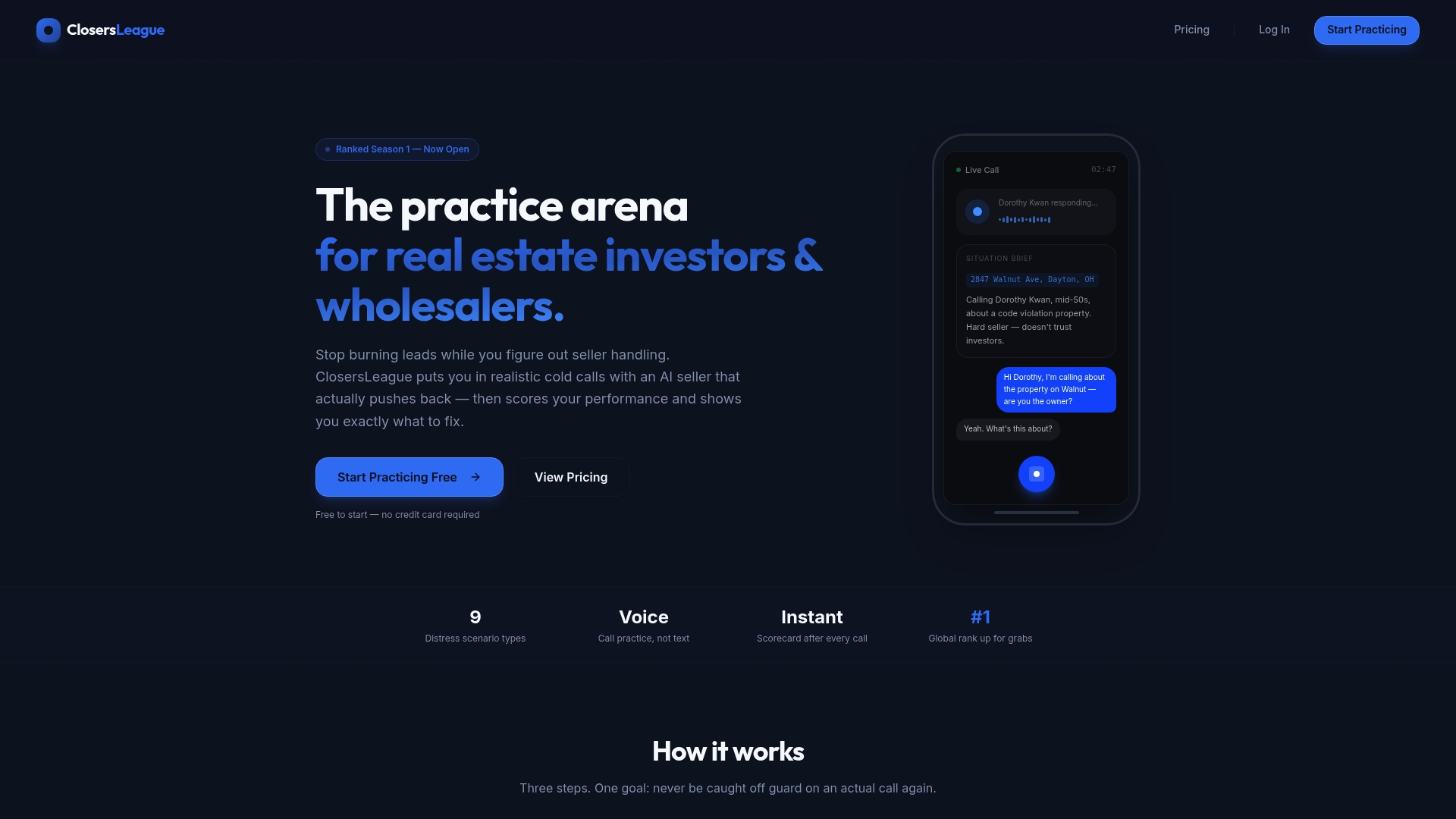
Each session scores your delivery in real time, flags where you broke silence too early, and grades your follow-up questions against the prospect’s actual response. You get a scorecard after every call, so improvement is measurable, not guesswork. The competitive leaderboard keeps practice from feeling like homework.
Stop winging it on live calls. Start drilling these scripts with AI-powered feedback today and see your decision velocity improve within your first week of practice.
Sources
- Motivating Buyers with Negative Reverse Selling
- Negative reverse selling: stop pushing prospects and start letting them sell themselves
- Negative Reverse Selling: Stop Pushing Prospects and Start Letting Them Sell Themselves
- The Complete Guide to Negative Reverse Selling
- Negative Reverse Selling – Sandler
FAQ
What is negative reverse selling?
Negative reverse selling is a Sandler Selling System technique that uses a softener, a negative frame, and a qualifying question to remove sales pressure. The goal is to prompt prospects to either defend the purchase themselves or give a fast, honest no.
What are the four types of selling?
The four commonly cited selling types are transactional, consultative, solution-based, and provocative selling. Negative reverse selling fits within the consultative and provocative categories, where the rep’s role is to surface truth rather than push a product.
What are negative sales?
“Negative sales” is an informal term for techniques that use restraint, doubt, or withdrawal rather than persuasion to move a prospect toward a decision. Negative reverse selling is the most structured and widely taught version of this approach.
What is the 2-2-2 rule in sales?
The 2-2-2 rule is a follow-up cadence: contact a prospect two days after an initial meeting, two weeks after that, and two months after that. It’s a pipeline management framework, separate from negative reverse selling, though both address the problem of stalled deals.
When should you not use negative reverse selling?
Avoid it in early discovery, with enthusiastic buyers already moving toward a decision, and with emotionally vulnerable prospects such as homeowners in acute financial distress. The technique requires established rapport and a genuine belief that the fit may be wrong.