When someone tells you “I’m not the decision maker,” they’re telling you they lack final authority or budget sign-off, not that the conversation is over. Your immediate move is to find out who does have that authority and whether the person in front of you can champion your case internally. Ask directly: “Who else typically weighs in on something like this?” Then request a brief introduction before you invest more time.
TL;DR:
- People who say “I’m not the decision maker” often accurately reflect their organizational roles, such as gatekeepers, end-users, or procurement staff, rather than being insincere.
- Identifying the actual decision maker requires asking targeted questions, verifying roles through public information, and noting if the contact cannot name anyone else involved, which signals a red flag.
- When confirmed not to be the approver, focus on securing introductions, providing shareable materials, and gradually building the contact into a champion with clear next steps.
- The timing of decisions can be effectively assessed using the 10-10-10 rule to reframe emotional hesitation as long-term value, especially when aligned with fiscal cycles or renewal periods.
- Consistently practicing objection handling and qualification scripts through roleplay and AI-drilled scenarios improves sensitivity to signs of stall, increasing closing chances without relying on false promises.
Table of Contents
- Why People Say “I’m Not the Decision Maker”
- Is This a Real Limitation or a Stall? How to Tell
- Scripts for Cold Calls, Discovery Calls, and Interviews
- Turning a Non-Decision-Maker Into Your Champion
- The 10-10-10 Rule and Other Timing Checks
- When to Escalate, Ask for an Intro, or Walk Away
- What Practice Teaches You About Handling This Objection
- A Straight Answer, Not a Sales Trick
- Practice the Response Before You Need It Live
- Sources
- FAQ
Why People Say “I’m Not the Decision Maker”
The phrase almost never means what it sounds like on the surface. Most of the time it’s an accurate description of how the organization actually works, not a brush-off.
Job title tells you far less than you’d think. A “Director of Operations” might control a six-figure budget or none at all, depending on the company. Purchasing authority correlates more with budget ownership and role responsibility than with the title on someone’s email signature, which is why relying on LinkedIn titles alone leads sellers to the wrong person constantly.
Buying committees compound the problem. In most B2B purchases, no single person signs off alone. There’s a budget holder, an end-user who has to live with the tool daily, a procurement gatekeeper who checks contracts, and often an executive sponsor who only shows up at the final approval. When your contact says they’re not the decision maker, they may simply be one voice in that group.
A few roles say this phrase constantly, for legitimate reasons:
- Gatekeepers (assistants, front-desk staff, junior team members) whose job is literally to filter, not approve.
- End-users who influence heavily but need sign-off from a manager or department head.
- Procurement staff who negotiate terms but can’t greenlight spend without finance approval.
None of these people are lying to you. They’re describing their actual role in decision-making authority, and the smart move is to treat that as useful intelligence rather than a rejection.
Is This a Real Limitation or a Stall? How to Tell
Not every “I’m not the decision maker” is honest. Some people say it because it’s easier than saying no. The trick is reading the signals around the statement, not just the statement itself.
Genuine lack of authority usually comes with specifics. The person names a title, a department, or a process (“Our facilities director signs off on anything over $5,000”). They sound relieved, not defensive, and they’re often willing to help you get to the right person because it gets you off their plate.
Stalling sounds vague on purpose. Watch for hesitation, a refusal to name anyone else, or a quick subject change. If someone says “it’s complicated” or “we’ll have to see” without naming a single other person, that’s evasiveness, not an org chart problem.
A short round of qualifying questions usually settles it:
- “Who else is typically involved in a decision like this?”
- “What would need to happen for this to move forward on your end?”
- “Have you dealt with something like this before? How did that process go?”
- “If I sent over a one-page summary, who would you share it with?”
- “Is there a budget conversation that needs to happen first?”
If you still have doubts, verify independently. A quick LinkedIn search, a look at the company’s leadership page, or even a scan of recent job postings (a hiring surge in a department often signals who controls that budget) tells you more than the conversation did. Public evidence like job postings, conference bios, and press mentions maps ownership more reliably than an org chart, which is frequently out of date.
Pro Tip: If a contact can’t name a single other person involved in the decision, that’s a bigger red flag than the “not the decision maker” line itself. Real processes have real names attached to them.
Scripts for Cold Calls, Discovery Calls, and Interviews
Once you’ve confirmed the person genuinely isn’t the approver, your language needs to do two things: get you closer to the real decision maker, and keep the relationship warm enough that this person still wants to help you.
Three ways to ask for an introduction, depending on the setting:
- Cold call: “Totally understand. Who’s the best person to loop in on something like this, and would you be open to a quick intro?”
- Discovery meeting: “That’s helpful context. Based on what we’ve covered, who else on your team would need to sign off before this moves forward?”
- Job interview: “I appreciate you walking me through the role. Who else is typically part of the final hiring decision, and is there anything I should prepare for that conversation?”
If the person seems willing but not positioned to make an intro happen immediately, pivot to coaching them as your internal champion instead of pushing harder for access. Offer something concrete: a one-page summary they can forward, three bullet points on return on investment, or a short video they can share instead of trying to explain your pitch from memory.
On a cold call specifically, treat “I’m not the decision maker” as an objection to work through, not a dead end. Sales coaching commonly frames this response as a map rather than a wall, one that tells you who to ask for next and how to enable the person you’re already talking to. A simple rebuttal: “No worries at all. Would it make sense for the three of us to jump on a quick call, or would you rather I send something over that you can pass along first?”
For internal conversations, like a job candidate probing a hiring manager, the same logic applies. You’re not challenging their authority; you’re figuring out the real approval path so you don’t waste effort chasing the wrong signature. Keep the phrasing collaborative:
- “Just so I understand the process, who typically has final say on offers?”
- “Is there a committee involved, or does this come down to one person?”
Turning a Non-Decision-Maker Into Your Champion
A contact who isn’t the approver can still be your most valuable asset in the deal, if you give them the right tools and a light structure to work with.
Champions need small, shareable materials, not a full deck. The most useful kit includes a one-pager summarizing the offer, three or four ROI bullets in plain language, a short objection cheat-sheet (“if they ask about X, say Y”), and a two-minute demo clip they can forward without scheduling another meeting. Handing a willing contact these kinds of shareable assets, along with a suggested agenda, measurably increases the odds they’ll actually present your case internally.
A short briefing call works better than a long email chain. Keep it to fifteen minutes: confirm what matters most to the real decision maker, walk through the one-pager together, and agree on what happens next.
On that call, ask for three specific commitments:
- A rough timeline for when the real decision maker will see the material.
- The name and role of at least one other point of contact.
- An honest read on how much influence your champion actually has in the room.
Watch for red flags that mean it’s time to stop investing effort: the champion can’t name anyone else, keeps pushing the timeline with no specifics, or admits they’ve never gotten something like this approved before.
Pro Tip: Ask your champion one blunt question: “On a scale of one to ten, how much pull do you have in this decision?” People are surprisingly honest when you ask directly, and the answer tells you exactly how much more time to spend here.
The 10-10-10 Rule and Other Timing Checks
Decisions stall for emotional reasons far more often than logical ones, and the 10-10-10 rule is a fast way to cut through that. The framework asks how you’ll feel about a choice in 10 minutes, 10 months, and 10 years, which reframes short-term anxiety against long-term consequence.
Applied to a business purchase, it looks like this: a facilities manager hesitating over a new software subscription might feel uneasy signing anything today (the 10-minute view), but recognize that in 10 months the tool will have paid for itself, and in 10 years the decision won’t register as a big deal either way. That reframing often unlocks stalled approvals faster than another round of feature pitches.
The rule works best for meaningful decisions, not routine ones. Don’t waste it on trivial calls where the stakes barely register.
A short checklist keeps timing realistic:
- Confirm which fiscal quarter the budget falls under.
- Ask if there’s a renewal or planning cycle that naturally aligns with your offer.
- Find out if a slower “yes” now beats a faster “no” later.
Buying groups are rarely small. A significant majority of B2B buying groups include multiple stakeholders, often six or more (https://www.leadfeeder.com/blog/sales-prospecting/how-to-find-decision-makers-in-a-company/), which is exactly why one contact saying “I’m not the decision maker” is the norm, not the exception.
When to Escalate, Ask for an Intro, or Walk Away
Every stalled deal deserves a quick gut check, not endless follow-up. A simple scoring rubric works: rate fit, potential return, and your actual access to the real decision maker, each on a scale of one to five. Multiply the three scores. Anything below a rough threshold you set for yourself (many reps use 30 out of a possible 125) isn’t worth more effort right now.
If the score is decent, escalate deliberately:
- Ask for a warm introduction rather than cold-emailing the approver directly.
- Propose a joint call where your current contact stays in the room, which keeps them relevant and gives the approver context.
- Send a short written follow-up documenting what was discussed, so nothing gets lost if the deal goes quiet for a few weeks.
Disqualify fast when you see the real warning signs: no identifiable budget, a timeline that keeps sliding with no fixed date, or a champion who can’t or won’t help you reach anyone else.
Whatever the outcome, write it down. Log the stage, the blocker, and a re-check date 30 to 60 days out. Half of “dead” deals aren’t dead, they’re just early.
What Practice Teaches You About Handling This Objection
Reps who hear “I’m not the decision maker” dozens of times a week get better at it the same way anyone gets better at a repeated skill: through structured reps, not more live calls where the mistakes are expensive.

A ten-minute roleplay drill works well here. One person plays a gatekeeper who’s vague on purpose; the other has to extract a name, a timeline, and one commitment within the call, then pivot to offering a one-pager. Run it three times back to back, swapping who plays which role, and the phrasing starts to feel automatic instead of scripted.
Two drills worth running on repeat:
- Objection speed round: Fire five variations of “not the decision maker” at a rep in under two minutes and score how fast they recover with a qualifying question.
- Triage drill: Give a rep three fictional scenarios (probate seller, tax-delinquent property, out-of-state landlord) and time how quickly they identify who actually holds authority over the sale.
This is precisely the kind of scenario ClosersLeague’s platform is built to drill. Its AI-powered call practice lets real estate investors and wholesalers rehearse exactly this moment, a homeowner or intermediary deflecting authority, until the response is second nature instead of improvised under pressure.
Pro Tip: If a rep can’t recover from “I’m not the decision maker” within two sentences during practice, they’ll freeze on a live call. Fix it in roleplay, not on a seller’s phone line.
A Straight Answer, Not a Sales Trick
The single biggest mistake sellers make with this objection is treating it as a rejection instead of a routing problem. Someone telling you they lack authority is handing you a map. The reps who follow that map, asking for a name, an intro, or a timeline, close more deals than the ones who either give up or keep pitching the wrong person.
Test the scripts in this piece for two weeks and track two numbers: how often you get an intro, and how often a “champion” actually follows through. Those two metrics tell you more about your process than any gut feeling ever will.
— Dave
Practice the Response Before You Need It Live
Reading a script is one thing. Delivering it smoothly when a probate contact or a tired landlord catches you off guard is another. An AI roleplay platform can drill exactly these moments, seller pushback, gatekeeper deflections, and stalled authority conversations, with real-time coaching and performance scorecards that show you where a call actually broke down.
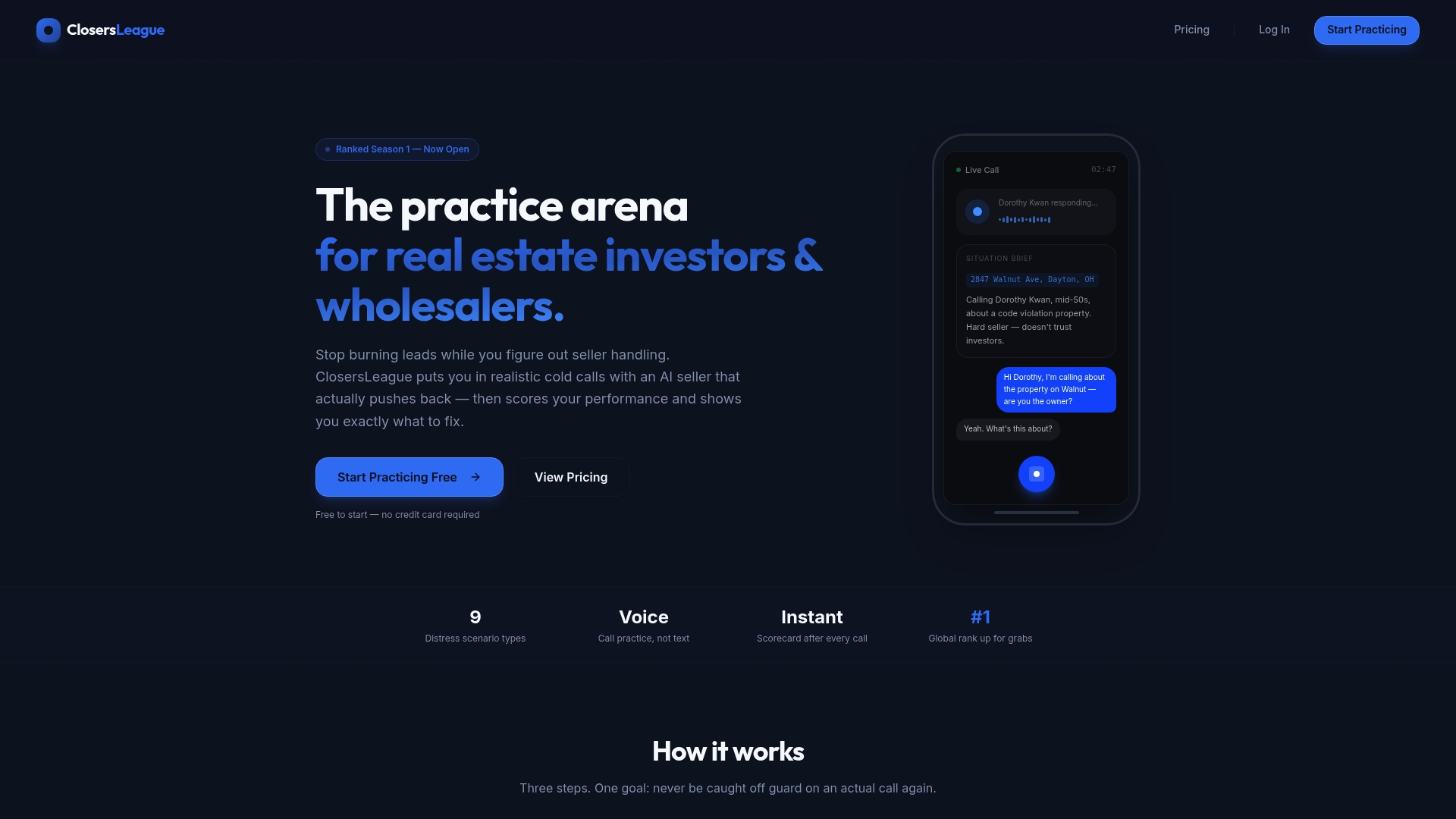
Instead of guessing why an intro rate is low, you get objection-by-objection breakdowns across distress property types so you can fix the specific moment where “I’m not the decision maker” derailed the call. Competitive leaderboards and targeted skill drills turn a vague weakness into a measurable one. If you want to see how the scenario-based practice works for cold-calling scripts like the ones above, start with the real estate cold calling practice platform and run your first roleplay session today.
Sources
For readers who want to go deeper on the frameworks referenced above:
- How emotionally intelligent leaders apply the 10-10-10 rule for better decision-making
- B2B decision-makers: How to identify them
- How to handle objections in sales
FAQ
What does it mean to be a decision maker?
A decision maker is the person with final authority to approve a purchase, hire, or agreement, typically because they control the relevant budget or hold sign-off responsibility for that category of decision.
What is the 10-10-10 rule for decisions?
The 10-10-10 rule asks how you’ll feel about a choice in 10 minutes, 10 months, and 10 years, which helps separate short-term emotion from long-term consequence.
What are the four types of decision makers?
Common categorizations include the budget holder (controls spend), the end-user (influences based on daily use), the technical evaluator (assesses fit or risk), and the executive sponsor (gives final approval), though exact roles vary by organization.
What is another word for a decision maker?
Common alternatives include “approver,” “budget holder,” “final sign-off,” and “buying authority,” depending on the industry and context.
How do I know if someone is really not the decision maker?
Ask a few direct qualifying questions, like who else is typically involved and what the approval process looks like, and cross-check with public signals such as job postings or leadership pages before assuming the statement is a stall.
Should I keep talking to someone who says they’re not the decision maker?
Yes, if they can name a real process or person and seem willing to help you reach that approver; treat them as a potential champion rather than a dead end, and equip them with short materials they can share internally.