Default to three frameworks: LAER for layered objections with real complexity, Validate‑Isolate‑Reframe for fast diagnosis mid‑call, and Validate‑Label‑Ask when you’re cold calling and seconds matter. The habit that makes all three work is the same: pause, isolate the real objection, then respond. Below you’ll find the exact scripts, drills, and metrics to build that habit into muscle memory.
TL;DR:
- Shorter objection diagnosis sequences like Validate‑Isolate‑Reframe outperform longer ones under pressure, especially during live discovery and negotiation calls.
- The core habit for effective objection handling involves pausing, acknowledging, diagnosing, and responding, regardless of the specific framework used.
- For cold calls, using Validate‑Label‑Ask maximizes speed and engagement, while LAER is better suited for complex, multi-stakeholder situations.
- Consistent practice, including daily micro-drills and call clip reviews, significantly improves repetition-based skills like pause and isolate effectiveness.
- Tracking metrics such as pause length, confirm-to-next-step rate, and continuation rate reveals whether objection handling practices are improving outcomes.
Table of Contents
- What Is the Best Objection Handling Framework to Start With?
- The Behaviors Every Framework Shares
- How to Choose the Right Framework by Call Stage
- Scripts You Can Use on Your Next Call
- Building an Objection Handling Practice Routine That Sticks
- What to Measure to Know the Framework Is Working
- Why Most Objection Handling Training Fails Anyway
- Practice at Scale With ClosersLeague
- Sources
- FAQ
What Is the Best Objection Handling Framework to Start With?
Most reps default to whatever framework they learned first and stick with it regardless of situation. That’s backwards. The right objection handling framework depends on call stage, how many people are on the line, and how much working memory you have left after 40 dials.
LAER (Listen, Acknowledge, Explore, Respond) is the framework Carew International built decades ago, and it still holds up for layered, high-stakes objections. The Explore step is where the real diagnostic work happens — you’re not rebutting yet, you’re figuring out what’s actually driving the pushback. Use LAER when a deal has multiple stakeholders, when the objection sounds vague (“I need to think about it”), or when you’re on a discovery or demo call where you have three or four minutes to work with.

Validate‑Isolate‑Reframe (V.I.R.) trims that down to three moves, and that’s the point. A large-sample analysis of 67,149 sales calls found that shorter diagnostic sequences get executed more reliably under pressure than longer ones, because reps simply forget steps four and five when their heart rate is up. Validate the concern, isolate whether it’s the real objection or a smokescreen, then reframe. This is your workhorse for live discovery and negotiation calls; understanding seller concerns about discretion and value can improve handling, as discussed in Pocket Listing Real Estate – Discretion and Value Impacts.
Validate‑Label‑Ask is built specifically for cold calling, where you get one shot before someone hangs up. You validate the brush-off, label what you think is happening (“Sounds like this caught you at a bad time”), then ask a permission-based question that earns five more seconds. It’s the leanest of the group.
Feel‑Felt‑Found (FFF) is the classic empathy bridge: “I understand how you feel, other sellers have felt the same way, and here’s what they found.” It’s dated in tone but still effective for emotionally charged objections, particularly with distressed sellers navigating probate or divorce, where acknowledgment matters more than logic.
The Boomerang technique flips an objection into a reason to move forward. “You’re saying the price is too high because the repairs feel steep? That’s exactly why a cash offer without repair costs makes sense here.” Use it sparingly. Overused, it reads as manipulative rather than clarifying.
Here’s the quick-reference rule for picking one:
- Multiple stakeholders or a complex, drawn-out concern → LAER
- Live call, need speed and diagnosis → V.I.R.
- Cold call, five seconds to earn attention → Validate‑Label‑Ask
- Emotionally loaded objection (grief, financial stress, family conflict) → FFF
- Objection that’s really a buying signal in disguise → Boomerang
The Behaviors Every Framework Shares
Strip away the acronyms and every one of these frameworks asks you to do the same four things in roughly the same order: pause, acknowledge, diagnose, respond. The framework names are just different packaging for the same discipline.
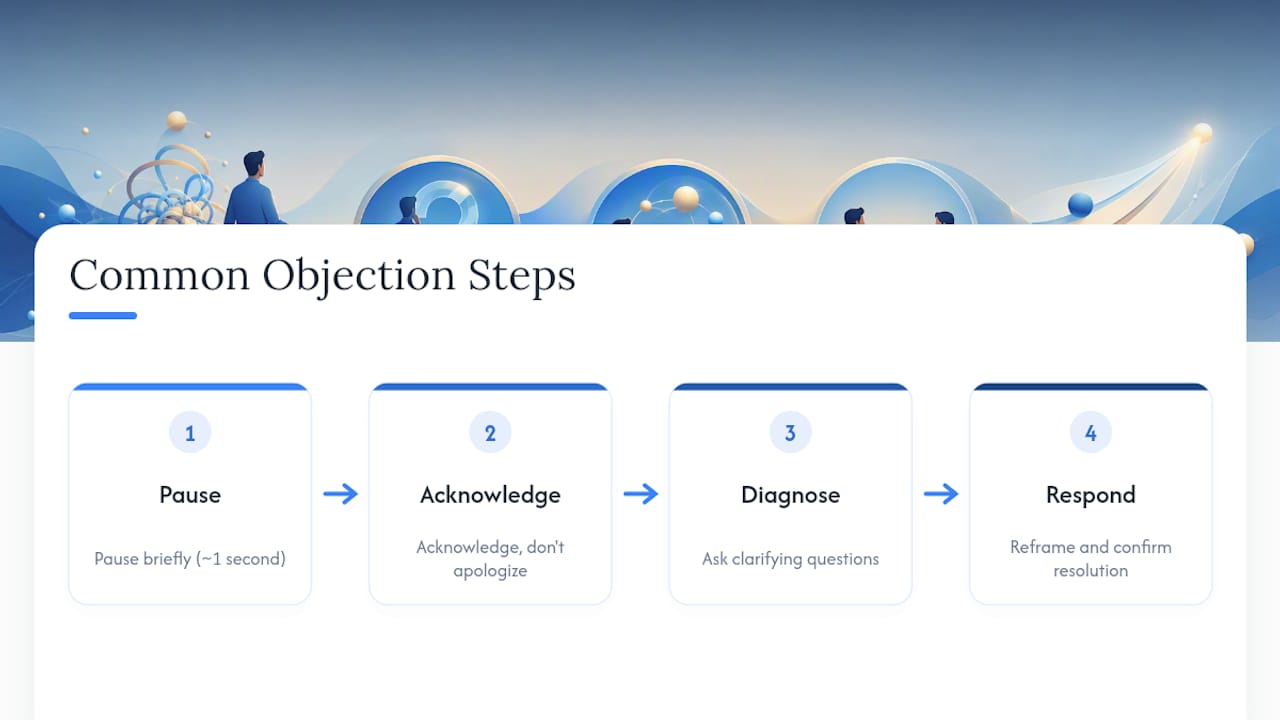
1. Pause before you speak. Most reps jump in within half a second of hearing an objection, which guarantees you’re responding to the words instead of the meaning behind them. A brief pause—even one full second—signals confidence and gives you a beat to actually process what was said instead of reaching for a canned rebuttal.
2. Acknowledge without agreeing or apologizing. “That makes sense” or “Fair point” costs you nothing and lowers the seller’s guard. Skipping this step is the fastest way to sound like you’re arguing.
3. Explore or diagnose before you respond. This is the step Carew identifies as the most critical phase in LAER, and for good reason: premature responses routinely miss the buyer’s actual concern. Ask something like, “When you say the price is too low, is that compared to what you were hoping for, or what a neighbor’s house sold for?” You’re isolating the real blocker, not the stated one.
4. Respond with a reframe, not a script recitation. Once you know the real objection, your response options multiply: reframe the cost of inaction, offer a comparable example, or present an alternative structure. Then confirm you’ve actually resolved it before moving forward. “Does that address the concern, or is there something else on your mind?” This confirmation step gets skipped constantly, and it’s why deals stall even after a “successful” objection response.
Pro Tip: Time yourself on your next ten calls. If your average pause after an objection is under half a second, you’re rebutting on reflex. Aim for one full second before your first word.
How to Choose the Right Framework by Call Stage
Picking a framework in real time comes down to four questions you can run through in about ten seconds: How complex is the objection? How much time do you have? What’s the emotional tone? Is there an existing solution or vendor already in the picture?
Cold calls demand the leanest framework you have, because you’re fighting for continuation, not resolution. Discovery calls give you more runway to explore. Demos and negotiations, where budget and authority objections cluster, benefit from LAER’s full sequence because the stakes and stakeholder count are higher.
- Cold call, reflex objection (“not interested,” “send an email”) → Validate‑Label‑Ask, because nearly half of all objections on cold calls are dismissive reflexes that don’t need deep exploration, just acknowledgment and a permission-based follow-up
- Discovery call, situational objection (timing, competing priorities) → V.I.R., since you have a few minutes to isolate the real timeline concern
- Demo, budget or authority objection → LAER, because multiple decision-makers are often involved and premature responses waste the meeting
- Negotiation, existing-vendor objection → LAER or Boomerang, depending on whether the seller is comparing offers or just testing your resolve
When in doubt, default to fewer steps. A three-move framework you execute cleanly beats a five-move framework you half-remember. Escalate to the fuller LAER sequence only when the objection resists a quick reframe, or when you sense there’s a second, unstated concern underneath the first.
Scripts You Can Use on Your Next Call
These map directly to the frameworks above, so you’re not just memorizing lines, you’re practicing the underlying sequence. Real estate investors will recognize most of these from calls with distressed sellers navigating probate, pre-foreclosure, or divorce, where emotional stakes run higher than a typical B2B call.
Cold-call objections (Validate‑Label‑Ask):
- “I’m busy” — “Totally get it, this caught you at a bad time. Would thirty seconds work, or should I call back this evening?”
- “Send me an email” — “I can do that. Quick question first, though: is timing the issue, or is it more that you’re not sure you want to sell right now?”
- “We already have someone” — “Good to know you’ve got that covered. Out of curiosity, are you locked in with them, or still weighing options?”
- “Not interested” — “No problem at all. Can I ask, is that because you’re not looking to sell, or because you’ve had a bad experience with investors before?”
- “We don’t have the budget” (from a buyer-side contact) — “Understood. Is that a company-wide freeze, or is this particular project not prioritized right now?”
Demo-stage objections (V.I.R. or LAER):
- Budget pushback: Validate (“Makes sense you’d want to be careful with spend”), Isolate (“Is it the total number, or the timing of payment?”), Reframe (“If we structured this over 90 days instead, would that change things?”)
- Timing objection: “I hear you on timing. Help me understand, is this a this-quarter issue or a this-year issue?” Then respond to the actual window, not the vague delay.
- Authority objection (“I need to check with my partner/spouse”): “Absolutely, that’s a big decision to make solo. What do you think their main question will be, so I can make sure we’ve covered it?”
- Trust objection (“How do I know you’re legit”): Reframe with social proof and a low-risk next step. “Fair question. Most sellers ask the same thing before signing anything. Would it help if I sent over a couple of recent closings in your area first?”
Coach cue for all of these: the goal on the first pass isn’t to close, it’s to earn one more exchange. If you resolve the stated objection but the seller still hesitates, you probably answered the wrong concern. Go back to Isolate.
Building an Objection Handling Practice Routine That Sticks
Reading a script once doesn’t make it yours. Building an objection handling framework into instinct takes repetition spaced out over time, not a single training session.
Daily micro-drills (2 to 3 minutes): Pick one objection type and run the pause-then-isolate sequence five times in a row, out loud, alone if needed. This isn’t roleplay, it’s muscle memory. Spaced repetition works for conversational skills the same way it works for vocabulary: short, frequent exposure beats one long cram session.

Weekly roleplay sessions (10 minutes): Partner up, run a scenario with a surprise objection thrown in halfway through, and give feedback immediately after using a simple scorecard (did they pause, did they isolate, did they confirm resolution).
Call-clip review: Tag recorded calls by objection type, pull three clips a week, and watch the moment right after the objection lands. That two-second window is where most reps either isolate correctly or rebut on reflex.
- Week 1: Focus on the pause. Target: 1-second pause on 80% of objections.
- Week 2: Add isolation questions. Target: ask one diagnostic question before responding on every call.
- Week 3: Layer in framework selection by call stage. Target: correct framework choice on 90% of calls.
- Week 4: Full integration plus clip review. Target: measurable lift in continuation rate.
Pro Tip: Record yourself for one full day of calls and count how many times you say “but” or “however” right after an objection. That word is almost always a tell that you skipped the isolate step and went straight to rebuttal.
What to Measure to Know the Framework Is Working
Scripts and drills only matter if you’re tracking whether they change outcomes. Four metrics tell you almost everything: pause length after an objection lands, your confirm-to-next-step rate, how often a call continues past an initial brush-off, and objection frequency by type.
- Pause length: Aim for at least one full second before your first word after an objection.
- Confirm rate: Track how often you actually ask “does that resolve it?” before moving on, versus assuming it did.
- Continuation rate: After a reflex objection like “not interested,” what percentage of calls get a second exchange?
- Objection taxonomy frequency: Log which objections show up most so your drill time matches reality, not guesswork.
Run a five-minute call review at the end of each shift: pull one call, mark where the objection hit, and note whether you isolated or rebutted. A weekly team dashboard comparing these numbers across reps turns individual habits into a coaching system, and pairing roleplay with measurable scorecards consistently outperforms slide-based training alone. Expect meaningful movement in continuation rate within four to eight weeks if the daily drills actually happen.
Why Most Objection Handling Training Fails Anyway
The frameworks in this article aren’t complicated. LAER has four steps. V.I.R. has three. That’s not the problem. The problem is that almost every sales team treats objection handling as a one-time training topic instead of a physical skill that decays without reps.
I’ve watched training programs for real-estate cold callers where the script was solid and the roleplay was almost nonexistent, maybe once a month if the manager remembered. The reps who actually got better weren’t the ones with the best scripts memorized on paper. They were the ones running short, ugly, five-minute roleplays multiple times a week, getting corrected on the pause and the isolate question specifically, not on tone or general “confidence.”
That’s the gap conventional advice glosses over: it’s not framework quality that separates good closers from mediocre ones, it’s repetition frequency. Try this: run a 15-minute drill session tomorrow where you only work the isolate step on five recorded objections, then measure your continuation rate on the next twenty real calls against your baseline. The number will tell you more than another article on scripts ever could.
— Dave
Practice at Scale With ClosersLeague
Reading scripts is one thing. Getting enough live reps against realistic pushback, on distressed-seller scenarios like probate, pre-foreclosure, or tired landlords, is another problem entirely, especially when your only practice partner is whoever’s free on the team that day. ClosersLeague gives you unlimited AI roleplay calls that throw the exact objection types covered here at you on demand, scored against pause length, isolation questions, and confirmation rate automatically, so you’re not guessing whether the drill worked.
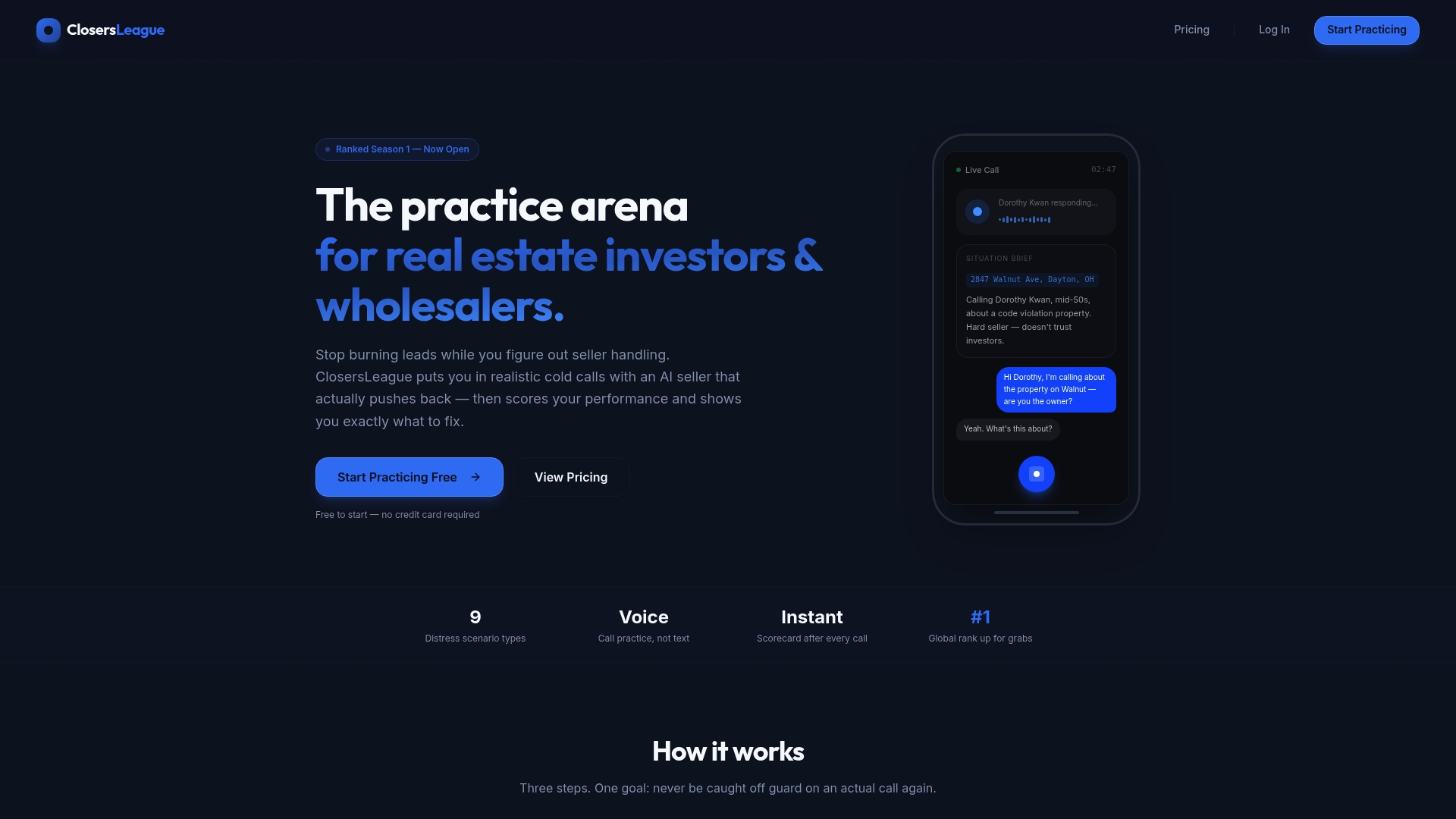
The scenario library covers the seller situations real estate investors actually run into, from inherited property to code violations, with real-time coaching after each call and a leaderboard that turns solo practice into something your whole team can track together. Instead of waiting for a manager to review three call clips a week, you get a scorecard after every single rep. If you want to build the pause-and-isolate habit into instinct instead of theory, start with a free trial of AI cold calling practice and run your first scenario today.
Sources
For deeper reading, Carew International’s LAER resources cover the framework’s origin in detail. Gong’s analysis of 300 million cold calls breaks down objection taxonomy at scale, and QUOTA Training’s cold-call guide offers additional script structures worth testing against your own call data.
- Handling objections using LAER — Carew International
- We found the top objections across 300M cold calls; here’s how to handle them all — Gong blog
- Objection Handling: What 67,149 Sales Calls Reveal — Prospeo
- Cold call objection handling: Turn pushback into meetings — QUOTA Training
FAQ
What Are the Five Steps of Objection Handling?
The most common version follows Listen, Acknowledge, Explore, Respond, and Confirm, an extension of Carew’s LAER model with an added confirmation step to verify the objection is actually resolved before moving forward.
What Are the Three Golden Rules for Objection Handling?
Pause before responding, isolate the real objection before you rebut, and confirm resolution before advancing the call. Skipping any one of the three is why objections that seem “handled” resurface later in the deal.
What Are the Three Major Objection Categories?
Sales calls typically produce dismissive/reflex objections, situational objections like budget and timing, and existing-solution or status-quo objections tied to a current vendor. On cold calls specifically, dismissive reflex objections account for a large share of all pushback, which is why cold-call scripts need a different structure than discovery-call scripts.
What Are the Five Most Common Sales Objections?
Across outbound calls, the recurring five are “I’m busy,” “send me an email,” “we already have someone,” “not interested,” and “no budget.” Together these account for the large majority of pushback reps hear on a first call, which is why the scripts above target exactly these five first.
Which Objection Handling Framework Should Beginners Start With?
Start with Validate‑Isolate‑Reframe. It has only three steps, so it’s easier to execute consistently under pressure, and it builds the isolate habit that every other framework, including LAER, depends on.