Pattern interrupts on cold calls work because they force a prospect’s brain to stop running its default “not interested” script and actually listen. The technique, sometimes called a conversational disruptor in practitioner circles, buys you a short window of real attention before the autopilot kicks back in. Here are three openers you can use on your next call right now:
- Honesty interrupt: “Hey [First Name], this is a cold call. Can I have 18 seconds to tell you why I called?”
- First-name curiosity hook: “Hey Bob?” (pause, wait for response) “This is [Your Name] — I’ll be honest, you don’t know me.”
- Third-party pain hook: “I just spoke with another homeowner on [Street Name] who was dealing with a code violation. I figured I’d reach out to a few neighbors.”
Pro Tip: Slow down on the first three words. Prospects hang up on speed, not honesty. A deliberate, unhurried opener signals confidence and keeps the line alive long enough to matter.
Key Takeaways
Pattern interrupts on cold calls work because they reset the prospect’s autopilot rejection reflex and buy 10–30 seconds of genuine attention, but only consistent drilling converts that window into appointments.
| Point | Details |
|---|---|
| Start with two openers | Test the honesty interrupt and first-name hook first; drill each on 50+ connects before switching. |
| Use the five-part structure | Move from interrupt to reason, value, question, and meeting ask on every call. |
| Track the right metric | Connect→appointment rate is the only number that tells you an interrupt is actually working. |
| Avoid ethical shortcuts | Never impersonate a contact or fabricate urgency; scrub lists for DNC and TCPA compliance. |
| ClosersLeague accelerates mastery | AI roleplay with real-time scorecards shortens the gap between knowing a technique and executing it under pressure. |
Table of Contents
- What are pattern interrupts in cold calling, and why do they work?
- Which pattern interrupt techniques actually work on cold calls?
- Copy-ready cold-call scripts for each technique
- How do you practice and test pattern interrupts to get real results?
- How do you handle objections that follow a pattern interrupt?
- What mistakes and ethical lines should you watch for?
- Pre-call checklist: what to confirm before you dial
- What high-volume dialing actually teaches you about pattern interrupts
- ClosersLeague turns pattern interrupt practice into measurable skill
- Sources
- FAQ
What are pattern interrupts in cold calling, and why do they work?
A pattern interrupt is a deliberate conversational disruption designed to reset a prospect’s autopilot rejection reflex and buy you a short window of genuine attention. The goal is not to trick anyone. It’s to stop the mental script that fires the moment someone realizes they’re on a cold call.
Neuroscientists call this the orienting response: when something unexpected happens, the brain briefly pauses its current processing to evaluate the new stimulus. Sandler practitioners describe this as a deliberate disruption that resets the prospect’s autopilot rejection reflex and can be used ethically to buy 10–30 seconds of attention. That window is all you need to deliver a reason to keep talking.
Mailchimp frames pattern interrupts as a tactic to disrupt a customer’s usual thought process and re-engage them before the pitch, with practical examples for outreach. The key word is “before.” The interrupt is not your pitch. It’s the door that lets you deliver one.
Honesty and surprise work better than gimmicks because they bypass suspicion rather than triggering it. Nutshell’s explainer on pattern interrupt sales techniques reinforces the same point: brief, honest openers outperform clever tricks every time.
Pro Tip: Never impersonate a government official, a prior contact, or a referral you don’t actually have. A fake interrupt destroys trust the moment the prospect figures it out, usually within 30 seconds.
Which pattern interrupt techniques actually work on cold calls?
Six techniques show up consistently across high-volume dialing workflows. Each fits a different prospect type or call stage.
- Honesty interrupt: You name the call for what it is. Works on nearly every list because it disarms the “who is this and what do they want” reflex immediately. Best for cold lists where you have zero prior contact.
- First-name curiosity hook: You say the prospect’s first name, pause, and wait. The pause is the interrupt. Saleshandy’s practitioner data shows a first-name curiosity opener can buy 3–5 extra seconds of attention and materially improve early retention on calls. Best for any list; especially effective when you’re dialing at high volume and need a fast, repeatable opener.
- Assumptive greeting: You open as if you already have a relationship. Works best on warm lists or when a prior touch (mailer, text, voicemail) has already landed.
- Third-party story: You reference a neighbor, a similar homeowner, or a recent transaction in the area. Creates immediate local relevance. Best for geo-targeted lists like probate, pre-foreclosure, or tax-delinquent.
- Negative reverse: You give the prospect an easy out, which paradoxically makes them less likely to take it. Example: “I’m not sure this even makes sense for you.” Works well mid-call when a prospect is going cold.
- Up-front contract: You state what will happen on the call and ask permission. Borrowed from the Sandler methodology, it works best with decision-makers who are skeptical of sales calls but respond to transparency.
HubSpot advises that warm touches or prior name recognition make interrupts more effective because the opener lands against a familiar frame instead of pure cold noise. If you’ve sent a mailer or left a voicemail, your interrupt is no longer random. It’s contextual.
Pro Tip: Match the technique to the list. Probate and inherited-property leads often respond better to the third-party story because they’re emotionally guarded. Pre-foreclosure leads tend to respond to the honesty interrupt because they’re already stressed and appreciate directness.
Copy-ready cold-call scripts for each technique
These are short, tested openers and micro-scripts you can adapt and A/B immediately. Keep them under 20 words for the opener line.
Honesty interrupt openers
- “Hey [First Name], this is a cold call. Can I have 18 seconds?”
- “I’ll be upfront — you don’t know me, and I’m calling out of the blue. Fair warning.”
- “This is [Your Name]. Totally cold call. I’ll keep it under a minute if you’ll give me a shot.”
First-name curiosity openers
- “Hey Maria?” (pause) “This is [Your Name] — I know you weren’t expecting my call.”
- “Is this David?” (pause) “Good. I was hoping to catch you.”
Third-party story openers
- “I just helped a homeowner two streets over with a situation similar to yours. I wanted to reach out before I left the area.”
- “I was speaking with someone on [Street] dealing with a probate property. Figured I’d call a few neighbors who might be in a similar spot.”
Assumptive and up-front contract openers
- “[First Name], I’m calling because I buy properties in [City] and I wanted to see if you’d ever considered an offer. Takes about 90 seconds to find out if it’s even worth talking.”
- “Here’s what I’d like to do: spend 60 seconds explaining why I called, then you tell me if it makes sense to keep talking. Fair?”
Moving from interrupt to meeting ask (micro-script)
Prospeo recommends a five-part structure that keeps the call on track after the interrupt lands:
- Interrupt: Open with one of the lines above.
- Reason: “The reason I’m calling is I buy homes directly from owners in [City], and I noticed your property at [Address].”
- Value: “We close fast, pay cash, and handle everything — no repairs, no agent fees.”
- Question: “Is that something you’d ever consider, or is the property off the table entirely?”
- Meeting ask: “Would it make sense to spend 10 minutes this week just to see if the numbers work for you?”
For video calls, slow your pace even further and make eye contact with the camera on the opener line. The visual channel amplifies the interrupt because the prospect can see your confidence. For phone calls, the first 10 seconds determine whether the call continues. Smiling while you dial changes your vocal tone in ways prospects can hear, and a slower pace signals that you’re not reading from a script.
Pro Tip: Use distressed seller scripts as your base template, then swap only the opener line when A/B testing. Changing one variable at a time gives you clean data on what’s actually moving the needle.
How do you practice and test pattern interrupts to get real results?
Stop winging it. Start drilling. High-volume calling datasets in real estate show that roughly 20% of tested opener variations drive approximately 80% of appointment wins, according to practitioner analysis of cold calling psychology. That means you should pick one or two interrupts and drill them to muscle memory before testing a third.
A/B test plan
- Pick two openers: one control (your current opener) and one interrupt variant (start with the honesty interrupt or first-name hook).
- Set a sample size: run each opener on at least 50 connects before drawing conclusions. Fewer than that and the data is noise.
- Run for one week: keep everything else constant. Same list type, same time of day, same follow-up sequence.
- Record outcomes per opener: track connect→conversation rate, connect→appointment rate, and mean call length.
- Pick the winner and test the next variable: once one opener consistently outperforms, make it your control and test a new variant against it.
Metrics that matter
| Metric | What to watch for | Minimum meaningful uplift |
|---|---|---|
| Connect→conversation rate | Are prospects staying on the line past 10 seconds? | +5 percentage points vs. control |
| Connect→appointment rate | Are conversations converting to scheduled calls? | +2 percentage points vs. control |
| Mean call length | Longer calls usually signal more engagement | +30 seconds vs. control |
| Talk/listen ratio | You should be talking less than 50% of the time | Shift toward less talk |
For daily practice, AI roleplay tools like ClosersLeague let you run scenario-based practice calls against simulated seller objections across distressed property types, with scorecards that show exactly where your opener or transition broke down. That kind of repeatable, graded practice is what shortens the gap between knowing a technique and executing it under pressure.
Pro Tip: Track call→appointment lift, not raw connect rate. A higher connect rate with no appointment lift means your list is better, not your opener. Appointment lift is the only metric that tells you the interrupt is actually working.
How do you handle objections that follow a pattern interrupt?
An interrupt wins attention. What you do in the next 15 seconds determines whether that attention converts to a conversation. Here are the six most common objections and tight responses that preserve trust.
- “Who is this?” Respond: “This is [Your Name] — I buy properties in [City]. I know this is out of the blue.” Don’t over-explain. Name, purpose, acknowledgment.
- “I’m not interested.” Respond: “That’s fair. Can I ask — is it that you’d never consider selling, or just not right now?” This separates a hard no from a timing objection. For deeper handling, this objection-handling workflow walks through the full sequence.
- “Don’t call me again.” Respond: “Absolutely. I’ll take you off my list right now. Before I go — is there anyone else in the family who handles decisions about the property?” Honor the request, then ask one clean pivot question.
- “How did you get my number?” Respond: “Public records — your property came up in my research. I should have led with that. Sorry for the surprise.” Transparency here rebuilds trust faster than deflection.
- “I already have an agent.” Respond: “That makes sense. I work differently — I buy directly, so there’s no listing process. Worth knowing the difference, even if it’s not the right fit.”
- “Send me something in writing.” Respond: “Happy to. What’s the best email? And while I have you — what would make an offer worth looking at for you?” Get the email and one piece of qualifying information before you hang up.
Pro Tip: When a prospect says “don’t call me” and means it, concede cleanly and move to follow-up. A forced conversation after a hard no destroys any chance of a future deal. Log the call, send a brief text or mailer, and let time do the work.
What mistakes and ethical lines should you watch for?
The most common pattern interrupt mistakes are predictable, and most of them come from overuse or laziness.
- Overusing the same opener on every call. Prospects in tight geographic markets talk to each other. If your opener sounds scripted, it spreads.
- Using random or irrelevant interrupts. A curiosity hook that has nothing to do with the prospect’s situation feels manipulative once they realize it.
- Creating false urgency. Saying “I only have one spot left” when you don’t is a short-term tactic that kills long-term reputation.
- Copying scripts word-for-word without adapting. Scripts are starting points. A line that works for a pre-foreclosure lead in Phoenix may land wrong on a probate lead in rural Ohio.
- Impersonating a referral or prior contact. This is both unethical and potentially illegal. Never imply you know someone you don’t.
- Ignoring Do Not Call and TCPA constraints. Scrub your lists. A clever opener doesn’t protect you from a TCPA violation. Check why some numbers generate unexpected call confusion before dialing recycled or purchased lists.
The goal of a pattern interrupt is to bypass autopilot so you can start a peer-to-peer dialogue, not to manipulate someone into a conversation they’d never agree to if they were thinking clearly. That distinction matters in practice because prospects who feel tricked don’t close deals.
Pro Tip: Keep your interrupts honest and high-ROE (return on engagement). If you wouldn’t be comfortable explaining exactly what you said and why to the prospect after the call, the opener needs to change.
Pre-call checklist: what to confirm before you dial
Run through this before every calling session, not just when you’re trying something new.
- Opener selected: choose one interrupt for the session and stick to it.
- Purpose statement ready: know your one-sentence reason for calling before you dial.
- List scrubbed: confirm DNC compliance and remove any numbers flagged from prior sessions.
- Pacing cue set: remind yourself to slow down on the first three words.
- Qualifying question loaded: have one open-ended question ready for the 30–60 second window after the interrupt lands.
- Meeting ask prepared: know exactly how you’ll ask for the next step if the conversation goes well.
- Metrics sheet open: log connect→conversation and connect→appointment in real time, not from memory at the end of the day.
For the first 10 seconds, your only job is to stay on the line. For the 30–60 second window, your job is to earn the right to ask a qualifying question. Everything after that is standard cold calling technique.
Pro Tip: Test one variable per session. If you change your opener and your tone and your list on the same day, you won’t know what moved the numbers. Micro-experiments run clean when only one thing changes.
- After the session: review your metrics, note which opener variant you ran, and flag any objections you hadn’t heard before for your next practice session.
What high-volume dialing actually teaches you about pattern interrupts
Most reps spend the first few weeks of high-volume dialing trying to sound natural while reading from a script. The interrupts that work aren’t the cleverest ones. They’re the ones you’ve said enough times that they come out without thinking.
The practical limit of pattern interrupts is this: they buy you attention, not trust. Trust comes from what you do in the 30 seconds after the interrupt. Reps who focus entirely on perfecting their opener and neglect the transition from interrupt to reason to value tend to see a spike in conversations but no lift in appointments. The opener is the door. You still have to walk through it.
Early wins in high-volume real estate dialing usually come from a single, well-drilled honesty interrupt paired with a clean third-party story for warm geographic lists. That combination covers most distressed seller scenarios without requiring you to memorize six different openers.
ClosersLeague turns pattern interrupt practice into measurable skill
Most reps know what a pattern interrupt is. The gap is in execution under pressure, when a real homeowner pushes back and the script goes out the window. ClosersLeague closes that gap with AI-powered roleplay that puts you in live-feeling conversations against simulated distressed sellers across probate, pre-foreclosure, inherited, tax-delinquent, and code-violation scenarios.
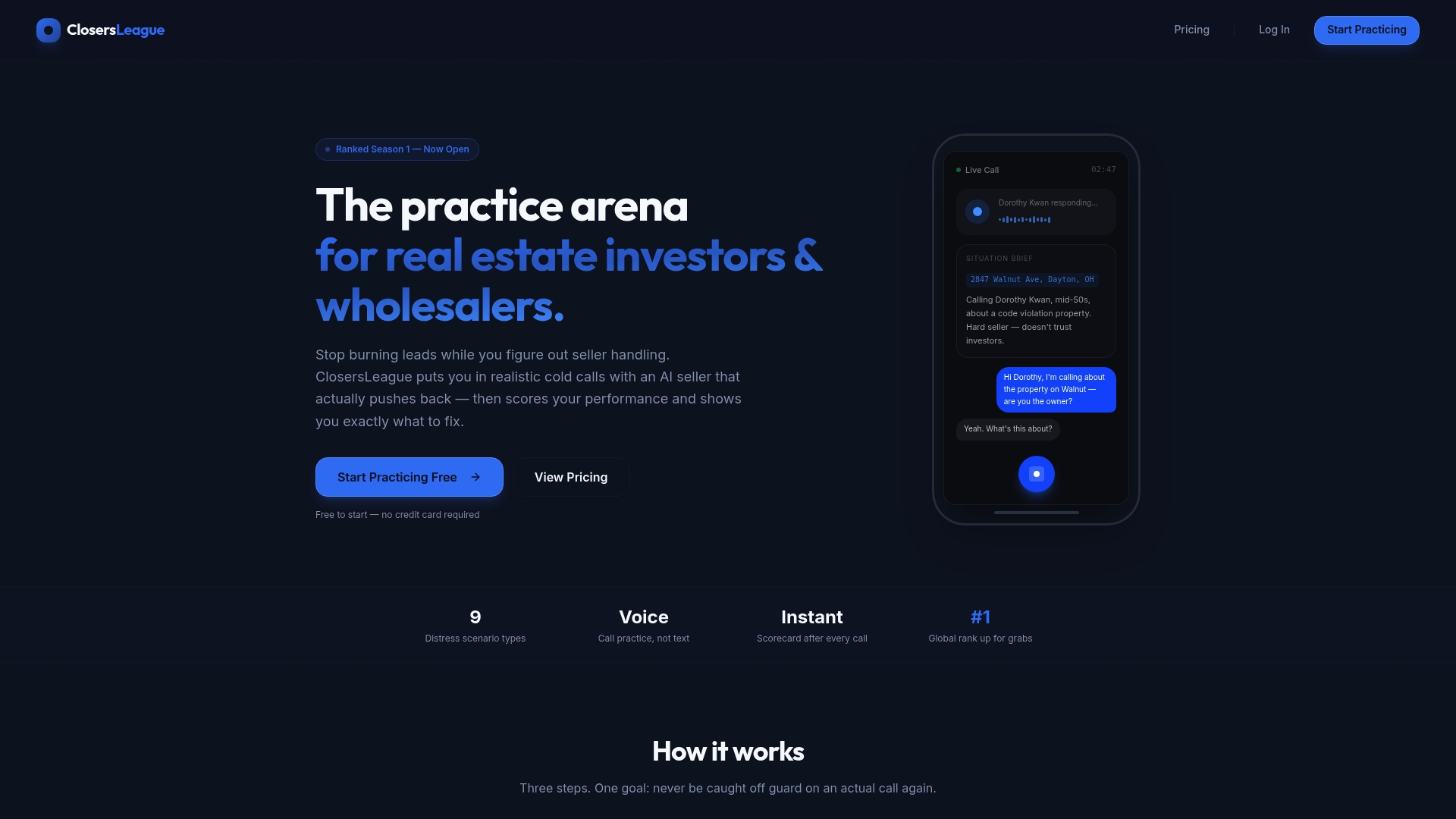
Every session is scored. You see exactly where your opener landed, where your transition broke, and which objections you fumbled. ClosersLeague’s AI roleplay modules mirror the seller objections you’ll actually face, so practice sessions build real muscle memory instead of false confidence. Features include:
- Scenario library covering 10+ distressed seller types
- Real-time coaching feedback on pacing, tone, and structure
- Performance scorecards that track improvement call over call
- Competitive leaderboards to keep your team sharp
Start with the inherited property practice module or explore the full platform at Closersleague and run your first AI practice call free.
Sources
- Break-the-Script-Using-Pattern-Interrupts
- Pattern interrupt (Mailchimp)
- How to use pattern interrupt (HubSpot)
- Pattern Interrupt Cold Call: 7 Openers That Book Meetings
- How to cold call in real estate (Saleshandy)
FAQ
Is cold calling still effective in 2026?
Cold calling remains one of the highest-ROI direct outreach channels for real estate investors, particularly for distressed seller lists where homeowners are not actively searching for buyers online. Pattern interrupts improve connection-to-conversation rates by making the first 10 seconds feel less like a sales call.
What are the three P’s of cold calling?
The three P’s are preparation, persistence, and personalization. Preparation means knowing your opener and your list before you dial; persistence means following a consistent cadence; personalization means adapting your interrupt and reason-for-calling to the specific seller type, whether probate, pre-foreclosure, or inherited property.
What are the biggest mistakes in cold calling?
The most damaging mistakes are using the same generic opener on every list type, skipping the transition from interrupt to a clear reason for calling, and failing to track connect→appointment rate as the primary performance metric. Overusing any single technique until it sounds scripted is equally costly.
What are the five stages of a cold call?
A structured cold call follows five stages: the pattern interrupt opener, the reason for calling, the value statement, a qualifying question, and the meeting ask. Prospeo’s practitioner framework maps this sequence and shows how each stage builds on the attention won in the first stage.
How do you practice pattern interrupts without burning real leads?
AI roleplay platforms like ClosersLeague let you run scenario-based practice calls against simulated seller objections across distressed property types, with scorecards that identify exactly where your opener or transition breaks down, so you build execution confidence before dialing live lists.