Price conditioning calls are conversations where you introduce a realistic price range before naming your final number, so the buyer’s brain adjusts before the moment of decision. The single best practice: share a high, low, and typical range early, then frame affordability with monthly payments when it fits the deal. Below, you’ll find the psychology, the exact scripts, and the data behind why this works.
TL;DR:
- Introducing a high, low, and typical price range early in the call helps set realistic expectations and prevents the buyer from anchoring on a low estimate.
- Presenting the range with the high number first, pausing, then the low, ensures the buyer processes each figure clearly and avoids confusion.
- Offering financing options and breaking down total costs into monthly payments significantly increases close rates, especially when buyers are deterred by lump-sum prices.
- Knowing your three key prices and practicing delivery with confidence and proper tone improve the effectiveness of price conditioning.
- Rehearsing the range-delayment sequence repeatedly, especially with realistic objections, builds muscle memory and reduces hesitation during live calls.
Table of Contents
- What price conditioning is and why it works on buyers’ brains
- Five practical keys to effective price conditioning
- When to anchor first versus when to ask the buyer’s number
- Scripted language you can use on your next call
- Using monthly payments to shift how price feels
- Handling “too expensive” and defending your anchor
- Why rehearsal, not memorization, builds this skill
- Practice price conditioning with Closers League
- Sources
- FAQ
What price conditioning is and why it works on buyers’ brains
Price conditioning is the practice of setting realistic, accurate price expectations early in a call so the final number doesn’t trigger sticker shock. Buyers often walk into a conversation with a number in their head that’s far below the real cost of a quality job, and that gap between expectation and reality is what kills deals at the finish line, not the price itself, according to contractor price conditioning guidance.
The mechanism is anchoring: whatever number lands first in a conversation becomes the mental reference point for everything after it. If you let the buyer anchor low, you spend the rest of the call fighting your own quote. If you anchor with an honest range instead, you’re doing the buyer a favor and protecting your close rate at the same time.
- Introduce the range before you diagnose the full scope, not after.
- Order matters: state the high figure first, then the low, then the typical price a similar job runs.
- A range feels honest. A single number feels like a demand.
Five practical keys to effective price conditioning
Price conditioning isn’t a single line you memorize. It’s a sequence, and skipping a step is usually why reps feel like they’re “winging it” on price instead of controlling the call.
- Build trust before you talk numbers. Ask diagnostic questions about the buyer’s situation first, so the price feels tied to their specific problem instead of a generic script.
- Know your three numbers cold. Have your high, low, and typical price memorized so you never hesitate when the buyer asks. Hesitation reads as uncertainty, and uncertainty invites negotiation.
- Give it time to sink in. Introduce the range early enough that the buyer has soak time to adjust before you present the final quote.
- Deliver it with the right tone. Confident and matter-of-fact beats apologetic every time. If your voice flinches at the number, so will the buyer.
- Offer choices, not a verdict. A good, better, best structure paired with financing gives the buyer control, which lowers resistance to the top line.
Pro Tip: Practice saying your highest number out loud until it sounds as routine as stating your name. Buyers hear hesitation before they hear the figure.
When to anchor first versus when to ask the buyer’s number
Anchoring first works best when you know more about the deal’s realistic range than the buyer does, which is most of the time in home services and property calls. Eliciting the buyer’s number first makes sense when you suspect they’ve already gathered competing quotes or when the job has enough variables that a premature anchor could misfire.
- Anchor first when you’re confident about the job scope and the buyer is pricing blind.
- Ask their number first when they mention “getting other quotes” or reference a specific budget unprompted.
- Anchor first when speed matters and a stalled conversation risks losing the lead entirely.
- Ask first when the deal has several moving parts (financing, timeline, add-ons) that could shift your range.
Negotiation research from Harvard’s Program on Negotiation supports going first whenever you hold more information about the realistic zone of agreement than the other side, since the first credible number anchors the entire discussion. For more on how these zones apply in real estate deals specifically, see our breakdown of negotiation tactics for better deals.
Scripted language you can use on your next call
Scripts only work when they sound like you, so treat these as starting points, not lines to recite word for word.
- Range opener: “Jobs like this typically run somewhere between [high] and [low], depending on a few details we’ll walk through, and most people land right around [typical].”
- Good, better, best: “We’ve got three ways to solve this. The full option runs [high], the standard package is closer to [typical], and if budget’s tight, the essential fix comes in around [low].”
- Precise anchor: Use a specific figure like $255,500 instead of a round $255,000. Research on negotiation anchors shows precise numbers read as more researched and carry more weight than round ones, according to PON’s anchoring research.
Pro Tip: When you state a range, pause after the high number. Let it sit for a second before moving to the low end, so it registers instead of blurring together.
For real estate specific phrasing, our guide on opening scripts for cold calls covers how to introduce pricing ranges without sounding scripted.
Using monthly payments to shift how price feels
Lump-sum pricing forces buyers to judge affordability against their bank balance today. Monthly-payment framing shifts the question to whether the job fits their budget over time, which is a much easier yes for most people.
Contractors who consistently offer financing on every job see close rates around 49% versus 38% for those who don’t, a meaningful gap tied directly to how the price gets framed, not the price itself.
- Lead with the monthly number when the total is likely to trigger sticker shock.
- Always disclose the total cost and any fees before the buyer commits, never bury them.
- Present financing as a standard option for every deal, not a rescue tactic pulled out only when someone objects.
Handling “too expensive” and defending your anchor
Most “too expensive” objections aren’t really about the number. They’re about a value gap you haven’t closed yet, and the fix starts with a question, not a discount.
- Ask what “expensive” is being compared to. Often the buyer is anchoring against a lowball quote or an outdated assumption, and naming that gap resets the conversation.
- Reframe toward the cost of inaction. A short line like “the cost today is fixed, but the cost of waiting usually isn’t” pulls focus back to value instead of price.
- Defuse a lowball counter without conceding. If a prospect drops a number far below your range, ask what they based it on before responding. That question alone often exposes an assumption worth correcting.
Objection scripts built for distressed seller conversations specifically are covered in our cold calling scripts that convert, and if the pushback involves a competing agent or buyer, our scripts for “I have a realtor” calls walk through re-anchoring in that specific scenario.
Why rehearsal, not memorization, builds this skill

Reading a script and delivering it live are two different skills, and the gap between them is exactly where price conditioning falls apart on real calls. Timing, tone, and the discipline to let soak time do its work only come from repetition against realistic pushback, not from reading a page once.
Structured rehearsal, where a rep introduces a range after a diagnostic sequence and then has to sit through actual silence before responding, builds the muscle memory that scripted bullet points alone can’t. Running that drill solo or with a team, on a fixed timer, forces the pause that most reps skip when they’re nervous.
— Dave
Practice price conditioning with Closers League
ClosersLeague is an AI powered cold calling training platform built for real estate investors and wholesalers, and price conditioning is exactly the kind of moment its scenario-based roleplay is designed to drill. Instead of guessing whether your range-and-pause timing lands, you get instant scorecards and feedback across seller types like pre-foreclosure, probate, and tax delinquent, where price sensitivity plays out differently every time.
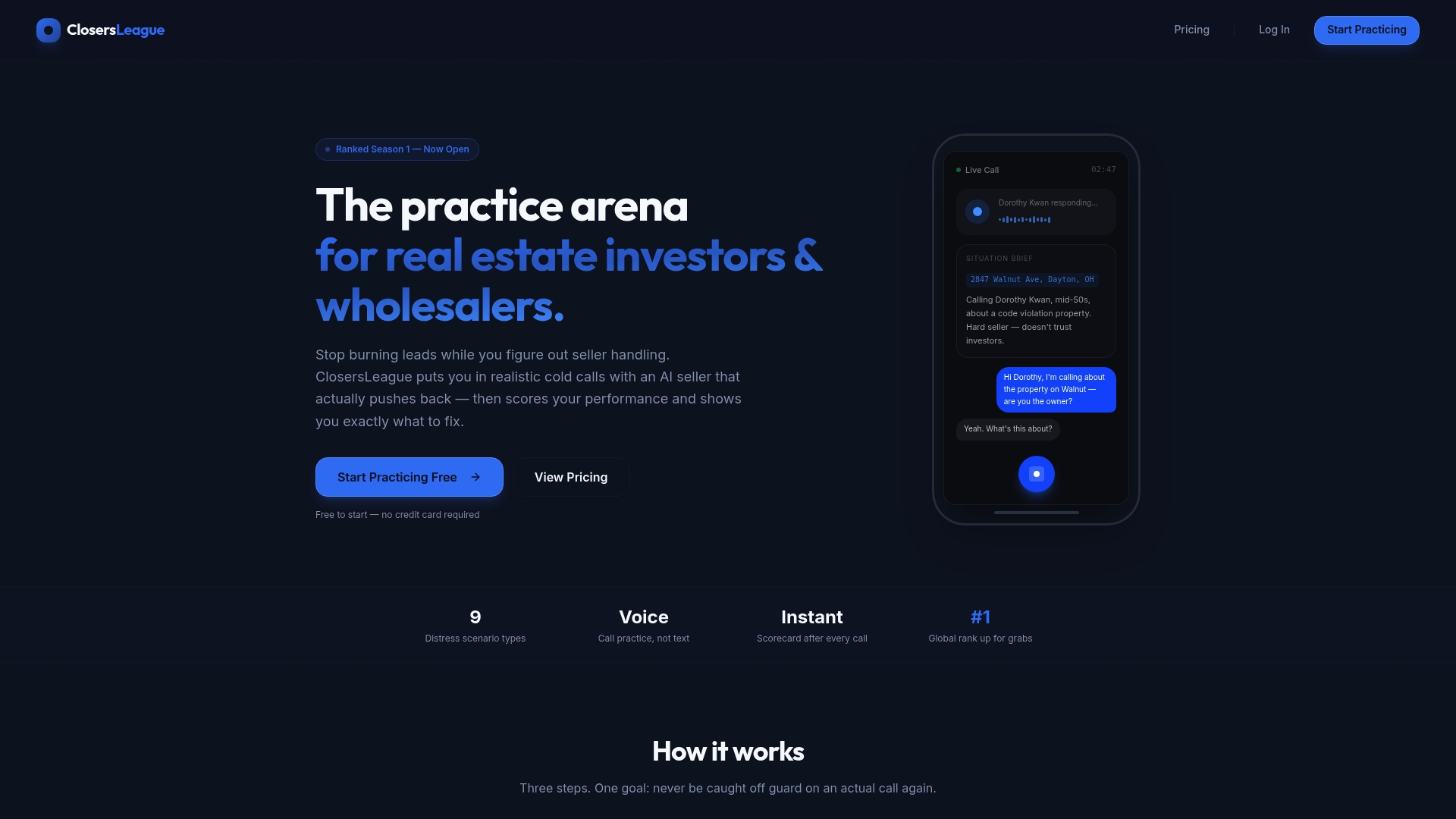
- Run repeated price conditioning drills against AI sellers modeled on nine distressed property types.
- Get scored on tone, timing, and objection handling instead of just call volume.
- Compare progress against other reps on the leaderboard as your close rate improves.
Plans start at $5 a month for Starter, with Growth at $10 and Pro at $18, each scaling the number of practice calls available. If you want to see the price conditioning scenarios in action first, check out the practice scenario library.
Sources
- 5 Keys to the Art of Price Conditioning | HVACR Business
- Survey Reveals Strategies to Boost HVAC Close Rates by Double Digits | ACHR News
- Anchoring bias in negotiation: Should you make a single offer or a range? | PON
FAQ
What is price conditioning and how does it work?
Price conditioning is the practice of introducing a realistic price range early in a sales call so the buyer’s expectations adjust before you state the final number. It works by anchoring the buyer’s mental reference point on an honest range instead of a guess, which reduces sticker shock at the moment of decision, according to contractor price conditioning guidance.
What are the four types of sales calls?
Sales calls are commonly grouped by purpose: prospecting calls to find new leads, qualifying calls to assess fit, presentation or pitch calls to walk through a solution, and closing calls to finalize the deal. Price conditioning most often happens during the presentation stage, right before or alongside the quote.
What is the 2-2-2 rule in sales?
Definitions of the 2-2-2 rule vary depending on the source, and no single version is treated as standard across sales training. A commonly cited version suggests following up two hours, two days, and two weeks after initial contact, though the specifics differ by industry and trainer.
What are the 5 C’s of pricing?
The “5 C’s of pricing” is a framework that varies by source and industry, with no single universally agreed definition. It’s not covered consistently enough across authoritative sources to state a definitive version here.
When should I introduce a price range instead of a single number?
Introduce a range as early as possible once you understand the basic scope of the job, ideally before the buyer has a chance to anchor on their own number. Waiting until the end of the call to reveal price removes the soak time buyers need to adjust their expectations.