
Real estate SMS marketing is the practice of sending targeted text messages to buyers, sellers, investors, and past clients across every stage of the property transaction lifecycle. Known formally as A2P (application-to-person) messaging, it uses dedicated SMS platforms rather than personal phones to deliver promotional, transactional, and conversational messages at scale while managing compliance. Real estate SMS platforms handle listing alerts, showing reminders, personalized follow-ups, and post-closing check-ins from a single dashboard. For agents and investors working distressed leads in foreclosure, probate, or divorce situations, this channel cuts through the noise faster than any other outreach method.
What is SMS marketing for real estate and how does it work?
SMS marketing in real estate operates through three core mechanics: lead capture, automated response, and two-way conversation routing. When a prospect sees your yard sign or online listing, they text a keyword to a short code (a 5 to 6 digit number) and receive instant property details in return. That single interaction captures their phone number, triggers an automated follow-up sequence, and flags them in your pipeline without you lifting a finger.
Here is how a standard SMS workflow runs for a real estate agent:
- Lead capture: A prospect texts “HOME5” to your short code after seeing a listing. The platform captures the lead instantly and sends automated property info within seconds.
- Automated nurture: The platform sends a follow-up text 24 hours later asking if the prospect wants to schedule a showing. No manual effort required.
- Reply routing: When the prospect replies “yes,” the system alerts you or a team member to take over the conversation in real time.
- Qualification: You confirm interest, answer questions, and book the appointment through a two-way text thread.
- CRM sync: The contact record, consent status, and conversation history sync automatically to your real estate CRM for ongoing pipeline management.
The speed advantage here is not theoretical. Agents can reach leads within minutes of inquiry through automation, which matters enormously in competitive markets where the first contact wins the deal.
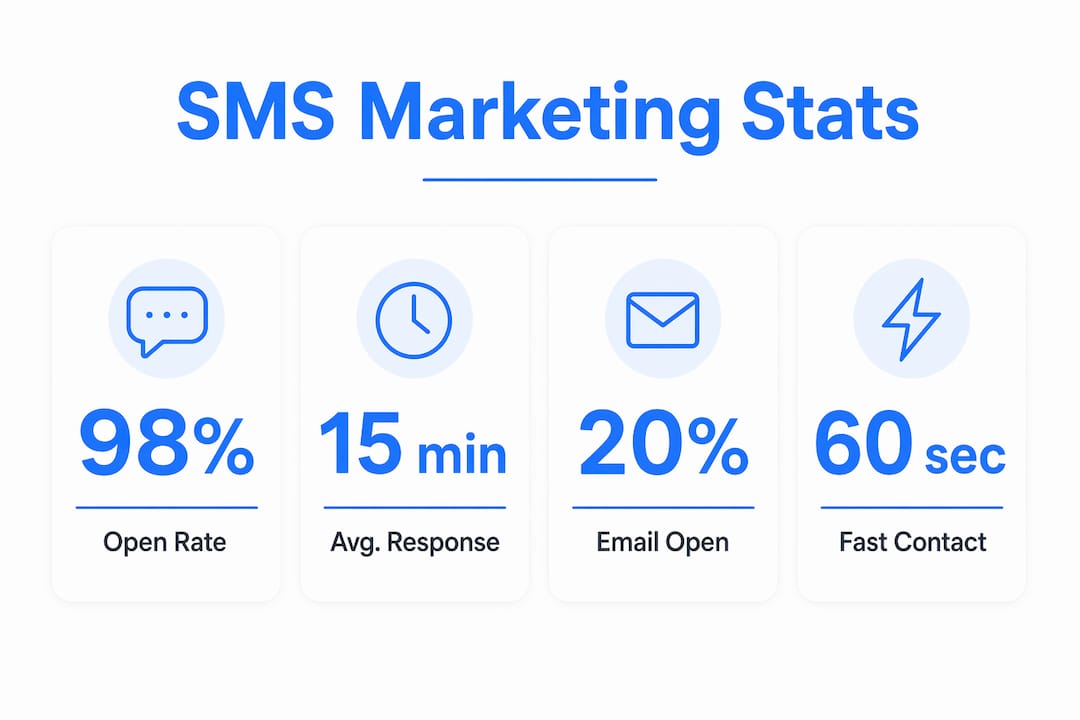
Pro Tip: Set your automated first response to fire within 60 seconds of a keyword trigger. Leads contacted in under a minute convert at dramatically higher rates than those reached even five minutes later.

How does SMS compare to email and phone calls?
The numbers make the case plainly. SMS open rates reach 98%, compared to roughly 20% for email. That gap is not a minor advantage. It means nearly every text you send gets read, while four out of five emails go unseen.
“Open rate comparisons between SMS and email are misleading. Focus instead on actionable metrics such as clicks, replies, and appointments.” — SMS vs. email research
The behavioral data behind SMS is equally striking. 32% of consumers check a new text immediately and 87% read it within 15 minutes, with 82% replying within that same window. That means your listing alert or showing reminder reaches a live, responsive person in real time, not a crowded inbox they check twice a day.
| Channel | Open rate | Avg. response time | Best use case |
|---|---|---|---|
| SMS | ~98% | Under 15 minutes | Urgent alerts, showing confirmations, lead follow-up |
| ~20% | Hours to days | Detailed property reports, newsletters, contracts | |
| Phone call | Varies | Immediate or voicemail | High-intent conversations, closing discussions |
Phone calls remain valuable for high-stakes conversations, but cold calls to distressed sellers often go unanswered on the first attempt. SMS fills that gap by creating a low-friction first touchpoint that warms the lead before you dial. For investors working real estate telemarketing alongside text outreach, this combination consistently outperforms either channel alone.
SMS also feels more personal than email. Recipients feel invited to reply, which enables low-friction engagement like confirming interest or scheduling a call. That interactivity is what separates text from broadcast channels.
What are the legal requirements for real estate SMS marketing?
Compliance is not optional, and the penalties for getting it wrong are severe. The Telephone Consumer Protection Act (TCPA) requires explicit opt-in consent before you send any marketing text. TCPA violations carry fines from $500 to $1,500 per message, and class action lawsuits in this space are common. One bulk send to an unverified list can cost more than a year of marketing budget.
The non-negotiable compliance requirements every agent must follow:
- Written opt-in consent: Prospects must actively agree to receive texts, either via web form, keyword opt-in, or signed document. Verbal consent alone is not sufficient.
- Immediate opt-out honoring: When someone replies “STOP,” your platform must suppress that number instantly. Delays are a compliance failure.
- Suppression list maintenance: Keep detailed logs of opt-outs, consent records, and message history. These records are your legal defense if a complaint is filed.
- A2P 10DLC registration: All business SMS must be registered through the A2P 10DLC system to avoid carrier blocking and filtering. This is not a one-time task. It requires ongoing management similar to email domain warmup.
- CRM and SMS platform integration: Without shared suppression state between your SMS tool and CRM, opt-out mistakes are common. Operational controls matter more than disclaimers.
Pro Tip: Choose an SMS platform that handles A2P 10DLC registration and monitoring on your behalf. Managing registration manually while running an active pipeline is a recipe for compliance gaps.
How to design effective SMS campaigns for real estate agents
The most effective SMS campaigns in real estate are built around conversation, not broadcast. Most agents make the mistake of treating text like a one-way announcement channel. The agents who win use SMS to start dialogues that lead to appointments.
Here are the campaign types that consistently perform for real estate professionals:
- New listing alerts: Send targeted texts to buyers who have expressed interest in a specific neighborhood or price range. Keep it under 160 characters with a direct link.
- Price drop notifications: Distressed sellers and investors respond well to price reduction alerts. These texts have high reply rates because the message is time-sensitive.
- Showing reminders and confirmations: Automated reminders 24 hours and 2 hours before a showing reduce no-shows significantly.
- Lead reactivation: Text cold leads from your CRM with a simple question: “Still looking for a property in [area]?” A single text can revive a lead that went dark months ago.
- Post-closing check-ins: A text 30 days after closing asking for a referral or review generates responses that email rarely does.
Timing and personalization drive results. Use the prospect’s first name, reference the specific property or neighborhood they inquired about, and send texts during business hours (9 a.m. to 7 p.m. in the recipient’s time zone). Frequency matters too. Two to four texts per month per lead is a reasonable ceiling before engagement drops.
Pro Tip: Balance bulk SMS campaigns with peer-to-peer (P2P) texting for your highest-priority leads. A personal text from your direct number to a motivated seller in foreclosure feels very different from a mass send, and that difference shows in your reply rates.
For investors working distressed leads, SMS works best as a warm-up channel before a call. Send a text first, then follow up with a call referencing the text. This approach, covered in detail in cold calling tips for investors, consistently improves answer rates on the phone.
What SMS platforms and tools work best for real estate?
Choosing the right SMS platform determines whether your campaigns run smoothly or create compliance headaches. The features that matter most for real estate professionals are not the same as those for e-commerce or retail.
Look for these capabilities when evaluating any SMS platform:
- Two-way texting with reply routing: The platform must support inbound message handling and alert your team when a lead responds.
- Keyword and short code support: This enables automated lead capture from yard signs, online listings, and print ads.
- A2P 10DLC registration assistance: The platform should handle brand and campaign registration, not leave it to you.
- CRM integration: Platforms that sync with tools like HubSpot, Follow Up Boss, or Salesforce keep your contact records and consent status aligned.
- Automation workflows: Look for drip sequences, trigger-based sends, and scheduling controls.
Platforms commonly used in real estate include EZ Texting, Podium, SlickText, and SimpleTexting. Each supports the core features above with varying levels of CRM integration and compliance tooling. SMS automation for real estate becomes significantly more powerful when the platform connects directly to your lead management system, eliminating manual data entry and reducing the risk of contacting opted-out numbers.
For agents managing rental properties alongside sales, platforms with lead capture and text automation built for property management, like those offered by Room Rental Manager, can handle both use cases from a single interface.
Key takeaways
Real estate SMS marketing succeeds when agents combine fast automation, compliant opt-in practices, and conversational follow-up to reach leads before competitors do.
| Point | Details |
|---|---|
| Speed wins leads | Automated texts must fire within 60 seconds of inquiry to maximize conversion rates. |
| SMS outperforms email | With a 98% open rate versus 20% for email, SMS reaches nearly every contact who opts in. |
| Compliance is non-negotiable | TCPA violations cost $500 to $1,500 per message; A2P 10DLC registration prevents carrier blocking. |
| Conversation beats broadcast | Two-way SMS flows that route replies to humans outperform one-way announcement campaigns. |
| CRM integration is critical | Syncing your SMS platform with your CRM prevents opt-out errors and keeps your pipeline clean. |
Why most agents are using SMS wrong
I have watched a lot of real estate professionals add SMS to their outreach stack and immediately treat it like email marketing. They build a list, blast a message, and wonder why replies are low. That is the wrong mental model entirely.
The agents I see winning with text are the ones who design for conversation from day one. They set up keyword intake so leads self-identify. They route replies to a human within minutes. They use SMS to warm up a lead before picking up the phone, not as a replacement for the call. That sequencing matters. A motivated seller in a probate situation who gets a thoughtful text before your call is far more likely to engage than one who gets a cold dial out of nowhere.
The compliance piece is where I see the most dangerous shortcuts. Agents skip A2P 10DLC registration because it feels bureaucratic. Then their messages start getting filtered by carriers, deliverability tanks, and they blame the platform. Registration is not optional. Treat it like email domain warmup. Do it once, maintain it consistently, and your messages will land.
My honest advice: start simple. Set up one keyword, one automated response, and one follow-up sequence. Get that working cleanly before you build complexity. The agents who try to automate everything on day one usually end up with a compliance mess and a disengaged list. Build the foundation first, then scale.
— Dave
Practice the conversations that SMS starts

SMS gets leads into your pipeline. What happens next depends entirely on how well you handle the conversation. At ClosersLeague, we train real estate investors and wholesalers to convert those warm leads into signed contracts through deliberate, AI-powered cold calling practice. Our platform simulates real seller objections across foreclosure, probate, divorce, and tax-delinquent scenarios so you are never caught off guard when a motivated seller replies to your text and picks up the phone. Stop winging the follow-up call. Start drilling it. Explore AI cold calling practice built specifically for real estate investors and wholesalers ready to close more deals.
FAQ
What is SMS marketing for real estate agents?
SMS marketing for real estate is the use of text messages to communicate with buyers, sellers, and investors across the transaction lifecycle. It includes listing alerts, showing reminders, lead follow-ups, and post-closing outreach delivered through dedicated A2P platforms.
How effective is SMS marketing compared to email in real estate?
SMS achieves open rates around 98% versus roughly 20% for email, and 87% of recipients read a text within 15 minutes. For time-sensitive outreach like new listings or showing confirmations, SMS consistently outperforms email on speed and response rate.
Do real estate agents need consent before texting leads?
Yes. The TCPA requires explicit opt-in consent before sending marketing texts. Violations carry fines from $500 to $1,500 per message, making documented consent and immediate opt-out honoring non-negotiable for any SMS campaign.
What is A2P 10DLC and why does it matter for real estate SMS?
A2P 10DLC is the carrier registration system for business text messaging in the United States. Without registration, carriers can filter or block your messages entirely. Agents should choose SMS platforms that manage this registration and monitor it on an ongoing basis.
Can SMS marketing work alongside cold calling for real estate investors?
SMS and cold calling work best as a sequence rather than separate strategies. Sending a text before a call warms the lead and increases answer rates, while a follow-up text after a voicemail keeps the conversation open until the seller is ready to engage.