
An off-market property is defined as real estate not publicly listed on the Multiple Listing Service (MLS) or major consumer platforms like Zillow or Redfin, but still potentially available for purchase through private channels, agent networks, or direct seller outreach. For real estate investors and homebuyers, understanding what is off market property means gaining access to deals that most buyers never see. These opportunities range from pocket listings quietly shared among agents to distressed properties where owners facing foreclosure, probate, or divorce haven’t yet decided to sell publicly. The advantage is real: less competition, more negotiating room, and early access before a property hits the open market.
What is off market property and why does it happen?
Off-market status is a fluid disclosure state rather than a fixed legal category. A property can move from off-market to on-market depending on how and when the seller or agent begins public marketing. This distinction matters because it shapes your entire acquisition strategy.
Several circumstances cause a property to be off-market:
- Listing expired or paused: The seller listed publicly, received no acceptable offer, and pulled the listing without relisting. The property still exists as a potential deal.
- Seller chose privacy: High-net-worth sellers, divorcing couples, or estate executors often prefer to avoid public exposure. They market quietly through trusted agents.
- Pre-market or coming soon: An agent shares a property within their personal network before submitting it to MLS. This window can last hours or days.
- Office exclusives: A brokerage markets a property only within its own agent roster. Under the Clear Cooperation policy, agents must submit listings to MLS within one business day of any public marketing, but internal office sharing does not trigger that requirement.
- Withdrawn listings: The seller formally withdrew from MLS. The property is no longer active but the owner may still entertain offers.
The terminology in this space trips up even experienced investors. Here is how the key terms differ. A pocket listing is a specific type of off-market property where an agent intentionally markets the home privately through their personal network and never publicly lists it on MLS. All pocket listings are off-market, but not all off-market properties are pocket listings. A withdrawn listing simply means the seller stopped the MLS campaign. An expired listing means the listing agreement ended without a sale. Knowing which category you are dealing with tells you how motivated the seller is and how much leverage you hold.
What are the benefits and challenges of off-market deals?

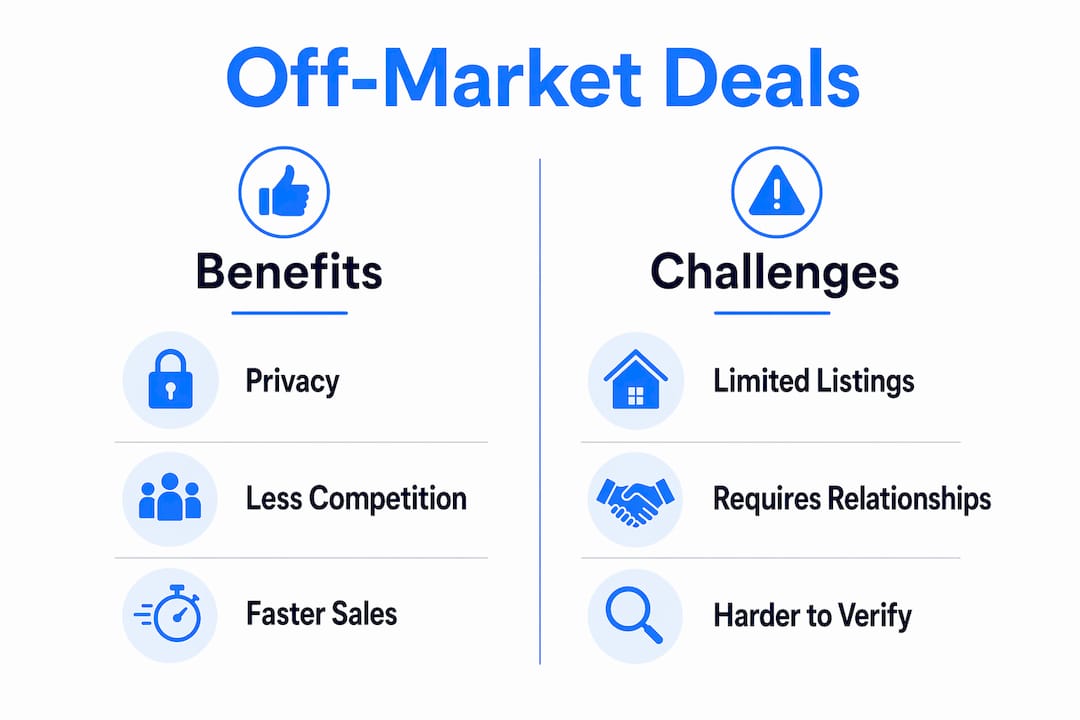
Off-market real estate offers distinct advantages for both buyers and sellers, but it comes with real tradeoffs that you need to plan around.
For buyers and investors, the primary benefits are:
- Reduced competition. When a property never hits Zillow or Realtor.com, you are not bidding against 20 other buyers. Negotiation happens one-on-one, which shifts power toward the buyer.
- Potential pricing advantages. Sellers who avoid public listing often prioritize speed and certainty over maximum price. That gap is your margin.
- Privacy and discretion. Some investors prefer to acquire properties without broadcasting their activity to competitors or the market.
- Early access. Acting before a property goes public means you set the terms before a bidding war starts.
The challenges are equally real. You need strong agent relationships or direct outreach skills to even find these deals. You must move fast. An off-market seller who gets a credible offer often accepts quickly or relists publicly if nothing materializes. You also carry more due diligence risk because there is less public data and fewer competing appraisals to validate your price.
For sellers, the calculus looks different. Privacy is the top motivator, particularly for probate situations, divorce settlements, or high-profile individuals. Sellers also avoid the disruption of open houses and public showings. The tradeoff is real: limited market exposure can mean leaving money on the table if the right buyer never hears about the property.
The market is moving in a clear direction. Off-market residential deals surged in New York City by over 30% across several boroughs from 2024 to 2025, with specific neighborhoods seeing volume increases exceeding 170%. That growth signals that off-market transactions are becoming a mainstream strategy, not a niche tactic.
Pro Tip: Before approaching any off-market seller, get your financing confirmed and your purchase criteria written down. Sellers in distressed situations, including foreclosure or probate, respond to buyers who can close fast and clean. Hesitation kills off-market deals.
How to find off market properties as an investor
Finding off-market properties requires a deliberate system, not luck. The investors who consistently source these deals combine multiple tactics and execute them repeatedly.
Build agent relationships first. The single most reliable source of off-market inventory is a well-connected buyer’s agent or investor-friendly broker. Some of the best investment opportunities never appear on public MLS listings. Agents with large networks hear about pocket listings, pre-market properties, and withdrawn listings before anyone else. Cultivate three to five agents in your target market and make it easy for them to bring you deals by being a reliable, fast-closing buyer.
Use specialized platforms and private networks. Platforms like PropStream and invitation-only investor groups surface off-market leads that never reach consumer sites. These tools aggregate data on tax-delinquent properties, pre-foreclosures, probate filings, and vacant homes. The data tells you who might be motivated to sell before they have decided to list.
Cold call and direct outreach. This is where most investors either win or lose. Direct outreach to homeowners in distress, including those facing foreclosure, probate, or tax delinquency, is the most scalable way to source off-market deals at volume. Your real estate cold calling skill determines how many of those conversations convert into contracts. A weak opener or a clumsy response to an objection ends the call before the opportunity develops.
- Identify your target list: Pull lists of pre-foreclosures, probate properties, tax-delinquent owners, and absentee landlords from county records or data platforms.
- Prepare your script and objection responses: Know how to handle “I’m not interested,” “I already have an agent,” and “How did you get my number?” before you dial.
- Follow up systematically: Most off-market sellers say no the first time. A structured follow-up system converts maybes into deals over weeks or months.
- Analyze property history before you call: Knowing whether a property had an expired listing, a withdrawn listing, or a prior sale at a loss gives you context that sharpens your pitch and your offer price.
Pro Tip: When you call a distressed homeowner, your goal on the first call is not to make an offer. It is to understand their situation and timeline. Ask open-ended questions. Let them talk. The seller who feels heard is far more likely to work with you than one who feels pressured.
Common misconceptions about off-market listings
The term “off-market” gets used loosely, and that creates real confusion for investors and buyers. Understanding the nuances protects you from chasing the wrong leads or misreading a deal’s status.
The most common source of confusion is what you see on consumer sites. When Zillow or Redfin labels a property as “off-market,” it typically means the home is not currently for sale, not that it is being privately marketed. The term means different things to consumers, agents, and investors. A consumer site showing a home as off-market is simply saying there is no active listing. An investor using the term means the property is available but not publicly listed.
Here is a direct comparison of the key terms to keep straight:
| Term | What it means | Seller motivation |
|---|---|---|
| Off-market listing | Available but not on MLS or public sites | Varies: privacy, speed, or distress |
| Pocket listing | Intentionally private, marketed through agent network only | Discretion or pre-market testing |
| Withdrawn listing | Removed from MLS by seller before expiry | Reconsidering sale or waiting for better conditions |
| Expired listing | Listing agreement ended without a sale | Often frustrated, potentially motivated to try again |
| Off-market lead | Homeowner not listed but potentially open to selling | Distress-driven: foreclosure, probate, divorce |
Another misconception is that off-market always means cheaper. It does not. A pocket listing in a hot neighborhood may carry a premium because the seller knows demand is high and wants to avoid the hassle of public showings without sacrificing price. The pricing advantage exists most clearly when the seller prioritizes speed or privacy over maximum proceeds, which is common in distressed situations.
MLS submission rules are triggered by the act and scope of public marketing. A sign in the yard, a Facebook ad, or a flyer in a coffee shop all constitute public marketing and require MLS submission within one business day. Private one-on-one conversations between agents do not. This means a property can legally remain off-market as long as marketing stays within those boundaries. Knowing this helps you understand why some deals move so quickly and why your agent relationships are the real competitive edge.
Key takeaways
Off-market properties give investors and buyers access to deals that never reach the public, but only those with strong networks, fast financing, and direct outreach skills consistently win them.
| Point | Details |
|---|---|
| Off-market definition | Properties not listed on MLS or public platforms, available through private channels or direct outreach. |
| Terminology matters | Pocket listings, withdrawn listings, and off-market leads are distinct categories with different seller motivations. |
| Market growth is real | Off-market deals in NYC surged over 30% year-over-year, signaling a mainstream shift in acquisition strategy. |
| Cold outreach is the edge | Direct calls to distressed homeowners in foreclosure, probate, or divorce situations are the most scalable sourcing method. |
| Speed and preparation win | Pre-approved financing and clear purchase criteria are non-negotiable for converting off-market conversations into contracts. |
Why relationships and readiness beat everything else
I have watched investors spend months building elaborate data systems to find off-market deals, then lose every one of them because they were not ready to move. The property was real. The seller was motivated. The deal fell apart because the buyer needed two more weeks to sort out financing or could not answer a seller’s objection on the phone.
Off-market real estate rewards preparation more than any other acquisition channel. The seller who is quietly considering a sale does not wait. They either accept the first credible offer or they relist publicly and you lose your advantage entirely. The investors I have seen build consistent off-market pipelines share two traits: they have agent relationships that produce real leads, and they practice their outreach conversations until objection handling is automatic.
The MLS policy environment is also shifting. Clear Cooperation rules are tightening in some markets and loosening in others as industry debates continue. Staying current on what counts as public marketing in your specific market is not optional. It determines which deals you can legally access and how your agent partners can help you.
One more thing worth saying plainly: off-market does not mean off-limits to due diligence. The absence of public data means you need to work harder on title history, property condition, and comparable sales. Skipping that step because a deal feels exclusive is how investors take losses they did not see coming.
— Dave
Practice the conversations that unlock off-market deals

Finding off-market properties is only half the equation. Converting a cold call with a distressed homeowner into a signed contract requires real skill, and skill comes from deliberate practice. ClosersLeague is an AI-powered cold calling training platform built specifically for real estate investors and wholesalers. You practice live conversations with AI-simulated sellers facing foreclosure, probate, divorce, and tax delinquency. You get scored on your opener, your objection handling, and your close. Stop winging your outreach calls. Start drilling them. Use AI cold calling practice to build the confidence and consistency that turns off-market leads into closed deals.
FAQ
What is the off-market property definition in real estate?
An off-market property is real estate not publicly listed on the MLS or major consumer platforms like Zillow or Redfin, but potentially available through private channels, agent networks, or direct seller outreach. The term covers pocket listings, pre-market properties, withdrawn listings, and homes owned by motivated sellers who have not yet decided to list publicly.
How do you find off-market properties as an investor?
The most reliable methods are building relationships with well-connected agents, using data platforms like PropStream to identify distressed owners, and cold calling homeowners in pre-foreclosure, probate, or tax-delinquent situations. Effective investor outreach combines multiple tactics and consistent follow-up to convert leads into deals.
Are off-market properties always cheaper?
No. Off-market properties offer pricing advantages primarily when the seller prioritizes speed or privacy over maximum proceeds, which is common in distressed situations. A pocket listing in a high-demand neighborhood may carry a premium because the seller knows buyer demand is strong regardless of public exposure.
What is the difference between a pocket listing and an off-market listing?
All pocket listings are off-market, but not all off-market listings are pocket listings. A pocket listing is intentionally marketed privately through an agent’s personal network. An off-market listing is any property not on MLS, including expired listings, withdrawn listings, and homes owned by sellers who have not engaged an agent at all.
What is the Clear Cooperation policy and how does it affect off-market deals?
The Clear Cooperation policy requires agents to submit a listing to MLS within one business day of any public marketing, including signs, digital ads, or flyers. Private, one-on-one agent communications and broker office exclusives are exempt. This policy defines the legal boundary between a true off-market listing and one that must be publicly submitted.