
ROI in wholesaling is defined as net profit divided by total investment cost, expressed as a percentage. This metric, formally called return on investment, tells you exactly how much you earned relative to what you spent to close a deal. For real estate wholesalers, understanding ROI is the difference between building a scalable business and chasing deals that look profitable on paper but drain your resources. Whether you’re working foreclosures, probate leads, or tax-delinquent properties, every deal you evaluate needs a clear ROI number behind it.
What is ROI in wholesaling and how does it work?
ROI in wholesaling follows the same core formula used across all investment types: (Investment Gain minus Investment Cost) divided by Investment Cost, multiplied by 100. In plain terms, it measures how much profit you generated relative to what you put in. For wholesalers, this is your primary tool for deciding whether a deal is worth pursuing or walking away from.
The reason ROI matters so much in wholesaling is that deals can look wildly different on the surface. A $10,000 assignment fee on a deal where you spent $8,000 in marketing and closing costs is far less attractive than the same fee on a deal where you spent $1,200. The percentage tells the real story. Tracking wholesaling return on investment across every deal you close also reveals which lead sources, seller types, and markets are actually producing results for your business.

Understanding ROI in wholesaling also requires knowing what counts as your “investment.” Unlike buying a rental property, you rarely put capital into the property itself. Your investment is the cost of acquiring the lead, your time, transaction fees, and any earnest money you put down. That distinction shapes how you calculate and interpret every number.
How to calculate ROI in wholesaling deals
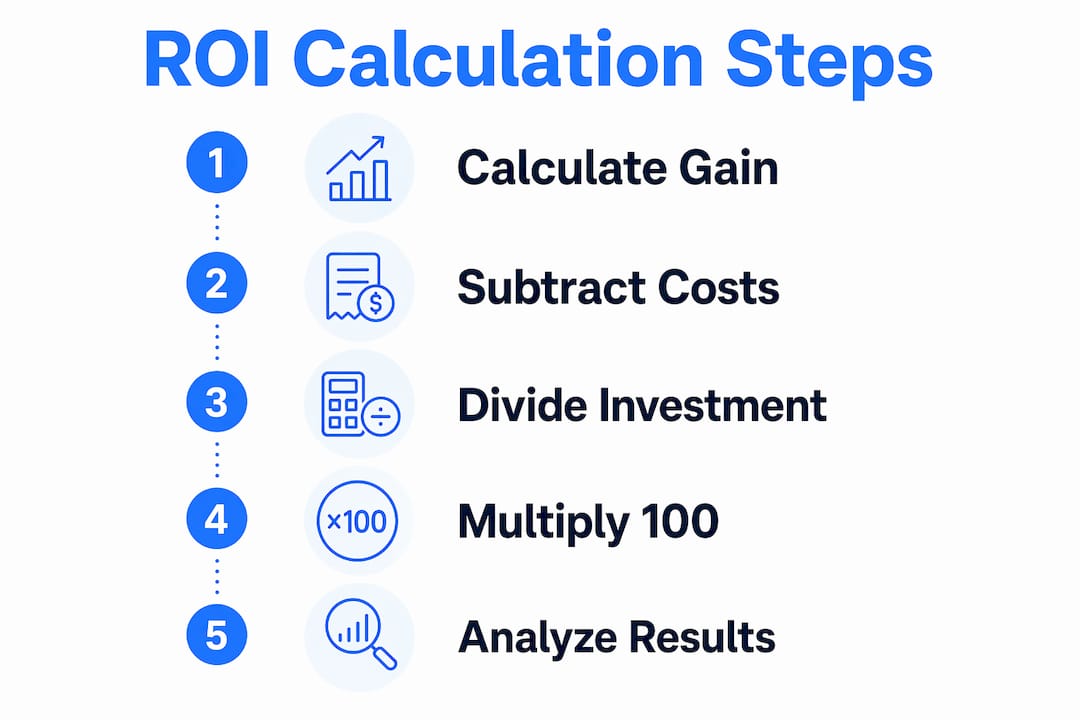
Calculating ROI on a wholesale deal follows a straightforward process once you know which numbers to plug in. Here is the step-by-step breakdown:
- Identify your assignment fee. This is the spread between your contract price with the seller and the price you sell the contract to your buyer. Assignment fees typically range from $5,000 to $15,000 per deal.
- Subtract your closing and transaction costs. These are the fees you pay on your side of the transaction, including title, escrow, and any administrative costs. A $15,000 assignment fee with $1,500 in closing costs leaves you with $13,500 in net profit.
- Identify your total investment cost. This includes your earnest money deposit, any marketing spend to generate that specific lead, and direct transaction costs.
- Apply the formula. Divide net profit by total investment cost, then multiply by 100. If your net profit is $13,500 and your total investment cost was $2,500, your ROI is 440%.
The math is simple. The discipline is in capturing every cost accurately. Many wholesalers only count closing costs and forget the $800 they spent on direct mail or the $300 skip-tracing bill that surfaced that lead. Those omissions inflate your ROI and give you a false read on deal quality.
Pro Tip: Track your lead acquisition cost per deal in a simple spreadsheet. Assign a portion of your monthly marketing spend to each closed deal based on which campaign generated the lead. This gives you a true investment cost denominator and a far more accurate ROI figure.
The difference between gross and net profit matters here too. Gross profit equals the assignment fee; net profit is what remains after subtracting closing costs. Always calculate ROI on net profit, not gross. Using gross profit overstates your return and leads to poor deal decisions over time.
What costs and expenses impact ROI in wholesaling
Cost accuracy is where most wholesalers lose control of their ROI analysis. The expenses that affect your return fall into two categories: deal-level costs and operational costs.
Deal-level costs include:
- Closing costs on your purchase contract (title, escrow, transfer fees)
- Closing costs on the assignment or resale side
- Earnest money deposits (even if refundable, they represent tied-up capital)
- Any inspection or due diligence fees you absorb
Operational costs include:
- Lead generation spend (cold calling lists, direct mail, pay-per-click advertising)
- Skip-tracing and data services
- CRM subscriptions and software tools
- Your time or the cost of a paid acquisitions team
Closing costs average 8 to 10% of the transaction value across both sides of a deal. That figure directly compresses your buyer’s profit margin and your ability to price your contract aggressively. Miss it in your calculations and you will overpay for contracts, slow your assignment speed, and shrink your effective return.
“A $15,000 assignment fee looks very different when your lead cost was $29 versus $4,500.” — iSpeedToLead, 2026 Wholesaler Profit Margin Report
That quote captures the core problem with incomplete ROI analysis. The assignment fee is the same. The actual return is not even close. Lead acquisition costs vary dramatically by source, and including operating expenses in your investment cost denominator is the only way to see your true profitability. Wholesalers who skip this step often believe they are running a profitable business when they are actually breaking even or losing money at the system level.
How deal structures affect wholesaling profit margins and ROI
Not every wholesale deal uses the same structure, and the structure you choose has a direct impact on your costs, your profit margins, and how your ROI is calculated. The three most common structures are assignment contracts, double closings, and co-wholesaling.
| Deal Structure | Typical Profit Range | Key Costs | ROI Implication |
|---|---|---|---|
| Assignment contract | $5,000 to $15,000 | Low closing costs, visible fee | ROI can appear near infinite with minimal capital deployed |
| Double closing | $10,000 to $25,000 | Two sets of closing costs, capital required | Higher gross profit, but 200 to 500% ROI range after costs |
| Co-wholesaling | Split of assignment fee | Shared marketing costs | Lower absolute profit, but reduced risk and investment |
Assignment contracts are the most common structure for newer wholesalers. You never take title to the property, so your capital exposure is minimal. The tradeoff is that your assignment fee is visible to the buyer, which can create pushback on larger spreads. Assignment fees are typically capped at $5,000 to $15,000 in most markets because buyers can see the number and negotiate against it.
Double closings solve the visibility problem. You close on the property, then immediately resell it to your end buyer. Your profit stays private. The cost is two full sets of closing costs and the need for transactional funding, which adds fees and complexity. The higher profit ceiling of $10,000 to $25,000 can justify those costs on the right deal, but your ROI calculation must account for every dollar of that funding and closing expense.
Co-wholesaling is worth understanding if you are building your buyer network or entering a new market. You split the assignment fee with a partner who brings either the deal or the buyer. Your individual ROI drops, but so does your investment. For wholesalers focused on property acquisition strategies across multiple markets, co-wholesaling can be a smart way to generate returns without heavy upfront marketing spend.
Pro Tip: Before choosing a deal structure, run the ROI calculation for both assignment and double closing. If the double closing profit increase does not exceed the additional closing costs and funding fees by at least 30%, the assignment contract is almost always the better choice.
Common pitfalls when analyzing ROI in wholesaling
ROI analysis in wholesaling breaks down in predictable ways. Knowing the mistakes in advance keeps your numbers honest and your business decisions sound.
- Ignoring lead acquisition costs. This is the most common error. Wholesalers calculate ROI using only closing costs and forget the marketing spend that generated the lead. The result is an inflated return that does not reflect the true cost of doing business.
- Setting assignment fees beyond buyer tolerance. Your assignment fee must fit within your buyer’s profit model. The MAO formula accounts for ARV, repair costs, holding costs, closing costs, and your fee. If your fee pushes the buyer’s offer above their MAO, the deal dies. A deal that does not close has an ROI of zero.
- Treating “infinite ROI” as a real metric. Because wholesalers deploy little to no capital in assignment contracts, ROI can appear infinite. This is a mathematical artifact, not a business insight. Use operational ROI instead, which includes all system-level expenses.
- Mixing deal ROI with operational ROI. Separating deal-level ROI from operational ROI gives you two distinct and useful signals. Deal ROI tells you if individual transactions are profitable. Operational ROI tells you if your business model is sustainable at scale.
Pro Tip: Run two ROI calculations for every deal: one using only direct transaction costs, and one that allocates a share of your monthly operational expenses. The gap between those two numbers tells you how efficiently your lead generation system is performing.
The most dangerous mistake is building a business on deal-level ROI alone. You can close ten deals with strong assignment fees and still lose money if your marketing costs are out of control. Tracking both metrics separately, as outlined in the 2026 Wholesaler Profit Margin Report, is what separates wholesalers who scale from those who plateau.
Key takeaways
ROI in wholesaling is only meaningful when it accounts for every cost, from lead generation to closing, not just the assignment fee spread.
| Point | Details |
|---|---|
| Core ROI formula | Divide net profit by total investment cost and multiply by 100 to get your return percentage. |
| Net profit definition | Assignment fee minus all closing costs and direct transaction expenses equals your true net profit. |
| Cost accuracy matters | Include lead acquisition and operational expenses in your denominator to avoid inflated ROI figures. |
| Deal structure changes ROI | Assignment contracts have lower costs but visible fees; double closings offer higher margins at greater expense. |
| Track two ROI numbers | Separate deal-level ROI from operational ROI to evaluate both individual deals and overall business health. |
Why most wholesalers are reading their ROI wrong
I have worked with hundreds of wholesalers who were convinced they were running profitable operations. When we pulled back the numbers and included every lead cost, every software subscription, and every hour of paid labor, the picture changed fast. The deals were fine. The system was bleeding.
The real insight I keep coming back to is this: ROI is not just a deal metric. It is a business health metric. A wholesaler closing five deals a month at $8,000 each looks great on paper. But if that same wholesaler is spending $25,000 a month on marketing, lists, and staff, the math does not work. You need both numbers on the table at the same time.
The other thing I see constantly is wholesalers who are afraid to negotiate harder because they think they will lose the deal. Improving your negotiation by even a few percentage points of ARV can add thousands to your assignment fee per deal. That is not a small adjustment. Over 20 deals a year, it is the difference between a side hustle and a real business. The wholesalers who consistently hit strong ROI numbers are not just better at math. They are better on the phone. They know how to handle objections, build rapport with distressed sellers, and close contracts at prices that leave room for everyone to win.
Stop treating ROI as a post-deal calculation. Build it into your offer process from the first conversation with a seller.
— Dave
How ClosersLeague helps you improve your wholesaling ROI
Better ROI starts before you ever run a calculation. It starts with the quality of your conversations with sellers.

ClosersLeague is an AI-powered cold calling practice platform built specifically for real estate wholesalers and investors. You practice live roleplay scenarios against AI sellers in foreclosure, probate, divorce, and tax-delinquent situations. Every session scores your performance across objection handling, rapport building, and closing technique. Better calls mean better contracts. Better contracts mean stronger assignment fees and higher ROI on every deal you close. If your lead acquisition costs are high but your conversion rate is low, the problem is not your marketing. It is your pitch. ClosersLeague fixes that with deliberate, scored practice that builds real skill fast.
FAQ
What is the basic ROI formula for wholesaling?
ROI in wholesaling equals net profit divided by total investment cost, multiplied by 100. Net profit is your assignment fee minus all closing and transaction costs.
What is a good ROI for a wholesale deal?
There is no single benchmark, but most experienced wholesalers target a minimum of 200% ROI on deal costs. When operational expenses are included, sustainable businesses typically aim for 50% or higher on a system-wide basis.
Why does ROI sometimes appear infinite in wholesaling?
Assignment contract ROI can appear infinite because wholesalers invest little to no capital in the property itself. This is a mathematical result of a near-zero denominator, not a true measure of profitability.
What costs should I include when calculating wholesaling ROI?
Include closing costs on both sides of the transaction, lead acquisition expenses, earnest money, skip-tracing fees, and a proportional share of your monthly operational costs. Leaving out any of these inflates your return and distorts your business picture.
How does deal structure affect ROI in wholesaling?
Assignment contracts carry lower costs but cap profits due to fee visibility. Double closings offer higher profit potential at greater expense, with ROI ranges of 200 to 500% after accounting for two sets of closing costs and transactional funding.