
Real estate wholesaling is defined as securing a property under contract at a discount and assigning that contract to a cash buyer for a fee, without ever taking ownership of the property. This strategy is gaining traction in 2026 because motivated sellers are everywhere: repair costs are climbing, foreclosure filings are rising, and financial pressure is pushing homeowners to accept below-market offers. The average assignment fee sits at $13,000 per deal, ranging from $5,000 to $20,000 depending on the market. For investors asking why choose wholesaling in 2026, the answer is speed, low capital, and a growing pool of distressed sellers ready to deal.
Why choose wholesaling in 2026 over other real estate strategies?
Wholesaling requires no mortgage approval, no credit checks, and no renovation budget. That single fact separates it from every other real estate investment strategy available today. Flipping requires capital, credit, and contractor relationships. Rentals require long-term financing and tenant management. Wholesaling requires a phone, a contract, and a buyer list.
The timeline difference is significant. A typical wholesale deal closes in 14–30 days. A flip can take 3–6 months from purchase to sale. A rental property may take years to generate meaningful cash flow. For investors who need income now, wholesaling is the fastest path from zero to a closed deal.

Here is how the three strategies compare across the factors that matter most to new investors:
| Factor | Wholesaling | Flipping | Rentals |
|---|---|---|---|
| Upfront Capital | Low (earnest money only) | High (purchase + rehab) | High (down payment + reserves) |
| Time to First Income | 14–30 days | 3–6 months | 12+ months |
| Credit Requirement | None | Strong credit needed | Strong credit needed |
| Risk Level | Low | High | Medium |
| Ongoing Management | None | None after sale | Active (tenants, repairs) |
| Income Type | Assignment fee | Profit on resale | Monthly rent |
The advantages of wholesaling in 2026 are sharpest for investors who want to build capital before moving into flipping or rentals. Many experienced investors use wholesaling as a cash-generation engine that funds their buy-and-hold portfolio. You learn the market, build relationships, and get paid while doing it.
Pro Tip: Build your cash buyer list before you sign your first contract. Pre-qualified buyers can respond within 24–48 hours to a new deal, which keeps your closing timeline tight and your seller relationships intact.
How has the wholesaling market shifted in 2026?
The wholesaling market in 2026 is not the same as it was five years ago. Economic stress has expanded the motivated seller pool significantly. Repair shock is real: homeowners facing $40,000 to $80,000 in deferred maintenance are choosing a discounted cash offer over a renovation they cannot afford. Pre-foreclosure lists are longer. Probate cases are moving faster. Divorce-driven sales are up.
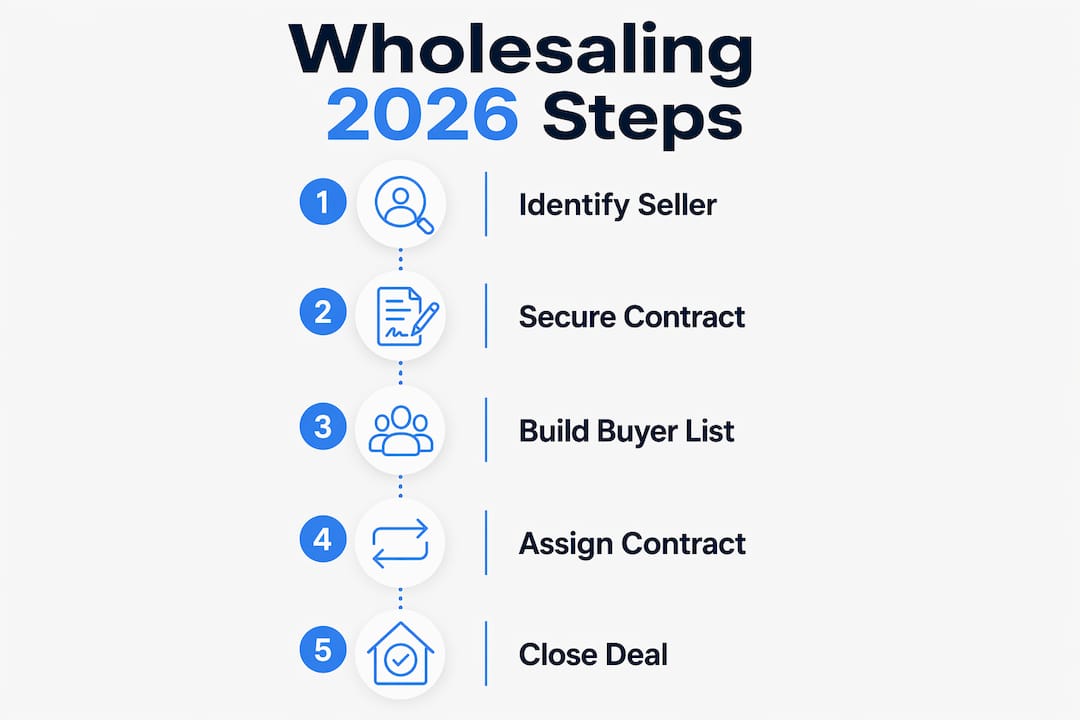
At the same time, cash buyers have become more selective. They are underwriting deals tighter, requiring accurate after-repair values (ARV), realistic repair estimates, and conservative maximum allowable offers (MAO). The wholesalers winning in this environment treat their business like a data operation, not a hustle. Tracking KPIs like lead-to-close ratios and cost-per-acquisition separates the professionals from the people who quit after 90 days.
The wholesaling trends in 2026 that are producing results include:
- Virtual wholesaling: Investors are closing deals in markets they have never visited by using skip-tracing tools, virtual assistants, and remote notarization.
- Cold calling consistency: Daily outbound calling to absentee owners, pre-foreclosure leads, and tax-delinquent properties remains the highest-ROI lead source for most wholesalers.
- Niche list targeting: Probate, divorce, and code violation lists are outperforming generic “motivated seller” lists because the sellers have a specific, urgent reason to move.
- Buyer network depth: Top wholesalers maintain active relationships with 20 or more cash buyers per market, not just a handful of names in a spreadsheet.
- Data-driven underwriting: Gut-feel deal analysis is gone. Buyers expect comps, repair breakdowns, and ARV support before they commit.
Pro Tip: Stop sending deals to your entire buyer list. Segment buyers by property type, price range, and geography. A targeted deal email to five qualified buyers outperforms a blast to fifty unqualified ones.
The growth of wholesaling in 2026 is tied directly to this shift toward professionalism. The investors who treat it as a business, with systems and metrics, are the ones scaling past their first few deals.
What steps do new wholesalers need to take in 2026?
Getting started in wholesaling requires a specific sequence. Skipping steps is the most common reason new investors fail to close their first deal. Follow this order:
- Build your cash buyer list first. Attend local real estate investment association (REIA) meetings, post in Facebook groups for local investors, and connect with buyers on platforms like PropStream or BatchLeads. Know who will buy before you find a deal.
- Pull your motivated seller lists. Start with absentee owners, pre-foreclosure, probate, and tax-delinquent properties. These sellers have the highest motivation to accept a discounted offer.
- Start calling every weekday. New wholesalers who make 50 calls daily typically close their first deal within 60–90 days. Consistency is the variable most directly tied to results.
- Estimate ARV, MAO, and repair costs accurately. Use comparable sales within a half-mile radius and within the last 90 days. Apply the standard MAO formula: ARV multiplied by 70%, minus estimated repairs. Never fudge these numbers. Transparent deal analysis builds buyer trust; inflated numbers destroy it permanently.
- Use contracts with proper assignment language. Every purchase agreement must include “Buyer and/or assigns” language to make the contract legally transferable. Without this clause, you cannot assign the deal.
- Present the deal to your buyer list within 24 hours. Speed matters. Sellers get nervous when time passes. Buyers move on to other deals. The faster you move from signed contract to assigned deal, the better your reputation becomes.
- Track everything in a CRM. Log every call, every follow-up, and every deal stage. Consistent lead generation discipline is what separates the 10% who stay in the business from the 90% who quit within five years.
The most common pitfalls are predictable. Investors sign contracts before they have a buyer. They underestimate repair costs and lose the deal at assignment. They overprice the contract and leave no room for a buyer’s profit. They ghost sellers after going under contract, which burns bridges in a market where reputation travels fast. Avoid all four and you are already ahead of most new wholesalers.
Is wholesaling recession-resistant in 2026?
Wholesaling is recession-resistant but not recession-proof. That distinction matters. During economic downturns, motivated seller pools grow. Homeowners facing job loss, medical debt, or foreclosure are more willing to accept discounted offers. Traditional buyers pull back because financing tightens. That combination creates more opportunity for wholesalers, not less.
Flippers and landlords face rising risks in downturns. Flippers get caught holding properties they cannot sell. Landlords deal with vacancies and delinquent tenants. Wholesalers carry none of that exposure because they never own the property. That makes wholesaling a lower-risk entry point during volatile markets.
That said, recessions do create real challenges for wholesalers:
- Cash buyers become more conservative, requiring deeper discounts and tighter numbers.
- Deal cycles slow down as buyers take longer to commit.
- Assignment fees compress in some markets as buyer competition drops.
- Marketing costs stay constant even when deal flow slows.
The wholesalers who survive downturns are the ones who maintain their marketing activity and buyer relationships through the slow periods. Cutting calls and outreach during a recession is the fastest way to fall behind when the market recovers. Consistent outbound activity during a downturn means you are first in line when buyers start moving again.
Pro Tip: During slow markets, use the extra time to negotiate with motivated sellers more carefully. A deal that looks thin at first can often be renegotiated when a seller has been sitting on a problem property for months.
Key takeaways
Wholesaling in 2026 is the most accessible real estate investment strategy for new investors because it requires no ownership, no credit, and no renovation capital while generating income in 14–30 days.
| Point | Details |
|---|---|
| Low barrier to entry | Wholesaling requires no mortgage, no credit check, and no renovation budget to start. |
| Fast income timeline | Most deals close in 14–30 days, far faster than flipping or rental income. |
| Assignment fee potential | The national average assignment fee is $13,000, with top markets reaching $20,000 per deal. |
| Recession resilience | Motivated seller pools grow during downturns, giving wholesalers more opportunity when others pull back. |
| Discipline drives results | Wholesalers who make 50 calls daily and track KPIs close their first deal within 60–90 days. |
Why i still think wholesaling is the sharpest entry point in real estate
I have watched a lot of investors chase flips and rentals before they had the capital or experience to manage the risk. Most of them lost money, time, or both. Wholesaling is different because the feedback loop is fast. You make calls, you get objections, you refine your pitch, and you close a deal in weeks, not months. That speed teaches you more about real estate markets than any course ever will.
The investors I have seen succeed long-term share one trait: they treat wholesaling as a business with systems, not a side hustle with occasional effort. They track their numbers. They protect their buyer relationships. They show up every day even when the pipeline feels empty.
The biggest mistake I see newcomers make is skipping the buyer list and jumping straight to seller outreach. You are not in the business of finding deals. You are in the business of solving problems for sellers and delivering value to buyers. The deal is just the transaction in the middle. Build both sides of that relationship first, and the deals will follow.
One more thing: the 90% attrition rate is real, but it is not inevitable. Most people quit because they stop calling, not because the strategy stopped working. The market in 2026 has more motivated sellers than it did three years ago. The opportunity is there. The question is whether you will stay consistent long enough to reach it.
— Dave
Build your wholesaling pipeline faster with ClosersLeague
Cold calling is the highest-ROI lead source in wholesaling, and it is also the skill most new investors avoid because they do not know what to say when a seller pushes back. ClosersLeague fixes that with AI-powered roleplay that simulates real conversations with distressed homeowners facing foreclosure, probate, divorce, and other motivated-seller scenarios.
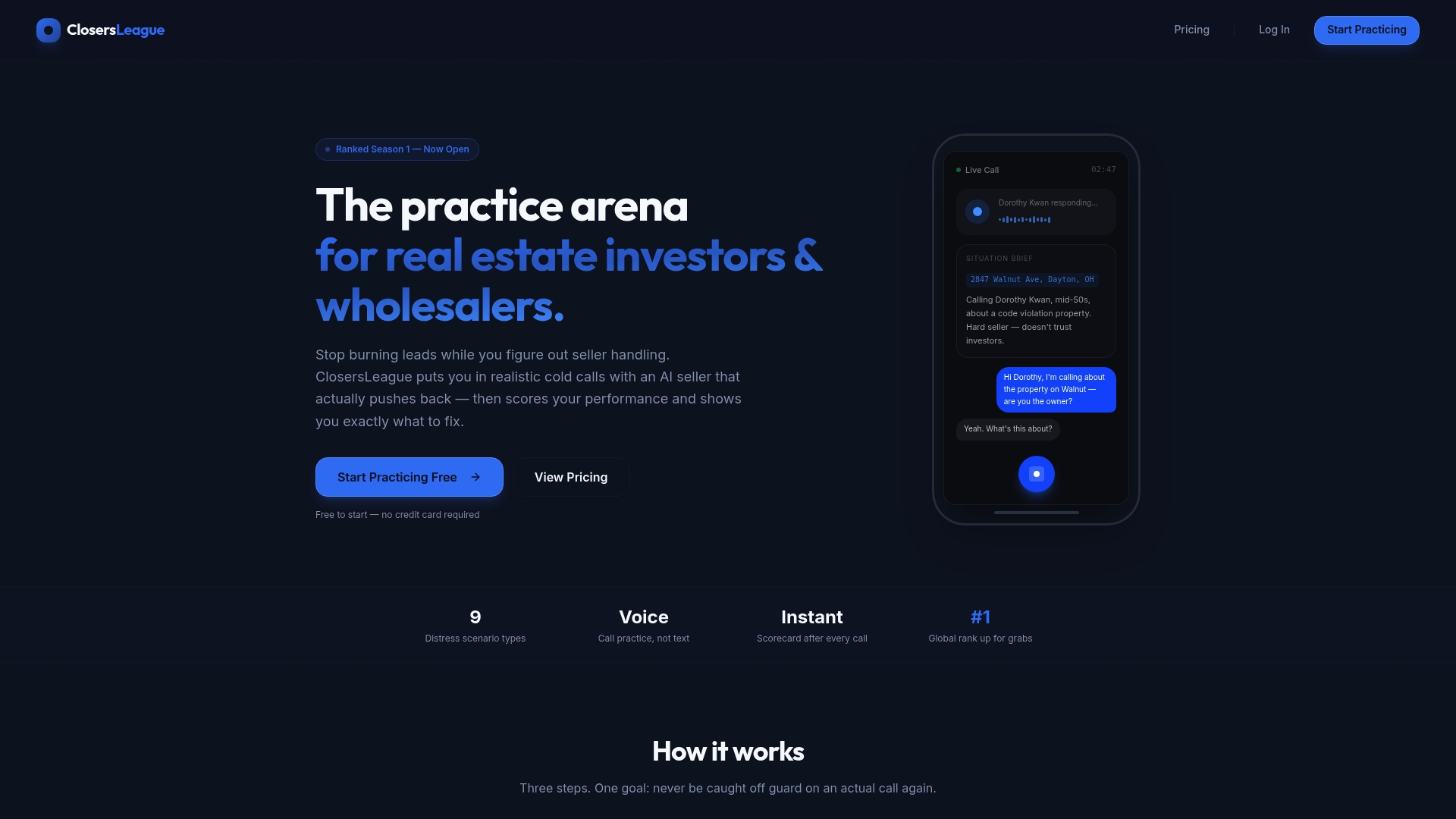
You can practice your pitch, handle objections, and build call confidence before you ever dial a real lead. ClosersLeague tracks your performance and gives you specific feedback so you improve with every session. Stop winging your calls. Start drilling with AI cold calling practice built specifically for real estate wholesalers. Your first deal starts with a conversation. Make sure you are ready for it.
FAQ
What is the average assignment fee in wholesaling?
The national average assignment fee is $13,000 per deal in 2026, with fees ranging from $5,000 to $20,000 depending on the market and deal quality.
How long does it take to close a first wholesale deal?
New wholesalers who make approximately 50 calls per weekday typically close their first deal within 60–90 days. Consistency in daily outreach is the primary factor.
Do you need money to start wholesaling real estate?
Wholesaling requires minimal upfront capital. You need earnest money to secure a contract, typically $500 to $1,000, but no mortgage approval, renovation funds, or credit history.
How does wholesaling perform during a recession?
Wholesaling is considered recession-resistant because motivated seller pools expand during financial downturns. Buyers become more selective, but deal opportunities increase as traditional financing tightens.
What is the most important step before signing a wholesale contract?
Building a cash buyer list before signing any contract is the most critical step. Pre-qualified buyers can respond within 24–48 hours, which protects your closing timeline and your seller relationship.