
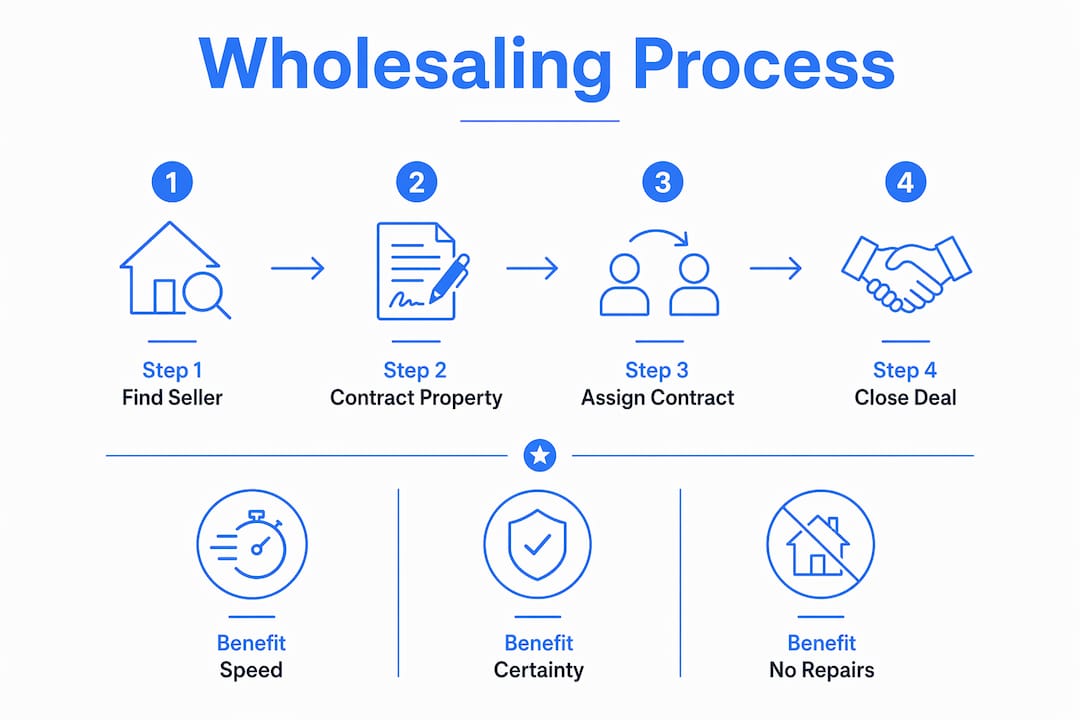
Wholesaling is defined as a real estate transaction method where an investor contracts a property from a seller and assigns that contract to an end buyer, often without ever taking ownership. Sellers use wholesalers primarily for speed, certainty, and the ability to sell a property as-is without repairs, showings, or drawn-out negotiations. The trade-off is real: wholesale offers typically land between 70% and 85% of fair market value, meaning sellers accept less money in exchange for a faster, simpler process. For sellers facing foreclosure, probate, divorce, or an inherited property they cannot maintain, that trade-off often makes complete sense.
Why sellers use wholesalers: speed and simplicity explained
Speed is the single biggest reason sellers choose wholesale buyers. 65% of sellers using cash-focused buyers closed their transactions within 30 days, compared to 52% with traditional agents. That 13-point gap matters enormously when a foreclosure auction date is approaching or an estate needs to be settled quickly.

The simplicity factor runs just as deep. Wholesalers buy properties as-is, which removes the entire repair-and-stage cycle from the seller’s plate. 54% of cash-buyer sellers incur no extra expenses before closing. That means no contractor bids, no weekend open houses, and no buyer inspection demands that reopen price negotiations.
Here is what sellers avoid when they work with a wholesaler:
- Repair costs: No need to fix plumbing, roofing, or electrical issues before listing.
- Staging and cleaning: The property sells in its current condition, regardless of clutter or cosmetic damage.
- Repeated showings: No strangers walking through the home on short notice.
- Prolonged negotiations: One offer, one contract, one closing timeline.
- Financing contingencies: Cash-based deals remove the risk of a buyer’s mortgage falling through.
Pro Tip: If you value your time more than squeezing out every last dollar, wholesaling is worth serious consideration. The hours saved on repairs, showings, and back-and-forth negotiations have real financial value that rarely shows up in a simple price comparison.
Understanding why homeowners sell fast helps clarify why the wholesale model fits so many distressed situations. Urgency is the common thread.
What financial concessions sellers make with wholesale offers
The convenience of wholesaling comes with a measurable cost. Wholesale offers typically fall between 70% and 85% of a property’s fair market value. That discount covers the wholesaler’s profit margin, marketing expenses, and the risk they absorb by putting a property under contract before finding an end buyer.
On a median-priced home, that gap translates to real dollars. Sellers often net $15,000 to $30,000 less through a wholesale transaction than through a traditional listing or a direct cash sale. That is not a rounding error. It is a deliberate trade sellers make when speed and certainty outweigh maximum proceeds.
| Scenario | Estimated offer | Estimated net loss vs. market value |
|---|---|---|
| $250,000 home at 85% | $212,500 | $37,500 |
| $250,000 home at 80% | $200,000 | $50,000 |
| $250,000 home at 70% | $175,000 | $75,000 |
| $400,000 home at 80% | $320,000 | $80,000 |
The table above uses the 70%–85% range from documented wholesale pricing norms. Actual offers vary by market, property condition, and wholesaler.
Sellers also carry a hidden risk in the contract assignment model. Assigned buyers frequently request credits or price reductions days before closing, after the original wholesaler has already moved on. That last-minute renegotiation can catch sellers off guard if they did not read the assignment clause in their contract carefully.
Pro Tip: Before signing any wholesale contract, ask the buyer directly: “Are you purchasing this property yourself, or will you assign this contract to another buyer?” The answer changes everything about who you are actually dealing with at closing.
The benefits of selling as-is can offset some of that price gap, especially when repair costs would have eaten into a traditional sale’s net proceeds anyway.
Which seller situations are best suited for wholesaling
Not every seller benefits equally from the wholesale model. Distressed and absentee owners, along with sellers holding inherited properties or homes needing significant repairs, are the profiles where wholesaling delivers the most practical value.
The seller situations where wholesaling fits best include:
- Pre-foreclosure: A seller with weeks before an auction date cannot wait 60 to 90 days for a traditional listing to close. A wholesale deal that closes in 14 to 21 days can stop the foreclosure clock.
- Inherited properties: Heirs who live out of state, have no interest in managing the property, or face estate tax pressure often want a clean, fast exit. Wholesaling removes the burden of maintenance, insurance, and carrying costs.
- Divorce settlements: When both parties need to liquidate a shared asset quickly and cleanly, a wholesale offer eliminates the drawn-out listing process that can become a point of conflict.
- Absentee landlords: Landlords burned out by tenant turnover, deferred maintenance, or code violations often prioritize speed over price. Wholesaling suits sellers who want zero involvement in showings, negotiations, or buyer calls.
- Severely distressed properties: Homes with foundation issues, fire damage, or major code violations rarely attract retail buyers. Wholesalers and their investor networks are built for exactly these properties.
Sellers who do not fit the wholesale model well are those with time, a property in good condition, and the ability to handle a walkthrough or two. Experts recommend avoiding wholesalers if you can manage minimal communication and a single showing, because direct cash sales often net more money with only slightly more seller involvement.
How the wholesaling process works from a seller’s perspective
Most sellers assume the person who signs their contract is the person who will buy their home. That assumption is wrong in most wholesale deals. Wholesale deals are contract assignments, not direct purchases. The wholesaler signs a purchase agreement with the seller, then transfers that contract to an end buyer for a fee.
Here is how the process typically unfolds from the seller’s side:
- Initial contact: A wholesaler reaches out, often by cold call, direct mail, or door knock, and expresses interest in buying the property.
- Property walkthrough: The wholesaler assesses condition and runs comparable sales to determine an offer price.
- Contract signing: The seller signs a purchase agreement that includes an assignment clause, giving the wholesaler the right to transfer the contract to another buyer.
- Marketing period: The wholesaler markets the contract to their investor network, typically over 7 to 21 days.
- Assignment: An end buyer is found and the contract is assigned. The seller may or may not be notified of the change.
- Closing: The end buyer closes the transaction. The wholesaler collects an assignment fee, not from the seller, but from the spread between the contracted price and what the end buyer pays.
The risk in this process is real. Earnest money deposits in wholesale deals typically run only $500 to $2,000. That low deposit means the wholesaler has limited financial exposure if the deal falls apart. Wholesale contracts fail to close at a rate of 35%–40%, compared to 12%–18% for direct cash sales. Sellers who do not verify a wholesaler’s track record and proof of funds expose themselves to wasted time and a property back on the market.
Verifying a wholesaler’s track record before signing is the single most protective step a seller can take. Ask for references, closed deal history, and a meaningful earnest money deposit.
Key Takeaways
Sellers use wholesalers because speed, certainty, and zero repair requirements outweigh the financial cost of accepting 70%–85% of market value, but only when urgency or property condition makes a traditional sale impractical.
| Point | Details |
|---|---|
| Speed drives the decision | 65% of cash-focused transactions close within 30 days, far faster than traditional listings. |
| As-is sales save real money | 54% of cash-buyer sellers pay zero extra costs before closing, avoiding repairs and staging. |
| Offers run below market value | Wholesale prices land at 70%–85% of fair market value, often $15,000–$30,000 less on median homes. |
| Contract assignment is the norm | Sellers often close with a different buyer than the wholesaler who signed the original contract. |
| Fallthrough risk is higher | Wholesale contracts fail at 35%–40%, so verifying earnest money and track record is critical. |
What I’ve learned about when wholesaling actually makes sense
Sellers often come into a wholesale conversation focused on the wrong number. They fixate on the offer price and feel the gap from market value as a loss. What they miss is the full cost of the alternative.
A traditional listing on a distressed property in poor condition is not a free path to a higher price. It involves contractor bids, carrying costs during the listing period, buyer inspection demands, and the real possibility of a financed buyer’s deal falling through. When you add all of that up, the wholesale discount shrinks considerably.
That said, I have seen sellers get burned by wholesalers who held contracts without the capital or buyer network to close them. The 2026 wholesaling landscape has shifted. Sellers are more informed now, and the old “we buy houses” pitch no longer works on anyone who has done 20 minutes of research. Wholesalers who succeed today lead with transparency, clear timelines, and real earnest money.
My honest advice: if you are a seller facing foreclosure, probate, or an out-of-state inherited property, wholesaling is a legitimate and often smart choice. If you have the time and the property is in reasonable shape, push for a direct cash sale instead. You will net more money with only slightly more effort. Either way, read the assignment clause before you sign anything. That one sentence in the contract defines who you are actually selling to.
— Dave
ClosersLeague and the art of reaching motivated sellers
If you work as a real estate investor or wholesaler, reaching the right sellers before anyone else does is the skill that determines your deal flow. Distressed sellers, inherited property owners, and pre-foreclosure homeowners all require a different conversation approach.

ClosersLeague is an AI cold calling training platform built specifically for real estate investors and wholesalers. You can practice live scenarios with inherited property cold calling roleplay, sharpen your objection handling, and build the confidence to have honest, effective conversations with sellers who are under real pressure. Stop winging calls. Start drilling the scenarios that actually show up in your pipeline.
FAQ
Why do sellers accept lower prices from wholesalers?
Sellers accept wholesale offers because the speed, certainty, and zero-repair requirement outweigh the price gap. For sellers facing foreclosure or managing an inherited property from out of state, closing in two to three weeks is worth more than waiting months for a higher retail offer.
What is a typical wholesale offer on a home?
Wholesale offers typically fall between 70% and 85% of fair market value. On a $250,000 home, that means an offer between $175,000 and $212,500, depending on the wholesaler’s costs and the property’s condition.
How does a wholesaler make money if they don’t buy the property?
A wholesaler earns an assignment fee by contracting a property at a below-market price and then transferring that contract to an end buyer at a higher price. The seller receives the contracted amount; the wholesaler keeps the spread.
What is the biggest risk for sellers working with wholesalers?
The biggest risk is deal fallthrough. Wholesale contracts fail to close at a rate of 35%–40%, compared to 12%–18% for direct cash sales. Low earnest money deposits give wholesalers little financial incentive to push a deal through if they cannot find an end buyer.
When should a seller avoid using a wholesaler?
Sellers with time, a property in decent condition, and the ability to handle one or two walkthroughs should pursue a direct cash sale instead. Direct sales typically net more money with only marginally more seller involvement.