AI call scoring evaluates recorded or live sales calls against a structured rubric and returns per-call, per-dimension scores instead of a manager’s gut read. The catch is that pure automation still misses context a human catches in ten seconds, so the pragmatic best practice is hybrid review, AI for volume, a person for judgment calls.
TL;DR:
- Hybrid call scoring combining rule-based checks and large language models effectively captures both objective and subjective call qualities.
- Stage-specific rubrics for different call types significantly improve coaching relevance and lead to measurable score improvements.
- Running pilot programs with calibrated scoring and evidence-backed feedback fosters trust and minimizes resistance among sales reps.
- Continuous calibration, evidence collection, and compliance with recording laws are essential to prevent model drift and ensure legal adherence.
- AI scoring excels when used to identify performance gaps early and informs behavior changes, rather than solely grading historical calls.
Table of Contents
- What Is AI Call Scoring Sales Teams Actually Use?
- The 12-Dimension Rubric Every Stage-Aware Scorecard Needs
- Running a Pilot: Calibration, Workflows, and Change Management
- Where AI Call Scoring Breaks, and How to Compliance-Proof It
- How Closers League Applies This to Real Estate Cold Calling
- What AI Scoring Does to Team Performance and Morale
- Case Studies: Where the ROI Actually Shows Up
- Scoring Calls Across Languages and Cultures
- Author Takeaway: Start Narrow, Then Scale
- Start a Pilot With Closers League in Under a Week
- Sources
- FAQ
What Is AI Call Scoring Sales Teams Actually Use?
AI call scoring sales organizations deploy today falls into three architectures, and picking the wrong one wastes a budget cycle. Rule-based systems flag keywords and objective markers: did the rep state pricing, mention a callback time, ask for the appointment. They’re cheap, fast, and completely blind to tone, hesitation, or whether an objection was actually resolved.
LLM-as-judge systems go the other direction. A large language model reads the transcript and scores subjective qualities like rapport, discovery depth, and objection handling the way a sales manager would. That flexibility comes with a cost: LLMs can drift over time, score inconsistently across similar calls, and occasionally reward a rep for using the right words without meaning them.
Hybrid architecture, rules plus LLM, splits the work. Deterministic checks handle objective items (did they ask for the appointment, did they cover pricing), and the LLM layer handles nuance (did the rep actually defuse the seller’s hesitation, or just talk over it). Industry writeups on production call scoring point to this hybrid model as the practical sweet spot for teams that need both accuracy and cost control, and Yale School of Management research backs the underlying logic: AI paired with human evaluation consistently outperforms AI running alone.
When you’re evaluating a vendor demo, watch for four signals that separate a serious tool from a scoring gimmick:
- Real-time prompts that nudge a rep mid-call, not just a report that lands the next morning.
- Evidence quotes attached to every score, an actual transcript snippet, not a bare number.
- Stage-aware rubrics that score a discovery call differently than a closing call.
- Audit sampling built in, so managers can spot-check the AI’s scoring the same way they’d spot-check a junior rep.
If a vendor can’t show you evidence quotes tied to scores, walk away. A number with no receipt is not coaching data, it’s a guess with better formatting.
The 12-Dimension Rubric Every Stage-Aware Scorecard Needs
Most scoring systems fail because they use one generic rubric for every call type. A discovery call and a closing call test completely different skills, and scoring them identically produces coaching advice nobody can use. A canonical 12-dimension rubric, adapted for the call stage, solves this.
Here’s the practical breakdown:
- Introduction and rapport — did the rep earn 15 seconds of attention before pitching anything?
- Agenda setting — was the purpose of the call stated clearly?
- Discovery quality — how many open-ended questions actually surfaced motivation?
- Pain identification — did the rep name the seller’s specific pain (foreclosure timeline, probate deadline, tax lien) or stay generic?
- MEDDPICC coverage — for complex deals, did the rep touch metrics, economic buyer, decision criteria, and paper process?
- Talk ratio — is the rep talking 70% of the call when they should be listening?
- Objection handling — was the objection acknowledged and resolved, or steamrolled?
- Demo or offer personalization — did the pitch reference what the seller actually said, or was it a canned script?
- Next-step clarity — did the call end with a specific date and action, or a vague “I’ll follow up”?
- Follow-up commitment — did the seller agree to something concrete?
- Value articulation — did the rep explain the benefit in the seller’s terms, not the company’s?
- Competitive positioning — if the seller mentioned another buyer or agent, did the rep address it directly?
Weighting changes by stage. Score these separately and the dashboard becomes a coaching map instead of a single vanity number.
Pro Tip: Don’t average all 12 dimensions into one score and call it done. A rep who’s excellent at rapport but weak at closing looks “average” on a blended score, and that hides exactly the gap a manager needs to see.
The payoff for doing this well shows up in the numbers. Reps who practiced with AI roleplay and received rubric-based feedback saw measurable score gains, with one industry report citing roughly a 10% lift in average scores tied to faster practice-to-feedback cycles. That’s the entire point of stage-aware scoring: it turns a raw number into a specific behavior a rep can drill.
Running a Pilot: Calibration, Workflows, and Change Management
Rolling out call scoring without a pilot is how teams end up with reps who distrust the tool by week three. Structure it deliberately.
- Pick one call stage and one rep segment. Score 50 to 100 calls over two to three weeks, not your entire team on day one.
- Run a calibration session before scoring goes live. Get every manager scoring the same five sample calls and compare notes until scores converge within a reasonable range.
- Set a 5% manual audit sample. Managers spot-check that percentage of AI-scored calls weekly to catch drift or gaming early, and this habit is one of the most reliable anti-gaming practices in the field.
- Require evidence quotes on every score. If a dimension can’t be traced back to a transcript line, don’t trust it yet.
- Route scores into coaching, not compensation, first. Tie AI scores to comp plans before reps trust the system and you’ll get pushback that has nothing to do with the tool’s accuracy.
- Feed low-dimension scores into micro-drills. A rep who consistently scores low on objection handling gets a 10-minute targeted drill, not a generic “improve your pitch” note.
Two coaching workflows work in tandem here. Real-time prompts catch a rep mid-call, useful for things like reminding them to ask for the appointment before hanging up. Post-call remediation handles the deeper stuff, reviewing a transcript together and drilling the specific weak dimension. Our own real-time call coaching breakdown covers how the in-call version works in practice, and pairing it with structured calibration sessions keeps manager judgment aligned as the rubric scales across a growing team.
Pro Tip: Frame the rollout as skill development, not surveillance. Behavioral research on engagement suggests that when a new evaluation system feels punitive or controlling, motivation drops, but when it’s framed as building autonomy and mastery, adoption sticks.
Where AI Call Scoring Breaks, and How to Compliance-Proof It
AI scoring has real failure modes, and pretending otherwise sets teams up for a bad surprise six months in. LLM scoring can drift over time as models update, so a rubric that scored consistently in January might shift by June without anyone noticing. Reps can also learn to game keyword-based rules, stuffing objection-handling phrases into a call without actually resolving the objection. And “quality” itself is subjective enough that two managers reviewing the same call can disagree on a score even with a shared rubric.
The mitigations aren’t complicated, but they require discipline:
- Keep the hybrid model, don’t let pure LLM judgment run unchecked on high-stakes calls.
- Require evidence quotes on every score so a manager can verify the AI’s reasoning in seconds.
- Run manager spot-checks on a fixed audit sample every week, not just when something looks off.
- Refresh the rubric on a set schedule, quarterly is reasonable, so it doesn’t quietly drift out of sync with what “good” actually sounds like now.
Compliance matters just as much as accuracy. Call-recording consent laws vary by state, so confirm your recording practices match the jurisdictions you’re calling into before you scale any scoring program. On the federal side, the FTC’s updated Telemarketing Sales Rule tightened recordkeeping requirements, including retention of call detail records and prerecorded message logs, which directly affects how long outbound programs need to retain call recordings and metadata. Build your retention policy around that rule, not around whatever your call platform defaults to out of the box.
How Closers League Applies This to Real Estate Cold Calling
Closers League built its scoring approach for one specific problem: real estate investors and wholesalers who need reps calling distressed homeowners, probate, pre-foreclosure, inherited property, tax delinquent, divorce, out-of-state owners, and more, to sound like they’ve had that exact conversation a hundred times. Generic sales roleplay with a colleague can’t simulate a seller in foreclosure who’s defensive and scared. AI roleplay can, and it can do it on demand, at 11pm, without pulling a manager off a call.
The platform runs scenario-based AI roleplay across nine distinct distressed seller types, then scores every practice call on a 0 to 100 scale across multiple categories, tone, objection handling, discovery, next-step clarity, so a rep sees exactly which skill is dragging their score down instead of a vague “good job” from a busy manager.
The QA First Call Playback Review closes the loop fast. Instead of waiting for a weekly team meeting to review a rough call, a rep gets the scored transcript with evidence snippets attached almost immediately, so the correction happens while the mistake is still fresh. Paired with the leaderboard, reps see where they rank on specific dimensions, not just total volume, which turns practice into something closer to a drill than a chore.
What AI Scoring Does to Team Performance and Morale
The performance case is straightforward: more scored reps, more visible skill gaps, more targeted coaching. Teams that shift from occasional manager spot-checks to full call coverage catch problems, like a rep consistently rushing discovery, weeks earlier than they would have otherwise. Reps practicing with AI roleplay and getting rubric-based feedback showed measurable improvement, with reported score gains around 10% tied to faster feedback cycles.
Morale is the part teams underestimate, and it can go either way. Reps who feel like a scoring system exists to catch them making mistakes disengage fast, sometimes gaming the rubric instead of improving. Reps who see the same system as a private practice space, low stakes, no manager watching, no comp tied to it yet, tend to lean in and use it more.
The difference usually comes down to sequencing. Teams that roll out scoring tied to coaching first, and only later (if ever) connect it to performance reviews, see far less resistance than teams that announce both at once. Reps also respond better when scores come with specific evidence, a transcript quote showing exactly where they lost the seller, rather than an unexplained number that feels arbitrary. A score with no receipt reads as judgment. A score with a quote reads as a lesson.
Case Studies: Where the ROI Actually Shows Up
The clearest documented efficiency gain in this space doesn’t come from a scoring vendor at all, it comes from research on knowing when to stop. A study using a GPT-4.1 “stopping agent” analyzed over 11,000 outbound calls and found the agent could cut time spent on calls likely to fail by 36% to 54%, while preserving almost all of the sales that would have closed anyway.

That’s the ROI story sales leaders should actually pay attention to: the biggest gains often come not from scoring calls better after the fact, but from using AI signals to change behavior mid-pipeline, cutting dead calls short and redirecting effort. Score data feeds that same logic. If your dashboard shows a rep consistently loses probate sellers at the objection-handling stage, that’s not just a training note, it’s a signal to route probate leads differently or drill that specific skill before the next batch of calls goes out.
Separately, reps using AI roleplay for practice reported faster practice-to-feedback loops and measurable score improvement over time, based on revenue enablement industry survey data. The pattern across both findings is consistent: AI’s biggest ROI shows up when it changes what happens next, not just when it grades what already happened.
Scoring Calls Across Languages and Cultures
Multilingual scoring is where a lot of otherwise solid systems fall apart. A rubric built and calibrated on English-language calls doesn’t automatically transfer to Spanish-language calls, and not because of translation quality alone. Tone, directness, and what counts as “rapport” shift by culture. A pace and phrasing that reads as confident in one cultural context can read as pushy in another, and an LLM trained mostly on English sales conversations may misjudge that nuance entirely.
The fix isn’t a universal rubric translated into more languages. It’s separate calibration for each language and cultural context your team actually calls into. If a meaningful share of your calls happen in Spanish, run a dedicated calibration session on Spanish-language calls specifically, don’t assume the English rubric’s weighting transfers cleanly. The same goes for regional dialects and code-switching, common in bilingual households, which can confuse keyword-based rules entirely.
Practically, this means: keep the hybrid architecture especially tight in multilingual scoring, lean more on human audit sampling for non-English calls until you’ve validated the LLM layer’s accuracy in that language, and never assume a single rubric weighting works everywhere. Teams calling into diverse markets, immigrant homeowner communities, multigenerational households, out-of-state owners with varied backgrounds, need this most, because seller psychology and communication norms shift as much as the language does.
Author Takeaway: Start Narrow, Then Scale
Start with one thing: pilot AI scoring on your highest-volume call stage, discovery calls are usually the best fit, before rolling it out everywhere. Hybrid scoring earns its cost when subjectivity matters, objection handling, rapport, tone. Simple rule-based checks are enough for pure compliance items like disclosure language.
The stopping-agent research points to where the next real efficiency gain sits: not just scoring calls better, but using AI signals to cut dead calls short, then redeploy that reclaimed time into calls with better odds. Score data and stopping logic aren’t separate tools, they’re the same discipline applied at different points in the call.
— Dave
Start a Pilot With Closers League in Under a Week
This approach offers an alternative to guessing whether reps are ready before they call distressed homeowners by providing practice against various AI-driven seller scenarios and delivering scores with evidence attached after every call.
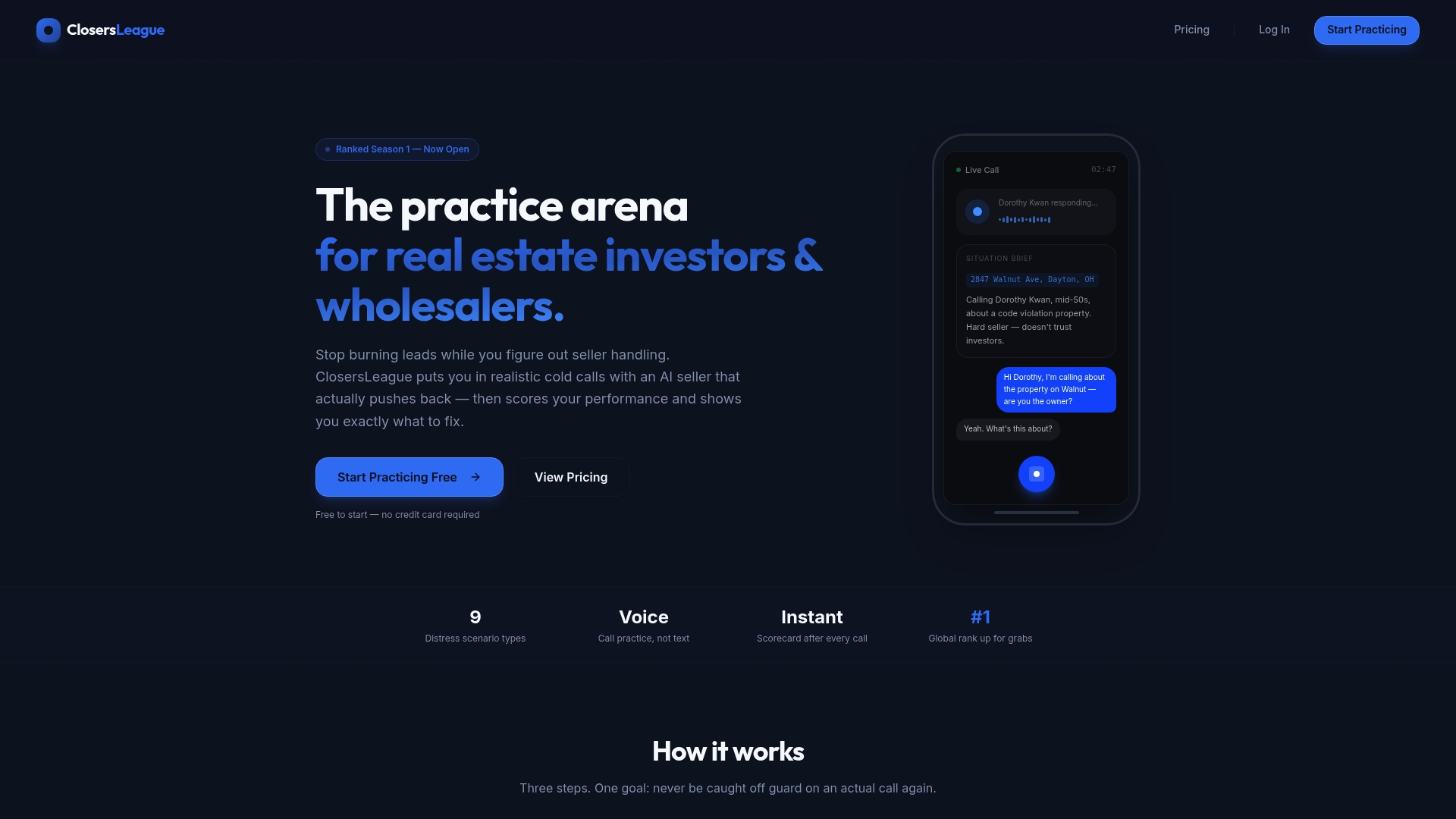
A pilot with Closers League looks like this in practice:
- Trial calls against realistic AI seller personas, probate, tax delinquent, divorce, and more.
- Instant scorecards across multiple skill categories, not one blended number.
- QA First Call Playback Review so reps see exactly where a call went sideways.
- Real-time coaching prompts and targeted drills built from each rep’s weakest dimension.
Track three numbers during your pilot: score lift over two to three weeks, appointment rate on real calls, and time-to-first-feedback compared to your old manager-review cycle. Getting reps that feedback fast is where AI roleplay earns its place, and pairing scored practice with strong follow-up messaging once appointments are booked closes the loop from practice to pipeline.
Plans start at Starter for $5 per month, with Growth and Pro tiers available as your team’s call volume grows. Sign up for a trial and run your first scored practice call today.
Sources
- Can AI help identify persuasive salespeople? | Yale School of Management Insights
- Learning when to quit in sales conversations — stopping agent research (arXiv)
- FTC — TSR final rule and recordkeeping requirements (2024)
- State of Revenue Enablement (Mindtickle report, 2025)
FAQ
Is There an AI That Can Analyze Sales Calls?
Yes. AI call scoring tools transcribe and evaluate recorded or live calls against a structured rubric, returning scores across dimensions like discovery quality, objection handling, and next-step clarity. Certain AI call scoring tools apply this specifically to real estate cold calling, scoring practice calls on a 0 to 100 scale with evidence attached to each score.
Are Companies Using AI for Sales Calls?
Yes, widely, for both live coaching prompts and post-call scoring. Revenue enablement research shows teams using AI roleplay for practice see measurable score improvement, roughly 10% in some reported cases, along with faster feedback cycles than manual review alone.
How Do I Practice Sales Calls With AI?
AI roleplay platforms simulate a realistic buyer or seller persona so reps can practice full conversations, get instant rubric-based feedback, and repeat scenarios until a specific skill improves. Some platforms offer AI-based roleplay for real estate cold calling, with scenario-based practice across various distressed seller types and instant scorecards after practice calls.
How Much Does an AI Call Answering Service Cost?
Pricing varies widely by vendor and depends on call volume and features included. Closers League’s own practice and coaching platform starts at $5 per month for the Starter plan, with Growth at $10 per month and Pro at $18 per month, each tier scaling by number of AI practice calls included.
Does AI Call Scoring Replace Manager Reviews?
No, and the strongest results come from combining both. Yale SOM research found that AI paired with human evaluation outperforms AI running alone, which is why hybrid scoring with manager audit sampling is the recommended approach rather than full automation.