
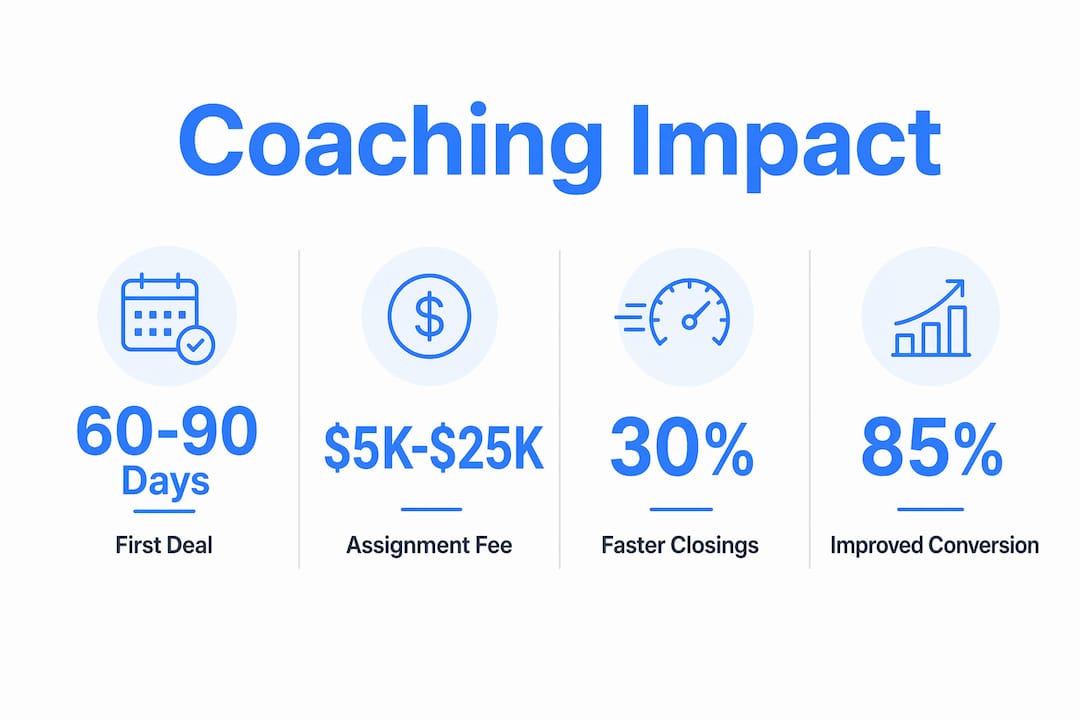
Coaching in real estate wholesaling is defined as structured, personalized mentorship that teaches investors how to find distressed properties, negotiate with motivated sellers, and close deals profitably. The role of coaching in wholesaling goes far beyond handing you a script. It builds the systems, habits, and judgment that separate wholesalers who close deals from those who quit after their first cold call. Coached wholesalers typically close their first deal within 60–90 days and earn assignment fees between $5,000 and $25,000. That timeline is not accidental. It reflects what happens when accountability, deal review, and repeatable frameworks replace guesswork and trial and error.
What measurable benefits does coaching bring to wholesaling performance?
Coaching produces results you can track. The most direct coaching benefits in wholesaling show up in three areas: call quality, appointment rates, and deal velocity.
- Call scores improve significantly. AI-based coaching improved call scores from 62 to 78, appointment-set rates from 18% to 31%, and close rates by 35%. Those are not marginal gains. A 13-point jump in call score means your conversations with distressed homeowners are more controlled, more empathetic, and more likely to move toward an offer.
- Deals close faster. Wholesalers with structured coaching close their first deal in 60–90 days. Without coaching, most beginners spend months learning the same lessons through expensive mistakes.
- Admin time drops sharply. Data-driven coaching reduced acquisition managers’ call review time by over 70%, from 15 hours to just 4 hours per week. That freed time goes directly into making more calls and analyzing more deals.
The underlying reason these numbers move is accountability. A coach reviews your calls, scores your performance, and tells you exactly where you lost the seller. That feedback loop is what pre-recorded courses cannot replicate.
Pro Tip: Track your talk-time ratio and inquiry-to-offer conversion rate every week. These two KPIs tell you faster than anything else where your coaching is working and where your funnel is leaking.
How does coaching improve wholesaling skills and business strategy?
Coaching improves wholesaling skills by replacing reactive, adrenaline-driven behavior with disciplined systems. Effective coaching programs focus on repeatable processes like lead qualification, script discipline, and deal analysis rather than motivational hype. That distinction matters. A hyped-up wholesaler makes calls until rejection stings too much, then stops. A coached wholesaler follows a process regardless of how the last call went.
Here are the core skill areas that structured mentorship develops:
- Seller conversation scripting. Coaching teaches you how to open a call with a distressed homeowner facing foreclosure, probate, or divorce without sounding like a telemarketer. You practice specific language patterns until they feel natural under pressure.
- Objection handling. Role-playing seller objections is a standard coaching technique. You rehearse responses to “I’m not interested,” “My house is worth more than that,” and “I need to think about it” until you stop freezing on live calls.
- Maximum Allowable Offer calculation. Coaching teaches you to calculate your MAO accurately using after-repair value, repair estimates, and your target profit margin. One miscalculated offer can wipe out three deals’ worth of profit.
- Lead qualification. Qualifying leads correctly separates motivated sellers from time-wasters. Coaching gives you a framework to assess seller motivation, timeline, and equity position within the first five minutes of a call.
- Buyer’s list development. Coaching prioritizes a quality buyer’s list over raw lead volume. A well-contracted deal fails without a reliable buyer ready to close. Building that list is a skill, not a side task.
Behavioral coaching is the piece most wholesalers underestimate. Coaching builds behavioral frameworks that help wholesalers sustain effort through rejection and the grind of cold calling. The emotional toll of calling homeowners in distress is real. Coaches who address that directly prevent the dropout that kills most beginners’ careers before they ever close a deal.
Pro Tip: After every role-play session, write down the one objection that still trips you up. Bring it to your next coaching call. Targeted repetition on your weakest point moves your skills faster than general practice.
What modern AI advances are changing wholesaling coaching?
AI is changing how coaching works, not replacing the coach. The shift is from gut-feel feedback to objective, data-driven analysis delivered immediately after every call.
Traditional coaching relied on a manager listening to recorded calls and giving notes days later. That lag meant wholesalers repeated the same mistakes for weeks before getting corrected. AI-powered call scoring changes that cycle entirely.
Gut-feel coaching vs. data-driven coaching
| Approach | Call review time | Feedback speed | Consistency |
|---|---|---|---|
| Traditional gut-feel | 15 hours per week | Days after the call | Varies by reviewer |
| AI data-driven | 4 hours per week | Immediately post-call | Objective every time |
The practical impact is significant. Coaches using AI dashboards can track each wholesaler’s progress across talk-time, objection handling, and offer conversion in real time. They spend less time on admin and more time on the conversations that actually need human judgment.
AI coaching in real estate also enables wholesalers to practice calls before they ever dial a real homeowner. AI roleplay tools simulate distressed seller scenarios, including foreclosure, probate, and tax-delinquent situations, so you build muscle memory in a low-stakes environment. That practice directly translates to better live call performance.
Key KPIs that AI coaching surfaces automatically include:
- Talk-time ratio (are you listening or talking over the seller?)
- Inquiry-to-offer conversion rate
- Appointment-set rate per 100 dials
- Objection frequency by seller type
These metrics help coaches pinpoint exactly where deals fall apart in the funnel. Without that data, coaching is educated guessing.
How do you choose and apply a coaching program effectively?
The coaching program you choose determines how fast you grow. Most programs fall into one of two categories: content-heavy courses with little accountability, or hands-on mentorship with real deal review. One-on-one coaching bridges theory and practice by providing accountability and deal review that prevents costly contract errors. That is the standard worth measuring every program against.
Use these criteria when evaluating any wholesaling mentorship program:
- Structure. Does the program follow a defined curriculum, or does it react to whatever question you bring that week? Structured programs produce faster results.
- Accountability mechanisms. Weekly call reviews, deal submission requirements, and KPI tracking are signs of a serious program. Vague “community support” is not accountability.
- Legal and compliance guidance. Wholesaling involves contracts, assignment clauses, and state-specific disclosure rules. A coaching program that skips legal basics leaves you exposed.
- Mentor experience. Your coach should have closed deals in markets similar to yours, not just taught about wholesaling.
- Scalability focus. The best programs teach you to build systems, not just close your next deal. A wartime CEO mindset focused on KPIs, offer cadence, and team accountability is what separates solo wholesalers from investors running real operations.
Avoid programs that lead with income screenshots and testimonials but offer no structured curriculum. Systems-focused programs consistently outperform hype-based courses because they teach you what to do when motivation runs low and the calls get hard.
Integrating coaching into your daily workflow is straightforward. Review your call scores after every session. Bring your two worst calls to your next coaching meeting. Practice your objection responses with AI roleplay tools between live sessions. Treat coaching as a daily practice, not a monthly check-in.
Pro Tip: Before signing up for any coaching program, ask the coach to walk you through how they handle a deal that falls apart at the title company. Their answer tells you whether they have real experience or just theory.
Key Takeaways
Structured coaching is the single most reliable way to shorten your path from first dial to first closed deal in real estate wholesaling.
| Point | Details |
|---|---|
| Coaching accelerates deal closings | Coached wholesalers close their first deal in 60–90 days with fees between $5,000 and $25,000. |
| AI coaching improves call outcomes | AI-based coaching raised appointment rates from 18% to 31% and improved close rates by 35%. |
| Behavioral coaching prevents dropout | Coaching builds the mental framework to sustain effort through rejection and cold calling difficulty. |
| Buyer’s list quality drives closings | A well-contracted deal fails without a reliable buyer. Coaching prioritizes list quality over lead volume. |
| Systems beat hype every time | Programs focused on repeatable processes outperform motivation-based courses in long-term wholesaler success. |
Why I think most wholesalers underestimate what coaching actually does
Most wholesalers I have seen come into this business thinking coaching means learning a better script. They spend a few hundred dollars on a course, memorize some lines, and wonder why their calls still fall apart at the first real objection.
The real value of coaching is not the script. It is the feedback loop. When someone who has closed hundreds of deals listens to your call and tells you the exact moment you lost the seller, that is information you cannot get from any course. You hear yourself differently. You fix things you did not know were broken.
What I have also seen is that the wholesalers who scale fastest are not the ones with the most leads. They are the ones who built systems early, tracked their numbers obsessively, and treated every coaching session like a film review before a big game. The sales pipeline discipline that separates a $10,000 month from a $100,000 month is almost always a coaching output, not a natural talent.
AI is making this even more accessible. You no longer need to wait for a weekly call to find out your talk-time ratio was off or that you rushed past the seller’s motivation. That data is available immediately now. The wholesalers who use it will compress their learning curves in ways that were not possible three years ago.
My honest advice: find a coach who has closed deals in your market, insists on reviewing your actual calls, and teaches you to build a buyer’s list before you obsess over lead generation. That combination closes deals. Everything else is noise.
— Dave
ClosersLeague: practice the calls your coaching teaches
Coaching tells you what to fix. Practice is where you actually fix it. ClosersLeague is an AI-powered cold calling training platform built specifically for real estate investors and wholesalers.
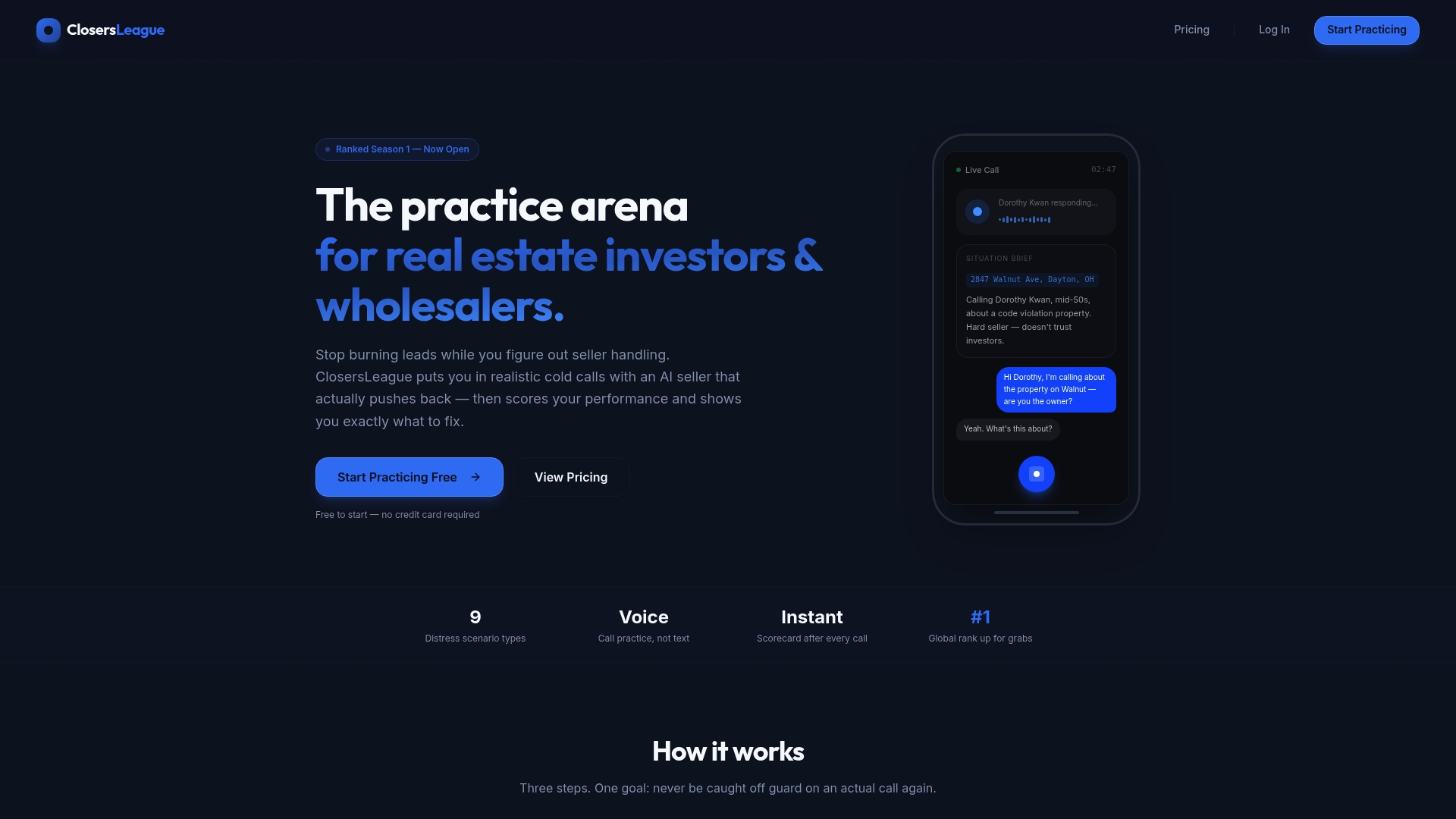
You can run live roleplay sessions against AI-simulated homeowners facing foreclosure, probate, divorce, and other distressed situations. Every call gets scored across objection handling, tone, and offer delivery so you know exactly where to improve. The real estate cold calling practice tools at ClosersLeague let you drill the scenarios your coach assigns, sharpen your weakest objections, and build the confidence that shows up on live calls. Stop winging it. Start drilling.
FAQ
What is the role of coaching in wholesaling?
Coaching in wholesaling provides structured mentorship that teaches lead qualification, deal analysis, and seller negotiation through accountability and real call review. It shortens the learning curve and reduces costly contract mistakes.
How fast can coaching help a wholesaler close their first deal?
Coached wholesalers typically close their first deal within 60–90 days and earn assignment fees between $5,000 and $25,000. Uncoached beginners often take significantly longer due to avoidable errors.
How does AI improve wholesaling coaching?
AI-based coaching scores calls immediately after they happen, tracks KPIs like talk-time and appointment rates, and reduces manual call review time by over 70%. That speed and objectivity accelerates skill development faster than traditional methods.
What should I look for in a wholesaling mentorship program?
Look for structured curriculum, weekly accountability, real deal review, and a coach with active market experience. Avoid programs that lead with income claims but offer no defined process or measurable feedback.
Why is a buyer’s list so important in wholesaling coaching?
A quality buyer’s list is what converts a signed contract into actual profit. Coaching prioritizes building reliable buyer relationships early because even a well-priced deal fails without a ready buyer to assign it to.