Effective cold call coaching is a weekly behavior-change loop: score calls with a published rubric, correct one behavior, and practice until the new behavior is habitual. That’s the whole system. If you’re trying to coach cold callers on your team right now, here’s your first move: pull one recorded call from this week, score it against a real rubric, and pick exactly one behavior to fix before the next shift.
- Grab one recent recorded call from any rep on your team
- Score it against a published rubric, not your gut feeling
- Choose one behavior to correct, not five
- Schedule a two-minute role-play before the rep’s next dialing session
Platforms like ClosersLeague exist because most managers don’t have time to build this loop manually, but the loop itself works whether you use software or a stopwatch and a notepad.
TL;DR:
- Coaches should focus on scoring calls against a detailed rubric and correcting only one specific behavior each session to ensure effective skill retention.
- A structured 4-week plan guides coaching on fundamentals, discovery, and closing skills, with input checks before technical coaching.
- AI-assisted call scoring and scenario role-play platforms like ClosersLeague automate grading, freeing managers to concentrate on personalized coaching.
- Reps’ psychological barriers, such as call reluctance and fear of rejection, require direct coaching and rehearsal rather than volume alone.
- Tracking key metrics like connect rate, objection handling, and talk/listen ratio helps measure coaching success and identify targeted improvements.
Table of Contents
- What Does It Mean to Coach Cold Callers?
- What Belongs in a Cold Calling Scorecard?
- How Often Should You Coach Cold Callers?
- Live Coaching or AI Roleplay: Which One Do You Need?
- Are Cold Calls Legal, and What Compliance Rules Apply?
- Which Metrics Prove Cold Call Coaching Is Working?
- How ClosersLeague Puts This Playbook Into Practice
- What’s Actually Stopping Your Reps From Dialing?
- Should You Coach a Rookie the Same Way You Coach a Veteran?
- How Does Coaching Fit Into Your CRM and Sales Enablement Stack?
- What Should a Cold Call Opener Actually Sound Like?
- What’s the Right Way to Give a Cold Caller Feedback?
- Manager Checklist for a First Coaching Session
- Put the AI-Assisted Coaching Loop to Work
- Key Takeaways
- Sources
- FAQ
What Does It Mean to Coach Cold Callers?
Coaching is not training. Training hands someone a script and a call flow once. Coaching is the repeated cycle of observing a call, scoring it against fixed criteria, correcting a single behavior, practicing that fix in a low-stakes rehearsal, and then applying it live. Skip any step and the loop breaks.
Sales coaching research backs this up directly: the biggest mistake managers make is treating coaching like teaching, delivering information once instead of running weekly, measurable behavior-change conversations.
- Observe: listen to or watch a real call, not a hypothetical
- Score: rate specific dimensions against a rubric
- Correct: name one behavior to change, not a list
- Practice: rehearse that one fix through role-play
- Apply: the rep uses it on the next live call, then you observe again
What Belongs in a Cold Calling Scorecard?
A scorecard only works if it scores the call in stages, not as one blurry impression. Score these five stages separately: the opener, the permission-based transition, the discovery and qualification phase, objection handling, and the close or next-step ask. A rep can nail the opener and completely blow the close. Lumping everything into one number hides that.
Inside those stages, effective programs use 10 to 14 measurable dimensions, each scored 0, 1, or 2:
- Opener clarity (does the rep state their name and reason for calling in under 10 seconds?)
- Permission-based transition (did they ask before pitching?)
- Reason-for-call specificity (probate, pre-foreclosure, tax delinquent, tailored to the property)
- Tone and pace control
- Discovery question quality
- Talk-to-listen ratio
- Objection acknowledgment before rebuttal
- Objection resolution technique
- Emotional-state reading (frustrated, motivated, guarded)
- Next-step specificity
- Confirmation and recap
- Call control under interruption
A standardized rubric with 10 to 14 dimensions keeps feedback objective instead of subjective, which is exactly what breaks down when managers score “vibes” instead of specific behaviors.
Here’s the part managers skip: pick one behavior per session. Not three. Not “everything wrong with the call.” One. A rep who hears five corrections remembers none of them. A rep who hears “your permission ask is missing, here’s exactly what to add” will fix it by Friday.
Pro Tip: Write the one behavior on a sticky note or in the CRM task field before the coaching call starts. If you can’t summarize the fix in one sentence, you haven’t narrowed it enough.
How Often Should You Coach Cold Callers?
New reps need 1 to 2 coached calls scored per week; tenured reps who are hitting benchmarks can drop to once weekly. Role-play should happen at least once a week for every rep, regardless of tenure, because skills decay faster than managers expect.
A 30-day starter plan that doesn’t require new headcount or software spend:
- Week 1: Baseline. Score 3 to 5 calls per rep against your rubric before touching anything. Diagnose inputs first: bad lead lists and thin call volume mask real coaching impact, so verify data quality before blaming the rep.
- Week 2: Opener mastery. Coach the first 15 seconds of every call. Role-play the opener daily in short bursts.
- Week 3: Conversation control. Shift focus to discovery questions and the talk/listen ratio.
- Week 4: Close and next-step. Score the ask, the recap, and the commitment.
- Check call volume (aim for consistent weekly dials per rep) before assuming a skill gap
- Check list quality (verified numbers, correct property type) before assuming a script gap
- Only coach behavior once inputs are confirmed clean
Live Coaching or AI Roleplay: Which One Do You Need?
Live, real-time coaching earns its cost with brand-new reps and high-stakes calls, like a hot probate lead who’s ready to talk numbers. Nothing replaces a manager listening in and correcting course mid-call when the deal is on the line.
Post-call review works better for pattern detection. You’re not trying to save one call; you’re trying to spot that a rep skips discovery questions on every third call. That pattern only shows up across a sample, not inside one live session.
This is where AI-assisted scoring earns its place. Auto-scoring reviews every call against the rubric automatically, cutting the manual grading burden that eats a manager’s week. Mature coaching programs increasingly run a hybrid model: AI scores 100% of calls, live cues trigger on 5 to 10% of them, and the manager personally reviews 2 to 3 calls per rep weekly for the actual behavior-change conversation.
- AI scores every call so nothing falls through the cracks
- Managers spend saved time on the coaching conversation itself, not data entry
- Role-play scenarios run on demand instead of waiting for a manager’s calendar
Pro Tip: If your team is drowning in unscored calls, that’s not a coaching problem, it’s a capacity problem. Fix capacity with automated scoring before you add more coaching frameworks on top.
Are Cold Calls Legal, and What Compliance Rules Apply?
B2B cold calling remains legal in the United States but stays regulated. The TCPA restricts autodialers and prerecorded or AI-cloned voice messages, and the FCC has ruled that AI-generated voices count as prerecorded under the law.
- Scrub numbers against the National Do Not Call Registry and maintain your own internal suppression list with at least a 31-day update cadence
- When you’re unsure which state’s rules apply, default to the strictest state’s calling window rather than guessing
- Use human dialing, not autodialers, for any number you can’t confirm is a landline
- Document consent and keep records; the FTC’s Telemarketing Sales Rule requires recordkeeping and limits calling hours
Several states, including Florida, Oklahoma, Washington, and Maryland, run stricter “mini-TCPA” laws that narrow B2B exemptions further than federal rules alone.
Which Metrics Prove Cold Call Coaching Is Working?
Track connect rate, connect-to-meeting conversion, meeting-to-opportunity rate, and talk/listen ratio. The 80/20 rule applies directly here: the prospect should carry roughly 80% of the talk time on a healthy discovery call, with the rep using the remaining 20% to map one specific solution to the seller’s actual situation.
- Connect rate tells you if your list quality and dial volume are solid
- Connect-to-meeting tells you if the opener and permission ask are working
- Meeting-to-opportunity tells you if discovery and objection handling hold up
- Talk/listen ratio flags reps who pitch too early or too hard
Read the shape of the scorecard, not just the total. A rep scoring low only on objection handling needs a completely different fix than one who’s weak across every dimension. Run weekly rep-level dashboards and roll them into a monthly trend review so a single bad week doesn’t trigger a panic correction.
How ClosersLeague Puts This Playbook Into Practice
ClosersLeague’s AI roleplay and scenario libraries map directly onto this rubric: scenario drills for probate, pre-foreclosure, and tax-delinquent sellers score openers, discovery, and objection handling automatically.
- Auto-scoring covers every practice call, not a sample
- Leaderboards create the weekly cadence managers struggle to enforce alone
- Managers still own the one-behavior coaching conversation; the platform just clears the scoring backlog
Use a platform when scoring volume outpaces manager time. Keep the live conversation human either way.
What’s Actually Stopping Your Reps From Dialing?
Most coaching plans focus entirely on technique and ignore the psychology that makes reps avoid the phone in the first place. Call reluctance is a real, measurable pattern, not laziness, and it shows up as reps who “run out of time” to make their dials or who front-load easier admin tasks before a shift.

Fear of rejection is the obvious barrier, but the subtler one is fear of sounding like a telemarketer. Reps who’ve internalized that cold calling feels intrusive will unconsciously rush the opener, skip the permission ask, and talk faster than they should, all signs of a rep trying to get the call over with rather than have it.
Coach this directly instead of hoping it fades with volume. Reframe the call’s purpose out loud with the rep: they’re not selling anything on this call, they’re finding out if the homeowner has a reason to talk. That reframe alone reduces the anxiety that causes rushed openers.
Objection anxiety compounds the problem. A rep who dreads “I’m not interested” will telegraph that dread in their tone before the seller even says it. The fix is rehearsal volume, not motivational speeches. Role-playing the same three objections (not interested, how did you get my number, send me something in writing) until the response is automatic removes the split-second hesitation that makes objections feel like confrontations.
Isolation makes all of this worse. Reps who dial alone, with no one reviewing their calls, tend to develop avoidance patterns that go unnoticed until pipeline numbers drop. A weekly scored call and a five-minute role-play session breaks that isolation, even when the news is “you’re doing fine.”
Should You Coach a Rookie the Same Way You Coach a Veteran?
No, and coaching everyone identically is one of the fastest ways to stall a team’s progress. New reps need coaching on fundamentals: the opener, the permission ask, basic call control. Coach a rookie on advanced objection-layering before they can deliver a clean 10-second opener and you’ll confuse them without fixing anything.
Tenured reps need different attention entirely. Their basics are solid, so their coaching should target the dimensions that actually move revenue: next-step specificity, discovery depth, and emotional-state reading on distressed sellers. A veteran calling probate leads for two years has usually built bad habits around rushing empathy, since they’ve heard every version of grief and fatigue and can go numb to it. That’s a coaching conversation about tone, not technique.
Industry context matters just as much as tenure. A rep working code-violation leads faces angry, defensive homeowners who feel targeted by the city; a rep working inherited-property leads faces grieving families who need patience before any business conversation starts. The scorecard dimensions stay the same, but what “good” looks like on emotional-state reading shifts dramatically between those two conversations.
Practical adjustment: build a short scenario library segmented by seller type, so a new rep coming onto tax-delinquent leads practices against tax-delinquent objections, not generic ones borrowed from a divorce-lead script. Coaching that ignores the seller category teaches skills that don’t transfer to the actual calls the rep is making that week.
How Does Coaching Fit Into Your CRM and Sales Enablement Stack?
Coaching that lives outside your CRM disappears within a month. If scorecards sit in a spreadsheet nobody opens, the one-behavior fix from last Tuesday gets forgotten by Thursday. Log each coaching session, the behavior targeted, and the follow-up date directly against the rep’s record so the next manager (or you, in six weeks) can see the pattern.
Tie call recordings to the specific lead record, especially for distressed property types where context changes fast. A probate lead coached on empathy in January needs a different note attached than a tax-delinquent lead coached on urgency in March. Enablement content, your objection-handling playbooks, and your script library should link directly to the CRM record type they support, not sit in a shared drive disconnected from the actual call.
Sales enablement teams often build objection frameworks and script libraries in isolation from the coaching cadence. Connect a workflow like the one detailed in ClosersLeague’s objection handling guide directly to the CRM’s objection-tagging field, so a rep’s recurring objection type surfaces automatically the next time a manager reviews their calls. That closes the loop between “here’s the framework” and “here’s proof the rep is using it.”
What Should a Cold Call Opener Actually Sound Like?
Every opener needs three things in the first 10 seconds: the rep’s name, a specific and honest reason for the call, and permission to continue. Skip any one of those and the seller’s guard goes up immediately.
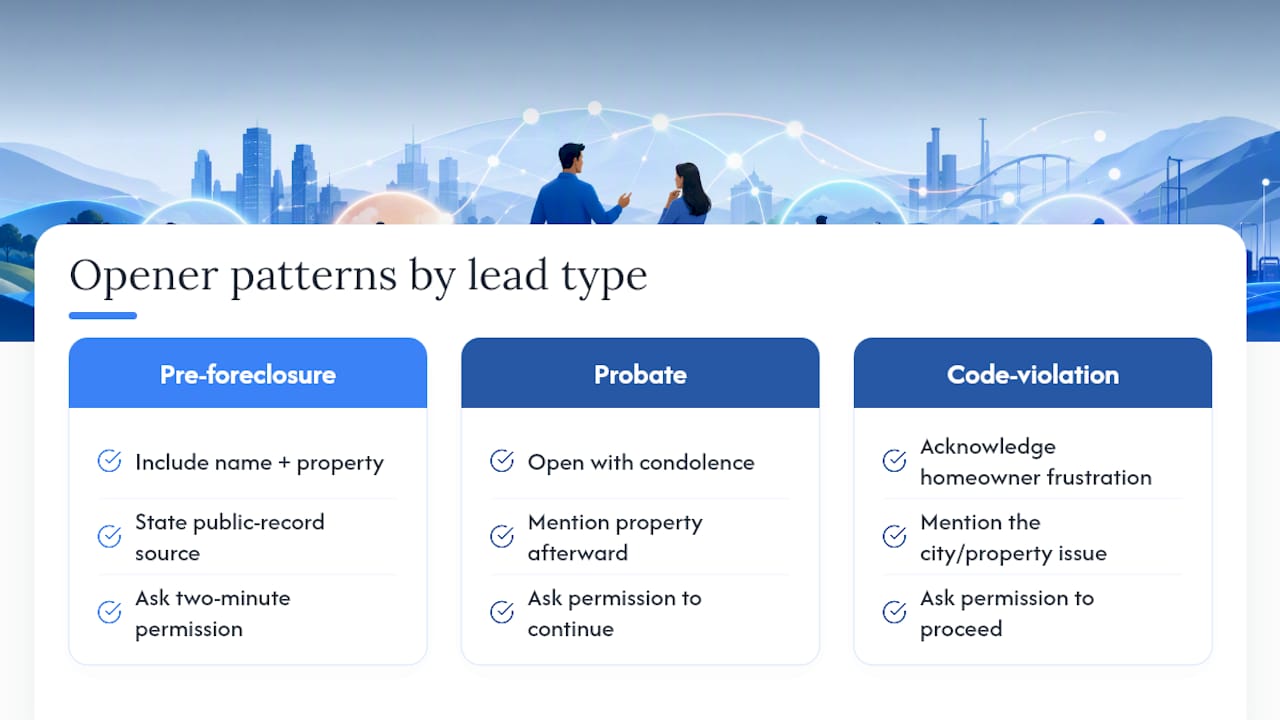
A workable structure for a pre-foreclosure lead: “Hi, this is [name] calling about the property on [street name], I saw some public records that suggested you might be dealing with a few things right now, do you have two minutes?” That’s specific, honest about the source, and asks permission before pitching anything.
Permission-based pattern interrupts work because they break the script the seller expects. Most cold calls follow a predictable rhythm the moment the seller hears “Hi, how are you today?” A pattern interrupt like “I know this call is probably out of the blue, so I’ll be quick” acknowledges the awkwardness instead of pretending it doesn’t exist, and sellers often relax specifically because the rep named the tension out loud.
For probate leads, leading with condolence-first language before any mention of the property tends to earn more talk time than jumping straight to business. For code-violation leads, acknowledging the frustration of dealing with the city before mentioning the property works the same way. The core techniques for cold calling homeowners hold across property types, but the specific wording of the opener should shift with the emotional context of the seller category.
What’s the Right Way to Give a Cold Caller Feedback?
Feedback lands or fails based on delivery, not content. Give it privately, never in front of the team, even when the fix is small and painless. Public correction, even gentle correction, makes reps defensive and less likely to actually change the behavior you flagged.
Be specific. “Work on your discovery questions” gives a rep nothing to act on. “Ask one follow-up question after the seller mentions why they’re selling, before you move to pricing” gives them something they can execute on the next call. Specificity is what turns a vague critique into a rehearsable skill.
Make it measurable. Tie the feedback to a scorecard dimension the rep can see scored, not a subjective impression. “Your permission-ask dimension scored a 0 on this call, here’s what a 2 sounds like” removes the emotional charge that comes with feeling judged, and replaces it with a concrete target.
Sandwich the correction between something real. Not empty praise, but an actual strength from the call. If the opener was clean, say so before moving to the fix. Reps disengage fast when every coaching conversation feels like a list of failures.
Manager Checklist for a First Coaching Session
Before the session, score one recent call against your rubric together with the rep, out loud. Pick one behavior, the lowest-scoring dimension, and name it specifically. Run two quick role-play repeats of the fix right there, not “later.” Keep feedback private, specific, and tied to the scorecard number, not a vague impression. Schedule the next check-in before the rep leaves the room. Success by the next session looks like one dimension moving up a point, nothing more ambitious than that.
— Dave
Put the AI-Assisted Coaching Loop to Work
ClosersLeague built its scenario libraries around the exact rubric and cadence this playbook describes, so managers get the scoring done automatically instead of doing it by hand every week.
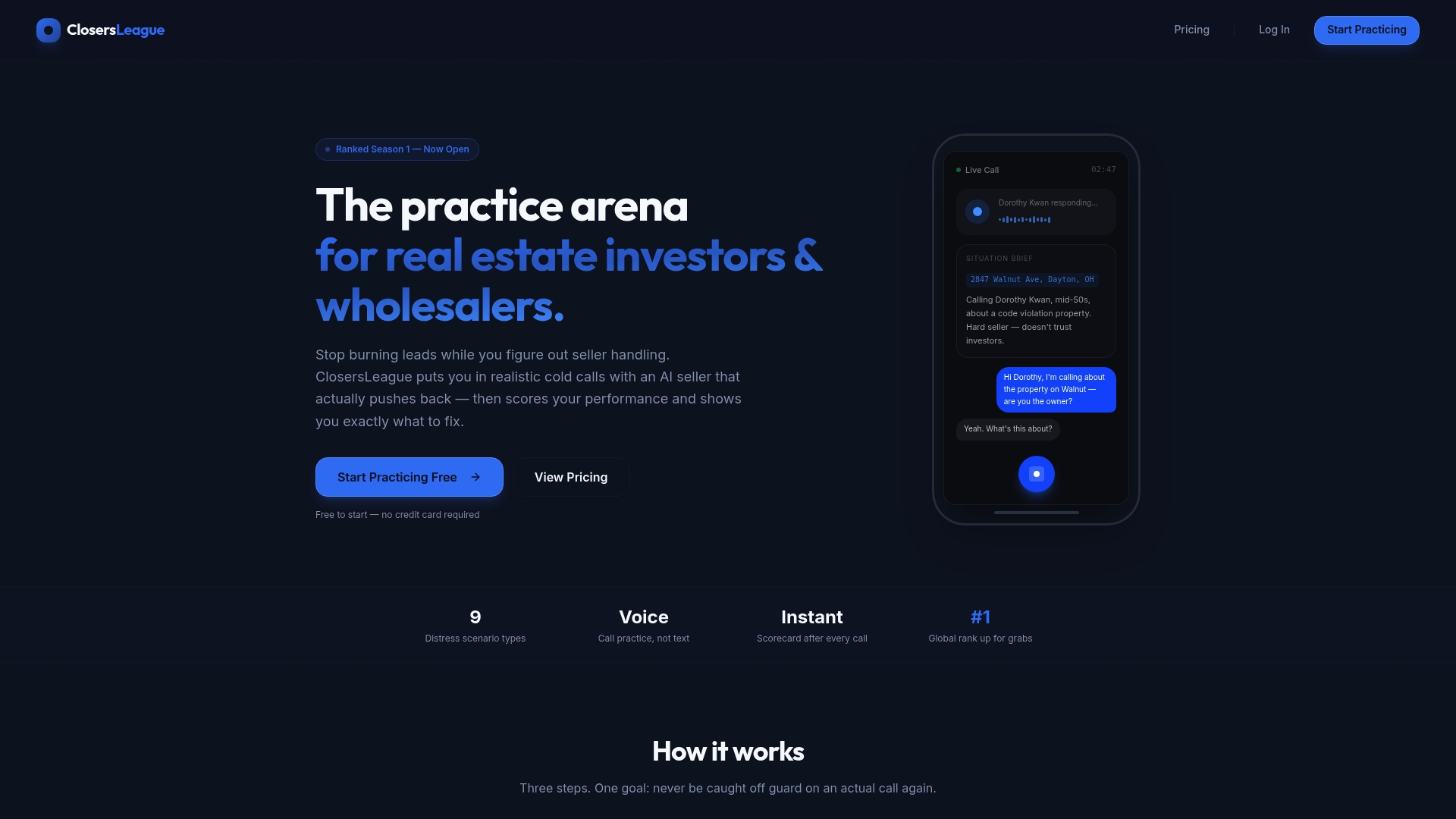
The platform runs AI roleplay against real distress scenarios, probate, pre-foreclosure, tax delinquent, code violation, inherited, and more, then auto-scores each practice call against dimensions like permission-ask clarity and objection handling. Leaderboards keep the weekly cadence alive without a manager chasing anyone down. A rep working inherited property leads can drill that seller type specifically instead of practicing generic objections that don’t match what they’ll hear on the actual call.
Start a free trial at ClosersLeague and score your team’s first calls this week using the same rubric structure outlined above. No spreadsheet setup required.
Key Takeaways
Cold call coaching works when managers combine a published scorecard, a fixed weekly cadence, and a strict one-behavior-per-session correction rule.
| Point | Details |
|---|---|
| Coaching is a loop, not a lecture | Observe, score, correct, practice, apply, then repeat weekly instead of teaching once. |
| Score five stages separately | Rate the opener, permission ask, discovery, objections, and close as distinct dimensions. |
| Fix one behavior at a time | Reps retain and apply a single correction far better than a list of five. |
| Diagnose inputs before skill | Check list quality and call volume before assuming the rep’s technique is the problem. |
| ClosersLeague automates the scoring layer | AI auto-scoring and scenario roleplay handle the grading tax so managers can focus on the coaching conversation itself. |
Sources
- FTC final rule: Telemarketing Sales Rule (TSR) — 2024
- Cold Call Coaching — The Complete 2026 Manager Playbook | Nimitai
- Cold Call Coaching: 30-Day Framework + Scorecards (2026)
FAQ
What Is Cold Call Coaching?
Cold call coaching is a recurring cycle of scoring recorded calls against a published rubric, correcting one specific behavior, and rehearsing it through role-play until it becomes automatic on live calls. It differs from training, which delivers scripts or information once without ongoing correction.
How Much Do Cold Callers Make Per Hour?
Pay varies widely by role, industry, and whether compensation includes commission, so there’s no single reliable hourly figure that applies across cold calling roles. Real estate cold callers working for investors and wholesalers are often paid a base rate plus bonuses tied to appointments set or deals closed rather than a flat hourly wage.
Is Cold Calling B2B Illegal?
No, B2B cold calling remains legal in the United States, but it’s regulated under the TCPA and the FTC’s Telemarketing Sales Rule, which restrict autodialers, prerecorded voices, and require Do Not Call compliance. Several states add stricter rules on top of federal law.
What Is the 80/20 Rule in Cold Calling?
The 80/20 rule means the prospect should do roughly 80% of the talking during discovery, while the rep uses the remaining 20% to ask focused questions and map a specific solution to the seller’s situation. A rep talking more than the seller on a discovery call is usually pitching too early.
How Does ClosersLeague Fit Into a Coaching Program?
ClosersLeague provides AI roleplay and auto-scoring against scenario libraries built for distress property types, letting managers automate the scoring layer of the coaching loop described in this article. Managers still lead the human coaching conversation; the platform removes the manual grading work.