
The most effective cold calling training resources for real estate investors combine AI roleplay, scenario-specific scripts, and live coaching — in that order. Generic sales courses won’t prepare you for probate sellers who just buried a parent or a pre-foreclosure homeowner who’s embarrassed to admit they’re behind. You need practice that mirrors those exact conversations.
Start here: Sign up for a free trial on ClosersLeague’s practice page and run 10 AI roleplay calls this week before you dial a single live number.
- Fastest next step: Complete 10 scored AI practice calls targeting your primary seller types (probate, pre-foreclosure, or vacant) before your first live campaign day.
- What to expect in 30 days: Measurably improved objection handling, a consistent opening framework, and a baseline KPI dashboard you can actually use to track progress.
Table of Contents
- What are the best cold calling training resources for distressed sellers?
- Why distressed-seller training is different from generic cold call training
- How do you choose the right training resource for your situation?
- Sample call frameworks and scripts for distressed sellers
- What does a 30–90 day cold calling practice plan look like?
- U.S. legal checklist for cold calling homeowners
- ClosersLeague gives you a faster path to measurable improvement
- Key Takeaways
- What separates callers who scale from those who stall
- Useful sources and further reading
- FAQ
What are the best cold calling training resources for distressed sellers?
Not all cold call training is built for the distressed-property niche. Here’s what actually moves the needle:
- AI roleplay platforms: ClosersLeague simulates distressed-seller emotional states across probate, pre-foreclosure, inherited, tax-delinquent, code violation, divorce, out-of-state, vacant, and tired-landlord scenarios. Every call is scored with a performance scorecard so you can iterate fast.
- Live coaching and bootcamps: A coach who has closed distressed deals can identify the specific verbal habits killing your conversion. Look for programs that include objection-handling drills and recorded call reviews.
- Script libraries: Scenario-specific templates for each seller type. Generic “We Buy Houses” openers consistently underperform on inherited leads — you need grief-sensitive, concierge-style language instead.
- Skip tracing + auto-dialer + CRM stack: Skip-trace hit rates commonly fall between 60–80%, with per-record costs of $0.05–$0.15. Pair that with a predictive dialer and a CRM that logs every touch.
- Call recording and analytics: Review your first 30 seconds on every call. That’s where most deals are lost.
7–14 day trial checklist: Run at least 20 AI practice calls. Track your scorecard on opener delivery, objection handling, and appointment-setting language. If a platform can’t show you those three metrics, move on.
Why distressed-seller training is different from generic cold call training
A pre-foreclosure homeowner isn’t just a motivated seller. They’re often ashamed, scared, and defensive. A probate heir may still be grieving. A code-violation owner may feel embarrassed about the property’s condition. Callers trained on seller psychology produce higher appointment rates and fewer hang-ups than those relying on generic scripts alone.

The mental shift that separates good callers from great ones: stop hunting for deals and start offering solutions. When your opener sounds like “I help homeowners in tough situations explore their options” rather than “I buy houses for cash,” the conversation changes immediately.
Timing matters too. For probate leads, several months after filing can be the best window for outreach. Calling too soon after a filing may feel invasive and sometimes triggers hostility.
Pro Tip: Practice tone mirroring in your AI roleplay sessions. Match the seller’s pace and energy level in the first 60 seconds. A grieving probate heir needs a slower, quieter tone. A frustrated tired landlord often responds better to a direct, no-nonsense pace. ClosersLeague’s emotional-state scoring flags when your tone is mismatched.
How do you choose the right training resource for your situation?
Evaluate any course, coach, or platform against this checklist before spending money:
- Scenario realism: Does it simulate the specific seller types you’re calling (probate, pre-foreclosure, vacant, tired landlord)?
- Measurable feedback: Scorecards, call grades, or objective metrics — not just “good job” from a coach.
- Seller-type coverage: At least five distressed-seller scenarios with distinct scripts and emotional contexts.
- CRM and dialer integration: Can you log practice outcomes and sync with your live campaign tools?
- Trial or demo availability: Any credible platform offers a free trial. No trial is a red flag.
- Instructor credentials: Has the coach actually closed distressed deals, or do they only teach theory?
Red flags that should disqualify a resource immediately:
- Only offers a generic “We Buy Houses” script with no seller-type variation
- No roleplay component or scoring mechanism
- No trial period and no money-back guarantee
- Promises deal flow without teaching objection handling
Running a 7–14 day evaluation: On day one, record your baseline scorecard. By day seven, compare your objection-handling score and appointment-setting rate. If neither has moved, the platform isn’t giving you enough specific feedback to improve. DIY cold-calling programs typically take 90+ days to ramp without structured feedback; the right training tool compresses that timeline significantly.
Cost shapes what you get: self-study scripts run $0–$200, live cohort coaching typically runs $500–$2,000, and managed services cost more but can be operational in under 14 days.
Sample call frameworks and scripts for distressed sellers
Two frameworks worth drilling before anything else:
The 3 C’s (Connect, Communicate, Convert) and the 3-3-3 rule (3-second hook, 3-minute value delivery, 3 follow-up attempts maximum per call cycle) are core structures that outperform traditional scripts for converting conversations into appointments.
Short openers by seller type:
- Pre-foreclosure: “Hi [Name], my name is [Your Name]. I work with homeowners in [City] who are navigating tough situations with their mortgage. I’m not here to pressure you — I just want to see if there’s a way I can help. Do you have two minutes?”
- Probate/inherited: “Hi [Name], I’m sorry for your loss. I work with families who’ve inherited properties and aren’t sure what to do next. I can walk you through your options — no pressure at all.” (See probate call examples for full language variations.)
- Vacant/out-of-state owner: “Hi [Name], I noticed the property at [Address] has been vacant for a while. I work with out-of-state owners who want to simplify things. Would a quick conversation be worth your time?”
- Tired landlord: “Hi [Name], I work with landlords who are done dealing with tenants and maintenance. If you’ve ever thought about cashing out, I’d love to hear what that would look like for you.”
- Tax-delinquent: “Hi [Name], I help homeowners who are behind on property taxes find a way out before it becomes a bigger problem. Is that something you’d want to talk through?”
Reading emotional cues mid-call: If a seller’s tone shifts defensive, drop the script and say: “I hear you — I’m not trying to push anything. What would make this conversation worth your time?” That one pivot reduces hang-ups significantly. For inherited-property sellers, understanding common mistakes they face helps you frame your offer as a genuine solution.
Drill cadence: Roleplay each opener 10 times per seller type. Score yourself on hook delivery, empathy language, and qualifying question quality. Repeat until your score is consistent across three consecutive sessions.
What does a 30–90 day cold calling practice plan look like?
Industry data shows that early-stage cold calling yields roughly 3–5 leads per 200 calls, with most deals closing after the 3rd–10th contact. Your practice plan has to account for that reality.
- Trial week (Days 1–7): Run 20 AI roleplay calls per seller type. Establish baseline scorecards. Identify your weakest scoring category.
- Stabilization phase (Days 8–30): Dial 50–100 live numbers daily. Log every connect, qualified conversation, and appointment. Review call recordings weekly.
- Scale phase (Days 31–90): Increase volume. Add a second seller type to your rotation. Refine scripts based on objection patterns from your CRM data.
| KPI | How to calculate | Target range (30–90 days) |
|---|---|---|
| Dial-to-connect rate | Connects ÷ total dials | 5–10% |
| Connect-to-conversation rate | Qualified conversations ÷ connects | 20–30% |
| Conversation-to-appointment rate | Appointments ÷ qualified conversations | 10–20% |
| Follow-up touches to close | Total contacts before deal | 3–10 touches |
| Lead-to-deal rate | Deals ÷ total leads | 1–3% |
Predictive dialing and call-window optimization can raise connect rates by up to 40% versus static dialing schedules. Build that into your tool selection early. Track your prospecting process alongside these KPIs so you can identify exactly where leads are dropping off.
U.S. legal checklist for cold calling homeowners
Non-compliance isn’t a training issue — it’s a liability issue. Cover these before your first live dial:
- Do Not Call (DNC) registry: Scrub your list against the National DNC Registry before every campaign. Calling a registered number can trigger fines up to $51,744 per violation.
- TCPA basics: The Telephone Consumer Protection Act restricts autodialed calls and texts to cell phones without prior express written consent. If you’re using a predictive dialer, confirm it meets FCC autodialer definitions and that your consent documentation is current.
- Call recording consent: The U.S. has both one-party and two-party consent states. In a one-party state, you can record without notifying the other party. In a two-party (all-party) state — California, Florida, Illinois, and others — you must disclose recording at the start of the call. Set up a compliant disclosure prompt before you record anything.
- Calling hours: Federal rules prohibit calls before 8 AM or after 9 PM in the recipient’s local time zone. Some states set tighter windows.
This section is general information, not legal advice. Confirm current rules with a qualified attorney or the FCC directly for your specific campaign setup.
ClosersLeague gives you a faster path to measurable improvement
Stop winging it. Start drilling.
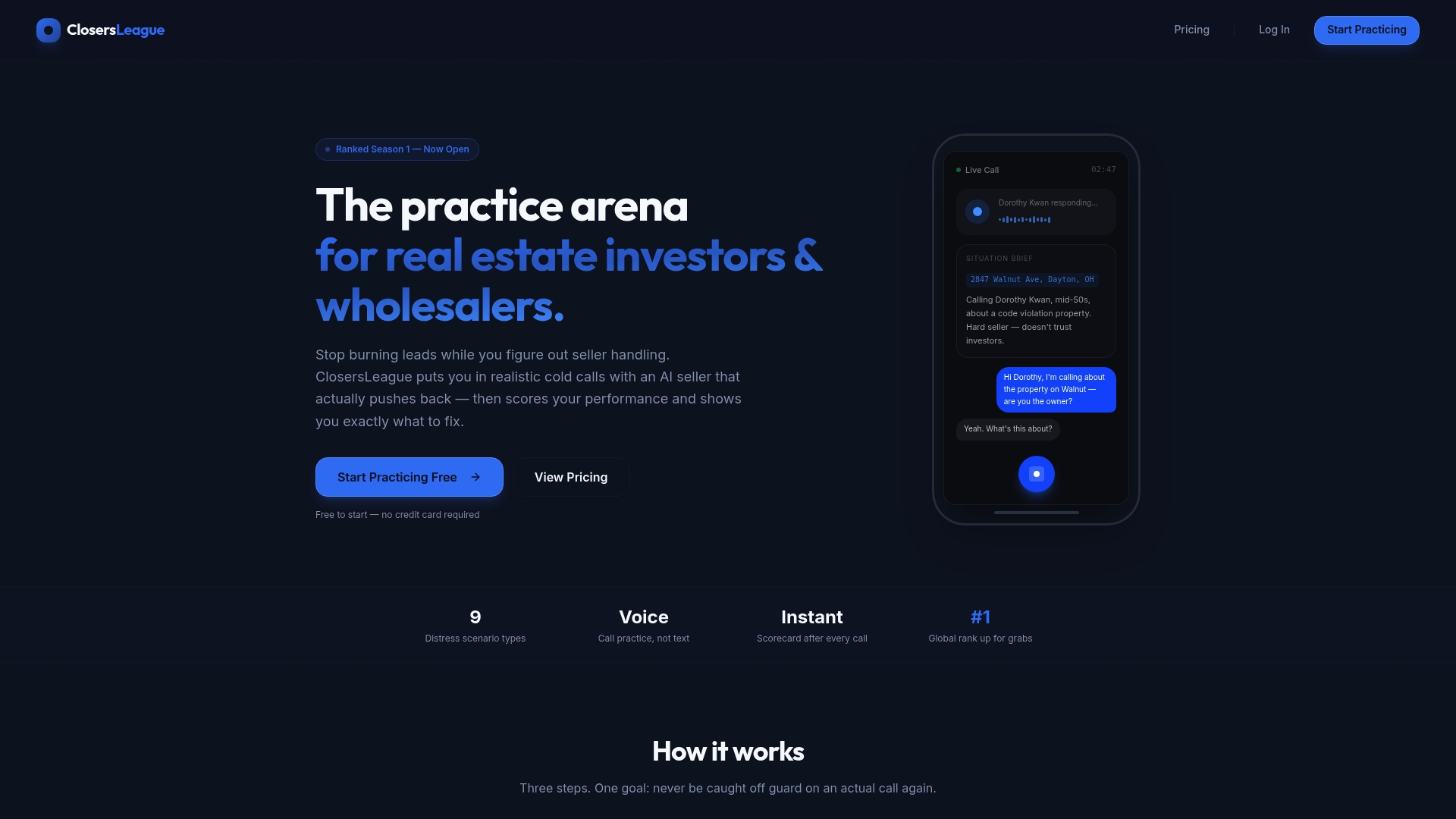
ClosersLeague is built specifically for real estate investors and wholesalers who need to get better at calling distressed homeowners — fast. The platform runs AI-powered voice roleplay across every major seller type: probate, pre-foreclosure, inherited, tax-delinquent, code violation, divorce, out-of-state, vacant, and tired landlords. Every call generates a performance scorecard so you know exactly what to fix, not just that something felt off.
The features that matter most for your workflow: scenario-specific drills, competitive leaderboards that keep practice consistent, and analytics that surface your weakest objection-handling patterns. You can also practice tired landlord scenarios and vacant property calls in dedicated modules built for those seller types.
Start your free trial, run 10 practice calls, review your scorecard, and adjust your scripts before you touch a live list. That’s the fastest path from uncertain dialer to consistent appointment-setter. Start your free trial here.
Key Takeaways
The most effective cold calling training for distressed sellers combines AI roleplay with scenario-specific scripts and a structured 30–90 day practice plan tied to measurable KPIs.
| Point | Details |
|---|---|
| Prioritize distress-specific training | Generic scripts underperform; train on probate, pre-foreclosure, vacant, and tired-landlord scenarios separately. |
| Use AI roleplay before live dials | Run at least 20 scored practice calls per seller type to establish a baseline before your first live campaign. |
| Track five core KPIs | Monitor dial-to-connect, connect-to-conversation, conversation-to-appointment, follow-up touches, and lead-to-deal rate. |
| Stay compliant before you dial | Scrub DNC lists, confirm TCPA consent, check state recording laws, and respect the 8 AM–9 PM calling window. |
| ClosersLeague accelerates the ramp | AI roleplay with scorecards across every distressed-seller type lets you iterate scripts against objective metrics, not guesswork. |
What separates callers who scale from those who stall
Most investors treat cold calling like a volume game. Dial more, close more. That logic breaks down fast when you’re calling a probate heir or a homeowner three weeks from foreclosure. Those conversations require a different kind of preparation — one that most generic sales training simply doesn’t provide.
The callers who consistently book appointments aren’t necessarily the most confident or the most experienced. They’re the ones who practiced the uncomfortable conversations before they were live. They drilled the grief-sensitive probate opener until it felt natural. They rehearsed the pre-foreclosure pivot until the empathy was genuine, not performed. That kind of preparation only comes from deliberate, scored repetition — not from reading a script PDF the night before a campaign.
The other thing most investors underestimate: follow-up is where deals actually close. The real estate cold calling data is clear that most conversions happen between the 3rd and 10th contact. Your training plan needs to include follow-up scripting and cadence, not just the opener. Investors who close more deals from cold calling treat every “not now” as a pipeline entry, not a rejection.
Useful sources and further reading
The research and frameworks in this article draw from the following sources. Use them to go deeper on specific seller types, compliance rules, and KPI benchmarks.
| Source | Best used for |
|---|---|
| ClosersLeague AI Roleplay Practice Page | Platform trial, scorecard methodology, seller-type scenario list |
| Televista: Cold Calling Distressed Properties ROI | Seller psychology, empathy training outcomes, DIY vs. managed timelines |
| Televista: 3 C’s & 3-3-3 Rule Frameworks | Call structure frameworks, predictive dialing connect-rate data |
| Televista: Off-Market Properties Expert Guide | Probate timing windows, off-market outreach strategy |
| Televista: Inherited Property Cold Calling | Grief-sensitive scripts, inherited-lead conversion guidance |
| DealRun: How to Cold Call Sellers | Conversion rate benchmarks, follow-up cadence data |
| DealRun: Cold Calling Scripts for Motivated Sellers | Skip-trace hit rates and per-record cost ranges |
| DealRun: Real Estate Cold Calling Guide | Full-cycle cold calling process, VA scaling guidance |
| HouseGoodbye: Common Mistakes Selling Inherited Properties | Seller-side perspective for probate script framing |
| ClosersLeague: Probate Call Examples | Probate call language and timing examples |
| ClosersLeague: How to Handle “I’m Not Interested” | Objection-handling patterns and response scripts |
FAQ
What are the most effective cold calling training resources for real estate investors?
The most effective resources combine AI roleplay platforms, scenario-specific scripts for distressed seller types, and live coaching with recorded call review. ClosersLeague offers all three elements in one platform built specifically for investors and wholesalers.
How long does it take to improve cold calling skills with structured training?
With scored AI roleplay and a consistent practice schedule, most investors see measurable improvement in objection handling and appointment-setting within 30 days. DIY programs without structured feedback typically take 90+ days to ramp.
What is AI cold call roleplay and how does it help investors?
AI cold call roleplay simulates real seller conversations, including emotional cues specific to distressed situations like probate or pre-foreclosure, and scores each call against objective metrics. That feedback loop lets you fix specific weaknesses faster than live-call trial and error.
What KPIs should I track when practicing cold calling?
Track dial-to-connect rate, connect-to-conversation rate, conversation-to-appointment rate, follow-up touches to close, and lead-to-deal rate. Early-stage programs typically yield 3–5 leads per 200 calls, with most deals closing after 3–10 contacts.
Is cold calling homeowners legal in the United States?
Cold calling is legal, but subject to strict rules: scrub lists against the National DNC Registry, comply with TCPA consent requirements for autodialers, respect the 8 AM–9 PM local calling window, and follow your state’s call-recording consent law. Confirm current requirements with a qualified attorney before launching any campaign.