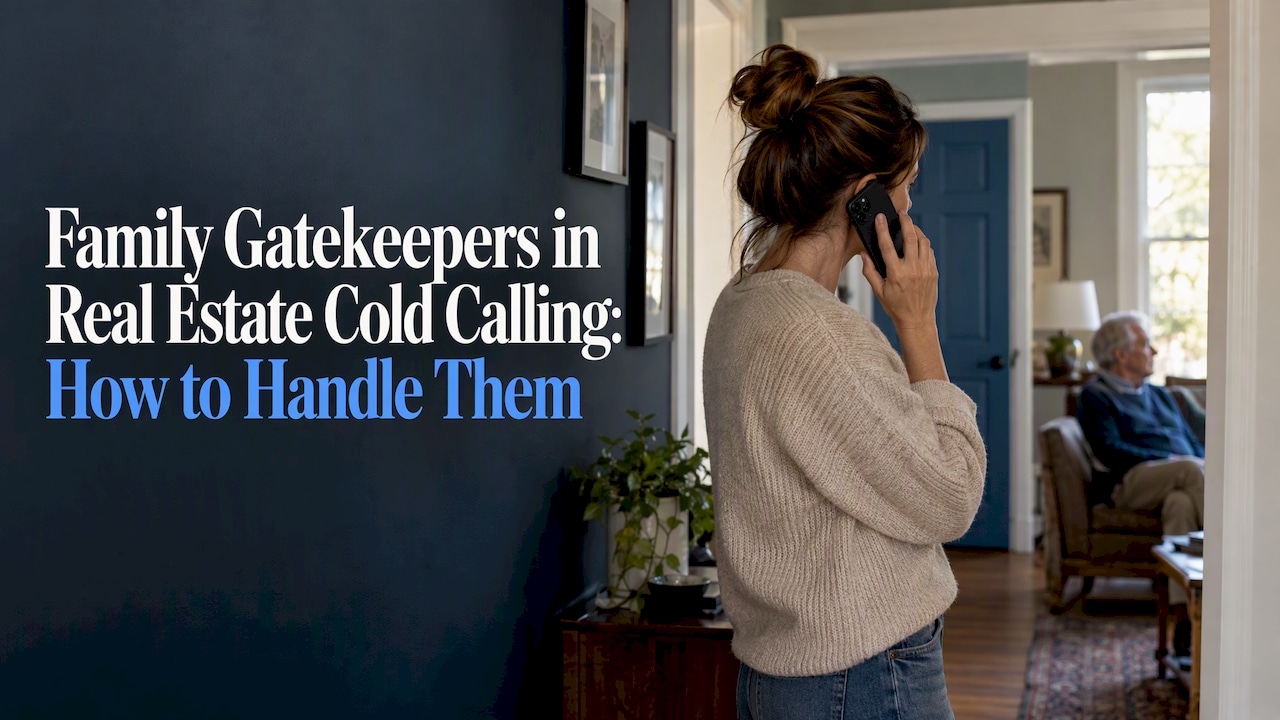
A family gatekeeper is a spouse, adult child, parent or sibling who answers the phone before the homeowner does and screens the call. To get past one, be plain about who you are, ask how they relate to the owner, make a low-pressure request to speak with the owner, and back off gracefully if they say no. You don’t trick them, and you never pretend to have a buyer you don’t have.
This guide covers who these gatekeepers are, the scripts that work, how to handle the three hardest moments, and the legal lines you can’t cross.
TL;DR
- A family gatekeeper often assumes you are a telemarketer. Open with your name, the reason for the call and a permission question.
- Before you pitch, find out how they are related to the owner and whether they have a say in the property decision.
- Never assume the person you’re talking to is on the deed. Confirm who owns the property before any real conversation about selling.
- If they decline, leave a brief message and a callback number, log the outcome and respect “don’t call again.”
- Federal rules, state recording laws and some city lists all apply when a relative picks up. Know them before you dial.
Table of Contents
- Who the family gatekeeper is and why they screen
- The first 30 seconds: permission, not persuasion
- Questions to ask before you go further
- What to say when they push back
- Inherited and probate leads: lead with empathy
- Timing and persistence without pestering
- Legal rules when a relative answers
- Practice the hard moments before you dial
- Perspective: why the gatekeeper call is a skill, not a script
- Try it before your next call block
- FAQ
- Sources
Who the family gatekeeper is and why they screen
On distressed-property lists, you often call numbers that belong to people in the middle of something hard. A probate file means someone died. A pre-foreclosure file means money is tight. A divorce file means tension at home. The person who picks up may be the one holding everything together.
That is why relatives screen. They think you are a telemarketer, a scammer or one more investor, and they want to protect the owner. Elderly owners are the clearest case: an adult child may handle the phone for a parent, and some of those children have already fielded dozens of “we buy houses” calls. If you call seniors often, read our guide to calling elderly homeowners legally too.
Gatekeepers fall into a few types:
- The protector. An adult child or spouse who wants unsolicited sales calls to stop. They respond to respect and clarity.
- The decision partner. A co-owner, heir or spouse whose signature is needed. They are not blocking you. They are part of the deal.
- The wrong number. A relative the skip trace returned by mistake, who may not know where the owner is or may not want to share it.
- The grieving family member. Common on inherited and probate leads. They need empathy before information.
Your first job is to figure out which one you have. Don’t guess. Ask.
The first 30 seconds: permission, not persuasion
Most investors lose the gatekeeper in the opening line. They sound rehearsed, they hide the reason for the call, or they bury the owner’s name in a pitch.
A few principles apply to every family gatekeeper call:
- Say who you are in the first sentence. Your name and, if asked, your company. No disguised openers.
- Say what you want, simply. “I’m calling about the property on Maple Street.”
- Ask whether it’s a reasonable time. The opening is about permission. You can earn the rest.
- Ask one question at a time. Stacked questions sound like a script, and scripts sound like telemarketers.
- Sound confident, not apologetic. “Sorry to bother you, I know you’re busy…” tells the gatekeeper to hang up. Calm and direct sounds like someone with a legitimate reason.
A short opener that works:
“Hi, this is [Name]. I’m trying to reach [Owner Name] about the property on [Street]. Is [he/she] available?”
That is short, honest and specific. It gives the gatekeeper something to react to besides a sales pitch. Our post on 10 proven cold calling tips for real estate investors goes deeper on tone and pacing.
Questions to ask before you go further
If the person doesn’t simply hand over the phone, shift into discovery. You are not interrogating them. You are working out whether they matter to this deal.
Ask how they are related.
“Sure, and may I ask how you’re related to [Owner Name]?”
This is natural, polite and tells you whether you’re talking to a child, a spouse, a tenant or someone unconnected.
Ask whether they’re involved in decisions about the property.
“Are you involved in decisions about the house, or would it be better to speak with [Owner Name] directly?”
Ask about the title, carefully.
“Is it just [Owner Name] on the title? Is there anyone else who’d need to weigh in before a decision?”
Treat what you hear as a lead, not a fact. A relative may sound as if they have authority and not be on the deed. Confirm ownership through public records before you spend real time discussing a sale. Don’t assume joint ownership because a family member is talking.
This matters most on inherited properties, where ownership may be unclear until the estate is settled. Heirs sometimes can’t sell until probate finishes. In Texas, owners can also pass a home outside probate with a transfer on death deed, which changes who actually has the right to sell. State rules differ, so verify locally.

What to say when they push back
Three moments cause most of the damage. Practice each one until it is automatic.
“Who is this and why are you calling?”
Be honest and brief. If the gatekeeper asks directly, say you’re interested in buying the property and would like to make a cash offer. Don’t invent a different reason. A relative who feels tricked will tell the owner, and you will have lost the lead permanently.
“I’m a local real estate investor. I’d like to make [Owner Name] a cash offer on the house, and I wanted to ask before sending anything. Is that something they’d want to hear about?”
Two guardrails apply. Don’t claim to “have a buyer” unless it’s literally true. And don’t say you’re a friend, a bank or a government office to slip past the screen.
“They’re not available” or “I’m not putting you through”
Don’t argue. A protective relative who feels pushed becomes a permanent blocker.
“Understood. Could I leave my name and number so [Owner Name] can call back if [he/she] is interested? There’s no pressure either way.”
If they say no to that, thank them and end the call. Respect is not a tactic here. It keeps you out of trouble and leaves the door open for a later call, since circumstances change.
“Please don’t call here again.”
This is not an objection to overcome. Say “Absolutely, I’ll take you off my list,” and do it. The FTC states that if a consumer asks a company not to call again, the company must honor that request, as laid out in its Q&A on do-not-call provisions. Mark the number as do-not-call in your CRM the same day.
Inherited and probate leads: lead with empathy
When the gatekeeper is a grieving relative, your approach changes. Express condolences if you learn there’s been a loss. Acknowledge that it’s a hard time. Position yourself as someone who can explain options rather than someone hunting for a deal.
“I’m sorry to hear that. I don’t want to add to what you’re dealing with. If it ever helps to understand your options for the house, I’m happy to talk, whenever you’re ready.”
Then stop. Offer a number and let them go. Families in this position often need to understand selling steps and taxes before they can say yes to anyone, and a clear inherited property sale walkthrough is the kind of resource that helps them make a calm decision. When you can send or point to something helpful rather than pushing for a meeting, you stand out from the callers they have already hung up on.
For foreclosure leads, where a spouse or parent may be embarrassed or stressed, see our foreclosure cold calling guide. The same rule holds: lower the pressure first, then ask for the conversation.
Timing and persistence without pestering
Calling at different times of day can help you reach the owner instead of the person who screens. Early mornings, evenings and weekends sometimes put the owner on the line rather than a relative, according to one skip-tracing company’s guidance. Treat it as something to test, not a guarantee, and stay inside the legal calling window covered below.
A simple follow-up rhythm keeps you professional:
- Day 1: Call. If the relative answers, ask the discovery questions and leave your callback number.
- A few days later: Try once more at a different time of day.
- After that: Space your attempts out, and stop if there is any request to stop.
Log every conversation. Note the relative’s name, relationship, what they said and the outcome. Notes protect you if a complaint arises, and they prevent the embarrassing mistake of calling the same protective daughter three times in one week.
What not to ask the family member
Skip anything that sounds like fishing:
- Financial details such as mortgage balances or income
- Health information about the owner
- The owner’s other phone numbers, address or schedule, unless the relative offers them
- Anything about the family’s dispute, divorce details or private circumstances
The gatekeeper is not your lead. They are a person you are treating respectfully so the real lead can decide for themselves.
Legal rules when a relative answers
No script fixes a compliance mistake. Know these before you build a calling routine. This is general information, not legal advice, so have an attorney review your process.
Do-not-call and calling hours. The FTC’s Telemarketing Sales Rule and the FCC’s TCPA require telemarketers to honor the National Do Not Call Registry, keep their own internal do-not-call list and call only between 8 a.m. and 9 p.m. in the called party’s local time. The FTC lays this out in Complying with the Telemarketing Sales Rule. Don’t stack your calls toward the end of the window just because a relative may be home.
Autodialers and prerecorded calls. The TCPA generally requires prior express consent for non-emergency autodialed and prerecorded calls to cell phones, and written consent when the call includes an advertisement, according to the FCC’s page on unlawful communications. Prerecorded advertising calls to residential landlines generally require prior express written consent as well. Our seven-step TCPA checklist for investors walks through how to set up your dialing process.
Recording calls. Some states require everyone on the call to consent to recording. California, Florida and Pennsylvania are among them, per Justia’s 50-state survey. When a relative answers, you may be recording someone you didn’t intend to. Announce recording at the start of the call, or don’t record.
City-level limits. Some cities add their own protections. ProPublica reports that Philadelphia keeps a do-not-solicit list that lets residents opt out of in-person pitches, emails, calls and mailers, with fines up to $2,000 for offenders. ProPublica also notes that Atlanta bars contact for six months after a homeowner rejects an investor’s first approach. Check your target city’s rules before you launch a campaign there.

Practice the hard moments before you dial
Reading a script isn’t the same as saying it to a skeptical stranger. Most investors discover how they sound on the gatekeeper call only after it has gone wrong on a real lead.
That is the gap we built ClosersLeague to close. On our platform you can run AI cold calling practice against realistic sellers in scenarios like probate, pre-foreclosure, inherited and divorce, then get an instant scorecard on how you handled objections and tone. Drill the hardest moments back to back: the “who is this?” opener, the polite refusal, the grieving relative.
If you want more on building an opener that holds up, read what an investor script is and how to adapt it to each seller type.
Perspective: why the gatekeeper call is a skill, not a script
We hear the same story from investors: the owner would have talked, but the daughter never put the call through. The lead wasn’t bad. The first 20 seconds were.
We think gatekeeper calls are the most undertrained part of distressed-property outreach. People rehearse the pitch and the offer, then improvise the moment when a protective relative picks up. That is the moment that decides whether you ever speak to the seller.
This is why we built ClosersLeague around deliberate practice. Realistic AI roleplay for distressed seller types, scorecards that grade the call by category, targeted drills and leaderboards give you repetitions without burning real leads. You can’t practice empathy on a live probate lead and then ask for a redo. You can practice it here first.
Stop winging it. Start drilling.
Dave
Try it before your next call block
Practice the family gatekeeper opener, the “leave a message” close and the grieving-relative response until they feel natural. ClosersLeague plans are billed monthly: Starter is $5 per month, Growth is $10 per month and Pro is $18 per month, tiered by the number of AI practice calls, and the free trial includes a limited number of calls.

See the plans and pricing or start from the ClosersLeague home page and run your first gatekeeper scenario today.
FAQ
What is a family gatekeeper in real estate cold calling?
It is a relative, such as a spouse, adult child or parent, who answers a homeowner’s phone and screens the call before the owner gets on. They usually assume the call is telemarketing and want to protect the owner. Treat them as a person to respect, not an obstacle to beat.
How do I ask for the homeowner without misleading the family member?
State your name and the property in your first sentence, then ask whether the owner is available. If asked, say you are interested in buying the house and would like to make a cash offer. Never claim a buyer, an agency or a relationship that doesn’t exist.
What if the family member says the owner isn’t interested?
Thank them and don’t argue. Offer to leave your name and callback number with no pressure, and log the outcome. If they ask you to stop calling, add the number to your internal do-not-call list immediately.
Can I record a call when a relative answers?
It depends on the state. California, Florida and Pennsylvania require all parties to consent to recording, so announce it at the start or don’t record. Check the rules in each state you call, and ask an attorney to review your process.
Should I assume the family member can sell the property?
No. They may have influence without being on the deed. Ask who is on the title, then confirm ownership through public records before you discuss price or terms in depth.
Sources
- Complying with the Telemarketing Sales Rule, FTC
- Q&A for Telemarketers & Sellers About DNC Provisions in TSR, FTC
- Unlawful Communications, FCC
- Recording Phone Calls and Conversations: 50 State Survey, Justia
- State, Federal Laws Do Little to Protect Homeowners, ProPublica
- Want to Sell Your Home for Cash? Read This First, ProPublica
- How to Get Past Gatekeepers When Calling Property Owners