At the start of the call, say your name, acknowledge the interruption, and give a one-line worth statement or ask for a brief moment. Keep it concise and say it like a person, not a script. Try this on your next call: “Hi Maria, it’s Dave, I know I’m calling out of the blue. Got 20 seconds to tell you why?”
TL;DR:
- After permission, move directly to one concise benefit; if the person hesitates, shorten the request rather than adding facts or another question.
- Use permission for guarded people, name the property when offering on inherited or vacant homes, and ask an ownership question when uncertain.
- Match the person’s energy, speak slightly slower than usual, and pause after your name and request; recording can reveal rushed, blurred endings.
- The Telemarketing Sales Rule counts an answered outbound call as abandoned if no representative connects within two seconds of the completed greeting.
- Test two openers across equal groups of calls and compare permission yes rates; track agreement to the brief request, not dial volume.
Table of Contents
- Why do the first 5 seconds decide the call?
- What do you do at 0–2, 2–5, and 5–10 seconds?
- Which opening templates work best?
- How should your voice, pace and delivery sound?
- What mistakes kill attention in the first seconds?
- What short openers can you copy and rehearse?
- How do you practice and measure your openers?
- Where should you focus your coaching energy?
- How can you practice this skill faster?
- FAQ
- Sources
Why do the first 5 seconds decide the call?
Attention on a cold call is fragile. The person on the other end did not plan to talk to you, so their interruption reflex fires fast, and they judge your tone and trustworthiness before you finish a sentence.
Timing matters on your side of the line too. Under the Telemarketing Sales Rule, an outbound call counts as “abandoned” if a person answers and no sales representative is connected within two seconds of the completed greeting. That rule is aimed at dealer behavior, but it shows how little patience a live answer gets. FTC guidance reinforces the same standard.
Here is what that means for your opener:
- Be brief. Every extra clause is another reason to hang up.
- Be relevant. One clear cue tells them this is not a random pitch.
- Ask small. A request for a brief moment is easier to grant than a request for a meeting.
What do you do at 0–2, 2–5, and 5–10 seconds?
Treat the opener as a timeline you can rehearse. Each window has one job, and cramming two jobs into one window is what makes openers sound rushed.
At the start: sound right and say who you are. Match the energy of their “hello,” keep your volume conversational, and state your first name clearly. Do not mumble your name to get to the pitch. They need it to decide you are a real person.
Next: acknowledge, then give one worth cue. A short line such as “I know I’m interrupting” shows respect for their time. Follow it with a single sentence on why you are calling, built around something they care about, not around your company.
Then: make the micro-ask. Ask for a brief moment, or ask one easy question that invites a yes. If they grant permission, move straight to one concise benefit. If they hesitate, do not pile on facts. Restate the ask in fewer words.

Rehearse each part separately, then together. When you can deliver the structure without sounding hurried, it is ready for live calls.
Which opening templates work best?
A few templates cover many situations. Each one fits in a single breath and can be personalized quickly with a name, a property detail or a situation cue.
- Permission opener. “Hi John, it’s Dave. I know I’m calling out of the blue. Do you have a brief moment?” Use it when you expect a guarded or busy person. Personalize it with their first name and a calm, unhurried tone.
- Value-first opener. “Hi Linda, it’s Dave. I buy homes in your area as-is, and I’m calling about the house on Elm Street.” Use it with property owners where your offer is the relevant reason for the call, such as inherited or vacant homes. Personalize it with the street name. For deeper scenario-specific lines, see our guide to distressed seller cold calling scripts.
- Curiosity opener. “Hi Tom, it’s Dave. Quick question about the property on Oak Lane. Is it still yours?” Keep the teaser to one short sentence, then stop talking and let them answer. Personalize it with the street and a calm, genuine tone.
If you want more phrasing ideas to rotate in, this playbook of conversation starters offers a few different angles. And for a closer look at building openers around seller situations, our post on creating high-converting opening scripts walks through the process step by step.
How should your voice, pace and delivery sound?
Your words get a few seconds. Your voice gets judged instantly. Small vocal adjustments change how the opener lands.
- Match their energy, then lead. If they answer low and tired, do not burst in at full volume.
- Slow down slightly. A pace a notch slower than your normal talking speed makes your name and reason easy to catch.
- Smile before you dial. A brief smile brightens your tone without sounding forced.
- Use one micro-pause. Pause briefly after your name and again after the ask so they have room to respond.
- Warm up briefly. Take slow breaths, then say a tongue twister or your opener, enunciating every word.
Pro Tip: Record your opener on your phone and listen for rushed endings. If your last three words blur together, slow down on the ask.
What mistakes kill attention in the first seconds?
Most failed openers share the same handful of errors. Cut these first, and your yes-rate will often improve before you change anything else.
- Pitching before permission. Opening with a long company description gives them no reason to stay.
- Rushing or going monotone. A flat, fast delivery sounds like a robocall, and people hang up on robocalls.
- Ignoring the interruption. Skipping the acknowledgment and the short-window ask makes you sound oblivious to their time.
- Overloading the opener. Jargon, several facts and two questions at once leave the person with nothing easy to answer.
What short openers can you copy and rehearse?
Here are some short openers. Swap in two details, a name and a pain cue such as the street, the situation or the timing, and they will sound personal.
- “Hi Sam, it’s Dave. Sorry to catch you out of the blue. Got a brief moment?”
- “Hi Sam, Dave here. I know this is unexpected. Can I take a moment to explain?”
- “Hi Sam, it’s Dave. I’m sorry to interrupt your day. Is now a bad time?”
- “Hi, this is Dave. I left you a short message about your property. Do you have a moment?”
- “Hi Sam, it’s Dave. I buy homes as-is, and I’m calling about your Pine Street house.”
- “Hi Sam, Dave here. I help owners of inherited homes sell without repairs. Is that you?”
- “Hi Sam, it’s Dave. I work with owners who live out of state. Is yours still vacant?”
- “Hi Sam, Dave here. I’m calling about the vacant property on Maple Drive. Are you the owner?”
- “Hi Sam, it’s Dave. Quick question about your house on Birch Road. Still yours?”
- “Hi Sam, Dave here. Did you ever decide what to do with the Cedar Court property?”
- “Hi Sam, it’s Dave. I had one quick question about your property. Is this a good time?”
- “Hi Sam, it’s Dave. Are you still thinking about selling the Walnut Street house?”
For openers tailored to specific seller situations, our guide to cold calling distressed homeowners covers each one in detail.
How do you practice and measure your openers?
Rehearsal and measurement turn a good opener into a reliable one. Start with two drills, then test live.
- Repetition drill: say your opener out loud repeatedly, adjusting pace and tone each round.
- Roleplay drill: run short blocks with a partner who plays a skeptical owner, and practice recovering from “who is this?”
- Live A/B test: alternate opener A and opener B across equal slices of your calls and compare the permission yes-rate.
- Micro-scorecard: after each call, score voice match, clarity, relevance and ask success, then review the lowest category.
If you run telemarketing at team scale, timing is also an operational matter. The FTC’s rule says a call is abandoned if no representative connects within two seconds of the completed greeting. The Commission’s recent amendments also add recordkeeping requirements and bar material misrepresentations, so log your scripts and results.
Prompt-connection rule: Under the FTC’s definition, a person who answers must reach a live representative within two seconds of finishing their greeting, or the call counts as abandoned.
Where should you focus your coaching energy?
I coach one thing above all: sound like a normal human who respects the other person’s time. Cleverness gets you a polite hang-up. A plain permission opener gets you a conversation. Track the share of people who say yes to your micro-ask, not how many dials you made. Then protect a simple routine: warm up, drill, and spend time after each session reviewing your scorecard.
— Dave
How can you practice this skill faster?
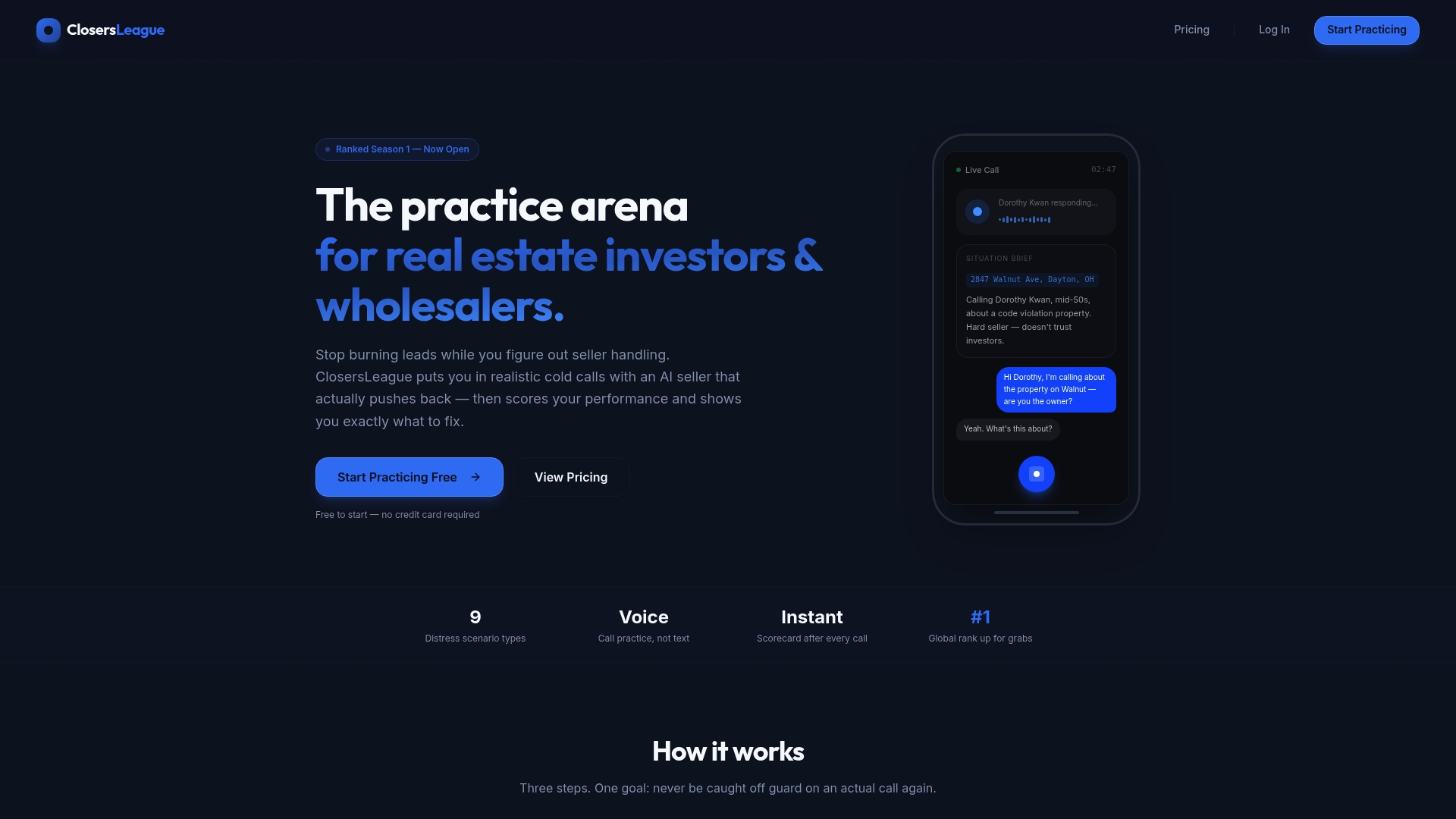
If you want a place to rehearse openers against realistic sellers, we built ClosersLeague for exactly that. You get AI roleplay across distressed-property scenarios, instant scorecards and targeted drills. Our Starter, Growth and Pro plans are available, and a free trial includes limited practice calls so you can try focused sessions today.
- Run scenario-based voice practice for inherited, probate, foreclosure and other seller types
- Get a scorecard after every call so you know what to fix next
- See our real estate cold calling practice page and start your first session
FAQ
What is the best opening line for a cold call?
The best opener states your name, acknowledges the interruption and asks for a short window. For example: “Hi Maria, it’s Dave. I know I’m calling out of the blue. Got a brief moment?” It works because it is short, polite and easy to answer.
What are the five stages of cold calling?
A common version includes opening, stating your reason for calling, asking discovery questions, handling objections, and closing with a next step. Definitions vary by team, but the opening decides whether you reach the later stages. Our list of cold calling tips for real estate investors covers each stage.
How concise should a cold call opener be?
Aim for a concise opener, delivered at the start of the call. Anything longer starts to sound like a pitch before you have earned permission. Practice until you can say it smoothly at a slightly slower-than-normal pace.
Does the FTC set timing rules for telemarketing calls?
Yes. The Telemarketing Sales Rule treats an outbound call as abandoned if a person answers and no representative is connected within two seconds of their completed greeting. Check the rule or a compliance professional for how it applies to your team.