Use a lightweight, five to seven phase call framework, not a word-for-word script, and you will book more meetings without sounding like a robot. The best structure runs opener, reason for calling, an engagement question inside the first 27 seconds, guided qualifying, a quick pivot on objections, and a close that asks for the meeting twice. Master that shape and you can handle any seller conversation that comes your way.
TL;DR:
- Using a flexible, five- to seven-phase call framework improves success rates by allowing adaptation to different prospect responses and situations.
- Top-performing calls typically last around 4.8 minutes, with engagement questions inside the first 27 seconds to maximize prospect interaction.
- Reps should focus on mastering one framework for at least 30 days, measuring key metrics like connect rate, talk-to-listen ratio, and objection pivot success.
- Drilling specific phases of the call separately builds judgment and fluency better than rushing through full calls repeatedly.
- Practicing with AI roleplay tools ensures consistent feedback on key skills such as the engagement question, objection handling, and call length, accelerating skill development.
Table of Contents
- What Is a Sales Call Framework (And How Is It Different From a Script)?
- Common Sales Call Frameworks: A Quick Reference Menu
- The 6-Phase Cold-Call Framework You Can Use Today
- Discovery Calls Need a Different Shape Than First Contact
- Handle Objections With a Pivot, Not an Argument
- Timing, Metrics, and Cadence Benchmarks That Matter
- How to Actually Internalize a Framework Through Practice
- Frameworks Beat Tools, Every Single Time
- Want Guided Practice Instead of Guesswork?
- Sources
- FAQ
What Is a Sales Call Framework (And How Is It Different From a Script)?
A script tells you exactly what to say, word for word, in order. A sales call framework tells you what to accomplish in each phase of the call and lets you choose the words. That difference matters more than most reps realize.
Think of it this way: a script is a recipe with exact measurements. A framework is knowing that a sauce needs fat, acid, and salt, then adjusting on the fly depending on what is in front of you. On a cold call, the “ingredients” are permission, a reason for calling, a question that surfaces a real problem, and a path to a next step. How you phrase each one changes based on the person on the other end.
The data backs the framework approach. Analysis from ColdCallGym’s review of 10,000 cold calls found that reps working from flexible frameworks post materially higher success rates than reps glued to rigid scripts, largely because frameworks adapt to what the prospect actually says instead of forcing the conversation back onto a printed page.
Here’s how to decide which one you need:
- New reps in their first 30 days: lean on a script for the opener and objection responses, then graduate to a framework once the phrasing feels natural.
- Experienced reps making 40+ dials a day: use a framework exclusively. Scripts slow you down and make you sound scripted, which prospects detect in seconds.
- Complex or regulated products: keep a script for compliance language, but frame everything else around you.
- High-emotion conversations (foreclosure, probate, divorce related outreach): frameworks win outright. A script cannot flex when a homeowner starts crying or gets defensive. A framework gives you a map while letting your tone match the moment.
The short version: scripts teach words, frameworks teach judgment. You want judgment by week three.
Common Sales Call Frameworks: A Quick Reference Menu
Different calls call for different structures. Here’s a rundown of the frameworks you’ll see referenced most often, what each is built for, and where each one falls short.
- SPICED (Situation, Pain, Impact, Critical Event, Decision): a discovery-heavy framework built for complex B2B sales cycles with multiple stakeholders. Strong for uncovering budget authority and urgency; weak for fast, transactional calls where you need a decision in one conversation.
- BANT-lite (Budget, Authority, Need, Timing, simplified): a stripped-down qualification checklist. Fast to run through, useful when you have five minutes and need a yes/no on fit. Too shallow for anything requiring real trust-building.
- Permission-based opener framework: built entirely around the first ten seconds of a call, asking for a short window of time before pitching anything. Excellent for cold outreach where trust is zero. Not a full call structure on its own, it only solves the opening.
- The 6-step cold-call framework (opener, reason, engagement, qualify, value, close): the most widely referenced structure across Skipcall’s B2B cold-calling playbook and similar industry guides. Balanced for general cold outreach; slightly too linear for calls that go off-script fast.
- 3-step discovery framework (menu of pain, dig, book next step): built for calls with someone who already knows you exist. Efficient for warm or referred leads; too thin for genuine cold prospecting.
- Bulletproof cold-calling framework: a heavier, objection-first structure that front-loads rapport before any ask. Works well for skeptical or previously burned prospects; slower pace makes it a poor fit for high-volume dialing days.
- Account-based outreach framework: multi-touch, research-heavy, built around a specific target account rather than a single call. Strong for high-value deals with long cycles; overkill for a distressed-seller call that needs to move fast.
Here’s what each style tends to fit best:
- Cold outreach to unknown numbers: permission-based opener plus the 6-step structure.
- Warm or referred leads: 3-step discovery.
- Skeptical or previously contacted sellers: Bulletproof cold-calling.
- Complex, multi-stakeholder deals: SPICED or account-based outreach.
Pick one framework, not three, and A/B test it against your current approach for 30 days. Track connect-to-meeting conversion before and after. If it beats your baseline, keep it. If it does not, swap and test again next month. Chasing a new framework every week is worse than sticking with a mediocre one long enough to actually learn it.
The 6-Phase Cold-Call Framework You Can Use Today
Here’s a canonical structure you can run on your very next dial, built around timing benchmarks pulled straight from large-scale call analysis.
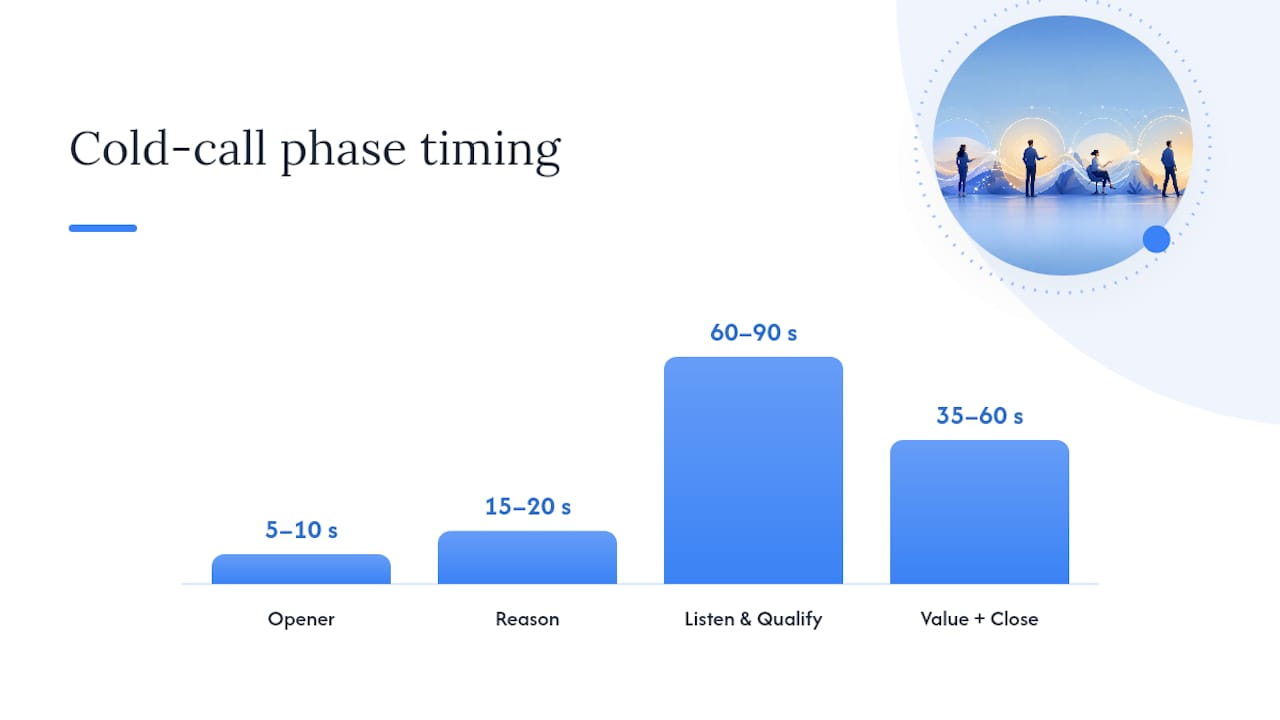
Phase 1: Opener (5 to 10 seconds). State your name and company, then ask for permission with something like, “Do you have 20 seconds?” This pattern interrupt matters because prospects brace for a pitch the moment they realize it’s a cold call. Breaking that expectation buys you room to keep talking.
Phase 2: Reason for calling (15 to 20 seconds). Give one clear, specific reason you called this person, not a generic pitch. Reference something real, like a recent probate filing, a code violation notice, or a property that has sat vacant.
Phase 3: Engagement question (inside the first 27 seconds). This is the phase most reps skip, and it’s costly. Gong’s analysis of 300 million cold calls shows that top-performing openers get a prospect talking early, and calls that reach an engagement question inside the first half minute convert at a noticeably higher rate than calls that don’t.
Timing Benchmark: Median successful cold calls run around 4.8 minutes, according to Gong-derived data reported by 30MPC. Calls that drag past 8 minutes on a first contact usually signal you’re over-explaining instead of qualifying.
Phase 4: Listen and qualify (60 to 90 seconds). This is where most of the call’s real value gets created. Ask about their situation, their timeline, and what they’ve already tried. Let them talk more than you do. A talk-to-listen ratio tilted toward the prospect during this phase is one of the clearest predictors of a productive call.
Phase 5: Lightweight value or social proof (20 to 30 seconds). Mention that you’ve worked with other homeowners in a similar situation, or that your process handles the exact complication they just described. Keep it short. This is not the moment for a full pitch.
Phase 6: Close to a meeting (offer it twice, 15 to 30 seconds). Ask directly for the next step. If you get a soft no or hesitation, ask once more with a slightly different framing before backing off gracefully.
Before you dial, run through this checklist:
- Identify the trigger event (foreclosure notice, probate filing, tax delinquency, inherited property).
- Set a talk-to-listen goal for the call, aiming to talk less than you listen from Phase 4 onward.
- Write down your top three qualifying questions so you’re not improvising them mid-call.
Discovery Calls Need a Different Shape Than First Contact
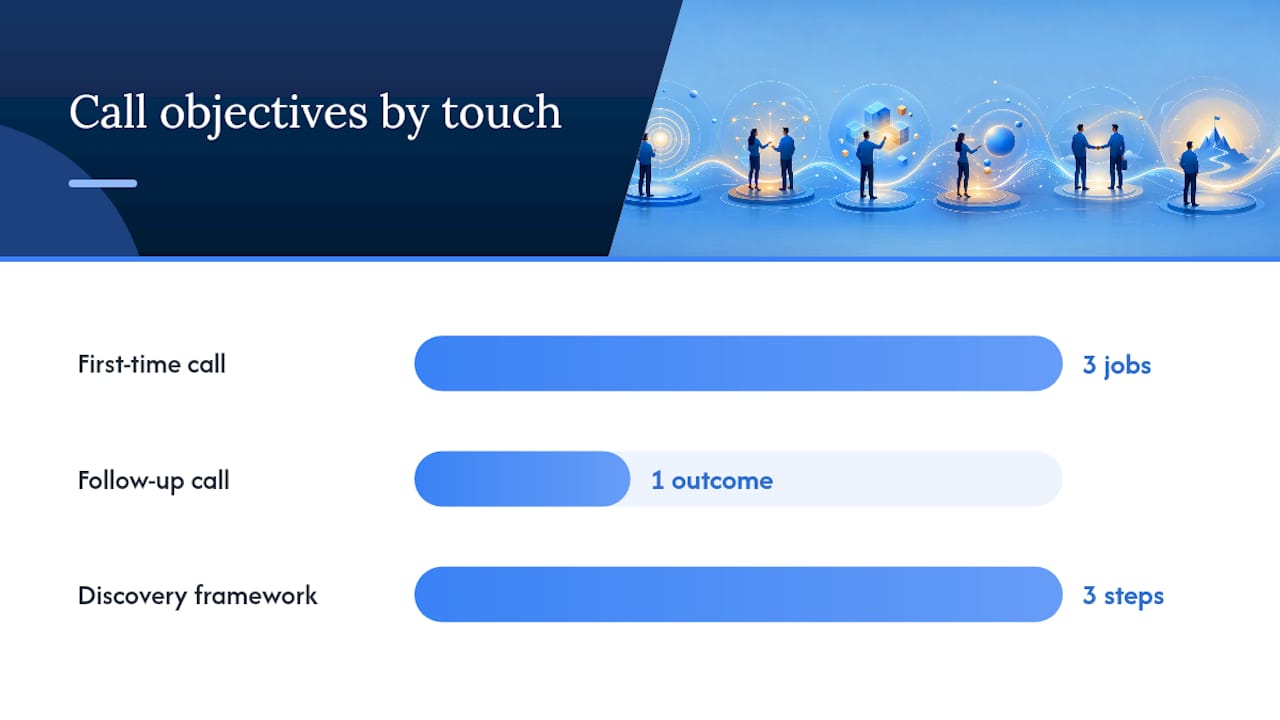
First-time calls and follow-up calls are not the same conversation, and treating them identically wastes both your time and the prospect’s. A conversation analysis of 150 recorded B2B cold calls found that first-time calls are built around three distinct jobs: gathering information about the prospect’s situation, collecting reliable contact details, and setting up permission for a future conversation. Subsequent calls look completely different. They’re organized as a single connected project aimed at one outcome, securing and scheduling an actual meeting.
That distinction should shape how you structure your second and third touches. If you’re still asking discovery questions on call three that you already answered on call one, you’re repeating work instead of advancing the relationship.
A simple 3-step discovery framework fits this pattern well:
- Menu of pain: offer two or three likely pain points based on the trigger event (“Is this more about the back taxes, or has the property sat vacant long enough to become a headache?”).
- Dig: follow whichever thread they pick with one or two specific questions (“How long has it been vacant?” or “What’s your ideal timeline to have this resolved?”).
- Book next step: transition directly into scheduling, rather than continuing to gather information you may already have.
The transition point matters. On call one, you’re earning the right to call back. On call two, you already have that right, so spend your time moving toward a date on the calendar instead of re-qualifying from scratch.
Handle Objections With a Pivot, Not an Argument
Every seller objection falls into one of five buckets, and each one signals something different about where the prospect actually stands.
- “I’m not interested.” Usually a reflex response to the interruption, not a real answer. Rarely means what it says on a first call.
- “This isn’t a fit for me.” Signals a mismatch between what they think you’re offering and what you actually do.
- “I don’t have the budget.” Can be real, or can mean they haven’t grasped the value yet.
- “I’m not the decision maker.” Sometimes true, sometimes a polite way to end the call without commitment.
- The hang-up. The clearest signal you have, and often the least personal. Move on.
The fix for all five is the same three-move pivot: acknowledge, reframe, question.
- Acknowledge: “Totally fair, I know these calls come out of nowhere.”
- Reframe: “I’m not calling to sell you anything today, just to understand your situation.”
- Question: “Can I ask what’s made this property harder to deal with lately?”
Pro Tip: Drill the pivot in isolation, not just during full mock calls. Spend ten minutes a day running only the acknowledge, reframe, question sequence against five different objection types until it comes out automatically, without a pause to think.
Track two numbers as you practice: how much time you spend stuck on an objection before pivoting, and how often the pivot actually leads to a real answer instead of a second brush-off. Both numbers should improve steadily if you’re drilling correctly.
Timing, Metrics, and Cadence Benchmarks That Matter
Four numbers separate reps who guess at their performance from reps who actually improve it: connect rate, meeting rate, average call length, and how consistently they hit that engagement question inside 27 seconds.
Morning hours tend to outperform afternoon blocks for connect rates, and RAIN Group’s research on top-performing sales prospecting confirms that the phone remains one of the most effective channels top performers use, provided the outreach is customized rather than generic.
Data point: Median successful cold calls run about 4.8 minutes, per Gong-derived analysis from 30MPC. Calls that end in under 90 seconds are usually a fast qualify or a fast no, not a wasted attempt.
Build your dialing and follow-up cadence around these rules:
- Give each number three to five attempts before pausing that prospect for the week.
- Leave one to two voicemails per prospect, not more. Voicemails tend to lower the immediate connect rate but drive a real lift in follow-up email replies.
- Send a follow-up email within a few hours of any voicemail, referencing the reason you called.
- Rotate to a different channel, text or email, after five unanswered dials rather than continuing to call the same number repeatedly.
- Review the ideal call length benchmarks for real estate outreach specifically, since distressed-seller calls run shorter than typical B2B discovery calls.
Track these numbers weekly, not monthly. A framework you can’t measure is just a hunch with extra steps.
How to Actually Internalize a Framework Through Practice
Reading a framework and running it live are two different skills, and the gap between them closes through deliberate, isolated practice, not raw call volume. Drilling the opener by itself fifty times builds more real skill than making fifty full calls where you rush past the opener every time.
Structure your practice around these three components:
- Component drills: isolate one phase (opener, engagement question, objection pivot) and repeat it against varied scenarios until it feels automatic.
- Repetition targets: aim for volume on the specific skill you’re weakest in, not an even split across every phase.
- Objective scorecards: score each rep on clarity, pacing, and whether the phase achieved its actual goal, not just whether it “sounded fine.”
Coaches and team leads should track three metrics closely: talk-to-listen ratio during the qualifying phase, how consistently a rep hits the engagement question inside the first 27 seconds, and the pivot success rate on objections. Those three numbers predict live-call performance better than raw activity metrics like total dials.
If you’re doing this solo, without a coach reviewing calls, that’s where a structured tool helps. ClosersLeague’s AI roleplay practice runs scenario-based drills against nine distressed-seller types, from probate to pre-foreclosure to tired landlords, and scores your calls automatically so you get the same objective feedback a coach would give, without needing one on standby.
Frameworks Beat Tools, Every Single Time
Here’s the uncomfortable truth about the current wave of AI dialers, call scripts, and sales enablement platforms: none of them make you better at selling. They make you faster at doing whatever you already do, good or bad. If your framework is weak, a faster dialer just gets you to more rejections per hour.
The reps who win long term are the ones who pick one structure and drill it until judgment kicks in before the words do. Tools and data sharpen execution once the framework is solid. They cannot build the framework for you. That still comes from repetition, feedback, and honestly reviewing what worked on a call and what fell flat.
Run one framework for 30 days straight before you touch another one. Measure it, adjust the phrasing, not the structure, and give it a real chance before you decide it doesn’t work.
— Dave
Want Guided Practice Instead of Guesswork?
ClosersLeague is built specifically for real estate investors and wholesalers who need to get comfortable handling distressed sellers, not generic B2B buyers. Instead of running these frameworks cold on real homeowners while you’re still shaky on the pivot, you practice against AI roleplay scenarios covering nine distinct seller situations, probate, pre-foreclosure, inherited property, tax delinquent, divorce, and more, each with realistic objections and emotional responses baked in.
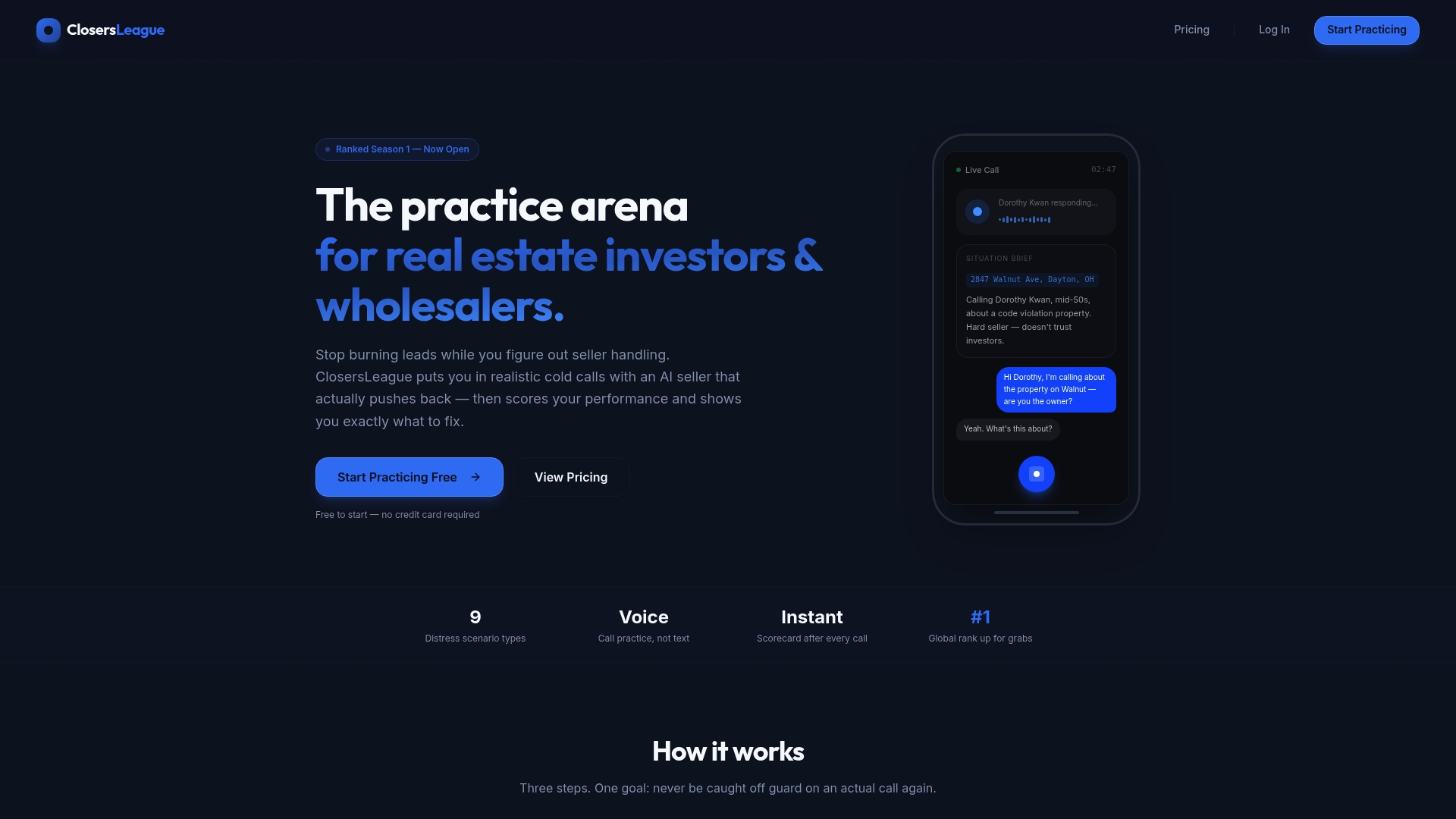
Every practice call gets scored automatically, so you see your talk-to-listen ratio, your objection pivot success rate, and how fast you hit that first engagement question, without waiting on a coach to review a recording. Leaderboards let you see how your scores stack up against other reps drilling the same scenarios. Plans start at $5 a month on the Starter plan, scaling up through Growth and Pro as your call volume grows. If you’re serious about turning this framework into a reflex, check the current plans and start your first practice session today.
Sources
The frameworks and benchmarks above pull from a handful of primary sources worth reading in full if you’re designing your own call experiments:
- Conversation analysis of B2B cold calls — 2020 (DOI)
- How to Master Cold Calls: Data From 300M+ Calls | 30MPC
- Top Performance in Sales Prospecting — RAIN Group (report)
- How to Cold Call in B2B: Playbook That Books Meetings | Skipcall
FAQ
What Are the Four Types of Sales Calls?
Most sales organizations break calls into four categories: cold calls to unknown prospects, warm or referred calls, discovery calls with qualified leads, and closing or follow-up calls aimed at scheduling a meeting or finalizing a deal. Each type calls for a different framework, since a conversation analysis of first-time versus subsequent B2B calls found the goals of each stage differ sharply.
What Is the 2-2-2 Rule in Sales?
The 2-2-2 rule is a follow-up cadence: call a prospect two hours after your first outreach attempt, again two days later, and once more two weeks after that if you still haven’t connected. It’s a simple structure for spacing out attempts without either giving up too fast or hammering someone with calls.
What Are the 7 Steps of a Sales Call?
A common seven-step breakdown expands the standard six-phase model into: preparation, opener, reason for calling, engagement question, qualifying, value or social proof, and close. Some versions merge preparation into the opener, which is why you’ll also see the same structure referenced as a six-step framework in playbooks like Skipcall’s.
What Is the 70/30 Rule in Sales?
The 70/30 rule says the prospect should be talking roughly 70% of the call while the rep talks about 30%, particularly during the qualifying phase. It’s a rough guideline rather than a strict measurement, but it captures a real pattern: calls where the rep listens more tend to surface better information and convert at a higher rate.
Do I Need a Different Framework for Every Seller Type?
You don’t need a separate framework for every scenario, but you do need to adjust your questions and value language based on the seller’s situation. A probate lead and a tired landlord respond to very different phrasing even inside the same six-phase structure, which is why practicing against varied scenarios, like the seller-type drills inside ClosersLeague, matters more than memorizing multiple rigid scripts.