For a quick burst of energy, run a lottery blitz. To build lasting habits, use a consistency challenge. For teamwork, try a team relay. For raising the floor on your low performers, a personal-best sprint beats a leaderboard every time. Pick the format that matches the behavior you want, set one clear metric, and announce it with a deadline.
TL;DR:
- Using tiered prizes, lottery elements, and rotation of formats increases engagement among all sales reps, especially middle performers, rather than only rewarding top winners.
- Contests should match the behavior you want, with clear metrics, appropriate duration, and fairness rules, to prevent gaming and ensure sustained motivation.
- Focus on tracking both immediate activity spikes and long-term retention to evaluate true impact and avoid short-term gains that don’t improve strategic performance.
- For skill improvement, roleplay-based challenges and measuring delta progress motivate reps to develop specific abilities rather than just pushing call volume.
- Smaller teams succeed with personal-best formats, mid-sized teams with brackets or pods, and large teams with segmented or lottery-based contests to maintain fairness and interest.
Table of Contents
- Sales Contest Ideas Organized by Goal
- What Makes a Sales Contest Design Actually Work
- How to Launch a Sales Contest Without Chaos
- Measuring Whether the Contest Actually Worked
- Prize Ideas That Don’t Rely on Cash Alone
- Copy-Ready Templates and Name Ideas
- Gamifying Call Skills, Not Just Call Volume
- What’s Legal and Fair When You Run a Contest
- Matching Contest Design to Your Team’s Size
- Tools and Platforms for Running Contests
- Keeping Energy Up for the Whole Contest Window
- A Manager’s Take: Why I Stopped Trusting Leaderboards Alone
- Turn Contest Energy Into Permanent Skill Gains
- Sources
- FAQ
Sales Contest Ideas Organized by Goal
Most sales contest ideas fail for one reason: they reward the same three reps every time and everyone else checks out by day two. The fix isn’t a bigger prize. It’s picking a format that gives every rep on the roster a real reason to keep pushing, then matching the metric to the behavior you actually want more of.
Below is a working bank of ideas, grouped by what you’re trying to accomplish. Steal the structure, swap in your own numbers, and adjust the prize to your budget.
Ideas that drive raw activity
- Lottery Blitz — Every qualifying activity (a call, a booked appointment, a demo) earns one raffle ticket. Metric: activity count. Duration: a short one- or two-day period. Prize: a modest value gift card drawn at random. Setup note: cap tickets per rep so top performers don’t lock out everyone else. Twist: double tickets for activity in an underworked lead segment.
- Power Hour — One hour, most dials wins. Metric: dial volume. Duration: a focused one-hour period. Prize: leave early on Friday. Setup note: run it right after a slow stretch to jolt momentum.
- Activity Bracket — Pair reps head-to-head, single elimination, based on weekly activity totals. Metric: calls or emails sent. Duration: one to two weeks. Prize: modest bonuses per round and a larger final prize. Twist: reseed brackets each round so a slow start isn’t fatal.
Ideas that accelerate deals
- Personal-Best Sprint — Reps compete against their own historical average, not each other. Metric: percentage improvement over baseline. Duration: about a fortnight. Prize: tiered bonus scaled to improvement percentage. Setup note: pull each rep’s trailing 90-day average before you launch, or the whole thing falls apart on day one.
- Deal Speed Challenge — Reward the fastest time from first contact to signed agreement. Metric: days to close. Duration: about a month. Prize: a paid time off reward. Twist: exclude any deal under a minimum size to stop reps from gaming small, fast wins.
- Big Fish Bonus — A spiff for the single largest deal closed in the period. Metric: deal size. Duration: about a month. Prize: a moderate cash bonus. Setup note: this is a classic cold caller spiff idea for teams generating their own leads, since it rewards quality conversations over sheer volume.
Ideas that build habits
-
Consistency Streak — Reps earn a point for every day they hit a minimum activity floor, no zero days allowed. Metric: consecutive qualifying days. Duration: several weeks. Prize: a badge plus a $10 daily pot split among everyone who kept their streak alive. Twist: one “streak insurance” pass per rep for a sick day or PTO.
-
Follow-Up Marathon — Rewards reps who complete every scheduled follow-up on time, tracked against your CRM follow-up fields. Metric: follow-up completion rate. Duration: around three weeks. Prize: a team lunch for high-performing members.
-
Morning Momentum — First five reps to log a qualifying activity before 9 a.m. each day get a point. Metric: early activity count. Duration: about a fortnight. Prize: modest coffee gift cards.
Ideas that build collaboration
- Team Relay — Split the floor into pods of three to five; each pod’s combined total counts. Metric: pooled activity or revenue. Duration: about a fortnight. Prize: a group experience such as a dinner outing. Setup note: mix senior and junior reps on every pod so no team starts behind.
- Peer Assist Bonus — Reps earn points when a teammate they coached hits a milestone. Metric: assisted closes or verified coaching sessions. Duration: about a month. Prize: public recognition and a shared modest bonus.
- Sales Bingo — A five-by-five grid of tasks (book a demo, get a referral, beat a specific objection, close a deal over a set size). Metric: lines completed. Duration: few weeks. Prize: tiered cash prizes for bingo achievements. Twist: make one square a wildcard the manager assigns weekly.
Ideas that build skill
- Objection Knockout Bracket — Reps face off in roleplay rounds handling a specific objection, judged on a scorecard. Metric: judged skill score. Duration: roughly a week. Prize: credit toward training resources. This works especially well as a team sales challenge when paired with recorded roleplay reviews.
- Script Remix Contest — Reward the rep who tests and shares the best-performing opener variation, verified against call outcomes. Metric: conversion lift on the new opener. Duration: about a fortnight. Prize: the winning line becomes the team’s standard opening, plus a $75 bonus.
- Emotional Read Challenge — For distressed-property callers, score reps on correctly identifying a seller’s emotional state (frustrated, overwhelmed, motivated) and adjusting their approach mid-call. Metric: accuracy score against a manager review. Duration: about a fortnight. Prize: coaching from a high-performing colleague.
Name your contests something the team will actually say out loud. “Q2 Push” gets ignored. “The Great Dial Off” or “Objection Royale” gets talked about at lunch.
What Makes a Sales Contest Design Actually Work
The single biggest design mistake is running a winner-take-all format. Sales-management research on contest design consistently finds that a single-prize structure disengages everyone outside the top few performers, because reps who know they can’t win by day three simply stop trying.
Fix that with structure, not bigger prizes:
- Use tiered prizes (first, second, third, plus a random draw) so more than one path to a reward exists.
- Add lottery elements tied to effort, not just outcomes, so a rep who makes 80 calls without a close still has a shot.
- Rotate formats every cycle. A team that runs the same leaderboard contest every month stops caring about it.
- Match contest length to the behavior: sprints of 24 to 48 hours for activity spikes, three to four week streaks for habit formation.
- Track middle-performer movement, not just top-line results. If your 5th through 15th ranked reps didn’t improve, the contest design needs work.
A 2022 meta-analysis covering 127 studies and more than 77,000 salespeople found that intrinsic motivation correlates more strongly with performance (r = .298) than extrinsic motivation (r = .176). Cash still works. It just works better alongside recognition, challenge, and a clear sense of progress than it does alone.
Pro Tip: Publish the middle-of-the-pack leaderboard positions, not just the top three. Reps ranked 8th and 9th will fight harder to crack the top five than your top performer will fight to stay at number one.
How to Launch a Sales Contest Without Chaos
Before you announce anything, lock down five decisions:
- Objective and KPI — Pick one primary metric. Two competing metrics confuses reps and lets them game whichever is easier.
- Baseline period — Pull 30 to 90 days of historical data so “personal best” formats and improvement percentages mean something.
- Eligibility — Decide if new hires, part-timers, or reps on leave get adjusted targets or sit this one out.
- Prize tiers — Set at least three reward levels, following the multiple-winner principle above.
- Tie-breakers — Define the exact tiebreak rule (earliest timestamp, highest deal count) before day one, not after a dispute.
For tracking, most teams use a mix of tools:
- CRM custom fields or reports for activity and pipeline data, tied to whatever system already houses your contact and deal records.
- A live leaderboard tool or shared dashboard that updates automatically, since manual spreadsheets fall a day behind and kill trust fast.
- Weekly manual spot audits on a small sample to catch data-entry gaming before it spreads.
Communicate on a fixed cadence: a launch email with the rules and prize structure, a midpoint nudge highlighting movement in the middle of the pack, and a same-day celebration when it ends. Build in a simple dispute process, too. One rep quietly convinced the contest was rigged can undo six months of goodwill.
Measuring Whether the Contest Actually Worked
Two different timeframes matter here, and most managers only check one.
Immediate KPIs tell you whether the contest created a spike: activity counts during the window, conversion rate changes, and pipeline movement compared to your baseline period. Durability KPIs tell you whether anything stuck: are reps still hitting the elevated activity level 30 and 60 days later, and did your middle performers actually close the gap on your top performers, or snap right back?
Compensation research from Harvard Business Review warns that poorly structured incentives can reward short-term output while missing the strategic behavior you actually need. A contest that spikes call volume but tanks close quality isn’t a win.
| Metric type | What to measure | When to check |
|---|---|---|
| Immediate | Activity count vs. baseline | End of contest |
| Immediate | Conversion rate change | End of contest |
| Durability | Activity retention | 30 and 60 days after |
| Durability | Middle-performer rank movement | 30 days after |
| ROI | Incremental revenue vs. prize and admin cost | 60 days after |
Run a short participant survey right after the contest closes. Ask what felt fair, what felt gamed, and whether the prize actually motivated them. Then sit down with the data before you plan the next one, and treat each contest as a test you’re refining, not a repeat you’re running on autopilot.
Prize Ideas That Don’t Rely on Cash Alone
Cash spiffs work, but they run out of juice fast if that’s the only lever you pull. Recent research on salesperson motivation found the strongest performance shows up when intrinsic and extrinsic rewards are both present and balanced, meaning recognition and challenge need equal billing with money.
Build your prize catalog across categories:
- Cash and near-cash: spiffs, gift cards, a bonus tied to a specific target.
- Experiential: a paid afternoon off, a team lunch, tickets to something the team actually wants.
- Development: a paid course, a coaching session with a senior rep, a conference pass.
- Symbolic: a rotating trophy on the desk, a badge, a shoutout in the team channel.
- Team rewards: a group outing that only unlocks if the whole floor hits a collective number.
Budget prizes as a percentage of expected incremental revenue, not a flat number pulled from last year. Tiered structures cost more in total dollars but spread across more winners, which is exactly the point.
Pro Tip: Pair every cash prize with a recognition moment. Handing someone a check quietly in a one-on-one wastes half the motivational value compared to announcing it in front of the team.
Copy-Ready Templates and Name Ideas
A rules template you can fill in five minutes:
- Objective: (what behavior you want more of)
- Metric: (the single number that decides a winner)
- Duration: (start date, end date, time zone if remote)
- Prize tiers: (first, second, third, and any lottery element)
- Tiebreaker: (the exact rule if two reps land on the same number)
A launch email needs three lines: what the contest is, how winning is measured, and when it ends. A midpoint email needs one line: current standings, with a nudge toward whoever is closest to a tier cutoff. A closing email announces winners and states the next contest is coming.
30 contest name ideas by tone:
Fun: Dial Fest, The Great Callback, Objection Royale, Deal or No Deal Week, Pipeline Party.
Competitive: Bracket Battle, The Closer’s Cup, Top Gun Sprint, Leaderboard Wars, Sudden Death Sales.
Professional: Q1 Performance Sprint, Consistency Challenge, Excellence Series, Growth Push, Milestone Month.
Gamifying Call Skills, Not Just Call Volume
Most sales competition themes reward outcomes: dials, deals, revenue. Few reward the skill that produces those outcomes in the first place, which is a missed opportunity for cold-calling teams where the gap between a decent call and a great one comes down to how a rep handles an objection or reads a seller’s tone.
Try this team sales challenge: score every rep’s roleplay session on an active listening scale before and after a training cycle, then run the contest on the delta, not the raw score. A rep starting from a low baseline has just as much shot at winning as your top performer.
Roleplay-based scoring, the kind ClosersLeague uses in its AI practice sessions, lets you measure skill improvement directly instead of only outcomes. That matters because a leaderboard built on score deltas motivates skill work without punishing anyone for a slow call week.
- Run four roleplay sessions per rep over two weeks, scoring active listening on a consistent scale.
- Leaderboard the improvement, not the absolute score.
- Prize the top three deltas, not just the single highest score.
What’s Legal and Fair When You Run a Contest
Sales contests sit inside your compensation structure, which means a few rules apply even at the small-team level. If your contest touches commissioned employees, check that any spiff or bonus doesn’t accidentally violate a state wage-and-hour rule about how commissions get calculated or paid out, since some states require commission-based pay structures to be documented in writing. When in doubt on anything involving payroll timing or commission calculation, run it past whoever handles your compensation compliance before you launch.
Fairness matters just as much as legality. A contest that only top performers can realistically win isn’t just bad design, it’s a morale problem waiting to surface. Keep eligibility criteria written down and applied the same way to every rep, including new hires and anyone returning from leave. If a manager’s favorite always seems to win, expect quiet resentment and quieter effort from everyone else.
Transparency protects you here. Publish the exact rules, the exact metric, and the exact tiebreaker before the contest starts, not after someone disputes the results. If you’re tracking activity through a CRM, make sure every rep understands what counts and what doesn’t; ambiguous rules invite gaming, and gaming invites accusations that poison the next three contests you try to run.
Avoid rewarding behavior that technically hits the metric but damages the customer relationship, like a rep rushing a call just to log volume. If your metric can be gamed without adding real value, someone will find that shortcut within the first 48 hours.
Matching Contest Design to Your Team’s Size
A five-person team and a fifty-person floor need different contest mechanics, even when the goal is identical.
Small teams (2 to 8 reps) should lean on personal-best formats over head-to-head leaderboards, since a tiny roster makes it obvious, fast, who’s going to win a straight competition. A consistency streak or a team relay where everyone’s number rolls into one shared total tends to land better than a bracket, because there’s no room for anyone to hide.
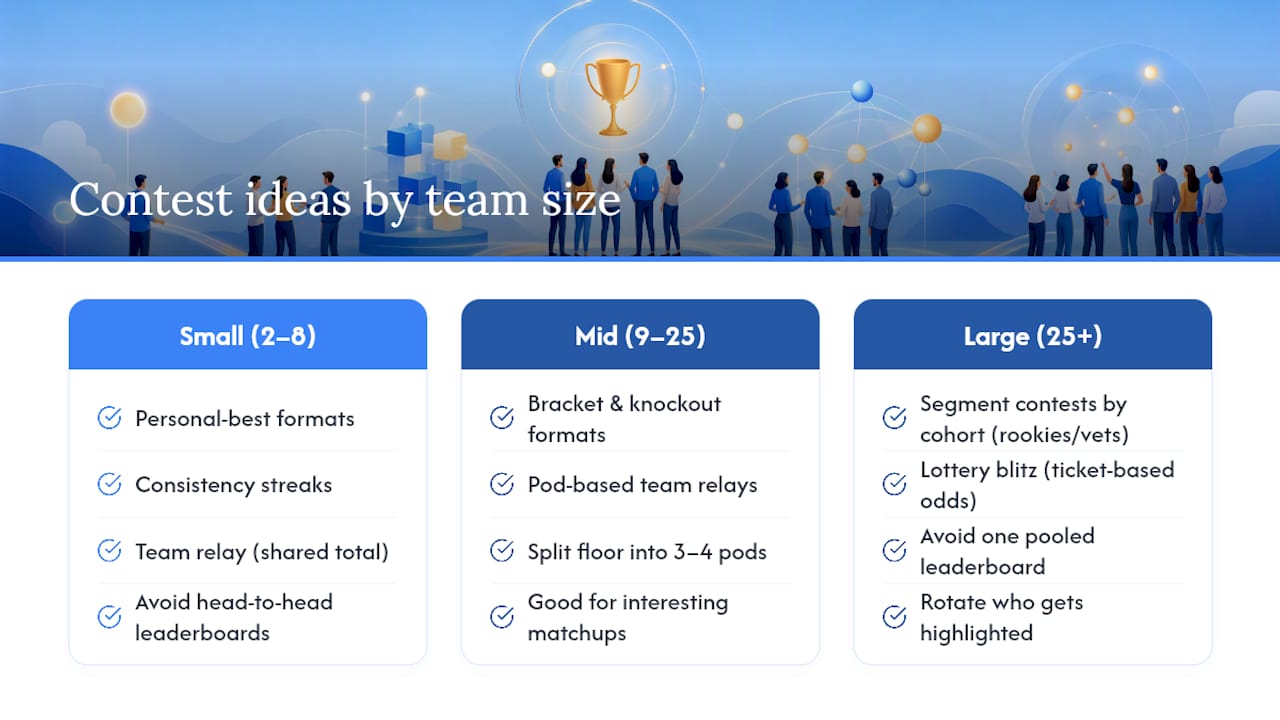
Mid-size teams (9 to 25 reps) are the sweet spot for bracket and knockout formats, since you have enough reps for interesting matchups without the logistics getting unwieldy. This is also where pod-based team relays work well, splitting the floor into three or four small groups so no individual rep can single-handedly win or lose it for a team.
Large or distributed teams (25-plus reps, especially across time zones or regions) benefit from segmenting contests by cohort. Compare rookies against rookies and veterans against veterans instead of pooling everyone into one leaderboard, or your newest hire will never crack the top ten and will stop trying by week two. A lottery blitz scales especially well here because ticket-based odds keep it interesting no matter how many people are competing.
Whatever your size, rotate who gets highlighted. A 50-person floor that only ever showcases the same five names on a wall-mounted leaderboard trains the other 45 to tune it out entirely.
Tools and Platforms for Running Contests
You don’t need enterprise software to run a good sales contest, but the tracking method has to match your team’s size and how distributed it is.
Smaller teams can run a contest entirely through a shared spreadsheet or a simple CRM report, updated daily or every few hours during a short sprint. It’s manual, but at under ten reps, manual is fast enough that the overhead isn’t worth automating.
Mid-size and larger teams benefit from a live leaderboard tool that pulls automatically from CRM activity, so standings update in real time instead of once a day. This matters more than it sounds. A leaderboard that lags by 24 hours kills the instant feedback loop that makes contests feel exciting in the first place.
For skill-based contests specifically, like the active listening challenge described earlier, you need a scoring system that can grade a call or roleplay session consistently across reps. That’s a different tool than an activity tracker. AI-powered roleplay platforms can generate a repeatable, standardized score for skill deltas, which a plain CRM report can’t do on its own.
Whatever platform you pick, test the leaderboard display itself before launch day. A tool that’s technically accurate but confusing to read on a shared screen defeats the entire point of public standings.
Keeping Energy Up for the Whole Contest Window
Every sales contest has a predictable energy curve: a strong opening burst, a sagging middle, and a scramble at the finish. Your job is flattening that dip in the middle.
Midpoint nudges do more work than most managers expect. A short update showing movement, especially among reps outside the top three, keeps the contest alive for people who assumed they were already out of contention. Highlighting a rep who jumped from 12th to 6th matters more than repeating who’s still in first.
Short, visible milestones inside a longer contest help too. If you’re running a month-long streak challenge, celebrate the one-week mark and the halfway point separately instead of saving all recognition for the final day, especially when partnering through a broker program for hard money loans can also incentivize deal flow and contests. It breaks a long stretch into wins your team can feel along the way.
Vary how you communicate. An email every three days becomes background noise fast. Mix in a quick shoutout in a team channel, a five-minute leaderboard review at a stand-up, or a printed standings sheet on a wall. The format matters less than making sure the contest stays visible without becoming the only thing anyone talks about.
A Manager’s Take: Why I Stopped Trusting Leaderboards Alone
We ran a straight leaderboard contest once and watched the same three names sit at the top from day one. By week two, half the floor had mentally checked out. Mid-contest, we switched the scoring to reward improvement over baseline instead of raw totals, and the energy in the room changed within days. Reps who’d never touched a leaderboard suddenly had something to chase.
The lesson: design for your middle performers first, not your top ones. They’re the group with the most room to move, and the group most likely to quit trying if the format ignores them.
— Dave
Turn Contest Energy Into Permanent Skill Gains
Most sales contest ideas reward what a rep already knows how to do. Some platforms are built for the harder problem: making the contest itself the training. Instead of measuring who dialed the most numbers, you can measure who improved the most on handling a probate objection, reading a frustrated seller’s tone, or recovering a stalled call, using AI roleplay sessions and scorecards built specifically for real estate cold callers.
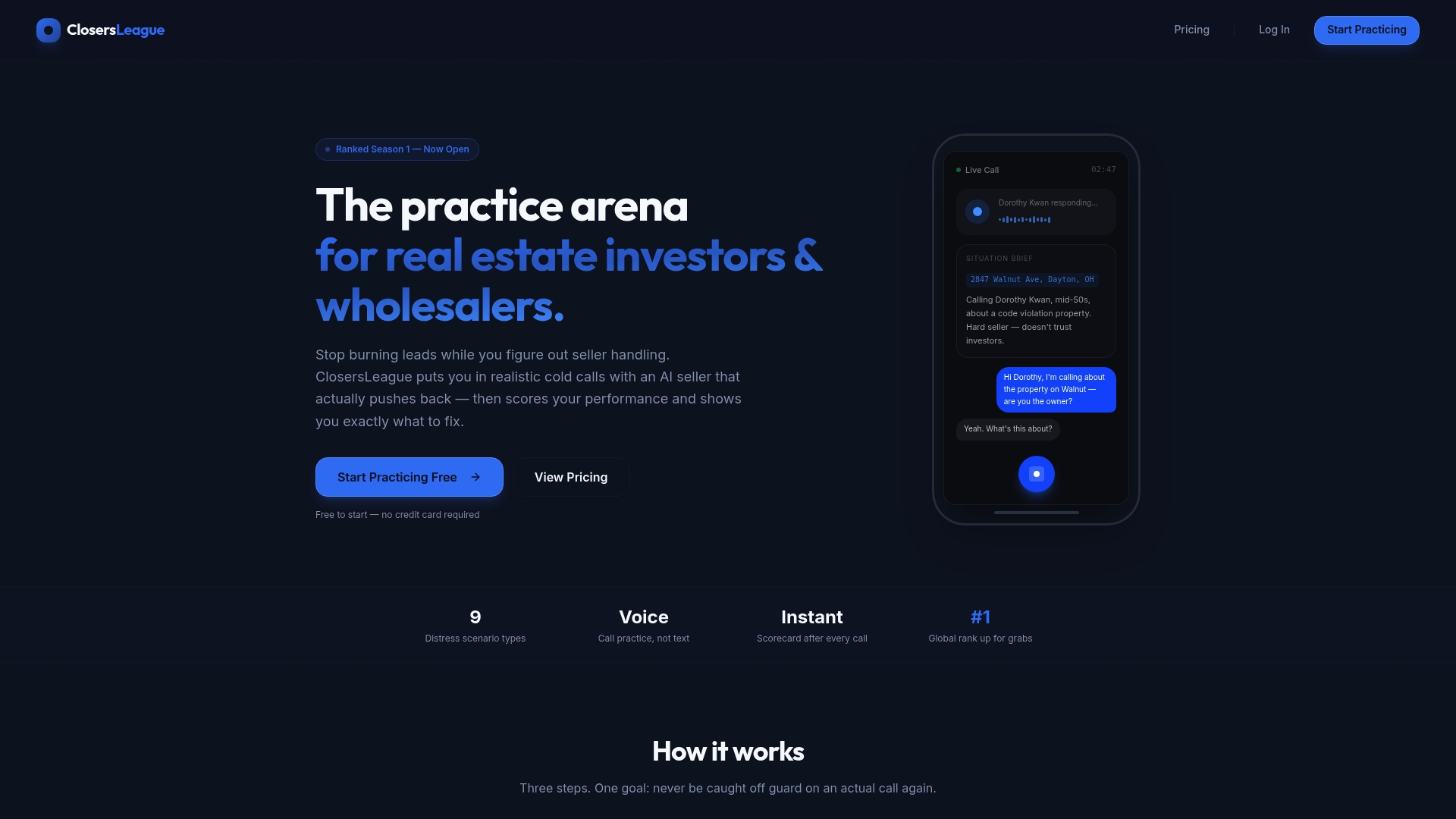
A simple pilot: pick one skill category, like objection handling on pre-foreclosure calls, and run a two-week contest scoring the improvement delta from each rep’s roleplay sessions rather than their raw call volume. It rewards the rep who closes their skill gap fastest, not just the rep who was already ahead. Start with the inherited property cold calling module if that’s a scenario your team struggles with, or explore the full AI cold calling practice platform to see how scorecards and leaderboards work together, before you set your next contest date.
Sources
- Improving salesperson performance: intrinsic vs extrinsic motivation (meta-analytic summary)
- Money, recognition, challenge and enjoyment: a response surface approach to salesperson motivation
- Contest design research: multiple winners vs winner-take-all (design recommendations)
FAQ
What are some good sales contest ideas for a small team?
Personal-best sprints and consistency streaks work best for teams under ten reps, since head-to-head leaderboards can feel discouraging when the same one or two people always win.
What are some fun contest ideas for a sales floor?
Sales bingo, objection knockout brackets, and lottery blitzes tend to generate the most energy because they mix in an element of chance or gamified structure rather than pure ranking.
What are some creative sales contest name ideas?
Names like Objection Royale, The Great Dial Off, and Bracket Battle work well because they’re specific and memorable enough that reps actually say them out loud, unlike generic names like “Q2 Push.”
What are examples of sales challenges that work across industries?
A lottery blitz for raw activity, a team relay for collaboration, a personal-best sprint for individual improvement, and a consistency streak for habit-building all translate across industries because they’re built around behavior categories, not specific products.
How do I keep a sales contest fair for reps at different skill levels?
Use tiered prizes, lottery elements tied to effort, or improvement-over-baseline scoring like personal-best sprints, since multiple-winner formats keep more of the roster engaged than a single winner-take-all prize.