
Active listening on sales calls is the deliberate practice of hearing, interpreting, and responding so the prospect does most of the talking, not you. Get this right and both conversion and rapport move in your favor. Reps who let prospects talk 38 to 46% of the time close at roughly 41%, versus 14% for reps who dominate the conversation at 65%+ talk time.
You don’t need a personality transplant to fix this. You need two habits.
- Target your talk-listen ratio. Aim to talk less than the prospect on discovery and negotiation calls; cold calls are the exception (more on that below).
- Use the 3-second rule. When the prospect stops talking, count to three before you respond. That pause alone surfaces more disclosures most reps cut off by jumping in too fast.
Pro Tip: Record one call this week and just count your interruptions. Most reps are shocked by the number until they see it in black and white.
Key Takeaways
Active listening works because it lets the prospect’s own words, not your script, drive the next question, and that shift alone raises close rates.
| Point | Details |
|---|---|
| Track your talk-listen ratio | Aim for 38 to 46% rep talk on discovery calls, higher only on cold calls where establishing relevance comes first. |
| Use the 3-second rule | Pause three full seconds after the prospect stops talking before you respond. |
| Apply LARA on every call | Listen, Acknowledge, Respond, Ask keeps you reacting to what was actually said. |
| Watch for talk-ratio swings | Reps who talk more when a deal wobbles close at lower rates than reps who stay consistent. |
| Practice with scored roleplay | ClosersLeague’s AI roleplay scenarios score interruptions, paraphrase frequency, and talk-listen ratio on every practice call. |
Table of Contents
- What Active Listening Looks Like on a Sales Call
- The Research Behind Why Listening Closes Deals
- Techniques and Scripts That Turn Listening Into Closed Deals
- Talk-Listen Benchmarks by Call Stage
- Active Listening in Action: Three Call Snippets
- Building Listening Skills at Scale
- Sources
- FAQ
What Active Listening Looks Like on a Sales Call
Active listening isn’t a single skill. It’s a ladder, and most reps live somewhere in the middle without realizing it.
- Waiting to talk. You’re nodding along, but really you’re rehearsing your next pitch line. The prospect can tell.
- Selective listening. You catch the parts that confirm what you already believe about the deal and tune out the rest, especially objections.
- Active listening. You track content and structure: what they said, in what order, and what they emphasized. You paraphrase it back.
- Empathetic listening. You catch the emotional undercurrent, hesitation, frustration, relief, and name it before pushing forward.
On a call review, a manager doesn’t need a psychology degree to spot which level a rep is operating at. Four markers tell the story:
- Interruption count. How many times did the rep cut the prospect off mid-sentence?
- Paraphrase frequency. Did the rep ever reflect back what the prospect said in their own words?
- Tone awareness. Did the rep react to a shift in the prospect’s voice, or plow through it?
- Note-taking behavior. Are there specific details captured, or generic bullet points that could apply to any call?
Run these four checks on five recorded calls and you’ll know exactly where a rep sits on the ladder, no guesswork required.
The Research Behind Why Listening Closes Deals
Listening isn’t a soft skill you tolerate because it’s nice. It’s a measurable driver of trust, relationship quality, and job performance, according to a meta-analytic review in the Annual Review of Organizational Psychology and Organizational Behavior. The mechanism the researchers point to is something called episodic listening: a short, focused window where the listener creates what the review calls a “state of togetherness” with the speaker.
That state of togetherness is exactly what a seller in foreclosure or a probate heir juggling three siblings needs to feel before they’ll disclose the real reason they’re selling. Nobody hands over their financial pressure points to someone who feels like a script reading at them.
Episodic listening creates a fleeting state of togetherness that helps generate clarity and commitment between speaker and listener, a mechanism distinct from simply staying quiet.
Separate research on active-empathic listening and selling success ties the same behavior to stronger customer orientation and better adaptive selling outcomes, meaning reps who listen well also adjust their pitch faster when the conversation shifts.
Here’s the catch most training programs miss: listening alone doesn’t close anything. It’s the input, not the output. A rep who listens beautifully but never adapts the offer, the timeline, or the objection response based on what they heard is just being a good audience. Active listening has to feed directly into adaptive selling, or it’s theater. The payoff isn’t in the listening itself; it’s in what you do with what you heard in the next 30 seconds of the call.
Techniques and Scripts That Turn Listening Into Closed Deals
Knowing you should listen more is useless without a repeatable structure for what to actually say in the gaps. The LARA framework gives you exactly that: Listen, Acknowledge, Respond, Ask.
- Listen. Let the prospect finish completely. No filler words, no “mm-hmm” stacked on top of their sentence.
- Acknowledge. Confirm you heard the substance, not just the noise. “So the property’s been sitting empty since your mom passed, and the taxes are piling up.”
- Respond. Address what they actually said, not the pitch you had loaded before the call. “That combination, an empty house and back taxes, is exactly the situation we deal with most.”
- Ask. Move the conversation forward with a question that requires more than a yes or no. “What’s made this harder to deal with, the property itself or dealing with the estate paperwork?”
Beyond LARA, four tactical moves belong in every rep’s rotation:
- Paraphrasing. Repeat the core of what they said in your own words. “So if I’m hearing this right, you’d sell today if the number worked, but you’re worried about where you’d move.” This does double duty: it proves you were listening and it gives the prospect a chance to correct you if you misread something.
- Mirroring, then reopening. Repeat the last two or three words the prospect used, then go silent. If they say “it’s just been a lot,” mirror with “a lot?” and wait. People almost always keep talking to fill the silence you just created.
- Labeling. Name the emotion you’re picking up without diagnosing it as fact. “It sounds like this has been stressful to deal with alone.” Labeling defuses tension faster than any objection-handling script, because you’re not arguing, you’re naming.
- Open-ended probes. Swap “Are you looking to sell soon?” for “What’s your timeline looking like, and what’s driving that?” One word changes the entire shape of the answer you get back.
The “3 before me” rule is the simplest guardrail here: before you offer your own opinion, ask three follow-up questions about what the prospect just told you. It sounds mechanical the first few times you try it. After a week it becomes instinct, and you’ll notice prospects volunteering information you never would have gotten by pitching.
Pro Tip: Energy matching matters as much as word choice. If a seller is speaking slowly and flatly because they’re grieving a parent’s death, matching their pace, not your usual upbeat sales cadence, keeps the call from feeling tone-deaf.

Deployment differs by call stage. On a cold call, you have seconds to earn the right to ask questions, so LARA’s “Respond” step needs to establish relevance fast before you can lean into open probes. On a discovery call, mirroring and labeling do the heaviest lifting because the goal is uncovering motivation, not selling yet. On a negotiation call, paraphrasing becomes critical because misreading a number or a condition at this stage costs you the deal. Real estate investors working distressed seller motivation specifically will find labeling does more work than any other technique, because probate, divorce, and foreclosure sellers are almost always calling from an emotional place before a financial one.
Talk-Listen Benchmarks by Call Stage
There’s no single magic ratio that applies to every call, and any script that tells you otherwise is coaching you wrong. Cold calls, discovery calls, and demos each demand a different balance.
- Cold calls: roughly 55/45 rep talk. You need more rep talk up front to establish who you are and why you’re calling before the prospect will engage. Push past 60% for more than the first minute and you’re pitching, not opening a conversation.
- Discovery calls: roughly 30 to 40% rep talk. This is where the 38 to 46% band tied to a 41% close rate lives. The prospect should be doing most of the talking by the middle of the call.
- Demo and negotiation calls: higher rep talk, but ranged. You’re explaining terms or product fit, so your talk share climbs, but it should never approach the 65%+ range that correlates with the lowest close rates in the data.
Three coaching metrics turn these ranges into something you can actually track on a scorecard:
- Interruption count, target near zero per call.
- Paraphrase frequency, at least once every few minutes of substantive conversation.
- Follow-up questions per prospect statement, aim for more than one.
Watch for one specific warning sign: a rep whose talk-listen ratio swings wildly between calls, especially reps who start talking more the moment a deal wobbles. That instinct to fill silence with more pitching when things get uncomfortable is exactly backward, and it predicts lower win rates far more reliably than a single bad call ever would. Consistency matters more than any individual number.
Active Listening in Action: Three Call Snippets
-
Cold call opener. Rep: “I work with homeowners dealing with inherited properties in this area, is that something on your radar?” Seller: “Actually yeah, my brother and I got a house from our dad.” Rep pauses three seconds, then: “That’s a big thing to sort out with a sibling. What’s the biggest headache so far, the property or the paperwork?” The labeling plus open probe pulls out the real story instead of a generic pitch.
-
Discovery call. Seller mentions the house has code violations and they’re overwhelmed. Rep mirrors: “Overwhelmed?” and waits. Seller volunteers the actual dollar amount owed to the city, information the rep never asked for directly.
-
Objection handling. Seller says, “I don’t know, this feels rushed.” Rep resists defending the timeline and instead labels: “It sounds like the pace is the concern, not the offer itself.” That reframe often uncovers the real objection underneath.
When a technique flops, silence and a plain question (“what part of that doesn’t sit right?”) recovers the call faster than backpedaling. Close every call with a next step framed from what you heard, not a generic “I’ll follow up,” for example: “Since the tax deadline is the real pressure point, I’ll call you back Thursday before that date, not after.”
Building Listening Skills at Scale
Listening skills don’t improve from a single training session. They improve from repetition, and specifically from repetition with a scoreboard attached. A structured interruption audit paired with a focused roleplay session builds the habit far faster than generic “be more present” coaching.
A weekly recipe that works: pull one recorded call, count interruptions and paraphrases, then run 20 minutes of roleplay where the only goal is practicing silence after the prospect finishes speaking and asking one more follow-up question than feels natural. ClosersLeague’s roleplay-based training approach for distressed property scenarios follows this same structure, drilling probate, foreclosure, and divorce conversations specifically because those sellers need labeling and patience more than any script.
Score every reviewed call against a simple rubric:
- Talk percentage against the stage-specific benchmark
- Paraphrase count
- Follow-up questions per prospect statement
- Interruption count
The advantage of AI-driven roleplay over manager-led sessions alone is objectivity and scale. A manager can review two or three calls a week per rep. An AI platform can score talk-listen ratio and interruption count on every practice call a rep runs, which means feedback loops shrink from weeks to days.
Pro Tip: Don’t just track the numbers, post them. A visible leaderboard showing interruption counts across the team turns an abstract skill into a competition reps actually care about.
Small Habits, Bigger Wins
The reps who actually get better at listening rarely do it through willpower alone. They build three small habits into their routine: setting an intention before the call (“today I’m going to let three silences sit before I speak”), running the 3-second rule as an actual counted pause, and spending 60 seconds after the call writing down one thing they missed. None of this requires a personality change, just a checklist you run before you dial.
Teams that celebrate this well don’t just reward closed deals. They call out the rep who dropped their interruption count from eight to two in a week, because that’s the leading indicator that predicts the closed deal three weeks from now.
Practice Active Listening With Real Objections, Not Generic Scripts
Reading about the LARA framework is one thing. Hearing a seller’s voice crack when you mention their tax deadline, on a call that doesn’t count against a real lead, is another. ClosersLeague built its platform around that gap: AI-powered roleplay scenarios that simulate probate heirs, pre-foreclosure owners, and tired landlords, complete with the emotional variation real sellers bring to the phone, exemplifying AI built realtor agent partnerships.
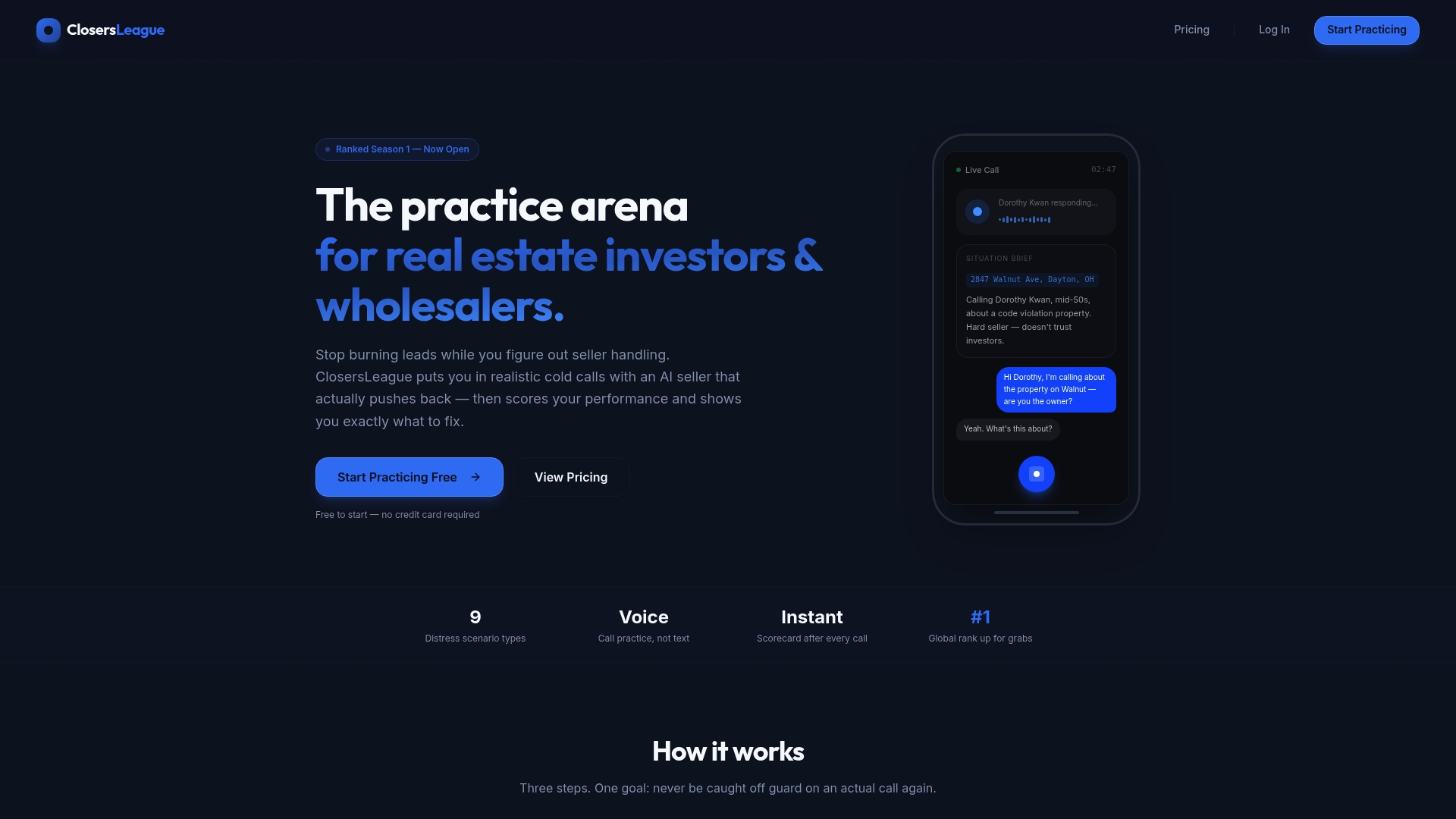
Every practice call gets scored on the exact metrics this article covers: talk-listen ratio, interruption count, paraphrase frequency, and how you handled the seller’s emotional state. That’s the difference from a manager sitting in on a live call once a week. You get objective feedback after every rep, competitive leaderboards to track progress against your team, and targeted drills for the specific distress categories, divorce, code violations, inherited property, where your listening skills are weakest. Start a free trial of ClosersLeague’s cold calling practice platform and run your first scored roleplay call today.
Sources
- Active Listening in Sales: Data-Backed Guide (2026)
- The power of listening at work (Annual Review of Organizational Psychology and Organizational Behavior)
- Sales call listening skills training guide — QUOTA Training
- Active listening techniques to use on your next sales call — HubSpot (2025)
FAQ
What Is Active Listening in Sales?
Active listening in sales is the practice of fully hearing, interpreting, and responding to what a prospect says rather than waiting for your turn to pitch. It shows up as paraphrasing, fewer interruptions, and questions that build directly on what the prospect just told you.
What Is the 70/30 Rule in Sales?
The 70/30 principle suggests the prospect should talk substantially more than the rep during sales conversations. Real benchmarks vary more than that by call stage: discovery calls tend to run closer to a 60/40 or 65/35 split in favor of the prospect, while cold calls often run closer to even.
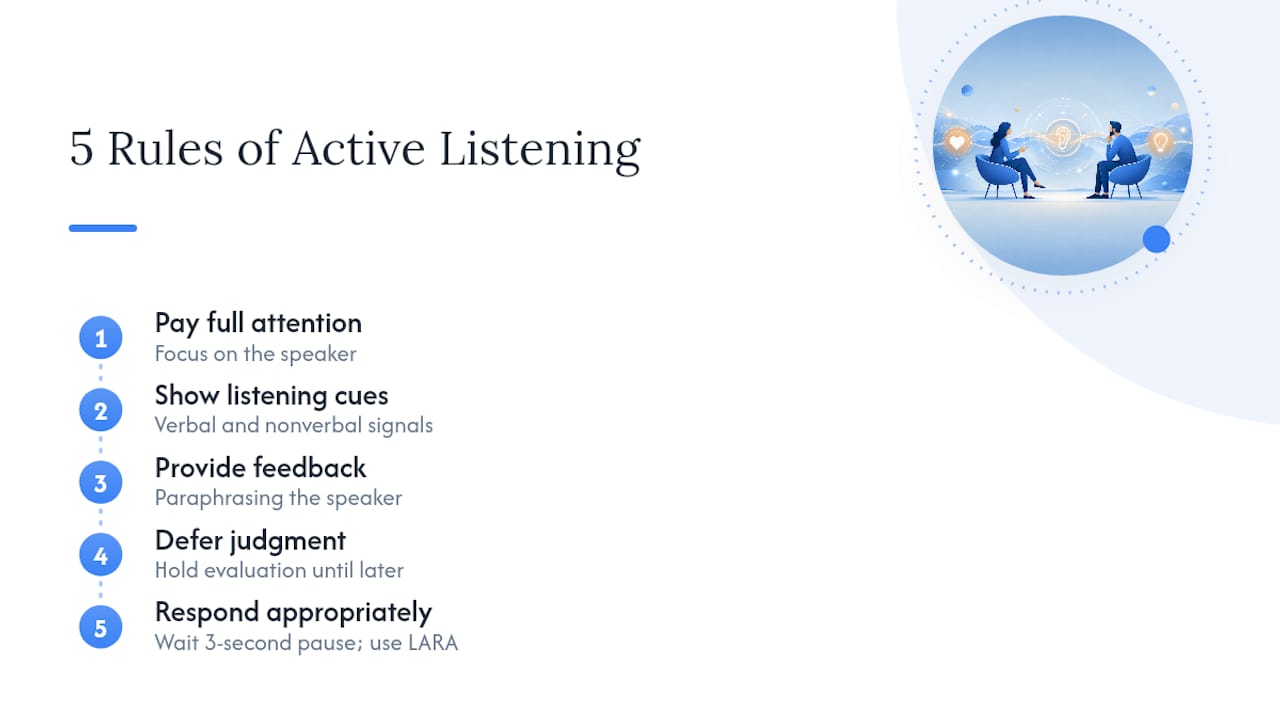
What Are the 5 Rules of Active Listening?
Common versions of the rules include paying full attention, showing you’re listening through verbal and nonverbal cues, providing feedback through paraphrasing, deferring judgment, and responding appropriately once the speaker has finished. Applied to sales, that last rule is where the 3-second pause and LARA framework do their work.
How Do I Improve My Talk-Listen Ratio on Calls?
Start by recording and reviewing your own calls to establish your baseline interruption count and talk percentage, then drill specific fixes like the 3-second rule and open-ended probes in roleplay. Platforms that score practice calls against these metrics, including ClosersLeague’s roleplay training, speed up the feedback loop compared to occasional manager review alone.