
An appointment-setting call is a short sales conversation whose only job is to get a confirmed meeting on the calendar. It isn’t a pitch and it isn’t a close. The benchmark worth tracking is simple: how often a connected call turns into a booked time, and top performers land that conversion in the 6 to 10% range.
TL;DR:
- Make three to five attempts at varied times before dropping a lead; one unanswered call provides little evidence that the prospect is unreachable.
- State your reason, ask one or two qualifying questions, then offer two specific meeting times and confirm the date, time, and format before ending.
- Send the calendar invitation before hanging up, then remind the prospect by text and email 24 hours beforehand and again about an hour before.
- Keep your talk to listen ratio near 43:57; if you speak for more than half the call, return to questions instead of pitching.
Table of Contents
- What appointment setting is and where it fits in the sales process
- Why appointment-setting calls work and realistic outcome benchmarks
- Ready-to-use scripts and annotated samples for common appointment-setting scenarios
- The component moves inside every successful script
- Handling objections and gatekeepers: short rebuttals and escalation rules
- Scheduling logistics: booking, confirmations, reminders, and reducing no-shows
- KPIs and tests: what to track and simple experiments to run
- Common mistakes to avoid and quick fixes
- How to practice and coach appointment-setting calls
- A straight take on what actually fixes appointment-setting calls
- Practicing these calls before you make them count
- FAQ
- Sources
What appointment setting is and where it fits in the sales process
Appointment setting is the step between finding a prospect and closing a deal. Cold calling is the outreach method, closing is the final yes, and appointment setting is the bridge connecting them: a focused conversation designed to earn a slot on the calendar, not a signed contract. HubSpot frames this role clearly: the setter’s job is to secure a micro-commitment and qualify the lead, not to sell the full offer in one breath.
In a typical pipeline, a prospect moves through four stages: initial contact, qualification, appointment, then a closer takes over. Each stage has a different goal, and trying to collapse them into one call usually backfires. Asking someone to buy before they’ve agreed to even talk is a mismatch in commitment level, and most people say no to protect themselves from that mismatch.
Treating appointment setting as its own discipline pays off in a few concrete ways:
- Higher close rates downstream. Closers spend their time with people who already agreed to a conversation, not cold strangers.
- Better pipeline efficiency. Setters can work volume while closers focus on fewer, warmer conversations.
- Stronger lead qualification. A good setter filters out tire-kickers before they ever reach a closer’s calendar.
For real estate investors and wholesalers, this split matters even more. A distressed homeowner dealing with probate or pre-foreclosure rarely wants to discuss numbers with a stranger on a first call. They want fifteen minutes with someone who understands their situation, scheduled for a time that works.
Why appointment-setting calls work and realistic outcome benchmarks
The reason a short call can out-convert a long pitch comes down to a psychological principle called the micro-commitment. Asking someone to agree to a small, low-risk step, like a quick call next Tuesday, is far easier to say yes to than asking them to commit to a sale on the spot. Each small yes builds momentum toward the next one.
Cold-call success for generating genuine interest averages just 2 to 3%, but regular daily callers who stick with the activity report appointment conversion rates of 6 to 10%. That gap between the industry-wide average and what consistent callers achieve is the whole argument for practice and repetition.
Persistence changes the math more than most new callers expect:
- Successful setters typically make three to five attempts before writing off a lead.
- A single unanswered call means almost nothing; a pattern across five attempts tells you something real.
- Calling at varied times of day catches prospects who are unreachable during a single daily window.
Timing also compounds with persistence. A lead who doesn’t answer Monday morning might pick up Wednesday afternoon, and each additional attempt costs little relative to what a booked appointment is worth. Investors working distressed lists, where sellers are often avoiding calls altogether, see this pattern even more sharply: the fourth or fifth touch is frequently the one that lands.
Ready-to-use scripts and annotated samples for common appointment-setting scenarios
Scripts work best as a skeleton, not a script to recite word for word. Most sales professionals adapt their script per conversation rather than following it verbatim, and that flexibility is what separates a natural-sounding call from a robotic one. Below are four scripts built around common scenarios.
1. Cold outreach script (0 to 90 seconds)
“Hi, is this [Name]? Hey [Name], this is [Your Name] with [Company], I know this is out of the blue so I’ll be quick. I work with homeowners in [area] who are dealing with [situation, e.g., inherited property], and I wanted to see if that’s something on your plate right now.”
Pause here. Let them respond before moving forward.
“Got it. The reason I’m calling is we help people in that exact spot move things forward without the usual hassle. I’d love to grab fifteen minutes this week to hear more about your situation and see if there’s a fit. Does Tuesday afternoon or Wednesday morning work better?”
2. Researched or warm lead script
Personalize the opening with a specific detail before anything else: “Hi [Name], this is [Your Name]. I saw the property on [Street Name] came up in county records tied to a [probate/tax delinquent] filing, and I wanted to reach out directly instead of sending a letter.” Naming a specific, accurate detail signals you did homework, which lowers resistance fast. From there, move straight into the same appointment ask used in the cold script.
3. Gatekeeper script
“Hi, I’m trying to reach [Decision Maker]. This is [Your Name] with [Company], calling about [specific property or situation]. Is there a good time I could catch them today, or should I follow up tomorrow?” Keep this short and courteous. A gatekeeper who feels respected is far more likely to pass along an accurate message or connect you directly.
4. Referral script
“Hi [Name], [Referrer] suggested I reach out, we helped them with [similar situation] and they thought you might be dealing with something similar. Do you have a few minutes, or would it be better if I called back at a specific time?” A referral script should always open with the referrer’s name in the first sentence; it’s the strongest credibility signal available before you’ve said anything else.
Each script above shares the same backbone, and the opening-line structure used in real estate cold calls applies whether you’re cold calling or working a referral. Swap in local details, the seller’s specific distress type, and the referrer’s name where relevant, and escalate to a closer or demo only after the appointment is actually booked, never during the setting call itself.
Pro Tip: Write your script, then read it out loud twice before your first call. If a line feels stiff in your own mouth, it will sound stiff to the prospect.

The component moves inside every successful script
Every script above follows the same four-part structure, and understanding why each part exists makes it easier to adapt on the fly when a conversation goes off-script.
- Opening (first 10 to 30 seconds): State your name, your company, and the reason for the call in one breath. A direct intro and purpose statement is how 46% of sales professionals open their calls, and it works because it respects the prospect’s time instead of burying the reason for the call.
- Qualification (30 to 90 seconds): Ask one or two high-impact questions, such as “Is this something you’re actively dealing with right now?” This step filters out people who aren’t a fit before you waste a slot on your calendar.
- Appointment ask: Offer two specific time options rather than asking an open-ended “when works for you?” Tie the ask to value: “so we can walk through your options” works better than a vague “to chat.”
- Close: Confirm the day, time, and method (phone or in person), then state exactly what happens next: “I’ll send a calendar invite right now so you’ve got it.”
The close matters more than most callers realize. Salesforce guidance is direct on this point: reps who explicitly confirm a next step before ending the call avoid the common trap of leaving prospects with a vague, forgettable promise.
Handling objections and gatekeepers: short rebuttals and escalation rules
Objections are rarely a hard no, they’re usually a request for more information or reassurance. Here are five you’ll hear constantly, with concise ways to respond:
- “I’m not interested.” “Totally understand, most folks aren’t until they hear the specifics. Mind if I take thirty seconds to explain why I called?”
- “I don’t have time right now.” “No problem at all, would later today or tomorrow work better for a quick fifteen minutes?”
- “Send me something in writing.” “Happy to, and I’ll also hold a time on my calendar for us to go over it together so nothing gets missed.”
- “How did you get my information?” “Public records show [specific detail], which is why I reached out directly instead of mailing something generic.”
- “I need to think about it.” “Makes sense, that’s exactly what the call is for, no pressure to decide anything on it.”
Gatekeepers need a slightly different approach. Stay brief, state your name and reason clearly, and never try to talk your way past them with pressure, it tends to backfire and can get you flagged as a nuisance caller. A respectful, specific request gets passed along far more often than a vague one.
When a call goes to voicemail, keep the message under twenty seconds: your name, company, the specific reason for the call, and a callback window. Follow it with a short text or email the same day. If three attempts across different times of day go unanswered, move the lead into a longer follow-up cadence rather than calling daily, which tends to irritate more than it converts.
Scheduling logistics: booking, confirmations, reminders, and reducing no-shows
Booking the appointment is only half the job, the other half is making sure the prospect actually shows up. A low-friction scheduling flow removes the back-and-forth that kills momentum.
- Offer exactly two time options instead of asking an open-ended question, it speeds up the decision and avoids analysis paralysis.
- Send the calendar invite immediately, while you’re still on the phone if possible, so the appointment feels real rather than theoretical.
- Send a reminder by text and email 24 hours before the appointment, then a short second reminder about an hour before.
- Keep the reminder message short: date, time, what to expect, and a one-tap way to reschedule if needed.
For tool choices, free calendar links work fine for solo setters handling low volume, while paid scheduling platforms with built-in SMS reminders make more sense once call volume climbs and manual reminders start eating into calling time. The right choice depends on volume, not on what sounds more advanced. A consistent scheduling and follow-up workflow matters more than which specific app you pick.
KPIs and tests: what to track and simple experiments to run
Tracking the right numbers turns appointment setting from guesswork into a repeatable system. Four metrics matter most:
| Metric | What it measures | Why it matters |
|---|---|---|
| Connection rate | Calls answered divided by calls dialed | Shows if your list and timing are working |
| Appointment rate | Appointments booked divided by calls connected | The core measure of script effectiveness |
| Show rate | Appointments kept divided by appointments booked | Flags confirmation and reminder gaps |
| Talk:listen ratio | Time you speak versus time the prospect speaks | A successful call runs close to 43:57, talking less than half the time |
Watch for sustained shifts over a week or two rather than reacting to a single bad day, call volume naturally fluctuates. Three quick experiments worth running: test two different openers against each other for a week, compare a same-day follow-up cadence against a next-day one, and test a text reminder against an email-only reminder to see which moves your show rate more.
Common mistakes to avoid and quick fixes
A handful of errors show up constantly in appointment-setting calls, and all of them are fixable within your next few calls.
- Leaving the call open-ended. If you hang up without a specific day and time locked in, you’ve lost the appointment, follow up immediately to lock down a slot rather than waiting for them to call back.
- Talking too much. If you’re doing more than half the talking, you’re not qualifying, you’re pitching, pull back and ask more questions instead.
- Skipping the calendar invite. An appointment without a calendar invite is just a verbal agreement that’s easy to forget, send it before you hang up.
- Ignoring gatekeepers’ names. Jotting down a gatekeeper’s name and using it on your next call builds rapport that pays off over repeat attempts.
- Giving up after one call. Three to five attempts is the realistic range before writing off a lead, one unanswered call tells you almost nothing.
How to practice and coach appointment-setting calls
Improvement comes from repetition with feedback, not from reading scripts silently. A focused roleplay session should isolate one skill, like the opening and qualification steps, and run six to eight short reps with feedback after each one. Conversation intelligence tools let you measure your talk:listen ratio and objection handling from real call recordings, turning every call into a coaching opportunity instead of a one-off attempt.

Pro Tip: Record one real call a week and listen back specifically for how long you talk before asking your first question.
A straight take on what actually fixes appointment-setting calls
Most struggling callers don’t have a script problem, they have a listening problem. They write a great opener, then talk straight through the qualification step without pausing for an answer. Fix that one habit and conversion jumps faster than any new script ever will.
Here’s a 7-day plan worth running: write or refine one script per scenario, run three roleplay sessions focused on qualification, run two A/B tests on your opener and your reminder message, and track connection rate and appointment rate daily. A week of disciplined tracking tells you more than a month of guessing.
— Dave
Practicing these calls before you make them count
Reading a script is one thing, saying it out loud under pressure with a real objection coming back at you is another. We built ClosersLeague specifically for real estate investors and wholesalers who need to practice appointment-setting calls against realistic seller pushback before dialing an actual homeowner.
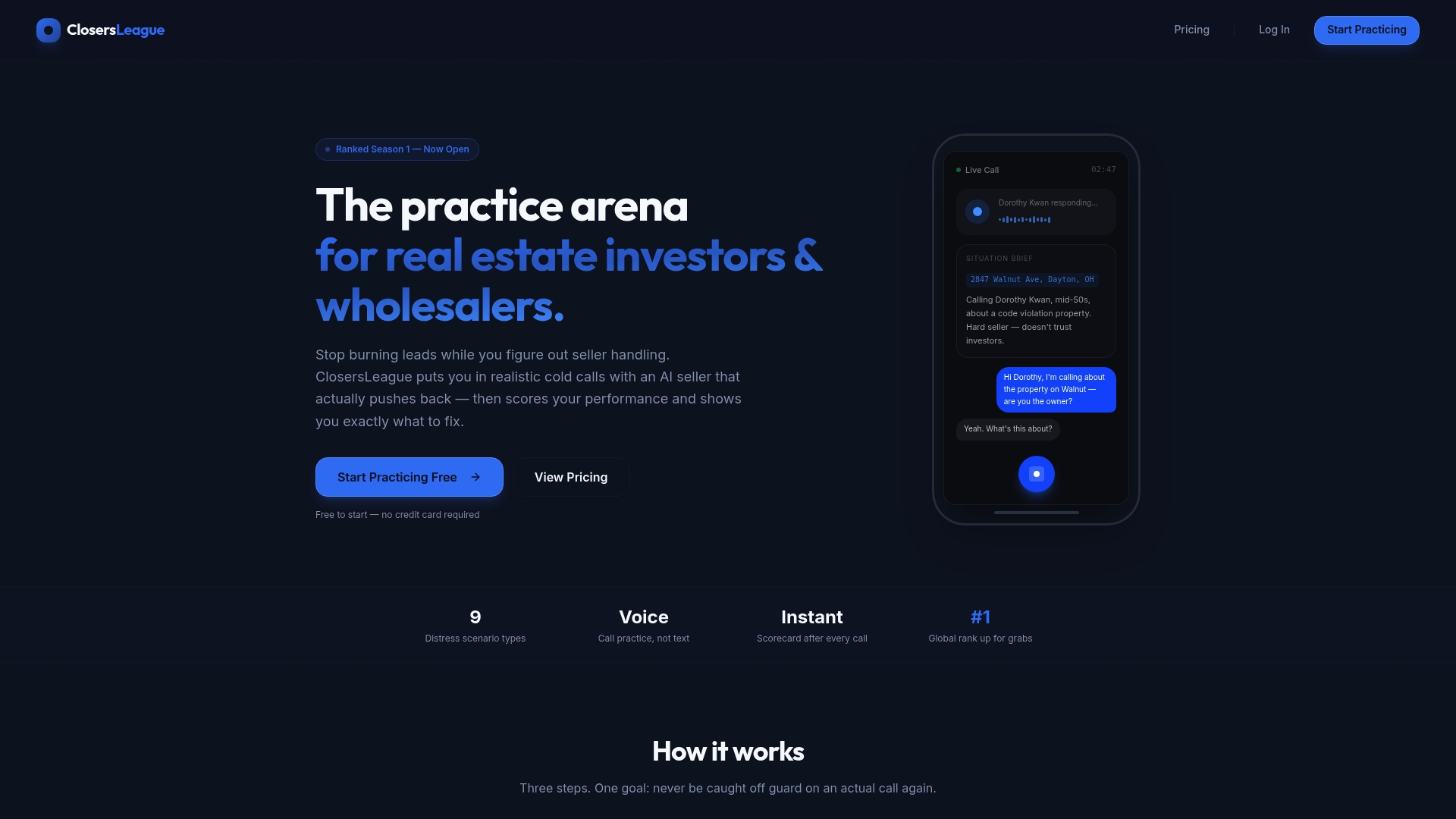
Our AI roleplay covers distressed seller scenarios from probate to pre-foreclosure to tax delinquent properties, each with its own objections and emotional tone. Every practice call generates various feedback and performance insights including scorecards, feedback on call momentum, targeted drills, and progress tracking.
Investors working inherited property leads benefit most, since that seller type carries some of the trickiest emotional terrain to navigate on a first call. Plans start at the Starter tier for $5 per month, with Growth at $10 and Pro at $18, so you can pick a volume of practice calls that matches how often you’re actually dialing. Check pricing and start practicing before your next round of calls.
FAQ
How do you set an appointment on a sales call?
Open with your name and reason for calling, ask one or two qualifying questions, then offer two specific time options instead of an open-ended ask. Confirm the day and time out loud, send a calendar invite immediately, and follow up with a reminder 24 hours before the meeting.
What does cold calling mean?
Cold calling is reaching out by phone to a prospect who has no prior relationship with you or your company. In appointment setting specifically, the goal of a cold call is narrower than a full sales pitch: it’s simply to earn a scheduled conversation, with success rates for generating real interest averaging 2 to 3%.
How do you politely ask for an appointment?
Tie the request to a clear benefit and offer a choice rather than an open question: “I’d love to grab fifteen minutes to walk through your options, does Tuesday or Wednesday work better for you?” Offering two options instead of asking “when are you free?” makes it easier for the other person to say yes.
How do you say you want to schedule an appointment?
A direct, low-pressure phrase works best: “I’d like to set up a short call to go over this in more detail, would [day] or [day] work for you?” Naming a specific reason for the meeting, rather than a vague “touch base,” increases the odds the person agrees on the spot.
Are appointment-setting calls to homeowners legal?
Under the FTC’s Telemarketing Sales Rule, most business-to-business calls are exempt from National Do Not Call Registry provisions, but calls to residential consumers must still honor entity-specific do-not-call requests and avoid deceptive claims. Check current FTC guidance for your specific situation before scaling outbound call volume.