
Property lead generation is the systematic process of attracting, capturing, and qualifying potential sellers or buyers to create a predictable pipeline of real estate conversations. For investors and wholesalers, the goal is never just collecting names. REALTOR.com confirms that real estate lead generation is about converting prospects into booked conversations, not building a contact spreadsheet. The difference between investors who close consistently and those who scramble month to month comes down to one thing: a repeatable system that moves people from first contact to a real conversation.
What is property lead generation and why does it matter?
Property lead generation is the front end of every real estate deal. Without a steady flow of motivated sellers or qualified buyers entering your pipeline, even the best negotiator runs dry. The industry term you will hear alongside “property lead generation” is real estate lead generation, and both refer to the same core process: identifying people with a reason to sell or buy, then creating enough trust and urgency to get them on the phone.
The process matters most for investors and wholesalers targeting distressed situations. Foreclosure, probate, divorce, and tax delinquency create sellers with real urgency. Those sellers do not browse Zillow listings waiting to be found. They need to be reached through deliberate outreach, and that requires a system built around their specific pain points rather than generic advertising.

Lead generation alone is insufficient without conversion optimization and systematic follow-up. That insight reframes the entire discipline. You are not running a marketing campaign. You are building a pipeline that reliably produces conversations with people who have a reason to act now.
What types of property leads exist?
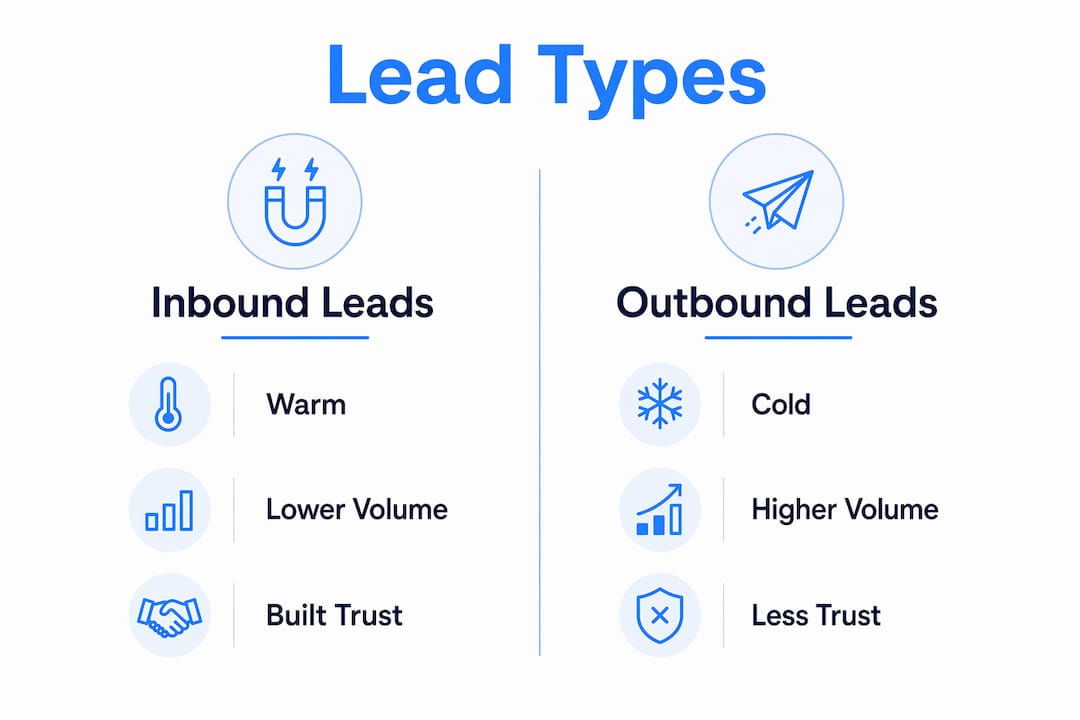
Not every lead behaves the same way, and treating them identically is one of the fastest ways to burn your pipeline. Brighton Escrow defines inbound and outbound leads as fundamentally different in how they are sourced and how quickly they expect a response. Understanding the distinction shapes your entire follow-up approach.
Inbound leads come to you after discovering your brand or offer through:
- Organic search results and SEO-driven blog content
- Paid ads on Google or Facebook that drive form fills
- Referrals from past clients or professional networks
- IDX property search tools on your website
Outbound leads are generated when you initiate contact first, through:
- Cold calling lists of pre-foreclosure, probate, or tax-delinquent owners
- Direct mail campaigns to targeted neighborhoods or property types
- Door knocking and community canvassing
- Email and SMS outreach to purchased or self-built lists
Inbound leads tend to be warmer because the prospect already expressed interest. The trade-off is that inbound volume depends entirely on your marketing spend and content output. Outbound leads require more skill to convert because you are interrupting someone who did not ask to hear from you. For wholesalers and investors targeting distressed sellers, outbound cold calling is often the primary channel because those sellers rarely self-identify through a Google search.
Lead readiness also varies by source. A referral from a past client arrives with built-in trust. A cold call to a probate list requires you to establish credibility in the first 30 seconds. Matching your follow-up approach to the lead’s readiness level is what separates average conversion rates from strong ones.
How does an effective lead generation system work?
Most investors run fragmented campaigns: a Facebook ad here, a cold call list there, a CRM they update inconsistently. Most lead generation failures occur when leads get lost between the first click and a real conversation. An integrated omnichannel pipeline prevents that drop-off.
A working system operates in three stages:
- Attract. Drive traffic through paid search, SEO content, social media ads, or direct mail. The goal at this stage is visibility with the right audience, not volume for its own sake. A Facebook ad targeting homeowners in pre-foreclosure zip codes outperforms a broad awareness campaign every time.
- Engage. Once a prospect responds or opts in, automated CRM sequences and AI-assisted follow-up keep them warm. Speed-to-contact within the first hour is a strong predictor of lead conversion. AI sales agents integrated with CRM platforms can trigger immediate text or email responses, eliminating the manual bottleneck that kills most leads.
- Qualify. Not every contact deserves equal time. Lead scoring, routing rules, and qualification calls separate motivated sellers from tire-kickers. A qualified lead at this stage is not just a name with a phone number. It is a scheduled conversation with someone who has a real reason to sell.
Pro Tip: Set a hard rule in your CRM: any new lead that does not receive a response within 60 minutes gets flagged for immediate callback. Automate the first touch, but make sure a human follows up within the hour on high-intent leads.
Running acquisition and follow-up as a single pipeline with CRM automation maintains lead intent and speeds conversion by enforcing consistent workflows. Investors who treat these as separate functions lose deals in the gap between them.
What makes a property lead truly qualified?
A raw list of homeowner names is not a lead list. It is a starting point. Qualified property management leads are defined as scheduled, phone-verified conversations with owners or investors who have clear pain triggers and demonstrated readiness to act. That distinction changes everything about how you allocate your time.
The table below shows the practical difference between raw contact data and a qualified lead:
| Dimension | Raw contact list | Qualified lead |
|---|---|---|
| Verification | Name and address only | Phone-verified, decision-maker confirmed |
| Pain point | Unknown | Identified: foreclosure, probate, divorce, etc. |
| Timing | No signal | Expressed urgency or timeline |
| Next step | Cold outreach required | Scheduled conversation booked |
| Conversion likelihood | Low | Significantly higher |
Lead capture and lead intelligence are separate but linked steps. Many investors fail by collecting only contact information without capturing decision signals like budget, timeline, or motivation. A form that asks “Are you behind on payments?” or “How soon do you need to sell?” generates intelligence, not just data. That intelligence routes the lead to the right follow-up sequence and tells you exactly how to open the conversation.
Pro Tip: When building your qualification criteria, segment by seller type. A probate lead requires a different conversation than a tax-delinquent owner. Build separate qualification scripts and CRM tags for each distress category to improve your appointment setting accuracy.
Practical strategies to generate property leads today
Knowing the theory is one thing. Executing it consistently is another. Here are the property lead generation strategies that produce results for investors and wholesalers in 2026:
- Dedicated landing pages. A generic homepage does not convert cold traffic. Build a single-purpose landing page for each seller type: one for pre-foreclosure, one for probate, one for inherited properties. Online lead capture funnels use landing pages and lead magnets to guide prospects from discovery to form fills or bookings. Each page should have one offer and one call to action.
- Lead magnets. Offer something specific in exchange for contact information. A free guide titled “What Happens to Your Home in Probate” converts better than a generic “Get a Cash Offer” button because it speaks directly to a seller’s immediate concern.
- Cold calling distressed lists. Pre-foreclosure, probate, divorce, and tax-delinquent lists are the highest-intent sources for wholesalers. The skill gap is not in finding the list. It is in knowing how to handle objections, build rapport in 60 seconds, and move the conversation toward a scheduled appointment. Consistent cold calling practice is what separates investors who convert these lists from those who give up after 20 dials.
- CRM organization and follow-up sequences. Most deals close on the fifth to eighth contact, not the first. A CRM that tracks every touchpoint and automates follow-up reminders keeps you in front of sellers who are not ready today but will be in 30 days. Consistent real estate follow-up is the single most underused advantage in this business.
- Referral networks and professional partnerships. Attorneys handling probate cases, divorce mediators, and bankruptcy trustees all encounter motivated sellers before those sellers ever appear on a public list. Building relationships with these professionals creates a referral channel that costs nothing per lead and arrives pre-qualified.
- Paid advertising with retargeting. Google Search ads targeting keywords like “sell my house fast” or “stop foreclosure” capture high-intent traffic. Retargeting pixels on your landing pages re-engage visitors who did not convert on the first visit. The combination of search and retargeting produces lower cost-per-lead than broad social campaigns for most investor profiles.
Balancing paid channels with organic content and referrals protects your pipeline from single-channel dependency. If your entire lead flow depends on Facebook ads and the algorithm changes, your business stops. Diversified real estate outreach across multiple channels creates resilience.
Key takeaways
Property lead generation succeeds when attraction, engagement, and qualification operate as one connected system rather than three separate activities.
| Point | Details |
|---|---|
| Definition matters | Property lead generation is about booking conversations, not collecting contact lists. |
| Lead types require different approaches | Inbound leads are warmer; outbound cold calling demands stronger communication skills and scripts. |
| System integration prevents lost leads | Omnichannel pipelines with CRM automation keep leads moving from first contact to conversation. |
| Qualification beats volume | A scheduled, phone-verified conversation with a motivated seller outperforms 100 unqualified names. |
| Follow-up is the conversion engine | Most deals close between the fifth and eighth contact, making consistent follow-up non-negotiable. |
Why most investors get lead generation backwards
I have worked with hundreds of investors who spend real money on lists and ads, then wonder why their pipeline is empty. The pattern is almost always the same: they optimize for lead volume instead of lead quality, and they treat follow-up as optional.
Here is the uncomfortable truth. A cold call to a probate owner is not a lead generation problem. It is a communication problem. The list is the easy part. What kills conversion is the investor who freezes when a seller says “I’m not interested” or stumbles through a conversation without knowing how to identify the seller’s real pain. Volume without skill produces noise, not deals.
The investors I have seen build real pipelines do two things differently. First, they qualify aggressively. They would rather work 20 verified, motivated sellers than 200 names with no context. Second, they practice their calls before they make them. Not once. Repeatedly. They drill objection handling, opening lines, and empathy responses until the conversation feels natural under pressure.
Speed matters too. Calling a pre-foreclosure lead three days after they fill out a form is almost as bad as not calling at all. The seller’s urgency does not wait for your schedule. The investors who win are the ones who respond fast, follow up consistently, and show up to every call prepared.
Stop winging it. Start drilling.
— Dave
Take your property lead generation skills to the next level
Generating property leads is only half the equation. Converting those leads into deals depends entirely on what you say when a motivated seller picks up the phone. ClosersLeague is an AI-powered cold calling training platform built specifically for real estate investors and wholesalers. You practice live roleplay scenarios against AI sellers in foreclosure, probate, divorce, and tax-delinquent situations. The platform scores your calls, flags weak spots, and builds the muscle memory you need to handle any objection with confidence. If you are serious about turning your lead list into closed deals, start practicing today and see how fast your conversion rate moves.
FAQ
What is a property lead in real estate?
A property lead is a potential seller or buyer who has shown some level of interest or fits a profile that suggests motivation to transact. For investors, the most valuable leads are distressed sellers in situations like foreclosure, probate, or divorce.
How do inbound and outbound property leads differ?
Inbound leads contact you after discovering your brand through ads, search, or referrals. Outbound leads are generated when you initiate contact through cold calling, direct mail, or email outreach to targeted lists.
What makes a property lead qualified?
A qualified lead is a scheduled, phone-verified conversation with a decision-maker who has a confirmed pain point and demonstrated readiness to act. Raw contact data without these signals is not a qualified lead.
How fast should you contact a new property lead?
Speed-to-contact within the first hour is a strong predictor of conversion. Leads contacted within 60 minutes convert at significantly higher rates than those reached hours or days later.
What tools do real estate investors use for lead generation?
Investors use CRM platforms for lead tracking and follow-up automation, dedicated landing pages for lead capture, cold calling scripts for outbound outreach, and AI training tools like ClosersLeague to sharpen their phone skills before working live leads.