
Cold calling multifamily owners works when you call with a reason, not a pitch. These owners hold large assets, often through LLCs, and they hang up on callers who don’t know their building. Do a short research pass first, open with one specific fact, ask about their plans instead of their price, and rehearse the objections until they feel routine. That last part is where we come in: ClosersLeague gives you AI voice practice with scorecards before a real owner ever hears you.
TL;DR
- Build a one-page owner file before you dial: who owns the building, how long they’ve held it, what debt they carry and what condition it’s in.
- Open in about 10 seconds with who you are, why you’re calling this owner and an easy next step.
- Treat the first call as a conversation to earn a second one. Large buildings rarely trade on one phone call.
- Plan 3 to 5 spaced touches per owner, and log every attempt.
- Know the federal calling rules (hours, Do Not Call, opt-outs) before you scale your list.
Table of Contents
- Why multifamily owners are a different call
- Build the owner file before you dial
- The first 10 seconds
- Questions that reveal motivation
- Set a first-call goal you can win
- Handle objections without arguing
- Follow up like it’s a relationship
- Know the calling rules
- Practice before the owner is on the line
- Start practicing the calls that matter
- FAQ
- Sources
Why multifamily owners are a different call
A single-family homeowner may be deciding whether to sell the house they live in. A multifamily owner is usually running a business. The building produces income, carries a loan, has tenants and leases, and may be one of several assets held in different entities.
That changes what a good call sounds like:
- They are guarded. The building is often a large share of their net worth. They won’t share numbers with a stranger.
- They get calls constantly. Brokers, lenders, property managers and other investors all dial the same public records.
- Timing matters more than persuasion. An owner sells when something shifts: a loan comes due, a major repair looms, management wears them out, or an estate needs settling.
One industry executive quoted by TechBullion in August 2026 argues that the real problem isn’t cold calling. It’s calling without knowing the property. An owner who has held assets for a decade will end the call fast on a caller who doesn’t know the portfolio.
Your edge is simple: know more than the last caller, speak plainly, and sound like someone worth a second conversation.
Build the owner file before you dial
Spend 10 minutes per prospect, not 10 seconds. You are looking for four things.
1. Who actually owns it
County assessor and recorder records usually show the owner of record, the mailing address and the last sale. Many counties also show unit count and assessed value, though what’s available varies by county. When the owner is an LLC, the state Secretary of State business database typically lists the registered agent and often the manager or officer. That is the person you want to reach, not the registered agent service.
Check whether the mailing address matches the building. An owner mailing from another city or state is a different conversation from one who lives next door. If you work absentee owners often, our neighbor cold calling guide shows another way to get useful context on a property.
2. How long they’ve held it and what they owe
A long hold means built-up equity and, often, tired management. Loan data is the strongest timing signal. The same TechBullion piece gives the example of an owner refinancing a 3.5% loan in 2027 at projected rates of 6.5% or higher: that owner is at a real decision point, and a caller who knows it has a reason to be on the phone.
3. Condition and distress signals
Drive the block or use street-level imagery. On smaller buildings (roughly 5 to 20 units), look for overgrown landscaping, broken mailboxes, boarded units and a “For Rent” sign that never changes. Then search county court and code enforcement records for liens, violations and evictions. A tired landlord often shows up in these records before they show up in a listing.

4. One fact you can open with
Write one line you could say out loud: “I saw the building on Maple has been under the same ownership since 2009.” That’s your reason to be on the call. If you can’t write one, the owner isn’t ready to call yet.
A simple file looks like this:
| Field | What to capture |
|---|---|
| Owner | Name on record, entity, manager or officer, mailing address |
| Property | Address, units, year built, last sale date and price |
| Signals | Long hold, estate or trust name, vacancy, code violations, old loan |
| Opening fact | One specific line you can say in a sentence |
| Outreach log | Dates, outcomes, next step |
Keep the log honest. Your second and third calls should pick up where the first one left off.
The first 10 seconds
Your opener has three jobs: say who you are, say why you’re calling this owner, and make the next step small.
“Hi, is this Dana? This is Alex, I’m a local investor. I noticed you’ve owned the building on Maple Street for a while, and I’m calling to ask a quick question about it. Do you have two minutes, or is now a bad time?”
What makes this work:
- You name yourself as an investor. Don’t pretend to be someone else or hide why you’re calling.
- The reason is specific. “Owned for a while” shows you looked. “I buy properties in your area” shows you didn’t.
- There’s an easy out. Offering to call back lowers defenses, and owners who stay on the line after that are choosing to.
Avoid vague openers like “I help landlords save money.” Owners hear dozens of them a year. For more opener structures, see our guide to high-converting opening scripts and the plain language scripts article. Plain wording lands better with owners who are busy and suspicious.
Questions that reveal motivation
Once the owner stays on the line, stop pitching and start asking. Good multifamily questions are open and unhurried:
- How long have you owned the property, and how has it been?
- What are your plans for it over the next year?
- Do you manage it yourself? What’s the hardest part?
- If you could design the ideal outcome for this building, what would it look like?
- Have you ever thought about selling? What held you back?
Listen for specific triggers: a loan maturing, a roof or boiler that needs replacing, a partner who wants out, an estate, a manager who quit, rising insurance or taxes. Each one tells you what a solution looks like. If an owner mentions a repair bill, your follow-up is about that bill, not your price.
Only after they’ve talked should you ask about the building itself: occupancy, rent roll, average monthly expenses. Many owners won’t share numbers on the first call. That’s normal. If they hesitate, don’t push. Ask whether you can send a short email so they can reply when they’re ready.
Our distressed seller scripts walk through discovery for estate, tax delinquent and other situations, and many of those questions transfer directly to tired landlords. If an owner is open to carrying paper, the seller financing call script covers that conversation.
Set a first-call goal you can win
On a $2 million building, nobody agrees to sell after a two-minute call from a stranger. Your realistic goals for call one:
- Confirm you have the right person.
- Learn one real fact about their situation.
- Get permission to follow up, ideally an email address or a better time to call.
Callers who chase a price on the first call burn leads they could have worked for months. Callers who leave with permission build a pipeline.
Handle objections without arguing
Most objections are a request for more safety, not a hard no. Keep your answers short, then ask a question.
| What they say | What’s usually behind it | A response that works |
|---|---|---|
| “Not interested.” | Wrong timing, wrong price, or no plan to sell | “Understood. Is it the timing, the price, or you’re just not looking to sell?” |
| “How did you get my number?” | Suspicion | “It’s from public records. I’m happy to take you off my list right now if you’d like.” |
| “I’m not selling.” | They may be right, for now | “Totally fair. If something changed down the road, who would you want to hear from first?” |
| “Send me an offer.” | Testing you | “I’d rather understand the building first so the number is real. Can I ask a couple of questions?” |
| “Call me later.” | A real maybe | “Of course. When is a good time, and is this the best number?” |
Two rules keep objection handling clean. First, honor an opt-out immediately. Second, never argue with an owner’s reason. Acknowledge it, ask one question, and let the owner decide whether to keep talking.
The skill here is delivery, not memorization. The same sentence sounds trusting or pushy depending on pace and tone, and the only way to tune that is repetition.
Follow up like it’s a relationship
Because multifamily deals build slowly, your follow-up matters more than your first call. A workable cadence:
- Day 0: First call. If no answer, leave one short, professional voicemail with your name, number and reason.
- Day 3 to 5: Second attempt at a different time of day.
- Day 7 to 10: Short email or mailed note referencing something specific from your conversation.
- Week 4: Third attempt, or a check-in with a useful local data point.
- Quarterly after that: A light touch for owners who showed any interest.
Send any promised email within 24 hours and call back when you said you would. If you reach three genuine dead ends, stop and move on. Update your log after every attempt so you never repeat yourself or call someone who asked you not to.
If you’re building a team to run this process, our 30/60/90 onboarding checklist and prospecting process guide lay out the routine. The investor script workflow shows how to keep scripts, notes and follow-ups in one system.
Know the calling rules
Most U.S. rules were written with consumers in mind, so how they apply depends on whom you reach and how. Know the basics before you scale.
- Calling hours. Under the FTC’s Telemarketing Sales Rule, outbound telemarketing calls to residences are barred before 8 a.m. or after 9 p.m. at the called person’s local time, unless they’ve consented (16 CFR Part 310). Staying inside that window is a safe default for every call.
- Do Not Call. The same rule gives callers a safe harbor when they use a copy of the National Do Not Call Registry no more than 31 days old, keep written procedures and maintain their own internal do-not-call list (eCFR). The FTC says most calls made to a business to solicit sales from it are exempt from the Do Not Call provisions (FTC Q&A). An owner who answers on a personal cell phone is a different matter, so scrub your lists either way.
- Opt-outs. Add anyone who asks to your internal do-not-call list on the spot.
- Autodialers and prerecorded messages. These fall under the FCC’s TCPA rules, which generally call for prior consent. Under a 2024 FCC order, any reasonable way an called party revokes consent must stop robocalls and robotexts (FCC order, April 2025).
- State rules. Some states add their own registries and restrictions, and wholesaling disclosure rules differ by state. Check yours before you call across state lines, and ask a real estate attorney if you’re unsure.
Introducing yourself honestly as an investor in the first sentence keeps you on the right side of most of this and builds trust at the same time.
Practice before the owner is on the line
Most investors prepare the research and skip the rehearsal. Then they try a new opener, a new objection answer and a new discovery question on live owners, which means the owners are the practice.
Deliberate practice looks different:
- Pick one skill, such as the opener or the “how did you get my number” answer.
- Run it against a realistic seller who pushes back.
- Score it, find the weak category and drill that.
- Repeat until it comes out naturally.
Our vacant property practice page shows what a roleplay scenario looks like. For a deeper checklist of habits, our cold calling tips for investors are a good companion.
Our view: stop winging it
We built ClosersLeague for investors and wholesalers because we kept seeing the same gap: people spend hours on lists and almost no time on how the call itself sounds. Multifamily owners are guarded, experienced and busy. They notice hesitation, jargon and scripts read out loud.
Our position is that calling skill is trained, not found. A colleague playing the owner is polite. A realistic AI seller isn’t, and it scores you the same way every time. Our platform is built for distressed seller conversations, including tired landlords, out-of-state owners and tax delinquent owners, with scenario-based voice practice, real-time coaching, scorecards and targeted drills.
Do the research. Then drill the call until the opener, the questions and the objections are second nature. That’s how a cold call turns into a conversation worth having.
Dave
Start practicing the calls that matter
ClosersLeague is an AI-powered cold calling training platform for real estate investors and wholesalers. You practice with realistic seller scenarios by voice, get coaching and a scorecard after each call, drill the categories where you score lowest and compare yourself on leaderboards. That includes scenarios for distressed situations such as tired landlords, out-of-state owners, vacant properties and tax delinquent owners.
Plans are priced by the number of AI practice calls: Starter is $5 per month, Growth is $10 per month and Pro is $18 per month. A free trial includes a limited number of calls so you can run your first opener before you commit.
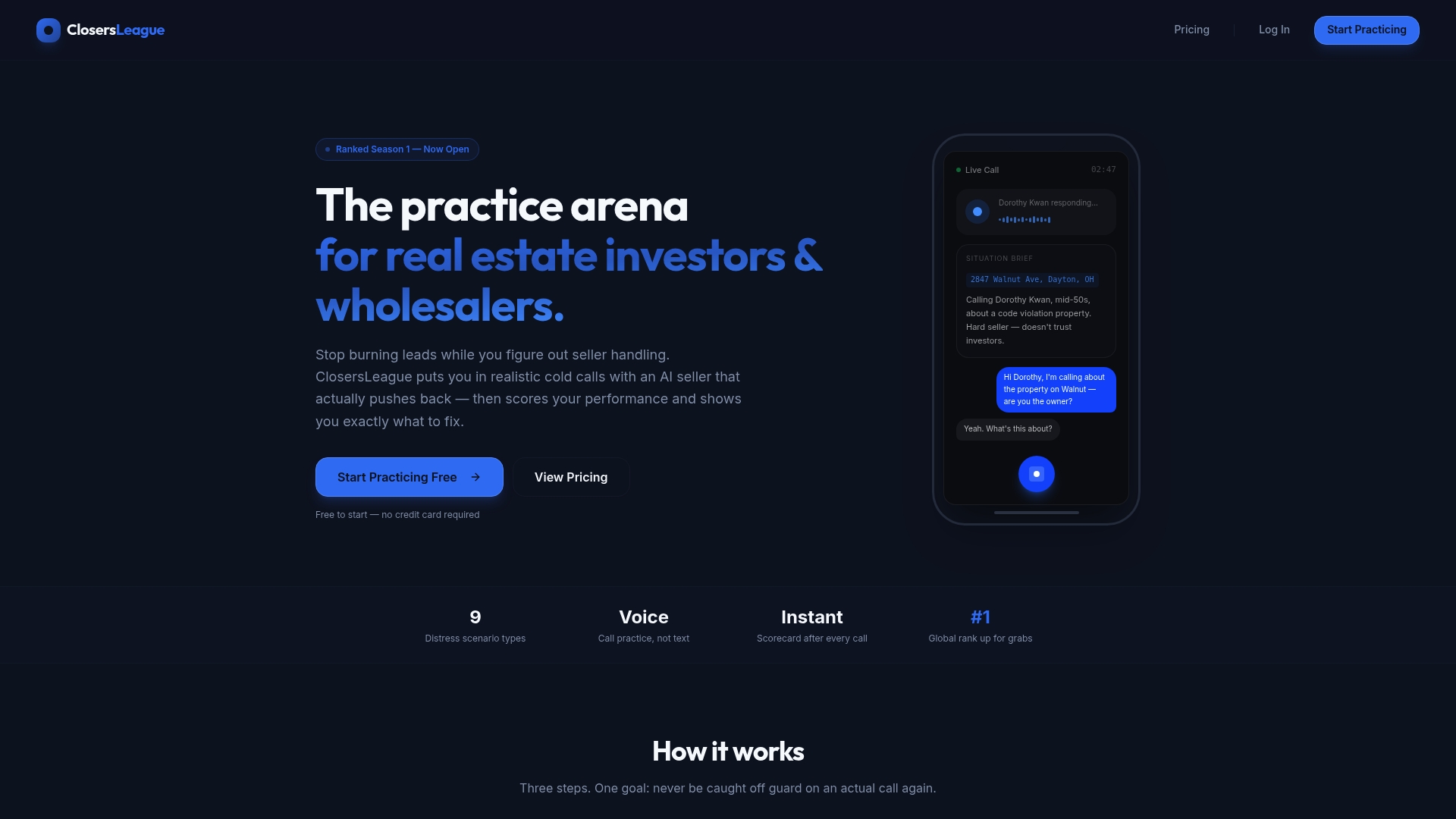
Bring your next multifamily opener, pick a scenario and start practicing on ClosersLeague.
FAQ
How many calls does it take to reach a multifamily owner?
Plan on many attempts per conversation, since owners screen calls and a lot of numbers are wrong or stale. Spread two or three attempts per owner across several days and different times of day, leave one voicemail, and log each try. Better research raises your connect rate more than extra dials do.
Should I try to get an offer or a price on the first call?
No. Aim for a real fact about their situation and permission to follow up. Large buildings take time, and owners guard their financials with strangers. A call that ends with an email address or a scheduled callback is a win.
What should I say if the owner asks how I got their number?
Be direct: you found it through public records and data sources, and you’re happy to remove them from your list if they’d like. Then honor that request immediately if they make it. Honesty here often keeps the conversation going.
Is cold calling multifamily owners legal?
Yes, with rules. Calls to residences must fall between 8 a.m. and 9 p.m. local time, Do Not Call lists and opt-outs must be respected, and automated or prerecorded calls bring consent requirements, per the FTC’s Telemarketing Sales Rule. Your state may add more, so check with a real estate attorney before you scale.
Sources
- eCFR: 16 CFR Part 310, Telemarketing Sales Rule
- FTC: Q&A for Telemarketers & Sellers About DNC Provisions in the TSR
- FCC Order DA 25-312, April 7, 2025
- TechBullion: Why Cold Calls Without Deep Property Data Are Killing Deals