In real estate investing, an upfront contract is not a legal document. It is a short, spoken agreement you make with a homeowner in the first minute of a call: how long you will talk, what you will cover, that either of you can say “this isn’t a fit,” and what happens at the end. It binds nobody to sell or buy. The written purchase agreement does that later. Used well, the upfront contract is what makes the later conversation honest, calm and fast.
That difference matters for wholesalers and investors. Two things share the word “contract” in your business: the verbal frame you set on a cold call, and the signed agreement that locks up a deal. This guide covers both, in the order you will use them.
TL;DR
- An upfront contract is a verbal agreement at the start of a seller call about time, topics, the right to say no, and the next step. It is not legally binding.
- Only a written agreement signed by the parties creates an enforceable contract to sell real property, so your call must lead cleanly to paper.
- State wholesale laws now require written disclosure of your assignment intent in several states, and some give sellers a cancellation window.
- Say who you are, what you do and what happens next on the call, and the written offer will hold up.
- The opener is a skill. You get it by repetition, not by reading a script once.
Table of Contents
- What an upfront contract means on a seller call
- An upfront contract is not a purchase agreement
- How to set an upfront contract, step by step
- What to clarify about expectations and next steps
- Handling “let me think about it” before it happens
- From the call to the written offer
- State rules on disclosure and cancellation
- Red flags that kill the transition
- Practice the opener until it is automatic
- Perspective
- FAQ
- Sources
What an upfront contract means on a seller call
The idea comes from a sales technique: before you start the process, you agree on the process. The goal is to set the rules of the conversation while the homeowner is still listening, so you are not chasing them later.
The homeowners you call are often stressed: a pre-foreclosure notice, a probate estate, a divorce, a vacant inherited house. They did not ask for your call. An upfront contract tells them what the next ten minutes look like and gives them control. That control lowers defensiveness, which is why the technique works on cold calls.
A solid upfront contract has five parts:
- Time. “I’d like about ten minutes. Does that work, or should I call back?”
- Purpose. “I’d like to ask about the house and your plans, and see if we could make you a fair offer.”
- Their agenda. “What would make this call worth your time?”
- Permission to say no. “If this isn’t a fit, tell me straight and I’ll thank you and move on. Is that fair? And if it is a fit, I’ll tell you that too.”
- The outcome. “At the end, we’ll either agree on a next step or we won’t. Either answer is fine.”
The fourth and fifth parts do the heavy lifting. When both sides have agreed a clear yes or a clear no is acceptable, “let me think about it” has less room to hide. You can see how to handle it when it still appears in our “need to think about it” scripts for investors.
An upfront contract is not a purchase agreement
Beginners sometimes assume a verbal “yes” on the phone locks the seller in. It does not.
The North Carolina Real Estate Commission explains that a binding real estate sales contract requires a written agreement signed by all parties, and that an oral willingness to accept an offer does not create a contract. Until those requirements are met, the seller may consider other offers. Another 2026 guide notes that all 50 states require real estate contracts in writing, signed by the party to be charged, with a narrow part-performance exception when someone has substantially relied on an oral promise.
So think of three layers:
| Layer | What it is | Binding? |
|---|---|---|
| Upfront contract | Spoken agreement on how the call runs and what happens next | No |
| Verbal offer | The number and terms you discuss on the phone | No |
| Written purchase agreement | Signed document with price, parties, earnest money, closing date | Yes, once the signing requirements are met |
Your upfront contract does not replace the paper. Its job is to make the paper possible: the seller already knows what you do, how you got your number and what comes next, so the document does not feel like a surprise.
How to set an upfront contract, step by step
Here is the routine, with the place each step usually fails.

Step 1: Identify yourself and ask for time
Give your name, and say you are a local investor calling about the property. Then ask for a specific amount of time. Vague requests (“got a minute?”) invite a quick no. A named time block (“about ten minutes”) sounds respectful and finite.
Where it goes wrong: rushing the opener because your first line feels awkward. That is a delivery problem, and delivery improves with reps. Our guide to opening scripts for real estate cold calls covers the first thirty seconds in detail.
Step 2: State the purpose in plain words
Say what you do. “We buy houses as-is, and sometimes we line up another buyer to close on the contract.” Use ordinary language: sellers should not need to decode terms like “equitable interest” or “assignment.” See our plain language scripts for investor calls for phrasing that sellers understand.
Where it goes wrong: hiding the assignment. In a growing number of states it is a legal requirement to disclose it in writing (more below), and a seller who feels misled on the phone will not sign, or will cancel after.
Step 3: Ask what they want from the call
“What would you like to get out of this conversation?” The answer tells you their real motivation: stopping a foreclosure sale, settling an estate, moving out of state. That answer becomes your guide for the rest of the call and your reference when you present the offer.
Where it goes wrong: skipping it and launching into your questions. A seller who never named a goal will not feel your offer addresses one.
Step 4: Agree that “no” is fine
“If it doesn’t make sense for you, just say so, and I’ll respect that. If I can’t make it work at a number that makes sense for me, I’ll tell you too.” This removes the pressure that makes homeowners hang up.
Where it goes wrong: treating this as a trick. If you say it, mean it, and do not chase a seller who told you no.
Step 5: Agree on the end of the call
“By the end, we’ll know if it’s worth putting something in writing. Does that sound fair?” You are setting up the next step before you ask a single discovery question.
Where it goes wrong: ending with “I’ll send you something” and no agreed follow-up time. Put a day and time on the next contact.
What to clarify about expectations and next steps
After you have set the frame, the call needs to leave the seller clear on three things: who you are in this deal, what happens after they say yes, and how long it takes.
One 2024 wholesaling guide suggests describing your role plainly: you are buying under an agreement, will complete due diligence, and other partners may need to see the home before closing, and a fast close still involves steps. That is good practice whatever your business model. Cover:
- Your role. Buying directly, or under contract with the right to assign it to another buyer.
- How you got your number. Many wholesalers explain it as after-repair value minus repairs, costs and profit. Sellers accept a lower offer more easily when they see the logic.
- The process. Written agreement, earnest money to a neutral third party, title work, closing.
- The timeline. A typical wholesale purchase agreement allows a closing window of 30 to 45 days so there is time to find an end buyer and clear title. Tell the seller what your window is.
- Updates. Promise a rhythm of contact and keep it. After signing, sellers start watching the clock, and silence reads as trouble.
If you want these points in a repeatable order, our investor script workflow lays out a full call structure.
Handling “let me think about it” before it happens
The upfront contract’s best feature is that it deals with the stall in advance. Because you agreed at the start that the call ends in a yes, a no, or a defined next step, you can return to that agreement when the seller hesitates:
“At the start we agreed that by the end we’d either have a next step or part ways. Where are you at?”
Say it calmly. It does not push; it reminds. Many sellers who say “I need to think” are really saying “I have a question I haven’t asked.” Find it. Our objection handling workflow for investors shows how to separate a real need for time from a hidden concern.
One caution on time pressure. Some guides advise giving a seller a 24 to 48 hour acceptance deadline written into the agreement as honest urgency. Keep any deadline honest and tied to a real reason, such as a title commitment or an end buyer’s timeline. Fake urgency, “sign today or lose the deal,” is a pattern consumer-protection agencies treat as a scam indicator, and it damages your reputation in a small market.
From the call to the written offer
Once the seller agrees verbally, the paper has to do what the phone cannot. A written wholesale offer should state:
- The purchase price and the full legal names of all title owners.
- Your name and clear assignment terms.
- The earnest money amount, who holds it and when it is due.
- The inspection or option period.
- A closing date that leaves room to find a buyer and clear title.
- Any state-required disclosures and seller cancellation window.
These are the elements one 2026 first-offer guide lists. A few details deserve attention.
Assignment language. The phrase “and/or assigns” after the buyer’s name signals that you can transfer your contract rights. Without it, the contract is personal to the original buyer and assignment becomes legally questionable. A separate assignment clause in the body is better still: one checklist suggests wording such as the buyer reserving the right to assign the contract before closing, with the seller acknowledging and consenting. That checklist also says any anti-assignment clause should be negotiated out or the deal abandoned.
Earnest money. The same checklist says wholesale earnest money usually runs $500 to $2,000, is held by a neutral third party named in the contract, and should never sit with the seller. Putting down too much is a rookie mistake, since it can be lost if the sale falls through for a reason your contingencies do not cover.
Acceptance must mirror the offer. Any change by the other side is a counteroffer that ends the original. Many form contracts also define the effective date as the day the last party signs, so a one-day delay in the final signature can shorten your inspection window by a day.
Common drafting errors. A legal-forms guide lists leaving the legal description blank, party names that do not match the deed, missed contingency-notice deadlines and failing to include a non-titled spouse in community-property states. Check each before you send anything.
State rules on disclosure and cancellation
Wholesaling remains lawful when you sell your own contract rights, but states are tightening how you must describe it. This is a fast-moving area, so confirm the rule in the state where the property sits before every deal, with a real estate attorney if you are unsure. A few examples from the research:
- Texas. Wholesalers must disclose in writing that they hold only an equitable interest and are marketing that interest, not the property itself, and since January 2024 the notice must reach the homeowner.
- Tennessee. SB909, effective April 8, 2025, requires disclosure in the written agreement of your equitable interest and intent to market it, and notice of an assignment’s effective date at least three business days ahead.
- Pennsylvania. Act 52, effective January 4, 2025, lets a consumer cancel a wholesale contract by the 30th day after execution or conveyance, whichever comes first, and requires prominent disclosures.
- Oklahoma, Ohio, South Carolina and others. The same checklist notes Oklahoma SB 1075 took effect November 1, 2025, Ohio’s disclosure rule took effect March 2, 2026, and South Carolina HB 4754 was signed in May 2024.
The practical lesson: the honest framing you build in your upfront contract is also your legal protection. If you have already told the seller in plain words that you may assign the contract for a fee, the written disclosure confirms what they heard rather than surprising them.
Red flags that kill the transition
Sellers have been burned by bad actors, so they watch for warning signs. One homeowner-facing guide flags a token earnest deposit of $10 to $100, a vague or missing buyer name, unclear closing timelines and evasive answers about whether the buyer is personally buying or assigning. Expect informed sellers to ask these questions. Have clear, honest answers ready, and invite them to have an attorney review the contract. A legitimate offer survives a few days of title checks and review.
Also know what happens after you lock up a deal. If you cannot find an end buyer, you may be tempted to renegotiate or back out, a risk to the homeowner that makes upfront honesty about the process important. Set expectations on that risk with realistic timelines and a fair price from the start.
Practice the opener until it is automatic
Reading about an upfront contract is easy. Delivering it to an upset homeowner who interrupts you in the first ten seconds is hard. The gap between the two is practice.
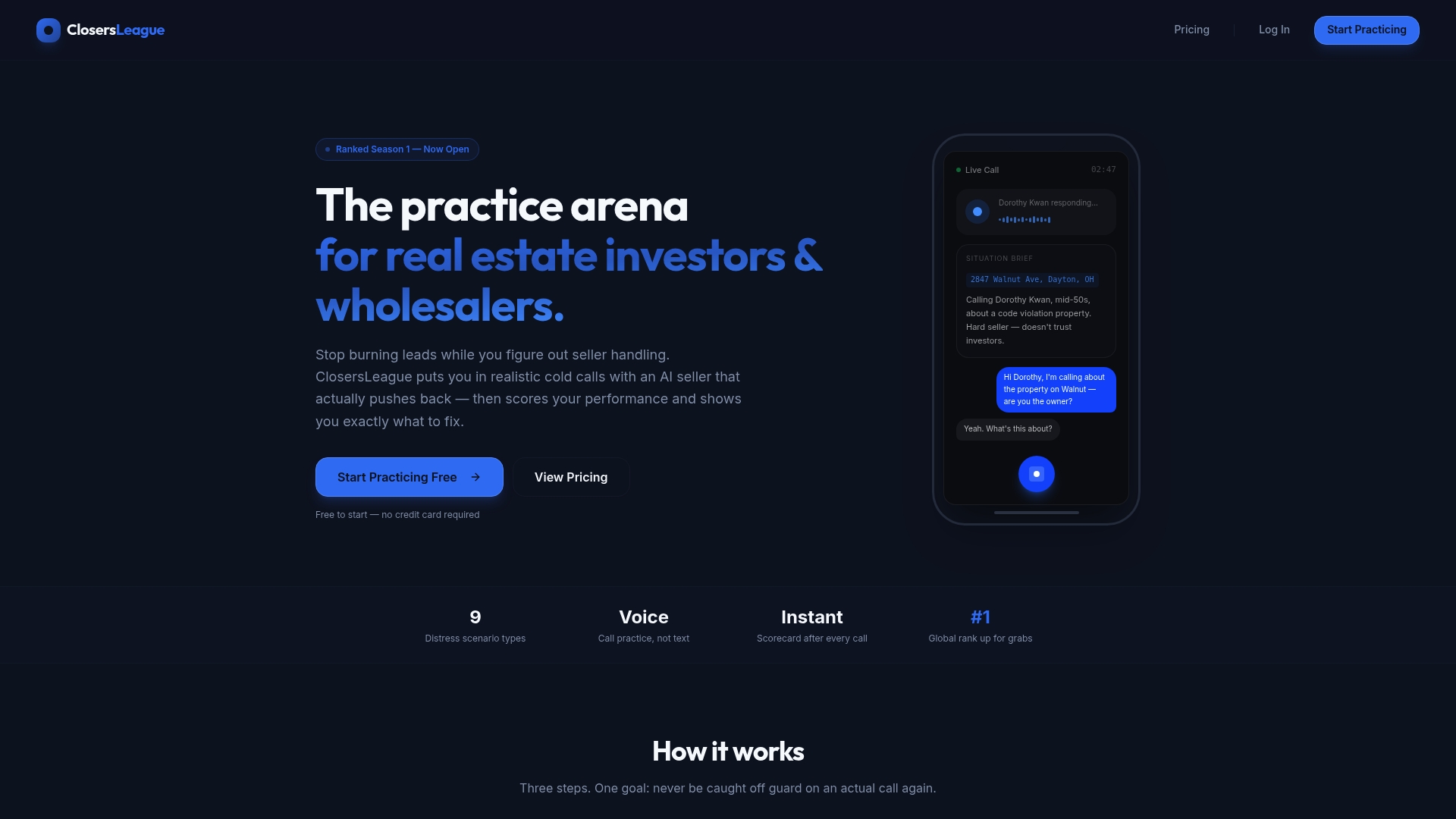
ClosersLeague is an AI cold calling practice platform built for real estate investors and wholesalers. You run scenario-based voice calls against AI sellers across distressed situations such as probate, pre-foreclosure, inherited, tax delinquent, code violation, divorce, out-of-state, vacant and tired landlord. You get real-time coaching, a performance scorecard after each call, targeted skill drills and leaderboards, so you can rehearse your opener, your role explanation and your next-step close on the exact type of seller you are calling.
Plans are monthly and tiered by number of AI practice calls: Starter is $5 per month, Growth is $10 per month and Pro is $18 per month. The free trial includes a limited number of calls. Start from the ClosersLeague home page and run your first upfront contract call today.
If you want to drill other conversation types too, see our guides to appointment setting calls, the novation call script and the seller financing call script.
Perspective
Most investors we talk to do not lose deals on the offer. They lose them in the first ninety seconds, when the homeowner decides whether you are a person worth talking to or one more caller.
The upfront contract fixes that, but only if it sounds natural. A stiff, memorized frame sounds worse than none. That is why we built ClosersLeague around repetition: you can practice setting time, purpose, permission to say no and the next step against nine distressed seller types, get scored on it, and fix what the scorecard shows.
Probate sellers need patience and a gentle pace. Pre-foreclosure sellers feel the clock. A vacant-property owner may have been called five times this month. The same opener does not work on all of them, and practicing against realistic AI sellers is how you learn to adjust. Stop winging it. Start drilling.
Dave
FAQ
Is an upfront contract legally binding?
No. It is a verbal agreement about how the conversation will go. A binding contract to sell real property needs a written agreement signed by the parties. Treat the upfront contract as a communication tool that leads to that document.
What is the difference between an upfront contract and an up-front offer?
An upfront contract is the agreement on process at the start of a call: time, topics, the right to say no and the next step. An up-front offer is a price or terms you put on the table, such as a backup or cash offer. The first sets the frame, and the second is the deal itself.
Do I have to tell the seller I plan to assign the contract?
In a growing number of states, yes, in writing. Texas, Tennessee, Oklahoma and Pennsylvania are among them. Even where the law does not require it, saying it plainly on the call builds trust and reduces cancellations. Check the rules for the property’s state and have an attorney review your contract form.
How long should an upfront contract take?
Under a minute. State the time you need, the purpose, that either side can say no, and the planned next step, then move to your discovery questions. If it runs longer, you are explaining rather than agreeing.
Sources
- NCREC Bulletins: When Does an Offer Become a Contract?
- Real Estate Contract Guide: Clauses, Red Flags and More
- Seller Expectations in Wholesale Real Estate Deals
- What Does a Wholesale Real Estate Contract Look Like?
- How to Get a House Under Contract for Wholesaling
- How to Make Your First Wholesale Offer
- Wholesale Real Estate Contract Checklist Essentials
- Purchase Agreement (Real Estate Purchase Contract)
- Tennessee SB909 Explained for Memphis Sellers
- Wholesale Real Estate Transaction Transparency and Protection Act
- Is Your Home Being Sold Without You? How to Spot a Wholesale Contract
- Difference Between a Wholesaler and a Cash House Buyer