A realistic voicemail callback rate for real estate cold calling is about 3% to 8% of the voicemails you leave, and sometimes higher on motivated lists like pre-foreclosure and probate. Those figures come from published industry guides, not audited studies. Your own number depends on your list, your message and how long you wait before you count a callback. This guide shows what to expect, how to calculate your rate, and how to raise it.
TL;DR
- Well-run U.S. real estate voicemail campaigns report callback rates of roughly 3% to 8%, with pre-foreclosure and probate lists reported at 5% to 10%.
- Calculate two numbers: callbacks per voicemail left, and callbacks per outbound attempt. Fix a window (7 days works) and stick to it.
- Do not compare your rate with inbound missed-call stats. They measure a different thing.
- Short, specific, low-pressure messages plus a text follow-up are the levers to test first.
- Never use ringless voicemail or prerecorded messages without checking consent rules.
Table of Contents
- What is a good voicemail callback rate for real estate investors?
- Which numbers to ignore
- How to calculate your voicemail callback rate
- What makes a homeowner call you back
- What to say in the voicemail
- Test your messages like a scientist
- Compliance: what the rules say about voicemail drops
- Our perspective
- Practice before you dial
- Frequently asked questions
- Sources
What is a good voicemail callback rate for real estate investors?
For U.S. real estate cold calling, one industry guide puts well-executed voicemail callback rates at 3% to 8%. The same guide reports that fresh absentee owner lists typically produce 4% to 8%, while pre-foreclosure and probate lists can reach 5% to 10%.

That gap makes sense. A homeowner facing a foreclosure auction or settling an estate has a reason to return an unknown number. An absentee owner with a stable rental may not.
Older numbers land in a similar zone. Sales-industry veteran Ken Krogue reported that direct prospecting voicemails averaged a 4% to 6% response rate in a 2010 context, rising to 12% to 14% when voicemail was combined with email. The lesson there is about stacking channels, not about the exact figure.
Treat all of these as ranges, not promises. No public dataset measures delivery, listening, callbacks, message length and follow-up channel under the same definitions, as a 2026 voicemail statistics review points out. Your own tracking is the benchmark that matters.
Benchmarks at a glance
| Source of list | Reported callback range | Notes |
|---|---|---|
| Well-executed real estate campaigns (overall) | 3% to 8% | Industry guide, 2026 |
| Fresh absentee owner lists | 4% to 8% | Same guide |
| Pre-foreclosure and probate lists | 5% to 10% | Same guide |
| Direct prospecting voicemail, any industry | 4% to 6% | 2010 context |
| Voicemail plus other outreach, any industry | 12% to 14% | 2010 context, includes email |
The first three rows are real estate specific. The last two are general sales numbers, so use them for direction only.
Which numbers to ignore
Search for this topic and you will find a lot of statistics that sound relevant and are not. Three traps come up often.
Inbound missed-call callback stats. Figures like “31% of businesses return missed calls within 48 hours” describe a business calling back a customer who rang first. A 2026 voicemail statistics roundup says plainly that this should not be presented as the rate at which voicemail recipients return a sender’s call. You are the sender. Different game.
Pickup lift numbers. A large study of 7.8 million cold calls found that later pickup rates rose 25.8% when a voicemail was left after the first call. That is a good reason to leave voicemails. It is not a callback rate, and it should not sit in the same column in your spreadsheet.
Abandonment stats. Headlines about most callers hanging up without leaving a message concern people calling a business. They tell you nothing about how a homeowner responds to your message.

How to calculate your voicemail callback rate
Pick your definitions before the first dial. Two formulas cover most needs.
- Message-level rate: unique return calls (and texts, if you count them) divided by total confirmed voicemails left.
- Attempt-level yield: unique return calls divided by total outbound attempts.
The first tells you how good your message is. The second tells you how productive your dialing is, including all the no-answers and hang-ups. One guide to the formula stresses defining the observation window, such as 7 days, and deciding whether repeat messages to the same prospect count as one or several attempts.
The basic arithmetic for any callback rate is the same: returns divided by total, multiplied by 100. If you left 200 confirmed voicemails and 12 different owners called or texted back within 7 days, your message-level rate is 12 ÷ 200 = 6%.
Set up your tracking in four steps
- Log voicemail as its own outcome. Do not lump it in with “no answer.” Logging voicemails as a separate outcome is the first step to a clean rate.
- Choose one window. Seven days is a practical default for motivated seller lists. Use the same window every time. Published rates use different windows, so they only compare fairly when the windows match.
- Count unique people. Match return calls and texts to the number you called. One homeowner calling three times is one callback.
- Record the list type. Tag every voicemail with its list: probate, pre-foreclosure, tax delinquent, vacant, absentee. A blended rate hides the lists that are working.
If your dialer cannot match inbound calls to outbound voicemails, a dedicated tracking number per campaign solves it.
What makes a homeowner call you back
The research points to the same handful of factors. Treat them as hypotheses to test, not guarantees.
- Seller motivation. A homeowner in distress has a reason to engage. Your list choice sets your ceiling before you say a word.
- List freshness. Recent filings and recent probate openings tend to beat stale lists, per the same real estate voicemail guide.
- Specificity. Mentioning the property address or street gives the owner a reason to believe the call is real. One real estate voicemail guide reports that personalized voicemails earn about 41% more callbacks than generic ones.
- Tone. A curious, low-pressure delivery tends to work better than a formal, rehearsed or overly polished one, according to the VA Horizon guide.
- Length. Keep it short. The same guide recommends under 30 seconds. Another source suggests 8 to 14 seconds. Our own breakdown of voicemails in the 15 to 22 second range sits between the two. Test where your market lands.
- Follow-up. A text after the voicemail gives the owner a second, lower-effort way to respond.
What to say in the voicemail
Keep the structure simple: your name, a brief reason tied to this person, and your callback number repeated slowly. Do not pitch. The goal of the voicemail is a callback, not a sale.
A template to adapt:
“Hi, this is [name]. I’m calling about the property on [street name]. I had a quick question about it, nothing urgent. My number is [number]. Again, [number]. Thanks.”
What to leave out:
- Price talk or “cash offer” language
- Pressure like “call me today”
- A long company introduction
- A fast, mumbled number
Say the number twice and slowly. A great message with an unreadable number earns nothing.
For distressed sellers, empathy matters more than polish. Someone dealing with a death in the family or a divorce does not need a pitch on a recording. If you want to prepare for the live conversation that follows a callback, see our guide on how to cold call motivated sellers and our notes on the ideal call length.
Test your messages like a scientist
Most investors change three things at once and learn nothing. Run clean tests instead.
- Split comparable contacts into two groups. For example, voicemail only versus voicemail plus text. Keep the caller, message, timing window and offer constant so only one variable changes.
- Measure more than callbacks. Track responses, callbacks, booked conversations, opt-outs and time to first response.
- Run enough volume. At a 5% rate, 40 voicemails yield about two callbacks. That is noise. Aim for a few hundred per variant before you declare a winner.
- Change one thing next. Message length, opening line, tone, and time of day are all fair tests. Do them one at a time.
Callback rate is not the whole story. A voicemail may also lift pickup on your next attempt, as the large cold calling study above suggests. Judge it by what happens across the sequence, not only by the inbound call.
When texts and calls both produce replies, you need one place to combine them. A simple property investor checklist is a useful model for keeping your follow-up measurement and underwriting steps in one routine.
For scheduling your attempts across days, our cold call scheduling workflow covers how to space them. For absentee lists in particular, our absentee owner playbook goes deeper.
Compliance: what the rules say about voicemail drops
Ringlessvoicemail and prerecorded messages are not a loophole. In a 2022 declaratory ruling, the FCC clarified that ringless voicemail to wireless phones is a “call” under the TCPA and requires prior express consent. Separately, under the FTC’s Telemarketing Sales Rule amendments of 2008 and 2009, prerecorded sales calls are generally prohibited unless the seller has the recipient’s express written agreement.
The safest way to keep your callback numbers honest is to leave live, personal voicemails when the call goes to voicemail, and to follow your counsel’s advice on texting and do-not-call lists. Our TCPA checklist for U.S. investors walks through the practical steps. For legal questions about your specific outreach, talk to a telecommunications or real estate attorney.
Our perspective
We built ClosersLeague because we kept seeing the same pattern: investors blame the list when the real problem is the first eight seconds of the message.
A voicemail is a tiny script with a huge job. It has to sound human, sound specific and ask for nothing but a callback. Most people have never heard themselves leave one. They wing it, they rush the number, and they never find out why the phone stays quiet.
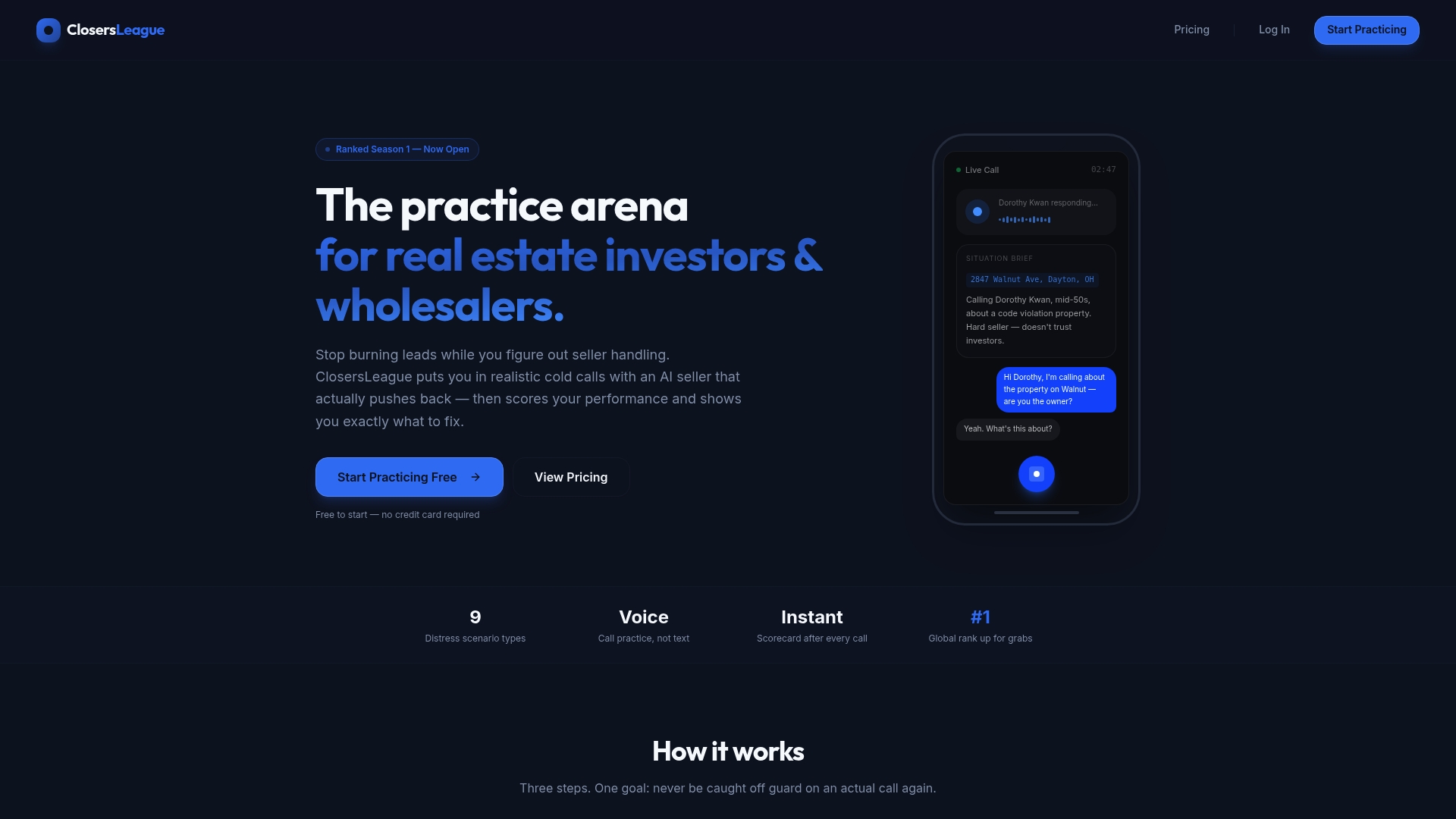
That is why we focus on deliberate practice. Our platform lets you run scenario-based voice practice against AI sellers across nine distressed situations, including probate, pre-foreclosure, divorce and vacant property. You get an instant scorecard, feedback by category and targeted drills. You can rehearse the hard moments hundreds of times before a real homeowner hears you.
Callback rate is a lagging number. Practice is the leading one. Stop winging it. Start drilling.
Dave
Practice before you dial
If your callback rate is flat, the fastest fix is repetition on the parts of the call you control: your opening, your tone and your pacing. ClosersLeague is an AI-powered cold calling training platform for real estate investors and wholesalers, with realistic roleplay for distressed seller types, real-time coaching, scorecards and leaderboards.
Plans are priced by the number of AI practice calls per month: Starter is $5 per month, Growth is $10 per month and Pro is $18 per month, and a free trial includes a limited number of calls. See the plans and start practicing.
Frequently asked questions
What is a good voicemail callback rate for real estate cold calling?
Published industry guidance puts well-run campaigns at about 3% to 8%, with pre-foreclosure and probate lists reported at 5% to 10% by one real estate guide. These are not audited figures. Track your own rate by list type over a fixed window and improve against that.
How long should I wait before counting a callback?
Pick one window and keep it. Seven days is a common choice for outbound campaigns. Published rates use different windows, so they only compare fairly when the windows match, as a 2026 voicemail statistics review notes.
Should I leave a voicemail at all?
Yes, in most cases. A large study of 7.8 million cold calls found that later pickup rates rose when a voicemail was left after the first call. Keep it short, personal and free of pitch.
Is ringless voicemail legal for investors?
It requires care. The FCC treats ringless voicemail to wireless phones as a call under the TCPA, which requires prior express consent. Ask an attorney before using it in a campaign.
Sources
- Voicemail Strategy for Real Estate Cold Calling
- Real Estate Voicemail Scripts That Get Callbacks
- Debunking Voice Mail Myths
- Voicemail Statistics 2026: Listen Rates and Callback Rates
- Voicemail Callback Rate 2026: Evidence and Formula
- Small Business Callback Statistics in 2026
- State of Cold Calling Report
- FCC 22-85 Declaratory Ruling on Ringless Voicemail
- FTC Telemarketing Sales Rule Amendments on Prerecorded Calls
- Property investor checklist