
Follow-up calling is the structured practice of contacting a homeowner again after an initial outreach, with a documented next step and a clear purpose at each touch. For real estate investors and wholesalers, the immediate action after any contact is simple: log what was said, set a scheduled next call, and start a three-phase cadence. Without that discipline, leads evaporate.
Channels typically used in a follow-up sequence:
- Phone calls — the highest-trust channel for distressed sellers
- Voicemail — keeps you present when no one picks up
- SMS — low friction, fast, and effective for check-ins
- Direct mail — adds credibility and reaches sellers who screen calls
Table of Contents
- Why does follow-up calling matter for distressed homeowners?
- What does an effective follow-up system actually need?
- Sample follow-up cadences and scripts you can use today
- How to position follow-up calls and handle common objections
- U.S. compliance basics before you run follow-up sequences
- How do you measure follow-up success and avoid lead limbo?
- Why training and roleplay accelerate better follow-up results
- How to integrate follow-up calling with your broader marketing
- How to personalize follow-up calls to increase engagement
- How to qualify and prioritize leads during follow-up
- Sharpen your follow-up skills with AI-powered roleplay
- Key Takeaways
- The follow-up gap most investors never close
- Sources and further reading
- FAQ
Why does follow-up calling matter for distressed homeowners?
Most deals do not close on the first call. Research aggregates show distressed homeowners require an average of 4.2 to 8 interactions before they engage meaningfully, and practitioner data puts 80% of wholesaling deals between the 5th and 12th contact.
Statistic: Investors who follow up consistently close 3–5x more deals than those who stop after one or two attempts.
The psychology matters here. A homeowner facing pre-foreclosure, probate, or divorce is not ready to sell the day you first call. They move through emotional stages: denial, then reluctant consideration, then acceptance. Your follow-up sequence is what keeps you in the room when they finally reach that third stage. The investor who called once in January is forgotten. The one who called in January, February, and March with genuine value each time gets the deal.
What does an effective follow-up system actually need?
A reliable system has four components working together.
- CRM with call logging — every contact attempt, outcome, and promise gets recorded. Without this, you are relying on memory, and memory loses deals.
- Task reminders and scheduled next contacts — the CRM should surface the next call automatically, not wait for you to remember.
- Basic automation for drips — texts, emails, and voicemail drops between human calls keep you present without burning your time.
- Qualification tiers — not every lead deserves the same cadence. Score leads by motivation level (hot, warm, cold/nurture) and adjust contact frequency accordingly.
Automation supports human follow-up by handling logistics and re-engagement drips. It does not close deals. When a seller is ready to talk, a human conversation closes the deal. Automation’s job is to make sure you are still in the picture when that moment arrives. For a deeper look at how automation fits the investor workflow, the automation guide for real estate investors covers the practical setup.
Pro Tip: Set a rule in your CRM: no lead leaves a call without a documented next step. Even “call back in 90 days” is a next step. A lead with no scheduled action is a lead you will lose.

Sample follow-up cadences and scripts you can use today
A three-phase cadence covers the full seller lifecycle without overwhelming anyone.
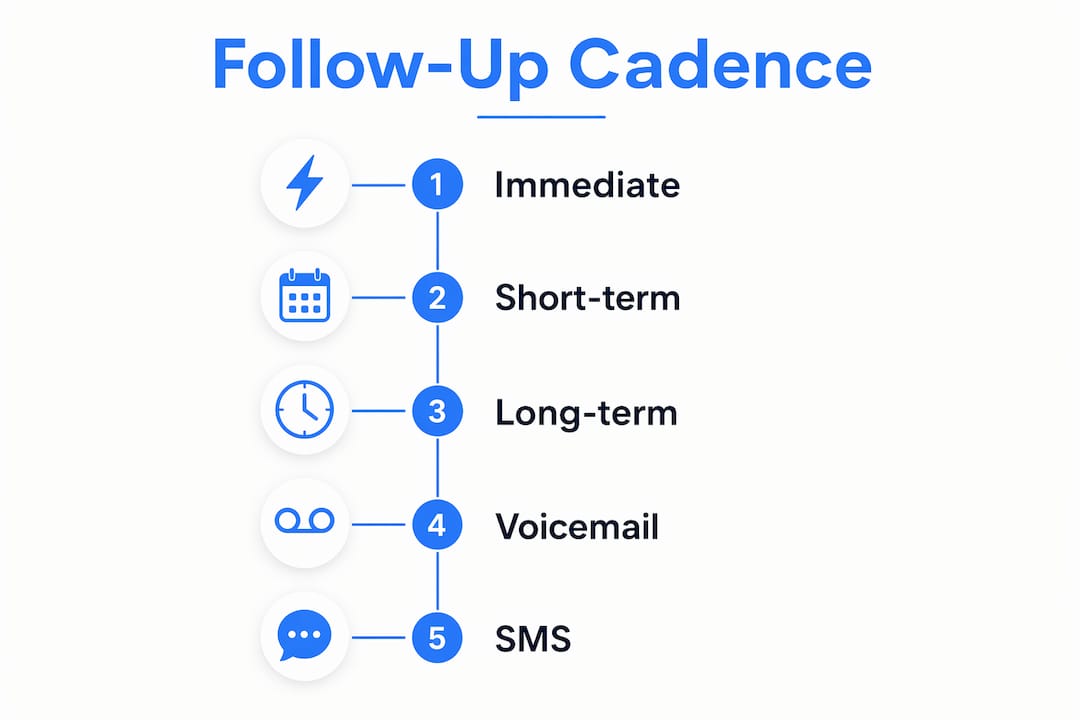
Phase 1: Immediate (Days 0–14)
Day 0: call + notes. Day 2: follow-up text. Day 7: call check-in. Day 14: “Any update on your plans?” A timed touchpoint framework like this keeps early momentum without feeling aggressive.
Phase 2: Short-term (Months 1–3)
Monthly calls with a value-add angle: a market update, a comparable sale nearby, or a straightforward question about their timeline. Each contact should give the seller a reason to stay on the line.
Phase 3: Long-term nurture (Quarterly)
Sellers who go quiet move here. One touch per quarter, low pressure, relationship-preserving. Many deals that close after month six come from this bucket.
Short voicemail script (pre-foreclosure):
“Hi [Name], this is [Your Name]. I work with homeowners in [City] who are weighing their options on their property. No pressure at all — just wanted to check in and see if anything has changed. You can reach me at [number]. Have a good day.”
SMS template:
“Hi [Name], it’s [Your Name] — we spoke about your property on [date]. Just checking in. Any update on your timeline? Happy to answer questions. [Your number]”
Adapt the tone to where the seller is emotionally. A seller in denial needs a softer, curiosity-based opener. A seller who has signaled readiness gets a more direct next-step ask.
How to position follow-up calls and handle common objections
Tone is the difference between a seller who picks up next time and one who blocks your number. Lead with empathy, not urgency. You are offering a solution to a problem they already have.
Common objections and short replies:
- “I’m not selling.” → “Totally understand. I’m not here to pressure you. Would it be okay if I checked back in a few months in case anything changes?”
- “I already have someone.” → “That’s great. I hope it works out. If anything falls through, I’d love to be a backup option.”
- “Not interested.” → “Fair enough. Can I ask — is it the timing, or is the idea of a cash offer just not the right fit?”
- “Call me back later.” → “Of course. What date works best so I can put it on my calendar right now?”
Every objection is an opportunity to document a next step. “Call me back later” is not a rejection; it is a scheduled follow-up with permission. Pre-foreclosure homeowners respond better when you lead with empathy and follow through on any promise you make during the call.
Pro Tip: Replace “I want to make you an offer” with “I’d like to learn more about your situation.” Service-oriented language lowers defenses and keeps the conversation open longer.
U.S. compliance basics before you run follow-up sequences
The Telephone Consumer Protection Act (TCPA) and the national Do Not Call (DNC) registry govern most investor outreach. Calling a number on the DNC list without a prior business relationship or express consent can result in fines. Check every number against the DNC registry before dialing.
Compliance note: TCPA violations can carry statutory damages of $500–$1,500 per call for willful violations. Compliance is not optional.
For SMS, express written consent is required before sending automated texts. Capture consent in writing, store it with the lead record, and honor opt-out requests immediately. For ringless voicemail drops (RVMs), the legal status is contested; consult a qualified attorney before deploying them at scale.
Call recording rules vary by state. Single-party consent states allow recording with only your knowledge; two-party (all-party) consent states require disclosure to the other party. California, Florida, and Illinois are all-party states. When in doubt, disclose: “This call may be recorded for quality purposes.” For specialized guidance on pre-foreclosure calls, the foreclosure cold calling guide covers disclosure language in detail.
This article is general information, not legal advice. Confirm current TCPA and state recording rules with a qualified attorney for your specific situation.
How do you measure follow-up success and avoid lead limbo?
Every follow-up should end with a documented decision or a scheduled next contact. A lead with no next action is in limbo, and limbo is where deals die.
Key metrics to track:
- Contacts per lead — how many attempts before a response
- Response rate by touch number — which call in the sequence gets the most replies
- Conversion by touch number — where in the cadence deals actually close
- Time to first response — speed-to-lead matters; contact within 15 minutes of a new lead dramatically improves response rates
| Lead State | Documented Next Step |
|---|---|
| New, no contact yet | Call within 15 minutes; log attempt |
| Spoke, not ready | Schedule follow-up call; note their timeline |
| Went dark after 2+ contacts | Move to long-term nurture (quarterly) |
| Said “not interested” twice | Archive; suppress from active sequences |
| Showed renewed interest | Escalate to immediate human outreach |
Run a monthly cleanup: review every lead with no scheduled next step, decide archive or nurture, and close the loop. This one habit prevents lead limbo from compounding.
Why training and roleplay accelerate better follow-up results
Knowing the cadence and executing it under pressure are two different skills. Scenario-based roleplay builds the reflexes that make objection handling feel natural rather than reactive. Scorecards reveal exactly where your language breaks down: whether you rush past the empathy opener, fail to ask for a next step, or default to price too early.
Integrating training with your CRM workflow is straightforward. After each roleplay session, identify the one objection you handled worst and drill it until the response is automatic. Then map that improvement to the specific touch in your cadence where that objection typically appears.
ClosersLeague’s AI-powered platform runs scenario-based voice practice across every major distress type: probate, pre-foreclosure, tax delinquent, divorce, inherited, and more. Real-time coaching and performance scorecards show you exactly what to fix. The top follow-up strategies guide on the ClosersLeague blog maps these drills directly to cadence improvement.
Pro Tip: After any live follow-up call that went sideways, recreate the scenario in a roleplay session the same day. The memory is fresh, the lesson sticks, and you will handle it better next time.
How to integrate follow-up calling with your broader marketing
Follow-up calls work best when they are not the only thing a seller hears from you. Distressed homeowners who see a direct mail piece, then receive a call, then get a text are far more likely to engage than those who only get calls. The channel mix builds familiarity before trust.
For investors running Facebook or Google ads targeting distressed homeowners, the call should follow a lead form submission within 15 minutes. That speed-to-lead window is where most deals are won or lost. Sharing a resource like why cash sales close faster during a follow-up call gives sellers a concrete reason to keep the conversation going, especially when they are weighing a traditional listing against a cash offer.
Direct mail and follow-up calls reinforce each other. Reference the mailer on the call: “You may have received a letter from us recently.” It signals professionalism and makes the call feel expected rather than random.
How to personalize follow-up calls to increase engagement
Generic follow-up gets ignored. Personalization gets callbacks. The simplest form: reference something specific from the last conversation. “Last time we spoke, you mentioned the property needed a new roof” tells the seller you were listening, not just dialing.
Tailor your opener to the distress type. A probate seller needs patience and acknowledgment of the emotional weight. A tax-delinquent owner needs a clear explanation of how a cash sale solves the immediate financial problem. An out-of-state owner wants speed and simplicity. The cold calling guide for motivated sellers breaks down opener variations by seller type.
Use your CRM notes as a personalization engine. Log every detail the seller shares: kids, timelines, concerns, competing offers. Reference those details on the next call. Sellers notice, and it separates you from every other investor who called that week.
How to qualify and prioritize leads during follow-up
Not every lead deserves equal attention. Prioritize by motivation signal, not by how recently you called. A seller who mentioned a court date or a bank notice is hotter than one who said “maybe someday,” regardless of when you last spoke.
Three-tier prioritization:
- Hot: Seller has a hard deadline (foreclosure date, probate court date, tax sale). Call every 2–3 days. Escalate to a human conversation immediately if they respond.
- Warm: Seller is open but has no urgency. Monthly contact with a value-add angle. Move to hot if a deadline emerges.
- Cold/Nurture: No motivation signal yet. Quarterly touch. Keep in the system; do not waste daily call time here.
During each follow-up call, ask one qualifying question to update the tier: “Has anything changed with your timeline?” or “Are you still weighing your options, or have things shifted?” The answer tells you exactly where to move the lead. For a full walkthrough of wholesaling call structure, the step-by-step wholesaling calls guide covers qualification in detail.
Sharpen your follow-up skills with AI-powered roleplay
Stop winging follow-up calls. Start drilling them.
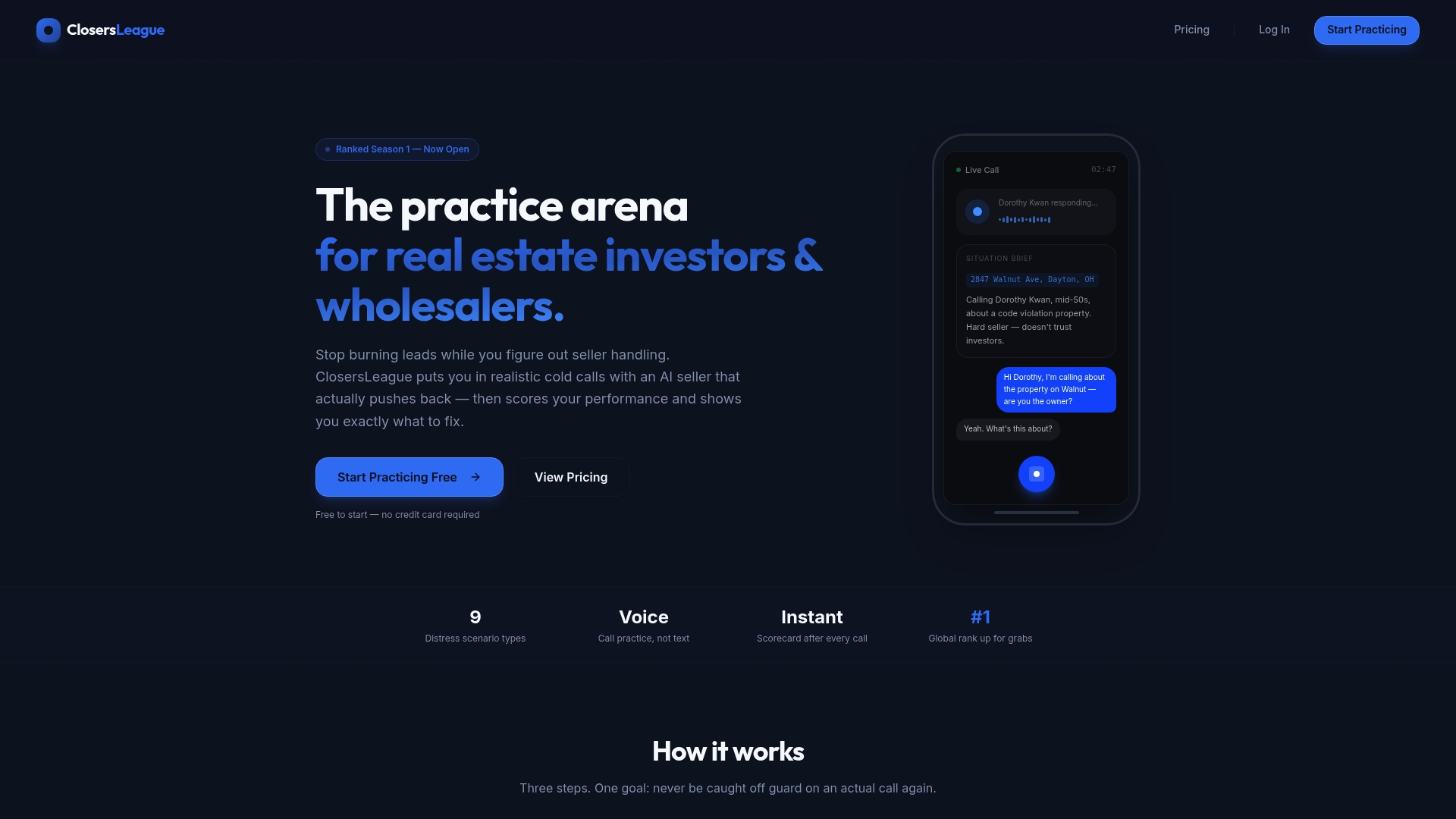
ClosersLeague gives real estate investors and wholesalers a dedicated AI training environment to practice every follow-up scenario before it happens live. You get real-time coaching, performance scorecards, and targeted drills built around the objections distressed homeowners actually raise.
- Practice objection handling across probate, pre-foreclosure, inherited, and tax-delinquent scenarios
- Score your calls and identify exactly where your cadence breaks down
- Build next-step discipline so no lead ever falls into limbo again
The inherited property roleplay practice is a strong starting point if inherited leads are in your pipeline. Ready to drill the full range? Start your free trial at ClosersLeague and run your first AI practice session today.
Key Takeaways
Consistent, documented follow-up calling is the single highest-leverage activity a real estate wholesaler can do to close more deals from the same lead list.
| Point | Details |
|---|---|
| Touches required | Distressed homeowners need an average of 4.2–8 interactions before engaging, and 80% of deals close between the 5th and 12th contact; plan your cadence accordingly. |
| Three-phase cadence | Run immediate (Days 0–14), short-term (monthly), and long-term nurture (quarterly) sequences. |
| No lead without a next step | Log a scheduled next contact after every call; leads with no action become lead limbo. |
| Compliance first | Check numbers against the DNC registry; get written consent before texting; disclose recording in all-party states. |
| ClosersLeague training | Use AI-powered roleplay and scorecards to build objection-handling reflexes and next-step discipline before live calls. |
The follow-up gap most investors never close
Most investors understand follow-up matters. Very few actually practice it before they need it. There is a real gap between knowing you should ask for a next step and doing it naturally when a pre-foreclosure seller is emotional and resistant on the phone.
What I have seen consistently: investors who drill objection responses in a low-stakes environment handle live calls with noticeably more control. They do not freeze when a seller says “I already have an agent.” They do not default to price when the conversation stalls. They ask the right question and document the next step without thinking about it.
The cadence templates and scripts in this guide give you the structure. Roleplay gives you the reflexes to execute that structure under pressure. One session on a probate scenario will reveal more about your weak spots than a month of live calls where you are too busy managing the conversation to notice what went wrong.
Test one script in a ClosersLeague roleplay session before your next live follow-up call. The difference shows up fast.
Sources and further reading
The claims in this guide draw from practitioner research, investor case data, and ClosersLeague’s training methodology. The table below lists the primary sources.
| Source | Key claim supported |
|---|---|
| Televista: Cold calling off-market properties | 4.2–8 touches before distressed homeowner engagement |
| Texas Signals: Outreach scripts | 3–5x more deals with consistent follow-up; timed touchpoint framework |
| Retipster: Follow-up and automation | Automation supports human follow-up; true follow-up begins after first response |
| FlipMantis: 7-day strike | Every follow-up needs a documented next step or archive decision |
| Discount Property Investor: Episode — | 80% of deals close between the 5th and 12th contact |
| BatchDialer: Pre-foreclosure mistakes | Empathy and promise follow-through build credibility with pre-foreclosure sellers |
| Televista: Cold calling ROI | Cold calling ROI remains strong; emotional stage guides script adaptation |
| ClosersLeague: Top follow-up strategies | Roleplay and scorecards improve cadence consistency and next-step discipline |
For deeper training, the ClosersLeague cold calling tips guide and the why follow-up increases deals post expand on the evidence and mechanics covered here.
FAQ
What is follow-up calling in real estate investing?
Follow-up calling is the practice of contacting a homeowner again after an initial outreach, with a documented purpose and a scheduled next step at each touch. For investors, it is the primary mechanism for converting distressed homeowner leads into deals over multiple contacts.
How many follow-up calls does it take to reach a distressed seller?
Research aggregates show an average of 4.2–8 interactions before a distressed homeowner engages, and practitioner data puts 80% of wholesaling deals between the 5th and 12th contact.
What should I say when a seller tells me they are not interested?
Acknowledge it without arguing: “Fair enough. Can I ask whether it is the timing or the idea of a cash offer that does not fit right now?” This keeps the conversation open and gives you information to document for a future follow-up.
Do I need consent before texting a seller?
Yes. TCPA rules require express written consent before sending automated texts to a seller. Capture and store that consent in your CRM, and honor opt-out requests immediately.
How does ClosersLeague help with follow-up calling?
ClosersLeague is an AI-powered training platform that runs scenario-based voice practice across distress types like probate, pre-foreclosure, and inherited properties, with real-time coaching and scorecards that build objection-handling reflexes and next-step discipline before live calls.