Skip tracing is the process of locating a person’s current contact information when ordinary channels have failed. According to Thomson Reuters Legal Solutions, it is used professionally across debt collection, legal service, repossession, real estate outreach, and process service. The term comes from the phrase “to skip town,” meaning someone who has left without a forwarding address.
Here is when skip tracing applies:
- Debt collection: a collector needs a current phone or address for someone who has stopped responding
- Legal service and process serving: an attorney or process server must deliver court documents to a named party
- Repossession: a lender or repo agent needs to locate a vehicle or asset
- Real estate investing: a wholesaler or investor wants to reach an absentee owner or inherited-property heir
- Bail and bounty work: a bondsman needs to locate a defendant who missed a court date
If you need one contact, a DIY approach using public records and free tools can work. If you are working a list of 50 or more leads, a paid batch service will save time and improve accuracy.
Key Takeaways
Skip tracing locates current contact information for hard-to-reach individuals using public records, commercial databases, and open-source research, with U.S. legal compliance under the FCRA, FDCPA, and TCPA required at every step.
| Point | Details |
|---|---|
| Core definition | Skip tracing finds current contact info when ordinary channels fail, using public records and commercial databases. |
| Legal must-dos | Document permissible purpose, avoid credit-report data for marketing, and keep written consent records for all automated outreach. |
| DIY vs. professional | Use the DIY checklist for single traces; upgrade to a paid batch service when working lists of 50 or more properties. |
| Real estate workflow | Start with a property address, run a batch or single trace, verify the top two numbers, then follow a structured outreach cadence. |
| ClosersLeague | Practice distressed-owner calls with AI roleplay before dialing traced leads to improve conversion and handle objections confidently. |
Table of Contents
- What is skip tracing and how does the process work?
- Who uses skip tracing?
- What tools and databases do skip tracers use?
- How to run a DIY skip trace: a step-by-step checklist
- U.S. legal and privacy rules you must know before skip tracing
- Verification, ethics, and recordkeeping best practices
- How real estate investors use skip tracing in practice
- What skip tracing taught me about real outreach
- Practice your outreach before you make the call
- Sources
- FAQ
What is skip tracing and how does the process work?
Skip tracing follows a consistent four-stage workflow regardless of who is running the trace. Bosco Legal Services describes the core method as moving from raw starting data through database searches, record matching, and finally a prioritized contact strategy.
-
Gather starting points. Collect everything you already have: full legal name, last known address, phone number, email, property parcel number, or employer. More starting data produces faster, more accurate results. A property address alone is enough to begin a real estate trace.
-
Search public records and proprietary databases. Run the subject through county property and tax assessor records, court dockets, business entity filings, DMV records (where accessible), and voter rolls. Commercial people-finder databases and reverse-phone services fill in gaps that public records miss.
-
Resolve and match records. This is where accuracy is won or lost. You are looking for consistent name-address-phone combinations across multiple independent sources. Watch for aliases, maiden names, LLC ownership layers, and trust structures that can obscure the true owner.
-
Verify and rank contact options. Not all numbers are equal. A mobile number confirmed active within the last 90 days outranks a landline listed three years ago. VoIP numbers often have lower answer rates. Rank your contacts by recency and line type before you dial.
-
Execute a contact strategy and keep records. Call, text, or send certified mail based on what you have verified. Log every attempt: date, time, number dialed, result, and source of that number. Good recordkeeping protects you legally and helps you refine your approach.
Pro Tip: When a trace returns multiple numbers, work them in order of recency. A number confirmed active within 60 days is worth three attempts before you move to an older one. Freshness beats quantity every time.
Who uses skip tracing?
Skip tracing is a standard tool across several professional fields. The objectives differ, but the underlying method is the same.
- Debt collectors use it to re-establish contact with borrowers who have moved or changed numbers, operating under CFPB-enforced debt collection rules
- Process servers and attorneys use it to locate defendants, witnesses, or parties who must be served with legal documents
- Repossession agents use it to find collateral, typically vehicles, when a borrower has defaulted and moved the asset
- Bail bondsmen use it to locate defendants who have skipped a court date before a bond is forfeited
- Landlords and property managers use it to track down former tenants who left owing rent or damages
- Private investigators use it for a wide range of location assignments, from missing persons to fraud investigations
- Real estate investors and wholesalers use it to find the owners of distressed, vacant, or absentee-owned properties before those properties ever hit the market
The real estate use case deserves a closer look because it drives a large share of consumer-grade skip tracing demand. An investor pulls a list of tax-delinquent properties from the county assessor. The listed owner has not paid taxes in two years and the property sits vacant. The mailing address on file returns mail as undeliverable. Skip tracing is the only way to find a working phone number or current address for that owner.
The absentee-owner scenario is the most common entry point for real estate skip tracing. A property address is the starting input; a verified mobile number for the decision-maker is the output; everything in between is the trace.
What tools and databases do skip tracers use?
Skip tracing draws from a layered stack of public and commercial sources. Understanding what each layer contains helps you choose the right tool for the job and research property owners more efficiently.
Public records (free, primary sources):
- County clerk and court records: case dockets, judgments, liens, and filings. Sites like Miami-Dade Clerk of Courts show the type of official records available at the county level
- Property and tax assessor records: ownership history, mailing address, assessed value, and tax payment status
- Business entity filings: state secretary of state databases that reveal LLC members, registered agents, and addresses
- Federal court dockets: PACER and bankruptcy court filings, including Southern District of Florida bankruptcy records, can surface debtors and related parties
- Voter registration rolls: available in some states, containing address and sometimes phone data
Commercial databases and aggregator services:
These are subscription or pay-per-search platforms that compile data from credit headers, utility records, and proprietary sources. Access to credit-header data is regulated under the Fair Credit Reporting Act, so permissible purpose matters. Common categories include people-finder platforms, reverse-phone lookup services, and REI-specific batch trace providers.
Open-source intelligence (OSINT):
- Social media profiles (Facebook, LinkedIn, Instagram) often contain current city, employer, and contact details
- Google searches combining name, city, and property address
- Obituaries and genealogy sites (useful for inherited-property traces)
- Professional directories and state licensing boards
Batch vs. single-trace services:
A single trace costs more per record but returns richer data. Batch services process hundreds or thousands of addresses at once at a lower per-record cost, with some accuracy tradeoff. For real estate investors running large lists, batch processing is standard. For a process server chasing one defendant, a single deep trace is worth the premium.
Skip tracing accuracy varies significantly by data tier. Entry-level batch services may return moderate match rates, while premium single-trace services targeting verified mobile numbers generally perform better. Always cross-check results against at least two independent sources before calling.
How to run a DIY skip trace: a step-by-step checklist
You can run a lawful skip trace without a paid subscription. The checklist below covers the core steps. For a deeper look at the full real estate prospecting process, the linked guide walks through how tracing fits into a broader outreach workflow.
-
Confirm your lawful purpose. Before you search, be clear on why you are tracing this person. Using skip-trace data for marketing to consumers can trigger FCRA obligations. Using it to harass someone violates the FDCPA and potentially state stalking statutes. Write down your purpose before you start.
-
Start with property and tax records. Go to the county assessor or property appraiser website for the subject’s last known county. Pull the ownership record, mailing address, and tax payment history. This is free in most U.S. counties.
-
Check county court dockets. Search the county clerk’s civil and criminal dockets for the subject’s name. Judgments, liens, and recent filings often contain current addresses and sometimes employer information.
-
Run a reverse-phone or reverse-address search. Free tools like WhitePages or AnyWho return basic results. Paid tiers return more numbers and confirm line type (mobile vs. landline vs. VoIP).
-
Search social media and professional directories. A LinkedIn profile updated last month is a strong signal of current city and employer. Facebook often contains a current city and sometimes a phone number in the “About” section.
-
Identify associates and relatives. Cross-reference the subject’s name with known relatives or business partners. A relative’s address sometimes leads to the subject’s current location, particularly in inherited-property situations.
-
Cross-check two or more independent sources. A phone number that appears in both a county filing and a social media profile is far more reliable than one that appears in only one place. Never call a number you cannot confirm from at least two sources.
-
Log everything. Record the date, source, and result of every search. Note when you found each piece of data and from where.
Before you contact anyone, verify the number is still active. A quick carrier lookup or a single ring-and-hang-up test can save you from burning a bad number on your first real attempt.
Pro Tip: When your DIY search stalls after steps 1–6, that is the signal to upgrade to a paid single-trace service. The incremental cost is almost always less than the time you would spend on additional manual searching, and the data quality is meaningfully better.
U.S. legal and privacy rules you must know before skip tracing
Skip tracing operates inside a framework of federal and state laws. Ignoring them exposes you to civil liability, regulatory action, and in some cases criminal penalties.
Fair Credit Reporting Act (FCRA)
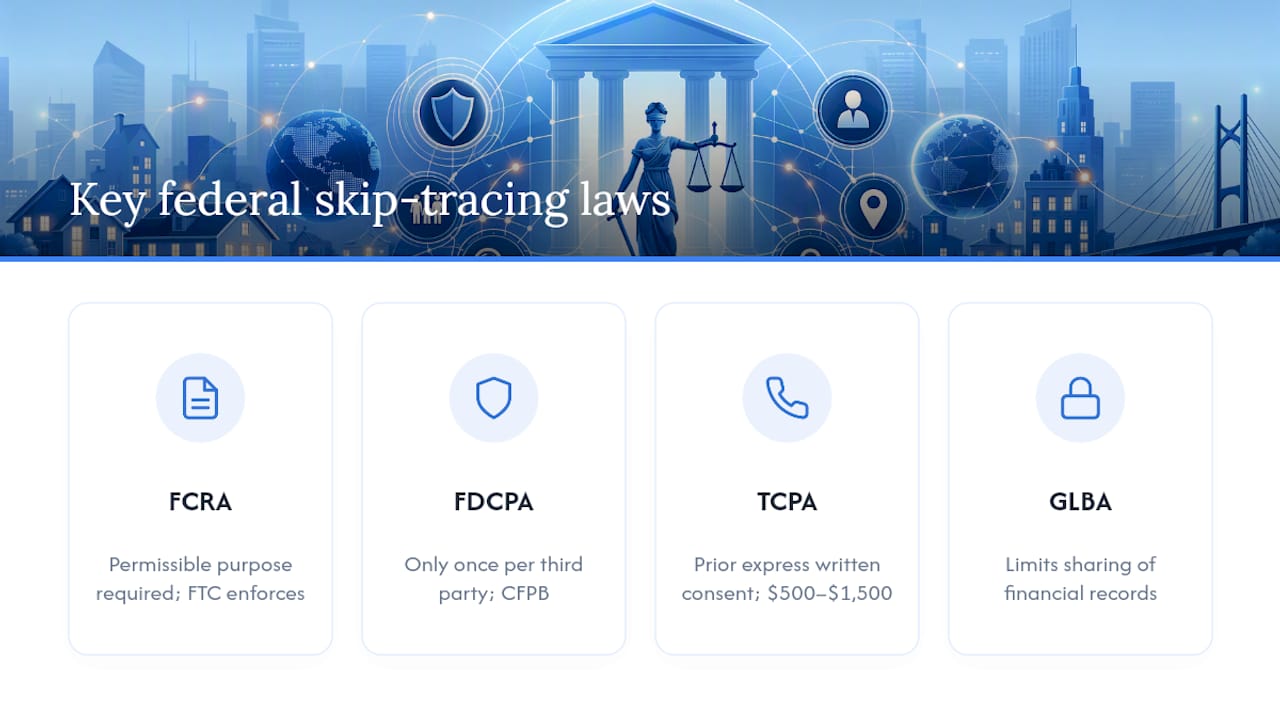
The FCRA governs when a data search becomes a “consumer report.” If you use a consumer reporting agency’s data to make decisions about credit, employment, housing, or similar purposes, you must have a permissible purpose. Using credit-header data for general marketing or skip tracing without a permissible purpose is an FCRA violation. The FTC enforces this actively.
Fair Debt Collection Practices Act (FDCPA)
The FDCPA, enforced by the CFPB, restricts how third-party debt collectors contact consumers. Collectors may contact third parties only to locate a debtor, and only once per third party. Repeated contact, harassment, or deceptive tactics are prohibited. Real estate investors are generally not “debt collectors” under the FDCPA, but anyone purchasing distressed debt should review their status carefully.
TCPA and FCC rules
The Telephone Consumer Protection Act and FCC telemarketing rules require prior express written consent before sending automated texts or using an autodialer to call a mobile number. The National Do-Not-Call Registry applies to telemarketing calls. Violations carry statutory damages of $500–$1,500 per call or text. Keep written consent records for every number you contact via automated means.
Gramm-Leach-Bliley Act (GLBA)
The GLBA imposes data-handling and privacy obligations on financial institutions. If your trace involves financial records or you work with a financial institution’s data, GLBA limits how that information can be shared or used.
State-level rules
California (CCPA), Illinois, and several other states have enacted privacy laws that go beyond federal minimums. County clerk rules also vary: some counties restrict bulk downloads of public records, and some states limit voter-roll access to specific purposes. Always check the rules for the specific state and county you are searching.
Practical compliance steps: document your permissible purpose in writing before each trace, avoid using credit-report data for marketing, maintain consent records for every SMS or automated call, and stop all contact immediately when a subject requests it in writing. The federal court rules governing process service set a useful standard for documentation even when you are not a process server.
Verification, ethics, and recordkeeping best practices
Accuracy and ethics are not separate concerns in skip tracing. A bad match that leads to contact with the wrong person creates legal exposure and damages your reputation with the right one.
Verification checklist:
- Confirm name, address, and phone number appear consistently across at least two independent sources
- Check the timestamp on each data point: a number confirmed active within 90 days is significantly more reliable than one last seen two years ago
- Validate line type before calling: mobile numbers have higher answer rates and different consent requirements than landlines
- Cross-reference LLC or trust ownership with state business filings to confirm the human decision-maker behind an entity
Ethical limits:
- Never use deceptive pretexting to obtain information (claiming to be someone you are not)
- Stop all contact immediately when a subject sends a written cease-and-desist
- Do not share traced data with third parties who do not have a lawful purpose for it
- Respect the difference between locating someone and surveilling them
Recordkeeping basics:
Keep a log for every trace that includes the subject’s name, the date of each search, the sources checked, the data found, and the contact attempts made. Retain these records for a minimum of two years, or longer if your industry has specific retention requirements. Good logs are your first line of defense if a contact ever disputes how you found them.

Pro Tip: Use a simple spreadsheet with columns for source, date found, data type, and confidence level (high/medium/low). Sorting by confidence level before you dial means your best numbers get called first, and you have a clear paper trail if questions arise later.
How real estate investors use skip tracing in practice
For investors and wholesalers, skip tracing is address-first. You start with a property, not a person. That distinction shapes the entire workflow and is why real estate data mining tools built for REI differ from general people-finder services.
Typical workflow:
- Pull a distressed-property list: tax delinquent, pre-foreclosure, probate, code violation, vacant, or out-of-state owner
- Upload addresses to a batch skip-trace service or run individual traces using the DIY checklist above
- Enriched output typically returns multiple phone numbers per record, along with an email address, a current mailing address, and any LLC or trust linkage
- Verify the top two numbers against independent sources before calling
- Check for disclosure obligations and legal considerations relevant to the property before outreach
Sample outreach flow:
- Day 1: Call the highest-confidence mobile number. Leave a brief, honest voicemail if no answer.
- Day 3: Send a short SMS referencing your voicemail.
- Day 7: Send a handwritten or certified mail piece to the verified mailing address.
- Day 14: Attempt the second-ranked number.
Sample opening script for a distressed-owner call:
“Hi, this is [your name]. I’m a local real estate investor, and I came across your property at [address]. I work with homeowners who are thinking about selling, and I wanted to see if that’s something you’d be open to discussing. Is now a good time?”

Keep it honest, keep it short, and let the seller respond. The goal of the first call is a conversation, not a close.
Pro Tip: After you run a skip trace and before you dial a single number, spend 20–30 minutes practicing the call with an AI roleplay tool. You will handle the first objection better, and you will not freeze when the seller says “how did you get this number?” Preparation at this stage directly affects your conversion rate.
What skip tracing taught me about real outreach
Skip tracing gives you the number. What you do with it is a separate skill entirely, and most investors underestimate that gap. The trace is the research phase. The call is the performance. Treating them as one continuous task is where most wholesalers lose deals they should have won.
The investors I see improve fastest are the ones who treat the outreach side with the same rigor they apply to finding leads. They practice specific objections, they work on their tone for probate calls versus pre-foreclosure calls, and they track their own performance. A skip trace that returns a verified mobile number for a motivated seller is only as valuable as the conversation that follows it. If you freeze on “I’m not interested” or stumble when asked how you found the number, the trace was wasted.
The other thing worth saying plainly: legal compliance in skip tracing is not a formality. The FCRA, FDCPA, and TCPA carry real penalties, and the rules are specific enough that a small procedural error can create significant exposure. Build the compliance steps into your workflow from the start, not as an afterthought.
Practice your outreach before you make the call
You have traced the lead. You have a verified mobile number and a property address. The next step is the call, and that call is where most investors leave money on the table.

ClosersLeague is an AI-powered cold calling training platform built specifically for real estate investors and wholesalers. You practice live conversations with AI sellers modeled on the exact distress types you are calling: probate, pre-foreclosure, inherited property, tax delinquent, code violation, and more. Every session scores your performance, flags the objections you missed, and tracks your improvement over time. No more winging the first call on a fresh trace. Start practicing with AI roleplay today, or go straight to inherited property scenarios if that is your primary lead type. A free trial gets you started with no long-term commitment required.
Sources
These are the primary U.S. government and authoritative sources for skip tracing compliance and legal context:
This article is general information, not a substitute for advice from a qualified lawyer. Consult a qualified legal professional about your own circumstances before acting on anything here.
FAQ
What is skip tracing in simple terms?
Skip tracing is the process of finding a person’s current phone number, address, or contact information when they cannot be reached through normal means. It uses public records, commercial databases, and open-source research to locate the subject.
Is skip tracing legal in the United States?
Skip tracing is legal when performed for a lawful purpose and in compliance with the FCRA, FDCPA, and TCPA. Using traced data for harassment, unauthorized marketing, or without a permissible purpose can violate federal law and expose you to civil or regulatory penalties.
What is real estate skip tracing?
Real estate skip tracing starts with a property address rather than a person’s name. Investors and wholesalers use it to find the owner of a distressed, vacant, or absentee-owned property, typically returning 2–4 phone numbers, an email, and a current mailing address per record.
How accurate is skip tracing data?
Accuracy depends on the data tier and service used. Always cross-check results against at least two independent sources before making contact.
When should you hire a professional skip tracer?
Hire a professional when a DIY search has stalled, when legal service of process is required, or when the stakes of a wrong match are high. For high-volume real estate lists, a paid batch service is the practical equivalent of a professional trace at a fraction of the per-record cost.