
The biggest shift in 2026 wholesaling trends is not about finding more leads. It’s about doing far more with the ones you already have, faster and with less legal exposure than ever before.
Here’s what’s driving the market right now:
- AI pipeline management has moved beyond lead generation. The real gains come from automating post-call CRM updates, follow-up sequencing, and disposition matching.
- Legal compliance is no longer optional. States like Ohio, Tennessee, Maryland, and Connecticut have passed new wholesaling disclosure laws, and TCPA enforcement is intensifying.
- Virtual wholesaling and AI-assisted valuations are reshaping how deals get analyzed and assigned, though manual verification still matters in thin markets.
- Buyer behavior has shifted toward cash investors and landlords as mortgage rates have stabilized at a moderate level, pricing out retail buyers and concentrating deal flow among your core audience.
- ClosersLeague trains wholesalers to master the one thing AI cannot replace: the live conversation with a motivated seller.
How AI is transforming wholesaling workflows in 2026
AI’s highest-leverage application in wholesaling is no longer lead generation. It’s pipeline management, and the gap between teams that understand this and those that don’t is widening fast.
Where AI delivers the biggest gains:
- Predictive lead scoring: Platforms like PropStream and BatchLeads analyze tax delinquency, probate filings, utility shutoffs, and equity positions to surface motivated sellers 6–12 months before they list. Users of these AI platforms report 30–40% cost per lead reductions by focusing on high-probability sellers.
- Skip tracing accuracy: AI-powered skip tracing now pushes contact hit rates up to 70–97% by cross-referencing voter registration, utility records, and commercial data aggregators in real time.
- Post-call CRM automation: Manual CRM updates after calls consume 2 to 3 hours daily per rep. AI transcription tools push structured data directly into your CRM within 60 seconds of a call ending, including property details, seller motivation, and follow-up commitments.
- AI-prioritized callbacks: Intelligent follow-up sequences adjust timing based on seller signals. Teams using AI-prioritized follow-up see a notably higher conversion rate on aged leads versus manual callback lists.
- Disposition automation: AI buyer-match agents tag cash buyers by zip code, rehab budget, and investment strategy. One operation reported days-on-market dropping from 11 to 4 after deploying a custom buyer-match agent.
Pro Tip: Track your team’s post-call CRM update time for one week. Most teams find 2 to 3 hours per rep per day lost to manual data entry. Closing that gap, not adding another lead tool, is where the fastest ROI lives.
The AI pipeline management insight that separates top wholesalers in 2026 is this: scaling deal volume no longer requires proportional headcount growth. It requires better automation between your existing tools.
Legal and compliance best practices for wholesaling in 2026
Regulatory pressure on wholesalers has never been higher, and the trend is toward more rules, not fewer. Ohio, Tennessee, Maryland, Oklahoma, and Connecticut all passed new wholesaling laws between 2025 and 2026, each requiring written seller disclosures, right-to-cancel periods, and in Connecticut’s case, registration with the Department of Consumer Protection.
What compliant wholesalers do differently:
- Use attorney-reviewed contracts tailored to their state, including proper assignment language and required disclosure clauses.
- Scrub every list against the Federal Do-Not-Call registry before dialing. TCPA liability from non-compliant automated outreach has generated significant litigation in recent years, and one lawsuit can erase a year of profits.
- Disclose their role in writing. Sellers must know the wholesaler is acting for their own profit, may assign the contract without consent, and that the purchase price may be below market value.
- Respect state calling windows and flag litigator numbers before deploying any AI dialer. Build the compliance layer before scaling, not after.
- Consult a real estate attorney before entering new markets, especially in Illinois, New Jersey, and California, where enforcement is active.
Regulatory tightening actually benefits professional wholesalers. It raises the barrier to entry, reduces competition from careless operators, and builds trust with sellers who’ve heard horror stories. Operate cleanly and you stand out.
The ReadyDeals regulatory analysis confirms that wholesaling is legal in every US state, but sloppy practices are what create legal trouble. Attorney-reviewed contracts and transparent disclosures are the baseline for 2026, not a differentiator.
For a broader look at how compliance parallels other regulated outreach industries, the mortgage compliance framework offers useful parallels on documentation standards and consumer protection obligations.
Modern wholesaling techniques and essential tools to adopt in 2026
The 2026 wholesaling toolkit has matured. The question is no longer whether to use AI tools, but which gaps to close first and in what order.
Core tools and techniques worth adopting:
- AI cold calling agents: Voice AI has crossed the threshold where it can hold a real first-touch conversation with a motivated seller. One Phoenix operation significantly reduced cold-calling costs by replacing a six-person team with an AI caller and fewer part-time reps, achieving comparable contract rates.
- Automated valuation models (AVMs): Tools like DealCheck generate ARV estimates quickly, but accuracy varies. In high-transaction suburban markets, AI valuations typically land within 5–8% of actual value. In rural or low-comparable markets, that margin can expand to 15–25%. Always cross-reference with a local CMA before committing to a spread.
- CRM automation: CRM integration that connects your dialer, transcription tool, and pipeline eliminates the manual gap that can save 10–15 calling hours per rep weekly.
- Virtual wholesaling: Remote deal-making using digital contracts, e-signatures via DocuSign, and virtual property walkthroughs has expanded the geographic reach of solo operators significantly.
- AI-assisted buyer matching: Segmenting your buyer list by investment criteria (BRRRR vs. flip vs. hold, max rehab budget, target zip codes) and automating outreach to the 20–25 most relevant buyers per deal is the most under-used advantage in disposition.
Pro Tip: Sequence your tool adoption: start with list scoring and CRM automation, then add an AI cold caller, then build the dispo buyer-match agent. Each stage pays for itself before you add the next layer.
The labor mix is shifting too. Fewer dialers, more automation engineering, and higher-value human roles focused on negotiation and relationship management. AI roleplay training helps wholesalers sharpen the live conversation skills that no tool can replace, particularly for distressed seller scenarios like foreclosure, probate, and divorce.
ClosersLeague helps you win the calls AI can’t make for you
AI handles the sourcing, the data entry, and the follow-up sequencing. But the moment a motivated seller picks up the phone, the deal lives or dies on your conversation skills. That’s where ClosersLeague comes in.
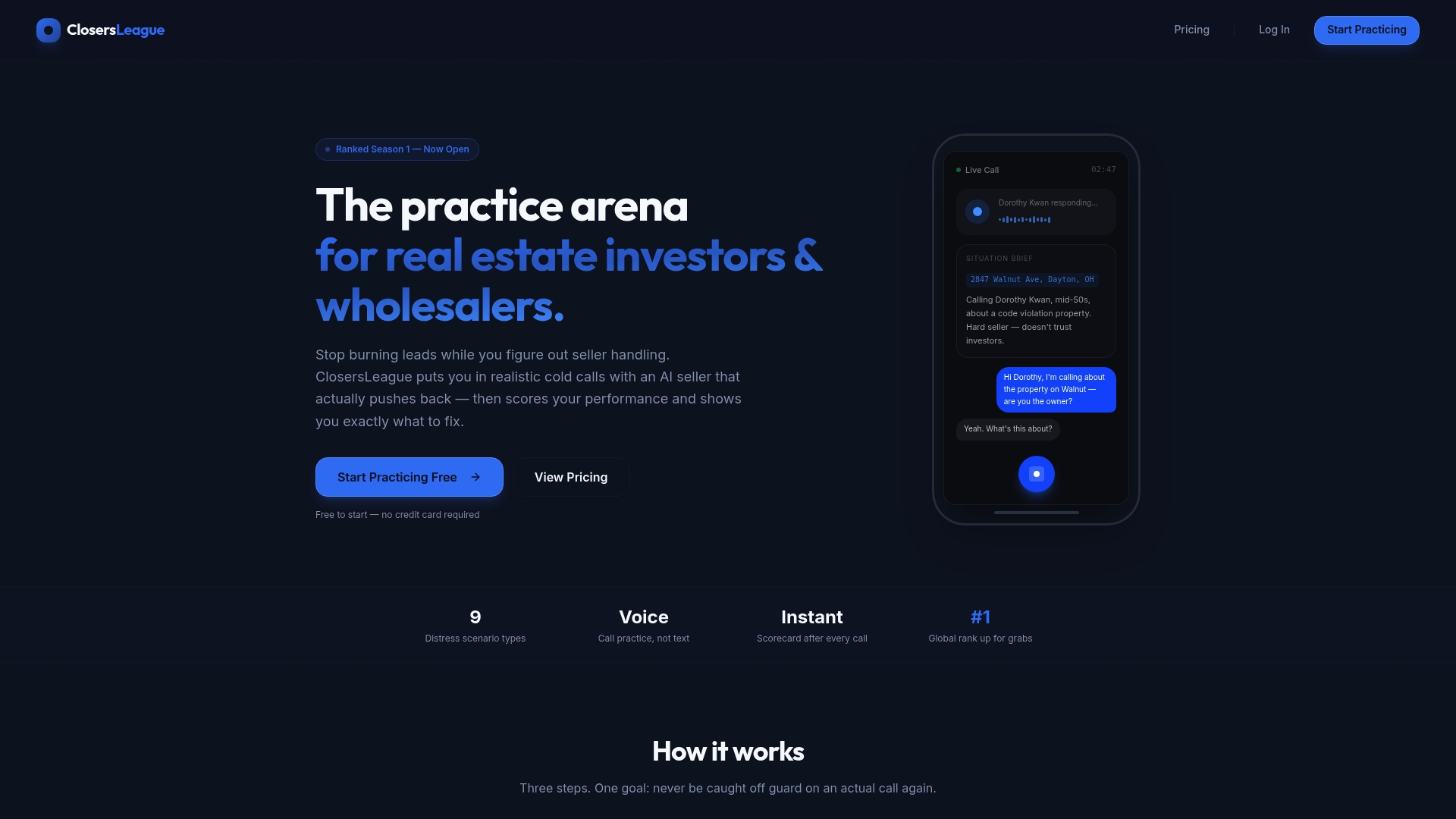
ClosersLeague is an AI-powered cold calling training platform built specifically for real estate investors and wholesalers. You practice live roleplay scenarios against AI-simulated sellers in distressed situations: foreclosure, probate, divorce, tax delinquency, and inherited properties. Every session scores your objection handling, empathy, and closing technique so you know exactly where to improve. No winging it. No vague feedback. Just deliberate, rep-by-rep skill building that translates directly to more contracts.
If you’re ready to close more deals in 2026, start with inherited property cold calling practice and build the conversation skills your AI stack depends on.
Key Takeaways
The single most important shift in 2026 wholesaling is that AI pipeline automation, not lead volume, determines which operations scale and which stall.
| Point | Details |
|---|---|
| AI pipeline management wins | Automating post-call CRM updates reclaims 2 to 3 hours per rep daily, the fastest ROI in any wholesaling stack. |
| Compliance is the baseline | Ohio, Tennessee, Maryland, and Connecticut passed new disclosure laws; attorney-reviewed contracts are required, not optional. |
| Disposition is under-automated | AI buyer-match agents cut days-on-market from 11 to 4 by targeting the right buyers per deal. |
| AVMs need manual verification | AI valuations are accurate within 5–8% in dense markets but can deviate 15–25% in low-comparable areas. |
| ClosersLeague fills the human gap | AI handles sourcing and data entry; ClosersLeague trains the live conversation skills that actually close distressed seller deals. |
FAQ
What are the biggest wholesaling trends in 2026?
AI pipeline automation, stricter state disclosure laws, and a shift toward landlord buyers are the three dominant forces shaping wholesaling in 2026. Wholesalers who automate their post-call workflows and operate with full legal compliance are pulling ahead of those still running manual processes.
How does AI improve wholesaling without replacing human reps?
AI handles lead scoring, skip tracing, post-call CRM updates, and buyer matching, freeing reps to focus entirely on live seller conversations. The phone call between a human rep and a motivated seller is still where deals close.
Which states have new wholesaling laws in 2026?
Ohio, Tennessee, Maryland, Oklahoma, and Connecticut all passed wholesaling-specific legislation between 2025 and 2026, requiring written seller disclosures, right-to-cancel periods, and in Connecticut, registration with the Department of Consumer Protection.
How accurate are AI property valuations for wholesaling?
In high-transaction suburban markets, AI automated valuation models typically land within 5–8% of actual appraised value. In rural or low-comparable markets, that margin can expand to 15–25%, making manual CMA verification necessary before committing to any deal spread.
How does ClosersLeague help wholesalers adapt to 2026 trends?
ClosersLeague provides AI-powered cold calling roleplay training for distressed seller scenarios including foreclosure, probate, and inherited properties, building the live conversation skills that determine whether a motivated seller signs a contract or hangs up.