
A call with an owner whose property is headed to auction is not a normal cold call. The owner is under a clock, often scared, and has probably heard from other buyers already. You win these calls by being clear, calm and compliant in the first 30 seconds, then asking the right questions in the right order. That is a skill you build by rehearsing it, which is why we built ClosersLeague around scenario-based AI voice practice for investors and wholesalers.
This guide covers who you are really calling, what to ask, what to explain about auctions, the calling rules that apply, and how to drill the conversation until it is automatic.
TL;DR
- Two owners hide behind this keyword: one facing a lender auction (pre-foreclosure) and one choosing to sell by auction. Open differently for each.
- Lead with who you are and why you are calling, then the owner’s options, then your offer. Never promise to save the house.
- Know the auction basics cold: formats, buyer’s premium, timelines. Owners will test you on them.
- Honor the National Do Not Call Registry, calling hours and every opt-out request the first time.
- Rehearse the call out loud against realistic sellers before you dial real ones.
Table of Contents
- Who you are actually calling
- Why owners get so many calls, and what that means for your opener
- The questions to ask, in order
- What to explain about auctions (because owners will ask)
- Lead with options, never with pressure
- The rules you follow on every call
- Objections you will hear on auction calls
- How to build the skill before you dial
- Practice these calls with ClosersLeague
- Our perspective
- FAQ
- Sources
Who you are actually calling
Search for auction property seller calls and you will find auction houses courting listings and homeowners asking why strangers keep phoning them. Both tell you something about your prospect.
The first type is the owner facing a lender auction. A foreclosure sale date is on the calendar, and the owner is juggling a payoff balance, other liens and family stress. These owners are the core of pre-foreclosure work, and our pre-foreclosure cold calling guide covers the scripts and objections in detail.
The second type is the owner who is considering an auction as a voluntary sale. Real estate auctions are often seen as a result of foreclosure, but many come from sellers who want to speed up a transaction, as one state auction overview notes. These owners are usually unencumbered, motivated by time, and comparing you to an auctioneer.
Either way, expect the owner to be wary. Consumer regulators have noticed. The Ohio Department of Commerce issued a March 2025 consumer alert warning that wholesalers and investors target older owners to sell below market value, and describing how wholesaling works: a contract at a low price, then an assignment to an end buyer. Owners have heard this story. Your first job is to sound like the opposite of it.
Why owners get so many calls, and what that means for your opener
Owners notice patterns. HomeLight explains that wholesalers approach homeowners with below-market offers and often assign the contract to an investor rather than taking title, with a finder’s fee usually in the 5% to 10% range. CNBC Select reports that wholesalers look for distressed or motivated sellers: pre-foreclosure, divorce, inherited property in poor shape.
So by the time you dial, an owner with an auction date may have had four or five similar calls. What they have not had is a call that starts with their problem instead of your price. That gap is your opening.
A workable opener for a pre-auction owner:
- Identify yourself and your company. Name, company, one sentence on why you are calling.
- Ask permission. A simple “Do you have two minutes?” lowers the guard.
- Point to their situation without presuming. “I saw the property may be headed to a sale date, and I wanted to see whether you have your options sorted.”
- Ask an open question. “Where do things stand right now?”
Then stop talking. The owner’s answer tells you which path you are on. If the first 30 seconds go badly, our guide to reducing hangups shows where most investors lose the call.
The questions to ask, in order
Qualifying an auction-bound owner is a sequence, not a checklist you recite. Ask in this order so each answer builds on the last:
- Lender status and sale date. Is there a notice, and when is the sale?
- Amount owed. What is the payoff, and is there a second loan or other lien?
- Title. Whose names are on it? A sale needs every owner on board.
- Occupancy and condition. Who lives there, and what needs work?
- The owner’s number and timeline. What would a good outcome look like, and by when?
- Plans after the sale. Where will they live, and is anyone helping them decide?
For owners considering a voluntary auction, the questions shift toward motivation and control. Auction professionals commonly ask about ownership structure, holding costs, flexibility on price, and whether the seller is willing to sell without a minimum, as United Country’s auction guide lays out. An unrealistic price expectation is the clearest sign the owner will not accept a direct offer either.
Two habits separate pros from amateurs. First, ask one question at a time and let the silence work. Second, say back what you heard before moving on: “So you owe about the loan balance, and there’s a second lien. Did I get that right?” It slows the call down, builds trust and prevents costly misreads of the numbers.
What to explain about auctions (because owners will ask)
Owners weigh your offer against the auction. If you cannot describe how auctions work in plain terms, you lose credibility. Know these points.
Auction formats
The seller’s control depends on the format. According to one auction company’s seller FAQ:
| Format | How it works |
|---|---|
| Absolute | Sells to the highest registered bidder at any price, no right to reject |
| Reserve | Undisclosed minimum the bidding must meet |
| Subject to confirmation | Seller may accept or reject the high bid |
| Stated minimum | Minimum bid is announced in advance |
This matters because a seller can lose the ability to back out. A West Virginia high court ruling, Alex Lyon & Son v. Leach (2020), held that in an absolute auction the property cannot be withdrawn once the auctioneer calls for bids, while in a reserve auction it will not sell unless the high bid meets the minimum. Rules differ by state, so treat this as an illustration, not universal law.
Costs and timing
The same seller FAQ explains that the auction company’s commission is often paid by the buyer as a buyer’s premium, while the seller covers marketing expenses. Its example: a 10% premium on a $100,000 sale means the buyer pays $110,000 and the seller receives $100,000. Mass.gov’s Auction 101 page adds that the seller bears marketing costs and may face additional costs if the property does not sell.
On timing, auctions are fast but not instant. One auction house describes a 30-day marketing timetable with the winning bidder closing within 30 to 45 days. Another says most campaigns finish within 30 to 60 days from launch to sale. An online platform lists 15 business days for cash and 30 for financed closings.
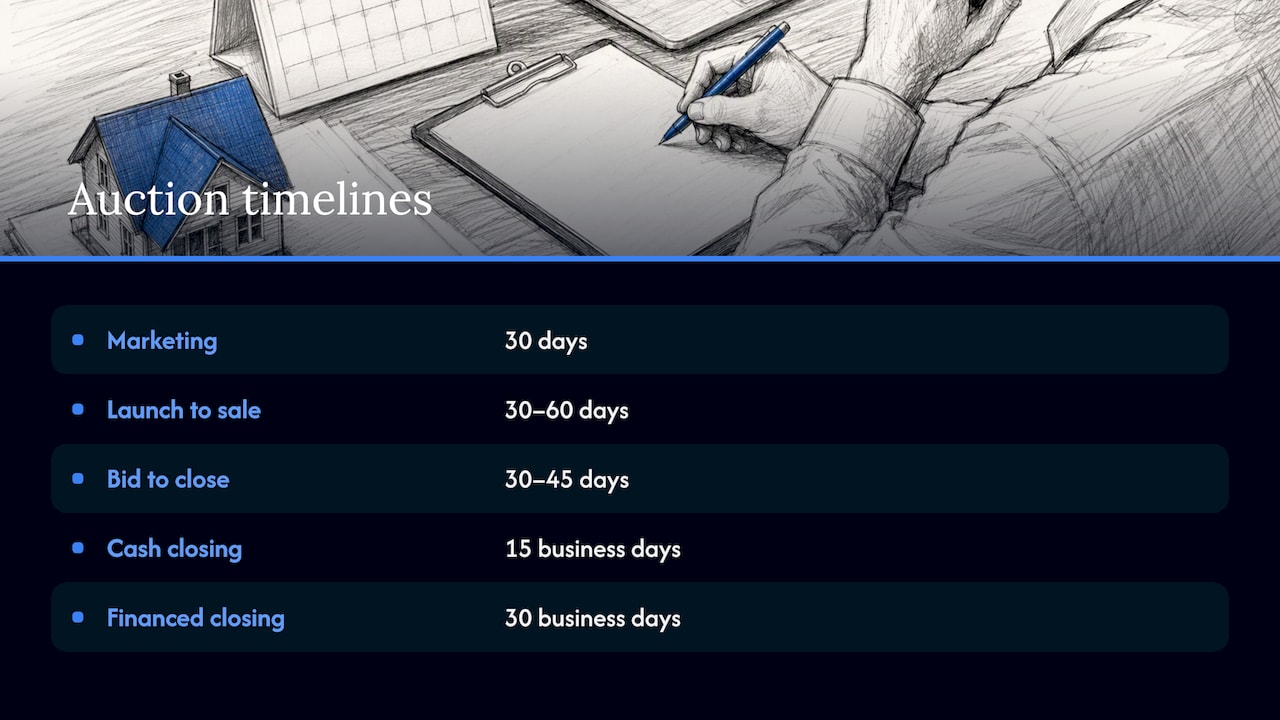
Why this belongs on your call: an owner who understands the clock, the costs and the loss of control can compare options honestly. Your direct offer has to stand on its own merits, and a clear explanation of how you would close is part of that.
Lead with options, never with pressure
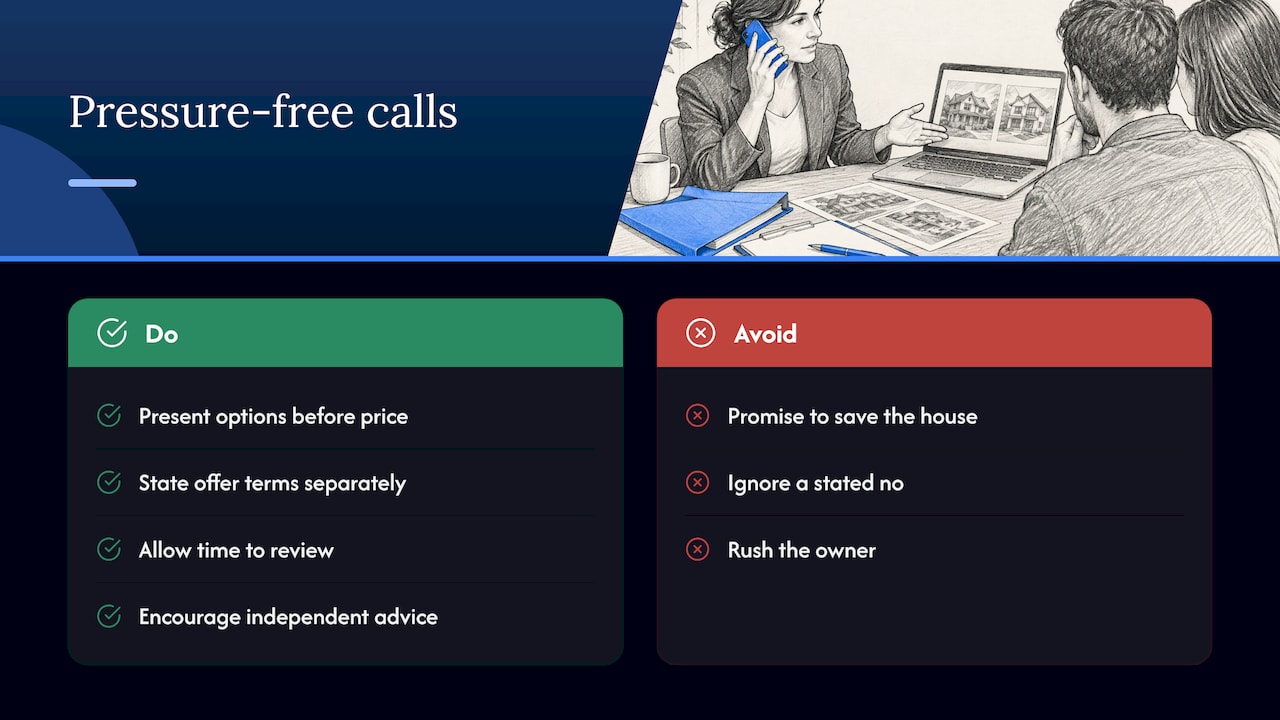
For an owner facing a lender sale, start with their options before any price. Reinstatement, loan modification and HUD-approved housing counseling are all possibilities, and a good caller says so. Never promise to save the house, and respect a no the first time you hear it. This is both the right thing to do and the thing that keeps the conversation alive. Owners who feel pushed hang up. Owners who feel informed keep talking.
When you do reach the offer, state its parts separately: price, condition assumptions, contingencies, closing timeline and who pays which costs. Give the owner time to review it, and encourage them to have their own attorney or advisor look at the contract. It is honest, and it answers the suspicion that you are rushing them. For the full approach, see our pre-foreclosure call approach guide and three pre-foreclosure scripts.
Older owners need extra care. Duana Patton, CEO of the Ohio District 5 Area Agency on Aging, warned in the Ohio alert that older owners may accept an offer without realizing it sits well below market value. Slow down, be transparent about price, and see our guide to calling elderly homeowners legally.
The rules you follow on every call
Compliance is part of the script. Check with your own attorney for your situation, but these are the federal basics.
- Two rulebooks. The FTC enforces the Telemarketing Sales Rule and the FCC enforces the TCPA. According to Henson Legal’s 2026 guide, calling a number on the National Do Not Call Registry is an abusive practice unless you have express written agreement or an established business relationship.
- Scrubbing is not a pass. The same guide clarifies that scrubbing against the registry within 31 days preserves a defense for an error, but it does not make a call to a registered number lawful.
- Calling hours. Telemarketing calls are not allowed before 8 a.m. or after 9 p.m. in the recipient’s time zone.
- Opt-outs. The FCC’s February 2024 order requires honoring company-specific do-not-call and consent-revocation requests for covered robocalls and robotexts within a reasonable time, no more than 10 business days, by any reasonable method.
- No misrepresentations. The FTC’s 2024 amendments to the Telemarketing Sales Rule prohibit material misrepresentations in business-to-business telemarketing and expand recordkeeping for telemarketing transactions.
- State rules. States add their own. Virginia, for example, requires honoring company-specific do-not-call requests for at least 10 years, per TCPA.com’s state summary.
Build “I’ll take you off our list right now” into your habits. A clean, fast opt-out is the cheapest compliance tool you have.
Objections you will hear on auction calls
These come up constantly. Prepare short, honest responses.
“I’m just going to let the auction happen.” Acknowledge it. Then ask what they expect to walk away with and whether they know the payoff and any other liens. Let the numbers do the persuading.
“Why are you calling me?” Answer directly: who you are, how you found the property record, and what you do. Evasion confirms the fear.
“I’ll list it with an agent.” Do not argue. Ask about timeline relative to the sale date. If time is short, that is the real conversation.
“Your offer is too low.” Walk through your costs and how you arrived at the number. Agents interviewed by HomeLight describe the trade-off as convenience: a seller there took a $300,000 cash as-is offer over a $325,000 offer for speed. Sellers weigh certainty, repairs and time, and you can help them see the full picture.
“Leave me alone.” Say “Understood, I’ll remove you,” and do it. Angry owners are common; our three-step empathy method shows how to de-escalate without pushing.
How to build the skill before you dial
Most investors learn these calls on live sellers. That costs you leads and leaves no feedback, only a click. Deliberate practice reverses it:
- Pick one seller type and one scenario, such as a pre-foreclosure owner with a sale date.
- Run the call out loud against a realistic responder, not a friend who goes easy on you.
- Score it. Did you identify yourself, ask permission, lead with options, avoid promises, ask one question at a time?
- Drill the weakest category until it is smooth, then run the full call again.
- Repeat daily in short sessions before your dial block.
Stop winging it. Start drilling.
Practice these calls with ClosersLeague
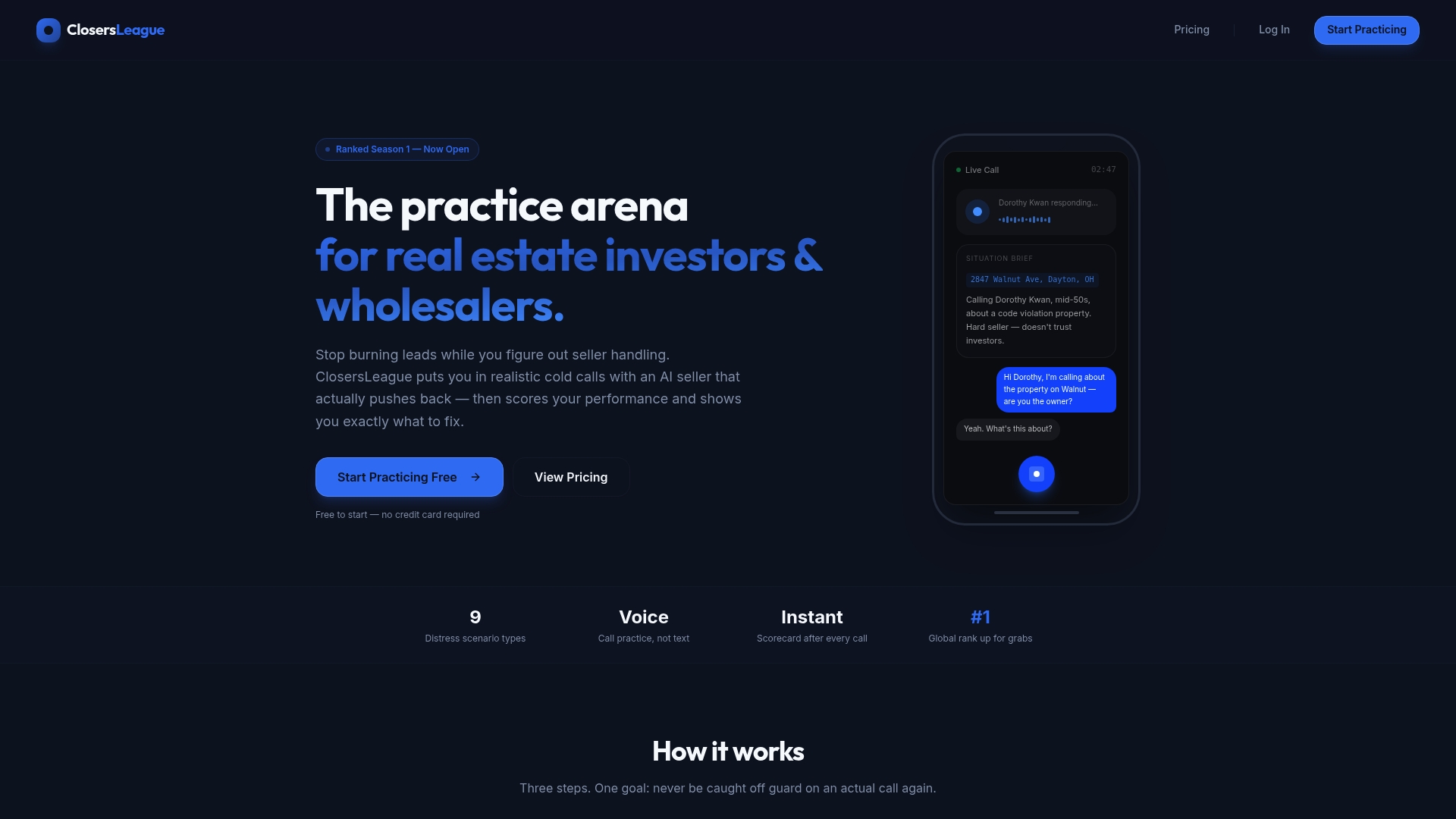
ClosersLeague is an AI-powered cold calling training platform for real estate investors and wholesalers. You practice with realistic AI roleplay across nine distinct distressed seller types, including pre-foreclosure, probate, divorce, tax delinquent and vacant. You get real-time coaching, an instant scorecard, multi-category skill grading, targeted drills, and leaderboards. For auction-bound owners, start with pre-foreclosure cold calling practice or foreclosure cold calling practice.
Plans are monthly and tiered by the number of AI practice calls: Starter at $5, Growth at $10 and Pro at $18 per month. A free trial includes a limited number of calls.
For wider context on the emotional side of these conversations, read how to talk to distressed homeowners and our foreclosure calling guide.
Our perspective
Auction calls punish improvisation. The owner is on a deadline, the stakes are high, and every sentence you say is judged against the last caller who pushed too hard.
We built ClosersLeague because generic sales training and roleplay with a colleague do not reproduce how a stressed seller actually talks. A seller facing a sale date sounds different from a probate heir or a tired landlord, and your approach should change with each. Our scenarios are built around that, with scorecards that show you exactly where the call slipped.
The investors who last in this business treat every call as a conversation about the owner’s situation first. That habit comes from repetition, and repetition is cheaper and kinder to prospects when you do it in practice, not on live leads.
Dave
FAQ
Why am I getting so many calls about selling my property?
If you are the owner, it is usually because investors and wholesalers search public records for distress signals such as pre-foreclosure, divorce or inherited property. If you are the caller, this is why your opener must be different from the stack of calls the owner already received.
Can a seller pull out of an auction sale?
It depends on the format and the state. In a reserve auction, the property does not sell unless the bid meets the minimum. In an absolute auction, once the auctioneer calls for bids, the property generally cannot be withdrawn, per the West Virginia ruling above. A seller who withdraws after listing may owe the auction company’s incurred expenses, so owners should read their auction agreement and consult an attorney.
What is the 15-minute rule in an auction?
There is no single rule across all auctions. Online platforms use soft-close extensions: one major platform extends bidding by 5 minutes whenever a bid lands in the final 5 minutes, per its FAQ, until 5 minutes pass without activity. Always confirm the terms of the specific auction.
Do I have to follow do-not-call rules when calling owners about an auction?
Yes. Federal rules cover calls to numbers on the National Do Not Call Registry, set calling hours of 8 a.m. to 9 p.m., and require honoring opt-out requests. States may add rules. Check your obligations with your attorney.
Sources
- Ohio Department of Commerce consumer alert on unsolicited real estate offers
- HomeLight: Why you keep getting unsolicited offers
- CNBC Select: What cash home buyers do
- Mass.gov: Auction 101
- United Country: Auctions and asking the right questions
- Absolute Auctions & Realty seller FAQ
- West Virginia Supreme Court of Appeals: Alex Lyon & Son v. Leach
- Rogers Auctioneers FAQ
- J. P. King seller FAQ
- Xome FAQ
- Henson Legal: DNC compliance guide
- FCC order FCC-24-24
- FTC Telemarketing Sales Rule final rule, 2024
- TCPA.com: Virginia telemarketing laws