
The best daily call practice routine for an investor or wholesaler is short, repeatable and scored: about 30 minutes, split into a warm-up, one targeted drill, two or three full role-play calls and a five-minute review. Do it before you dial live, on the same schedule every day, and change one skill focus per week. Below is the exact plan, how to adapt it to each distressed seller type, how to tell whether it is working, and the calling rules to keep in mind.
Stop winging it. Start drilling.
TL;DR
- Block 30 minutes a day before live dialing: 5 minutes warm-up, 8 minutes drill, 12 minutes full practice calls, 5 minutes review.
- Pick one skill per week: opener, listening, questions or objection handling. Rotate seller types (probate, pre-foreclosure, divorce, vacant) so you never practice only the easy ones.
- Score every session with the same categories, and track the trend over weeks, not the result of a single call.
- Practice the rules too: identify yourself, respect Do Not Call lists and know your state’s recording rules before a real homeowner picks up.
- Practice where mistakes are free. Role-play with realistic seller pushback instead of testing new lines on your best leads.
Table of Contents
- Why a daily routine beats occasional practice
- The 30-minute daily routine
- Drills that move the needle
- Practice with realistic pushback, not just a friend
- Rotate seller types through the week
- How to tell if the routine is working
- Practice the rules before you dial
- Our perspective
- Make the routine automatic
- Start practicing with a scorecard
- FAQ
- Sources
Why a daily routine beats occasional practice
Most investors and wholesalers practice by dialing. That works until you burn through a list of probate leads with an opener that was never tested. A homeowner facing foreclosure, an heir dealing with a parent’s estate or someone in the middle of a divorce gives you one chance to sound credible in the first ten seconds.
Daily practice fixes this for three reasons:
- Skills fade without repetition. An objection answer you nailed on Monday is gone by Friday if you did not say it out loud again.
- Small sessions are sustainable. Thirty minutes is easy to protect on a calendar. A two-hour weekly “training day” is the first thing to get skipped.
- Confidence is built before the live call. NAR’s guidance on negotiation skills says scenario practice improves confidence and preparedness, and that active listening is what uncovers the other side’s real priorities. Distressed sellers are exactly the conversations where that matters.
None of this replaces live dials. It makes each live dial worth more.
The 30-minute daily routine
Here is the plan at a glance. Adjust the minutes if you have 20 or 45, but keep the order.
| Block | Time | What you do | What it builds |
|---|---|---|---|
| Warm-up | 5 min | Read your opener aloud three times, then say your three toughest objection answers | Voice, pace, tone |
| Targeted drill | 8 min | Repeat one narrow skill (for example, the first 15 seconds) 5 to 8 times | One fixable weakness |
| Full practice calls | 12 min | Two or three complete calls with a realistic seller, start to finish | Flow, listening, closing |
| Review | 5 min | Score the calls, write one fix, one thing that went well | Feedback loop |
On days you have more time, add a second full-call block. On days you have less, keep the drill and the review and shrink the warm-up. The review is the block people cut, and it is the one that makes the other three count.
Block 1: Warm-up (5 minutes)
Stand up. Your voice carries differently standing, and you are rehearsing a live phone conversation, not an email.
- Say your opener three times at full speed, then once slower than feels natural. Most callers rush, and rushing sounds like a script.
- Say your top three objection answers out loud: “How did you get my number?”, “I’m not interested” and “What’s your offer?”
- Smile before you speak. It sounds corny, but homeowners hear warmth.
The warm-up is not about learning anything new. It gets your mouth and mind ready.
Block 2: One targeted drill (8 minutes)
Pick one narrow skill and repeat it until it is automatic. A drill is different from a call: you stop, reset and run it again. Examples are below in the drills section.
The rule is one skill per session. If you try to fix your opener, your pacing and your closing question all at once, you fix none of them.
Block 3: Full practice calls (12 minutes)
Now put the pieces together. Run two or three complete calls with a seller who pushes back the way real sellers do. Vary the situation. One day it is a skeptical heir, the next a tired landlord who is polite but vague.
A 2022 exercise published in the University of Nebraska at Omaha’s Marketing Education Review used short phone role-plays of 2 to 3 minutes followed by 3 to 5 minutes of feedback, scored on the introduction, rapport, objection response and ease of closing. That ratio is a good model for you: short calls, then immediate feedback. Don’t run twenty-minute calls in practice. Run short ones and run them often.
Block 4: Review (5 minutes)
Score each call on the same categories, write one specific fix and carry it into tomorrow’s warm-up. For example: “I asked ‘are you interested in selling?’ in the first 20 seconds. Tomorrow, ask about the situation first.”
If you review recordings or notes, look for these things:
- Did you state who you are and why you called in the first 10 seconds?
- Did you talk more than the seller in the first minute?
- Did you ask at least two open questions before mentioning price or an offer?
- Where did the seller’s tone change, and what did you say just before?
Drills that move the needle
Each of these fits inside the 8-minute drill block. Pick one per day.
Opener drills
NAR’s guidance on converting leads recommends practicing and role-playing your talk track, using a direct greeting and a clear reason for the call, and asking for a short amount of time. Turn that into a drill:
- Write your opener in two sentences: who you are, why you are calling.
- Say it 5 times and cut one word each time.
- End each version with a low-pressure ask, such as asking for a minute of their time.
- Run it against three different reactions: silence, “who is this?” and “not interested.”
Your opener is done when you can deliver it without sounding like you are reading, and when you can stay calm after a hang-up.
Listening drills
The seller usually tells you what matters in the first two minutes: a deadline, a family issue, a property they are tired of. Most callers miss it because they are waiting to talk.
- Echo drill: after each seller answer, repeat back the last three to five words as a question. Do it 10 times in a row.
- Note drill: during a practice call, write down only the seller’s own words about their situation. Use those words in your next question.
- Silence drill: after you ask a question, count to three before you speak again.
Question drills
Good questions are open and specific, and they come before any talk of price. Practice moving through a sequence: situation, timeline, condition, motivation, then next step. Run the sequence five times in a row with different seller backgrounds until it feels like a conversation and not a checklist.

Objection drills
Write down the five objections you hear most. For each one, practice a three-part response: acknowledge, ask a question, move forward gently.
- “I’m not interested.” Acknowledge it, then ask if you caught them at a bad time or if selling is simply off the table.
- “How did you get my number?” Answer honestly and briefly, then return to why you called.
- “I’ll list it with an agent.” Respect that, then ask what matters most in a sale, such as speed, condition or certainty.
- “What’s your offer?” Explain you need a few facts about the property before you can be fair.
The point is not to win arguments. Seller psychology in distress is emotional: embarrassment, grief, fear or exhaustion. Your tone has to be steady and respectful, or the objection is not really about the words at all.
Practice with realistic pushback, not just a friend
Role-playing with a colleague has value, but a friendly partner tends to go easy on you. The Omaha study reported that students who practiced with live professional role-play showed significantly higher perceived confidence and actual learning in objection response than students who practiced only with peers. The takeaway for investors is practical: the more your practice partner behaves like a real, resistant prospect, the more you learn.
That is why we built AI roleplay for every seller type. You can run a call at 6 a.m. or 10 p.m., with no one to schedule, and get a scorecard immediately. If you want a deeper look at how to structure those sessions, see our guide to real estate roleplay training for distressed calls.

Rotate seller types through the week
The same opener does not work on every homeowner. A weekly rotation keeps you from only practicing the call types you are comfortable with.
| Day | Seller type | Skill focus |
|---|---|---|
| Monday | Probate or inherited | Empathy and tone: the first 15 seconds |
| Tuesday | Pre-foreclosure | Questions about timeline and urgency |
| Wednesday | Divorce | Staying neutral, handling emotion |
| Thursday | Vacant property | Reaching the right decision-maker |
| Friday | Mixed or tired landlord | Objection handling, then a self-scored review |
Use the dedicated practice pages when you want to go deeper on one situation: probate, pre-foreclosure, foreclosure, divorce and vacant property.
On Friday, pick the seller type that scored lowest that week and run it twice. Your weakest category is where your next deal is hiding.
How to tell if the routine is working
Feeling more confident is nice. Measuring it is better. Track these every week:
- Score by category. Use the same list each time: opener, rapport, questions, objection handling, and next-step close. Look at the average per category, not one call.
- Talk ratio. In the first two minutes, aim for the seller doing most of the talking.
- Objection recovery rate. Out of every ten objections in practice, how many do you answer without freezing or getting defensive?
- Time to first question. How many seconds before you ask your first open question? Shorter is usually better.
- Live results. Once a month, compare live conversation rates: how many answered calls turn into a real conversation, then into an appointment or a follow-up. Do not expect this to move in a week. Look at 30-day trends.
Keep a simple spreadsheet or use a platform scorecard. The trend line matters. If your objection score has stayed flat for three weeks, change the drill, not the effort.
If you manage callers rather than just yourself, our 30/60/90 onboarding checklist with QA shows how to turn these same measures into a team routine.
Practice the rules before you dial
Training is not only about what you say. It is also about staying legal on live calls. This is general information, not legal advice. Check with an attorney or your state attorney general’s office about your specific situation.
- Do Not Call lists. NAR notes that if a number is on the National DNC Registry, real estate professionals may not call to offer listing services to an FSBO or expired-listing homeowner. The same page explains that a safe harbor protects businesses that have a written compliance plan, train their people and keep an internal do-not-call list. Make that part of your practice: rehearse how you respond when someone says “put me on your list.”
- State lists. While 31 states have adopted the National DNC Registry, 12 states maintain their own lists, so scrub against your state’s rules as well.
- List hygiene. The FTC’s 2024 Databook says sellers and telemarketers must remove newly registered numbers at least every 31 days, and that sales robocalls are generally illegal without written permission.
- Consent rules. The FCC’s one-to-one consent rule has been in flux: the FCC postponed its effective date pending judicial review in January 2025, and previous TCPA rules stayed in place. Confirm the current status with counsel before you build your lead process around it.
- Recording. State rules vary, and some states require all parties to consent to a recording. Ask permission at the start of a recorded call, and know which states your leads live in.
- Identify yourself. Say who you are at the start, and never block your caller ID.
- AI voices. The FCC has confirmed that the TCPA’s restrictions on artificial and prerecorded voices apply to AI technologies that generate human-sounding voices. Using AI to practice with is different from using AI voices to call homeowners, so keep your practice partner in the practice room and put live human callers on live calls.
The compliance opener belongs in your warm-up. Say your name, your company and your reason for calling until it comes out naturally.
Our perspective
Most investors we talk to do not have a talent problem. They have a repetition problem. They dial, they get a rough reaction, they change a line, and they never find out if the change helped.
We built ClosersLeague around a simple idea: deliberate practice should be easy to start and hard to skip. A scored session takes minutes. It gives you a realistic homeowner, immediate feedback and a clear next fix. And because distressed sellers are not all the same, the practice should not be either. A probate heir and a pre-foreclosure homeowner need different questions, a different tone and a different pace.
Generic sales training teaches you how to talk to a buyer. Our scenarios are made for sellers in distress, across nine types, with objections and emotional states built in. We think the daily 30-minute routine is the fastest way to turn that into confidence. Do it for a month, and your live calls will feel different.
Dave
Make the routine automatic
Here is a simple setup you can use tomorrow:
- Pick a fixed time. Right before your first live dial block is ideal, because the practice is fresh.
- Set the week’s focus on Sunday night. One skill, one seller type per day.
- Prepare your tools. Have your script, your objection list and your scorecard open before you start.
- Do the review before you dial. Write your one fix on a sticky note and put it where you can see it.
- Protect the streak. On a bad day, do the 10-minute version: warm-up, one drill, one review. Skipping a day makes the next one harder.
For more on what to say once you are warmed up, read our 10 cold calling tips for real estate investors and why cold calling still matters.
Start practicing with a scorecard
ClosersLeague gives you scenario-based voice practice, real-time coaching, performance scorecards, targeted skill drills and leaderboards for distressed seller types. Plans on our pricing page are tiered by the number of AI practice calls: Starter is $5 per month, Growth is $10 per month and Pro is $18 per month. A free trial includes a limited number of calls so you can run your first routine before you commit.
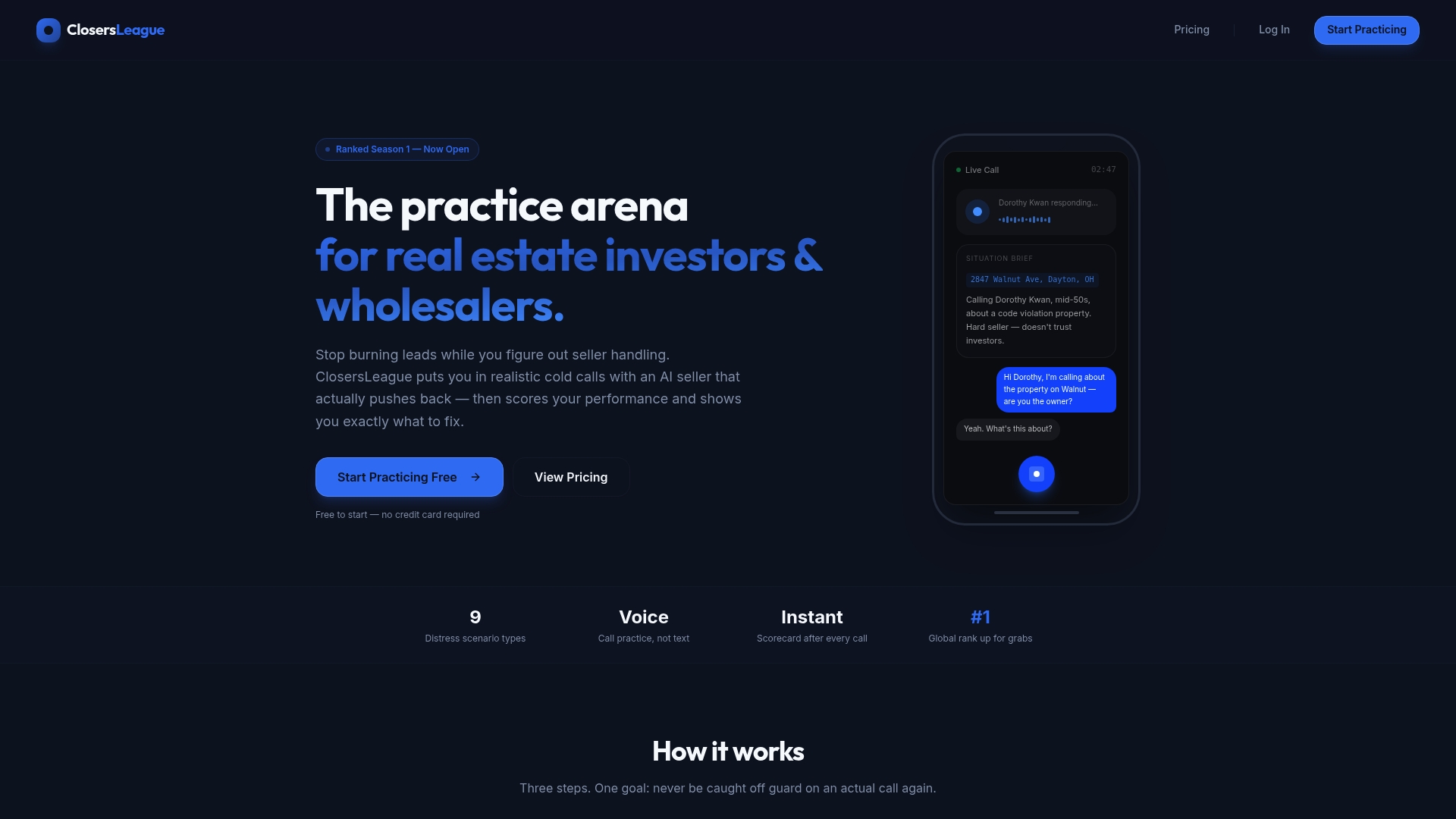
Ready to build the habit? Start your daily practice at ClosersLeague and run your first scored call today.
FAQ
How long should a daily cold call practice session be?
Thirty minutes is a good target: 5 for warm-up, 8 for a drill, 12 for full practice calls and 5 for review. If you only have 10 minutes, keep one drill and the review. Short sessions done daily beat long sessions done rarely.
Should I practice before or after live calls?
Before, in most cases. Practice warms up your voice and puts your one fix for the day fresh in mind. Use a few minutes after your live block to jot down what you heard from real homeowners, and feed that into tomorrow’s drill.
How many practice calls a day is enough?
Two or three complete calls plus a drill is enough for most people. Quality matters more than volume, because each call should be followed by a score and a fix. If you are new, do fewer calls and spend more time on the review.
Can I practice with a partner instead of AI?
Yes, as long as your partner plays a realistic, resistant seller and gives honest scores. Studies on role-play show that a more realistic counterpart helps learning, so ask your partner to push back. An AI practice partner is available any time and scores every call the same way.
Do I need to practice compliance?
Yes. Rehearse your self-identification, your response to a do-not-call request and your recording consent line. These come up in live calls without warning, and a calm, well-practiced answer protects you.
Sources
- Help Your Agents Sharpen Their Negotiation Skills (NAR)
- 5 Tips for Converting Online Leads Into Clients (NAR)
- Objection Practice Using a Live Appointment-Setting Call (University of Nebraska at Omaha)
- Telemarketing & Cold-Calling (NAR)
- Do Not Call: The History of Do Not Call and How Telemarketing Has Evolved (NAAG)
- DNC Databook 2024 (FTC)
- FCC Postpones Effective Date of One-to-One Consent Rule (NAR)
- FCC Confirms that TCPA Applies to AI Technologies that Generate Human Voices